


October 26, 2026 · 17 min read
Filing deadlines can depend on your reporting period and circumstances, so check the applicable deadline before submitting. Foreign businesses may have up to eight weeks after the relevant tax period ends to submit a Dutch VAT return. Knowing how to file a VAT return in the Netherlands means reporting sales, purchases and EU transactions accurately in the correct period.
VAT filing can feel complicated when you have to manage deadlines, input VAT deductions and cross-border transactions at the same time. Make the process more straightforward by confirming your filing frequency first, then organizing your figures and supporting records before completing the return.
This guide explains how to submit a Dutch VAT return, what to include, when you may deduct input VAT and how to correct an error. It also covers the VAT treatment of EU acquisitions, helping you prepare each part of your filing.
Key Takeaways
- Find out whether your assigned VAT filing frequency is monthly, quarterly or annual, and organize your records around that period.
- Separate business purchases from private use so you can assess which input VAT is eligible for deduction.
- Use the correction process that applies to the size of the error; some smaller differences can be adjusted in a later return.
- Report VAT on intra-Community acquisitions in section 4b, and claim eligible input VAT for those goods in section 5b.
- Review the return’s sales, purchases and adjustments before submitting it, especially when a transaction crosses a border.
Table of Contents
How do you file your VAT return in the Netherlands?
Report VAT charged on sales and eligible VAT paid on purchases for the assigned period. Reconcile invoices and transaction records before submitting the return, then pay any VAT due by the applicable deadline.
VAT Return Filing Deadlines
A filing deadline is the latest date for submitting a return for its reporting period. Netherlands-based companies must file within one month after that period ends, according to the Netherlands Tax Administration (Belastingdienst). For example, a first-quarter return is due by 30 April. Monthly returns and payments are due by the last working day of the following month. Annual returns are due by 31 March of the following year.
Foreign businesses may have up to eight weeks after the relevant tax period ends to submit a Dutch VAT return. Follow the deadline that applies to your filing period and status. For monthly filing, note the last working day of the following month. For quarterly filing, calculate one month from the end of the quarter.
VAT Payment Deadlines and Currency
The payment deadline is the date by which VAT due must be paid. Payment is generally due by the last day of the month in which the return must be filed, according to the Belastingdienst’s VAT return information. Pay in euros, without waiting for an assessment, payment link or separate request.
Treat submitting the return and paying any VAT due as separate tasks, and use the correct payment reference so the payment is allocated properly. Electronic payment is available. For a monthly return, align payment with the last working day of the month after the reporting period.
Who Files and How Foreign Businesses File
A business required to file Dutch VAT returns must submit one for each assigned period, including a nil return if it had no activity. Foreign businesses have been required to file electronically since January 2014. Non-resident taxable persons must appoint a Dutch fiscal representative under Article 33a of the OB 1968.
An eenmanszaak can file using DigiD or eHerkenning; a VOF or BV needs eHerkenning. A business can authorize someone else, such as a tax representative, to file on its behalf. Before completing the return, gather sales and supplier invoices, along with records of reverse-charged transactions.
The standard VAT rates are 21%/9%/0%. According to the Netherlands Tax Administration (Belastingdienst), some goods and services are subject to a 9% VAT rate. Report VAT on intra-Community acquisitions of goods in section 4b; eligible input VAT for those goods can be deducted in section 5b.
Business return deadlines are separate from tourist VAT refund deadlines. To qualify for a Dutch tourist VAT refund, a shopper must take purchased products out of the EU in their personal luggage within three months after the end of the purchase month. This does not change a company’s regular VAT filing obligations.
Businesses establishing operations in the Netherlands can review practical steps for starting a business in the Netherlands alongside their VAT filing responsibilities.
VAT return filing frequency
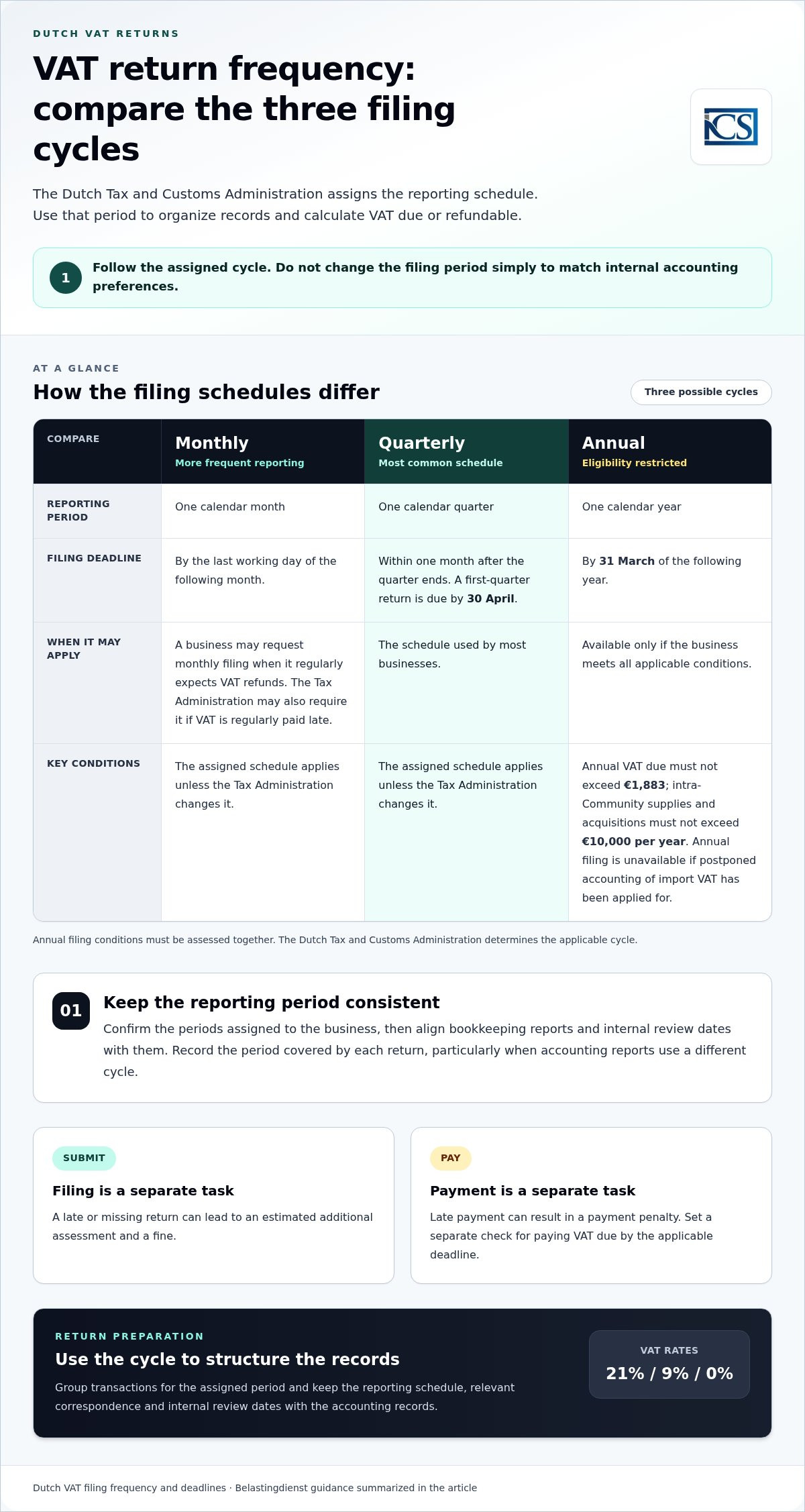
Filing frequency is the reporting schedule assigned to a VAT-registered business by the Dutch Tax and Customs Administration. Returns may be monthly, quarterly or annual, and most businesses file quarterly. Use the period shown on your return to organize records and calculate VAT due or refundable. Don’t choose a different cycle just to match your internal accounting preferences.
Annual filing is available only when the business meets the conditions for that schedule. Its annual VAT due must not exceed €1,883, and its intra-Community supplies and acquisitions must not exceed €10,000 per year. Annual filing is unavailable if the business has applied for postponed accounting of import VAT. These criteria should be assessed together before relying on an annual cycle.
A business may request monthly filing when its circumstances support more frequent reporting, such as when it regularly expects refunds. The Tax Administration may also require monthly returns if VAT is regularly paid late. A change in circumstances can affect both the reporting cycle and administrative workload. Keep the assigned schedule and the reason for any requested change in your accounting records.
If your filing schedule changes, first confirm which return periods the Tax Administration has assigned. Align bookkeeping reports and internal review dates with those periods. This helps you group transactions consistently, especially if your accounting system reports by calendar month but your VAT return covers a quarter. Record the period covered by each return you file.
Late filing and late payment are separate compliance failures. A late or missing return can lead to an estimated additional assessment and a fine, while late payment can result in a payment penalty. The Tax Administration may require monthly filing if VAT is regularly paid late. Set separate checks for submitting the return and paying VAT, rather than assuming that completing one task means both obligations are met.
Before selecting or requesting a frequency, compare the business’s expected VAT position, cross-border transaction volume and capacity to keep records current. Annual filing reduces the number of returns but is restricted by the eligibility conditions. Monthly filing can support regular refund reporting, while quarterly filing remains the common schedule. The Dutch Tax and Customs Administration determines the applicable cycle, so follow the schedule it assigns and retain its correspondence with the accounting records.
Input VAT deductions and private use
Calculate the VAT position by matching purchase VAT and taxable private use to the relevant reporting period. The Netherlands Tax and Customs Administration (Belastingdienst) requires the return to account for both VAT paid to suppliers and taxable private use.
Deductible Input VAT
Deductible input VAT is VAT a business may reclaim on business expenses. The Netherlands Tax and Customs Administration (Belastingdienst) states that entrepreneurs can reclaim VAT paid on business expenses by claiming input tax on their VAT return.
Start with purchase records for the relevant period. Match each amount you claim to a supplier invoice and confirm that the purchase relates to business activity. Keep the invoice with its accounting entry so you can trace the claimed VAT to the expense; for operational supplies and branded items, ordering through vendors like theceocreative.com that offer structured Net 15 payment terms can help keep trade invoices organized. This review helps distinguish business purchases from personal costs and transactions recorded in the wrong period.
For goods acquired from another EU Member State, the VAT may be reported as input tax in section 5b of the same Dutch return, according to the Belastingdienst. Keep the acquisition details with the purchase documentation and reconcile them to the return entry. If excess input VAT remains, the business can claim it through the return. The tax authorities repay a reported refund automatically after submission.
Private Use and Input VAT
Private use means using goods or services recorded by a business for personal purposes rather than solely for business activity. The Netherlands Tax and Customs Administration (Belastingdienst) requires taxable private use to be included in the VAT return.
Before finalizing the return, review expenses that may have both business and personal uses. Keep clear records of each purchase and how it was used, then account for taxable private use separately from the input VAT claimed. This avoids treating personal use as though the entire purchase were for business.
Maintain a period-by-period reconciliation that shows the purchase, its VAT amount, the deduction claimed and any private-use adjustment. For an EU goods acquisition, retain the transaction record supporting section 5b. These records make it easier to explain how each amount was treated without relying on memory or combining unrelated transactions.
If a previous return omitted excess Dutch input VAT, submit a recovery claim within five years of the relevant VAT period. Keep the original purchase evidence and calculation with your correction records. The documentation should show the period concerned and how you calculated the claimed amount.
Correcting VAT return mistakes
A VAT correction adjusts a return after you discover an error. First identify the affected period and transaction, then compare the filed figures with your sales and purchase records. Check whether the error changed the VAT due or the refund claimed. That difference determines what the correction must address.
In the Netherlands, a difference of less than €1,000 can be corrected in the next VAT return. For example, if a supplier invoice was omitted and the resulting difference falls below that amount, include the adjustment in the next filing. Keep the invoice and a clear calculation with the period’s accounting records, so the revised figure can be traced.
Do not apply the next-return adjustment rule to a difference of €1,000 or more. Separate the error from current-period transactions and determine the correction route that applies to the original return. Record the amount, the affected reporting period and the reason for the change. This helps distinguish a correction from ordinary VAT on new sales or purchases.
If an error means you charged too little VAT, calculate the shortfall from the transaction documents using the rate that applied at the time. If you charged too much, calculate the excess separately. Check the customer invoice and any credit or replacement document before changing the return figures. Base the correction on the underlying transaction, not an estimated total.
A correction that creates additional VAT due may affect payment. Interest is not charged on a Dutch VAT correction paid late if you make the correction within the three months following submission of the return. Record both the original submission date and the correction date. This correction period is separate from the deadline for an ordinary return.
An error affecting a refund also requires a transaction-level review. Confirm that the purchase belongs to the business, the supplier invoice supports the VAT amount and the deduction was assigned to the correct period. If the error reduced the refund, calculate the corrected balance from the original figures. Keep the calculation with its supporting documents.
Use a consistent correction record for each affected filing: note the period, transaction, original amount, corrected amount and effect on VAT due or refund. Reconcile that record with the next return when the difference is less than €1,000 and the adjustment is made there. For other differences, follow the correction route applicable to the submitted return. This process also helps identify repeat errors in VAT registration details, supplier invoices or transaction coding before another return is filed.
Who must file a VAT return in the Netherlands?
A business required to file Dutch VAT returns must submit one for every assigned period, even if it had no business activity in the Netherlands or expects a refund. Filing responsibility depends on taxable activities, VAT registration and any applicable scheme, not simply on the business’s legal form.
Businesses in the Netherlands must register for VAT from their first taxable activity, with no minimum turnover threshold. Non-EU businesses making taxable supplies in the Netherlands generally also have no VAT registration threshold. Before making supplies, a foreign business should assess whether its Dutch activities are taxable. Foreign status alone does not remove the registration obligation.
The small businesses scheme, known as KOR, is a VAT option for entrepreneurs with annual turnover not exceeding €20,000. The scheme may affect how participating businesses handle VAT, deductions and returns. Consider these linked consequences together: a business giving up input VAT deduction should compare that restriction with its expected VAT on sales and purchases.
A separate small-business registration threshold may apply to businesses with annual turnover of €2,200 or less that are not required to register with KVK. This is not the same threshold as the KOR. First establish whether KVK registration is required, then assess whether the business can use this separate option. Don’t assume that meeting one threshold automatically qualifies the business for the other.
Foreign businesses must distinguish between EU and non-EU circumstances. Non-EU businesses making taxable supplies in the Netherlands generally have no registration threshold. Non-resident taxable persons must appoint a Dutch fiscal representative for their VAT obligations under Article 33a of the OB 1968. This requirement concerns non-resident taxable persons, not every foreign company simply because it has owners abroad.
After registering, follow the filing schedule assigned by the Dutch Tax and Customs Administration. A VAT-registered business must submit every required return, including a nil return for a period with no reportable activity. If the return shows excess input VAT, submit it to claim the refund rather than skipping the filing. Keep records of taxable sales, purchases and registration details to complete each return consistently.
To assess your position, identify where the business supplies goods or services, whether those activities are taxable in the Netherlands and whether a scheme applies. Then establish whether registration is required, whether the business has opted into KOR and whether a non-resident fiscal representative is required. These steps clarify both registration status and ongoing filing obligations.
Intercompany Solutions: Dutch BV Company Formation
Intercompany Solutions supports foreign entrepreneurs who are establishing a Dutch BV and need to organize related tax compliance. Its Dutch BV Company Formation service includes registration and VAT applications, with remote formation completed within 3-5 business days. Once the company is operating, Accounting & Tax Services can support bookkeeping, tax filing and ongoing compliance, including the preparation of Dutch VAT returns.
Intercompany Solutions can help when you are setting up a Dutch entity or need support with its accounting and tax obligations. You remain responsible for providing complete transaction records and meeting the filing deadlines that apply to your business. Choose support based on whether you need company formation, ongoing accounting or both.
Contact Intercompany Solutions to discuss your Dutch company’s formation or accounting requirements.
Make your next VAT filing routine easier to manage
Use the next reporting cycle to establish a clear process for collecting invoices, reviewing transaction records and assigning responsibility for filing and payment. A consistent routine helps you spot missing documents early and link corrections to the right period. It also creates a practical basis for improving your accounting workflow as the business changes; for businesses managing international operations or upgrading their digital bookkeeping systems, resources from Count On Me highlight how cloud accounting platforms can streamline ongoing recordkeeping and compliance.
If you’re deciding how to file a VAT return in the Netherlands, turn the rules that apply to your business into a repeatable process. Set a calendar reminder, keep supporting records together and schedule a review before each return is due. If your Dutch company also needs accounting or tax support, Intercompany Solutions can discuss the relevant requirements with you.
An organized filing process gives you greater control and clarity each reporting period.
Frequently Asked Questions
How are Dutch VAT credits recovered?
A Dutch VAT credit is generally repaid automatically when a submitted return shows a refund due. Before filing, reconcile the credit against purchase invoices and check that the input VAT belongs to the period claimed. Keep the supporting records with your accounting documents. If you omitted excess input VAT from an earlier period, submit a recovery claim within five years of that VAT period.
How do VAT returns work for entrepreneurs?
Entrepreneurs report VAT for their assigned filing periods, accounting for sales, purchases and relevant adjustments in each return. For example, an entrepreneur with no sales during a period may still need to submit a nil return if filing is required. Businesses participating in the Dutch small businesses scheme, KOR, do not charge VAT on deliveries, deduct input VAT or file VAT returns.
How do you pay VAT?
Pay any VAT due in euros by the applicable return deadline. Don’t wait for a separate assessment or payment request. Electronic payment is available. Include the correct payment reference so the Dutch Tax and Customs Administration can allocate the payment to the right account. Keep proof of payment with the submitted return and accounting records, particularly if you file and pay separately.
How often are Dutch VAT returns required?
The Dutch Tax and Customs Administration assigns a monthly, quarterly or annual filing schedule. Quarterly filing is most common, but monthly reporting may apply in particular circumstances. Annual filing is available only to businesses that meet the relevant conditions. Follow the period shown for your return rather than choosing a schedule yourself, and keep records that support each assigned filing period.
Questions about your VAT return?
Start by identifying the return period and the figure or transaction you’re unsure about. Compare it with the underlying invoice, sales record or payment documentation, then check whether it relates to VAT charged, input VAT or an adjustment. Write down the issue and your calculation. This makes it easier to resolve discrepancies without mixing them up with transactions from another period.
How do you file a Dutch VAT return online through Mijn Belastingdienst Zakelijk?
Sign in to Mijn Belastingdienst Zakelijk using the access method for your legal form. An eenmanszaak can use DigiD or eHerkenning; a BV or VOF needs eHerkenning. Open the return for the assigned period, enter the figures in the relevant fields, review the totals and submit. Save the confirmation, then arrange payment separately if VAT is due.
What information and documents are needed to file a Netherlands VAT return?
Gather sales and supplier invoices, along with records of transactions requiring VAT adjustments. You’ll need figures for VAT charged to customers, VAT paid to suppliers, reverse-charged VAT and taxable private use. For EU goods acquisitions, keep the transaction details needed to report the acquisition and any deductible input VAT. Organize documents by reporting period so you can reconcile each return with its source records.
What are the Dutch VAT return filing periods and deadlines?
Deadlines depend on whether the assigned period is monthly, quarterly or annual and whether the business is established in the Netherlands or abroad. A Netherlands-based company generally files within one month after its period ends; foreign businesses may file up to eight weeks after the relevant period ends. For example, the first-quarter return is due by 30 April. Payment is also due by the applicable deadline.
Sources
- KVK - Registering with the Dutch Business Register
- Business.gov.nl - Private limited company (bv)
- Burgerlijk Wetboek Boek 2 (Dutch Civil Code, legal entities)
- Rijksoverheid - Ondernemen
- Belastingdienst - VAT (btw) for entrepreneurs
- European Commission - VAT rules and rates
- RVO - Doing business internationally
- Belastingdienst Douane - Customs
- CJEU, Cadbury Schweppes, C-196/04 (ECLI:EU:C:2006:544)
- Hoge Raad, ECLI:NL:HR:2021:1152
- PwC Worldwide Tax Summaries - Netherlands
- ICLG - Corporate Governance Laws and Regulations, Netherlands
Need more information on the Dutch BV company?
Contact an expertReady to start your company in the Netherlands?
| Formation time | Dutch BV formation completed in 3 to 5 business days |
|---|---|
| Process | Fully remote setup with step-by-step guidance |
| Compliance | Expert support for registration, VAT and compliance |
| Aftercare | Accounting, tax and legal support included |
| One partner | All of the above through one trusted formation partner |