


October 6, 2026 · 13 min read
A 30% ruling application is a joint process between employer and employee, not a tax form an employee can arrange independently. Understanding how to apply for the 30% ruling for staff means checking eligibility early and coordinating the application with the employment start date and payroll setup.
Eligibility depends on the employee’s circumstances and salary, and the application deadline can affect when the ruling takes effect. Employers should check the relevant conditions, agree who will gather each part of the application, and compare the information against the employment and payroll records before submitting. After approval, payroll must follow the decision’s terms and effective date. The steps below cover those checks, the joint application, and the records to keep afterwards.
Key Takeaways
- Check the employee’s recruitment or transfer circumstances, residence history, and applicable salary criterion before preparing an application.
- The employer and employee apply jointly, using accurate personal, employment, and payroll information.
- Coordinate the employment start date and submission timing because the deadline can affect when the ruling takes effect.
- After approval, align payroll instructions with the decision and keep the application and supporting records organised.
- Review changes in the employee’s circumstances against current Belastingdienst guidance before changing payroll treatment.
Table of Contents
What the Dutch 30% ruling means for international staff
The Dutch 30% ruling, formally known as the 30% facility, is a tax arrangement for certain employees recruited or transferred to the Netherlands from abroad. If the employee and employer meet the conditions and the Dutch Tax Administration approves the application, the employer may provide an allowance for qualifying extraterritorial costs through payroll. The Belastingdienst guidance on the 30% facility sets out the official conditions. For broader background on the facility’s place in the Dutch tax system, see this 30% ruling overview.
The ruling is not automatic for every international hire. Eligibility depends on the employee’s circumstances, the employment arrangement, and the applicable requirements. Approval also does not make the employee’s entire salary tax-free. The facility concerns the tax treatment of an allowance, subject to the rules and limits that apply in the employee’s case.
What the 30% ruling does, and does not, do
Where the conditions are met, the facility allows an employer to treat an allowance for extraterritorial costs as tax-free within the applicable rules. This is a payroll reimbursement mechanism, not a personal tax deduction claimed separately by the employee. The treatment follows the application and approval, and must then be implemented in payroll. The resulting net pay can differ between employees because eligibility, salary, and individual circumstances vary.
Employers should not promise a particular net salary before assessing eligibility and the proposed payroll treatment. The decision and its terms determine how the allowance may be processed.
Who applies: employer and employee responsibilities
The employer and employee submit the application jointly to the Dutch Tax Administration. The employer coordinates the process and provides accurate employment and payroll details, including information about the employment start date and salary. The employee supplies complete personal information and details of their previous residence and work history. These details help establish whether the relevant conditions are met.
For employers, the process begins with treating the application as a shared responsibility linked to payroll, rather than an employee-only tax request. Agree who will gather each item, then check that the information is consistent before submission. Next, assess the eligibility requirements and prepare the application.
The 30% ruling is separate from immigration permission. It does not grant a right to live or work in the Netherlands, and eligibility for the tax facility does not establish that an employee has the required residence or work authorization. Those requirements depend on the individual’s nationality and immigration status. Employers should assess them separately using the IND’s work and residence information.
Check staff eligibility before starting a 30% ruling application
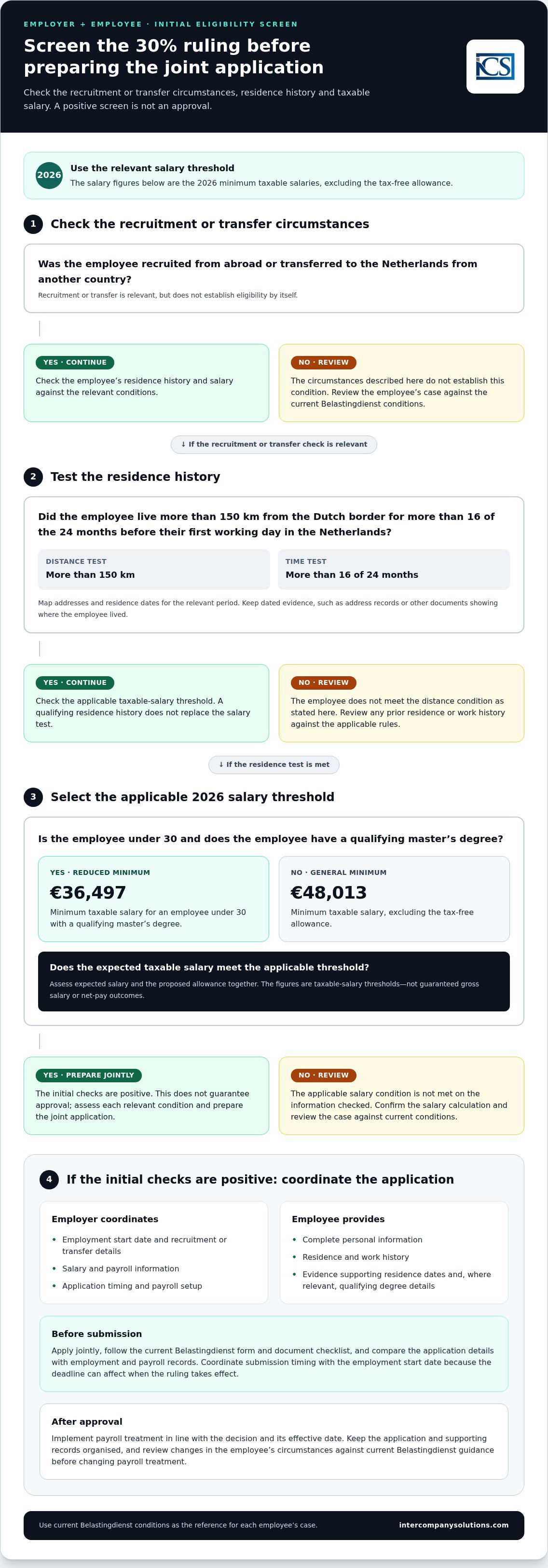
Screen each employee against the official conditions before preparing the joint application. Recruitment from abroad or a transfer to the Netherlands is relevant, but neither circumstance alone establishes eligibility. The employee’s residence history and taxable salary must also be assessed. Use the Belastingdienst’s conditions for the 30% facility as the reference point, and assess each criterion separately.
Employment history, recruitment, and residence conditions
The facility is intended for employees recruited from abroad or transferred to the Netherlands from another country. For the distance condition, the employee must have lived more than 150 kilometres from the Dutch border for more than 16 of the 24 months before their first working day in the Netherlands. A move to the Netherlands alone does not establish whether the test is met.
Ask the employee to map their addresses and residence dates over the relevant period. Keep dated evidence that supports this history, such as address records or other documents showing where the employee lived. Compare the timeline with the official test, including the distance from the Dutch border. If the employee previously lived or worked in the Netherlands, review their full history against the applicable rules rather than relying only on their most recent address.
Salary criteria and situations requiring extra review
For 2026, the minimum taxable salary, excluding the tax-free allowance, is €48,013. For an employee under 30 with a qualifying master’s degree, the reduced minimum is €36,497. These are taxable-salary thresholds, not a guaranteed gross salary or net-pay outcome. Assess the employee’s expected salary and the applicable allowance together, then compare the resulting taxable salary with the relevant threshold.
Confirm the employee’s age and qualifying degree evidence before applying the reduced threshold. Meeting the salary test is not enough: the recruitment or transfer circumstances and residence condition must also be assessed. Likewise, a qualifying residence history does not replace the salary requirement. Record the basis for each check so the employer and employee can resolve gaps before submitting.
These checks help employers assess the case without treating one qualifying factor as a guarantee of approval. To coordinate the eligibility review with payroll preparation, discuss the application process with our team.
How to apply for the 30% ruling for staff step by step
Once the initial eligibility checks are complete, the employer and employee can prepare the joint application. Follow the Belastingdienst’s current instructions for the 30% facility, including the application form and its document checklist. Use the form to identify what must be submitted, since the required attachments can depend on the case.
Prepare the application information and supporting evidence
Gather the employee’s personal details and residence history, along with the employment start date, recruitment or transfer information, and salary details. The employer should compare these against the contract and payroll records. The employee should check that personal details and dates are accurate. Use the current form to identify required evidence, and distinguish it from supporting records that are useful for reviewing the application internally.
Submit jointly and track the application
Both employer and employee apply together using the Belastingdienst’s prescribed process. The application must be submitted within four months of the employee’s first working day for the ruling to take effect from that day. If submitted later, the ruling generally takes effect from the first day of the month after the application is submitted. Check the current official instructions for the submission channel and effective-date conditions before sending the form.
Assign one person to coordinate submission and track its status. Keep a copy of the completed application, submission confirmation, and correspondence with the employee’s payroll file. If the Tax Administration requests further information, record the request and reply within the stated period.
After submission: decisions and payroll implementation
Do not apply the ruling in payroll before receiving and reviewing the decision. If approved, record the decision and its effective date, then give payroll clear written instructions that reflect the approved terms. If the application is still pending, continue using the existing payroll treatment until the decision confirms what may be applied. If it is declined, review the decision and ensure payroll reflects the applicable treatment. Keep the decision and related correspondence with the employee’s records, following the organisation’s recordkeeping policy.
Common application errors employers can prevent
Before submission, check that names, employment dates, salary information, and residence details match across the application and supporting records. Track the four-month deadline from the first working day, and make responsibility for submission explicit. Review changes in employment or eligibility against current Belastingdienst guidance. Do not assume an existing decision automatically covers changed circumstances.
Manage the 30% ruling through payroll and plan the next steps
Approval marks the handover from the application process to ongoing payroll administration. Keep the decision with the employee’s employment records and give payroll a clear instruction based on the decision’s terms and effective date. Payroll should not infer those details from the application or an expected outcome.
Build a clear employer and payroll handover
Assign responsibility for retaining the application and decision, updating payroll, and responding to later changes. Make sure the employee understands what the approved facility changes in payroll and what it does not: approval does not mean all pay is tax-free, and the same net result will not necessarily apply in every case.
Before each payroll update, compare the decision with the employee’s contract and current payroll data. If employment details change, or the employee moves to a different role or employer, review the situation against current Belastingdienst guidance on the 30% facility. Do not assume the original decision automatically covers changed circumstances. Keep a dated record of what was reviewed and why a payroll change was made.
When specialist payroll support may be useful
Coordinating the ruling with salary processing, employment records, and payroll taxes helps keep payroll treatment aligned with the approved terms. Intercompany Solutions provides payroll and staffing support, including 30% ruling applications and related payroll administration. This support can help organise the administrative handover, while eligibility and approval remain subject to the official conditions and the Tax Administration’s decision.
Employers can review the Dutch payroll services information and decide how application records, decision tracking, and payroll updates will be managed together. Assign an owner for the employee’s file, record the approved effective date, and confirm that payroll has implemented the decision as issued. If the employee’s circumstances change, review the treatment before making further adjustments.
Put the ruling process on a clear payroll timeline
A sound application starts with separate checks of the employee’s circumstances, residence history, and salary against the current conditions. The employer and employee apply jointly, then use the Tax Administration’s decision to guide payroll treatment. Approval is not automatic, so keep the application details, decision, and payroll instructions aligned.
Planning also means assigning responsibility for administration after submission. Intercompany Solutions handles 30% ruling applications alongside payroll and staffing support, including employment contracts, payroll taxes, and social security administration. For current eligibility and application guidance, refer to the Belastingdienst information on the 30% facility.
With clear ownership, accurate records, and payroll updates based on the confirmed decision, employers can manage each step consistently.
Frequently Asked Questions
Can an employee apply for the 30% ruling without their employer?
No. The employee and employer must apply jointly to the Dutch Tax Administration, as explained in the Belastingdienst guidance on the 30% facility. The employee supplies accurate personal and residence-history details, while the employer coordinates employment and payroll information and the submission. An employee can prepare their information but cannot obtain the ruling independently of the employer. Both parties should review the current form and instructions before applying.
How long does an employer have to apply for the 30% ruling?
To have the ruling apply from the employee’s first working day, the joint application must be submitted within four months of that date. The employer and employee should coordinate the form and supporting information promptly after employment begins. The Belastingdienst’s current application guidance sets out the deadline and effective-date rules. Keep a record of the first working day and the submission confirmation.
What documents are needed to apply for the 30% ruling?
Use the current Belastingdienst application form and checklist to identify the evidence required for the employee’s case. The application requires accurate identity, employment, salary, recruitment or transfer, and residence-history information. Check names and dates against the employment contract and payroll records before submission. Follow the official form’s instructions for the documents to provide.
What happens if the 30% ruling application is submitted late?
If the joint application is submitted more than four months after the employee’s first working day, the ruling generally starts on the first day of the month after submission, rather than from the employment start date. This can shorten the period in which the facility applies. Check the Belastingdienst’s effective-date guidance for the case, and ensure payroll follows the date stated in the decision.
Can every international employee qualify for the Dutch 30% ruling?
No. International recruitment alone does not establish eligibility. The employee must meet the applicable official conditions, which include recruitment or transfer circumstances, residence history, and a taxable-salary criterion. Different salary criteria may apply in specific situations, including to an employee under 30 with a qualifying master’s degree. Review the current Belastingdienst eligibility guidance and assess each condition separately before applying.
Does the 30% ruling give an employee permission to work in the Netherlands?
No. The ruling concerns the tax treatment of an allowance for qualifying employees; it is not a residence or work permit. Immigration requirements depend on the employee’s nationality and circumstances. EU, EEA, and Swiss nationals may be subject to different work-permit requirements than non-EU nationals. Employers should assess these requirements separately using the IND’s information on working in the Netherlands.
Last reviewed: October 2026
Sources
- ICS Payroll - Dutch payroll services
- KVK - Registering with the Dutch Business Register
- Business.gov.nl - Private limited company (bv)
- Burgerlijk Wetboek Boek 2 (Dutch Civil Code, legal entities)
- Rijksoverheid - Ondernemen
- Belastingdienst - Corporate income tax rates
- Belastingdienst - Payroll taxes (loonheffingen)
- UWV - Employer obligations
- SVB - Social insurance in the Netherlands
- IND - Highly skilled migrant
- IND - Start-up residence permit
- CJEU, Cadbury Schweppes, C-196/04 (ECLI:EU:C:2006:544)
- Hoge Raad, ECLI:NL:HR:2021:1152
- PwC Worldwide Tax Summaries - Netherlands
- ICLG - Corporate Governance Laws and Regulations, Netherlands
Need more information on the Dutch BV company?
Contact an expertReady to start your company in the Netherlands?
| Formation time | Dutch BV formation completed in 3 to 5 business days |
|---|---|
| Process | Fully remote setup with step-by-step guidance |
| Compliance | Expert support for registration, VAT and compliance |
| Aftercare | Accounting, tax and legal support included |
| One partner | All of the above through one trusted formation partner |