


August 28, 2026 · 17 min read
Expanding into the Dutch market often fails not due to a lack of demand, but because of a fundamental misunderstanding of local labor compliance. For an international entrepreneur, the transition from a foreign entity to a Dutch employer involves more than just issuing contracts. You likely recognize that the complexity of Dutch labor law and the uncertainty surrounding social security contributions can stall your growth plans. Managing a workforce remotely requires a structured approach to ensure every regulatory requirement is met without the need for a physical local presence.
This 2026 guide provides a comprehensive procedural roadmap for international entrepreneurs to establish a compliant staffing structure. We outline the exact steps for effective payroll management Netherlands foreign company setups, ensuring you understand your obligations regarding payroll taxes and pension contributions. You'll discover how to utilize the 30% ruling to reduce tax burdens for highly skilled migrants and learn the specific requirements for becoming an IND recognized sponsor. This article details the transition from initial recruitment to maintaining a compliant payroll system, including the shift to Rabobank as the Belastingdienst house bank as of 1 May 2026.
Key Takeaways
- Identify the most suitable staffing structure by comparing direct hiring via a Dutch BV with Employer of Record models and legal payrolling structures.
- Ensure compliance with the Dutch Civil Code by incorporating mandatory employment contract components and social security obligations for the 2026 fiscal year.
- Use the 30% ruling and IND sponsorship to attract international talent through tax-efficient salary structures and expedited visa applications.
- Establish a compliant system for payroll management Netherlands foreign company operations by registering with the Chamber of Commerce for a €85.15 fee and obtaining an employer tax number.
- Utilize the legalized Power of Attorney route to incorporate a Dutch BV and manage staffing requirements remotely without the need for physical travel.
Table of Contents
- Structural Options for Hiring Staff in the Netherlands as a Foreign Entity
- Statutory Employment Requirements and Payroll Taxes in 2026
- Attracting International Talent: The 30% Ruling and HSM Sponsorship
- Step-by-Step Guide to Setting Up Dutch Payroll Management
- Managing Dutch Payroll Remotely via Legalized Power of Attorney
Structural Options for Hiring Staff in the Netherlands as a Foreign Entity
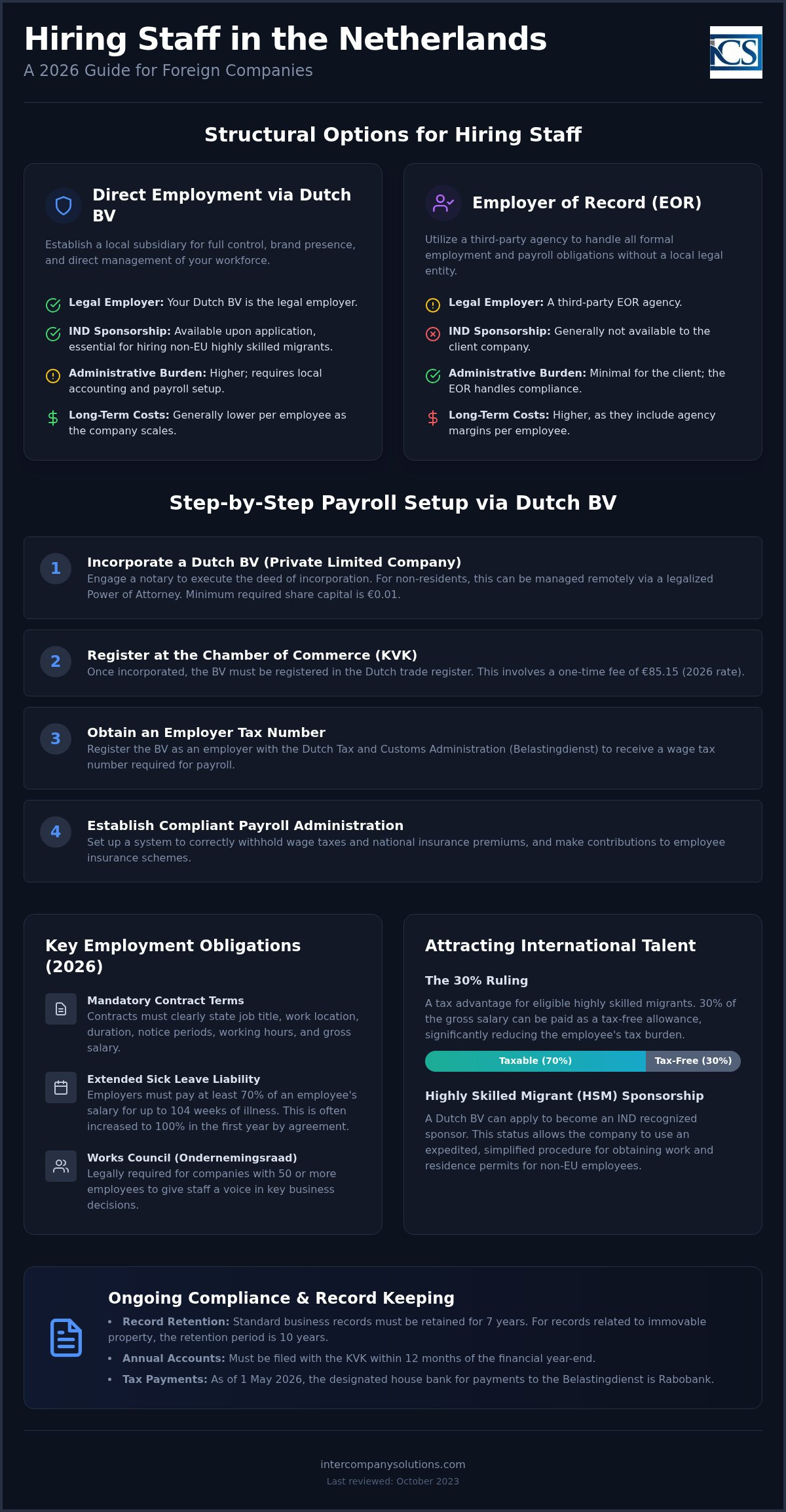
Foreign enterprises entering the Dutch market must choose between direct employment through a local subsidiary or utilizing third-party staffing arrangements. Each model carries distinct legal implications regarding labor law liability and administrative control. For a sustainable strategy in payroll management Netherlands foreign company operations, the choice typically depends on the intended headcount and the need for recognized sponsor status with the IND. The Netherlands also utilizes a specific "payrolling" model, which is a legal loan-back arrangement where a third-party agency serves as the formal employer while the worker remains under your operational direction.
| Feature | Direct Employment (Dutch BV) | Employer of Record (EOR) / Payrolling |
|---|---|---|
| Legal Employer | Your Dutch BV subsidiary | Third-party agency |
| IND Sponsorship | Available upon application | Generally not available to the client |
| Setup Time | 2-5 business days | Immediate |
| Administrative Burden | Higher (requires local accounting) | Minimal for the client |
| Long-term Costs | Lower per employee | Higher (includes agency margins) |
Direct Employment via a Dutch BV Subsidiary
Establishing a Dutch BV is the standard route for companies seeking full autonomy over their workforce. This structure requires a notary for the deed of incorporation and a minimum share capital of €0.01. Once incorporated, the entity must register with the Chamber of Commerce (KVK) and pay a one-time fee of €85.15. This model allows the business to apply for IND recognized sponsor status, which is a prerequisite for hiring non-EU highly skilled migrants. It integrates directly with Dutch BV company formation, providing a transparent framework for managing employment contracts, social security contributions, and local tax obligations under your own corporate identity.
Employer of Record (EOR) and Payroll Service Models
The EOR model serves as an entry-level solution for hiring staff without a local legal entity. The EOR handles all statutory requirements, including wage tax withholdings and social security premiums. However, the "hirer" remains liable for certain workplace safety standards and must ensure the employee receives conditions equal to those of direct staff under the Waadi legislation. While this reduces the initial administrative setup, it limits your ability to build local brand authority or sponsor visas directly. Most foreign entities transition to a BV structure once they reach a workforce size where the per-employee fees of an EOR exceed the costs of maintaining a dedicated Dutch payroll and accounting system.
Statutory Employment Requirements and Payroll Taxes in 2026
Hiring staff in the Netherlands requires strict adherence to the Dutch Civil Code, which dictates the mandatory components of every employment agreement. At a minimum, your contracts must specify the job title, place of work, duration of the agreement, and the applicable notice periods. It's also necessary to outline the working hours and the gross salary, including the statutory minimum wage requirements. For companies with 50 or more employees, establishing a Works Council (Ondernemingsraad or OR) is a legal obligation; this body provides staff with a voice in significant company decisions.
One of the most distinct features of Dutch labor law is the employer's obligation regarding sick leave. If an employee becomes unable to work due to illness, the employer is generally required to pay at least 70% of their salary for up to 104 weeks. In many cases, collective labor agreements (CAO) or individual contracts increase this to 100% during the first year. This long-term liability makes a robust system for payroll management Netherlands foreign company operations essential to track leave and manage potential insurance claims effectively.
Dutch Payroll Tax and Contribution Rates
Dutch payroll administration involves several layers of deductions and contributions. As an employer, you're responsible for withholding wage tax (loonbelasting) and national insurance premiums (volksverzekeringen) from the employee's gross pay. Additionally, you must pay employee insurance premiums (werknemersverzekeringen), which cover unemployment and disability benefits. Beyond the base salary, every employee is entitled to a statutory holiday allowance of at least 8% of their gross annual wage, typically paid in a lump sum in May or June.
Pension schemes often represent a significant portion of the total labor cost. While there's no universal statutory requirement for a private pension, many industries are governed by a CAO that mandates specific pension fund contributions. If you require a detailed assessment of these statutory costs for your specific industry, you can request a consultation with our tax specialists.
Corporate Tax Compliance for Employers
Maintaining a workforce in the Netherlands through a BV structure also brings broader corporate tax responsibilities. For the 2026 fiscal year, the corporate income tax (CIT) rate is 19% on profits up to €200,000 and 25.8% on any amount exceeding this threshold. When calculating taxable profit, you must account for the interest deduction cap, which is set at 24.5% of EBITDA. Compliance also requires meticulous record-keeping; all payroll and corporate documents must be retained for at least 7 years, or 10 years if the records involve immovable property.
Starting from 1 May 2026, all tax payments to the Dutch Tax Authorities (Belastingdienst) are processed through their house bank, Rabobank. Ensuring your internal accounting systems are updated to reflect these banking details is vital for avoiding late payment penalties. Clear financial oversight ensures that your payroll management Netherlands foreign company activities remain fully aligned with both labor and tax regulations.
Attracting International Talent: The 30% Ruling and HSM Sponsorship
The 30% ruling remains a primary incentive for international companies looking to attract high-level expertise to the Netherlands. This facility allows employers to provide 30% of an employee's gross salary as a tax-free reimbursement for extraterritorial costs. For a foreign company, incorporating this into their payroll management Netherlands foreign company strategy significantly reduces the total cost of employment while increasing the employee's net take-home pay. To qualify, the employee must be recruited from abroad and have lived more than 150 kilometers from the Dutch border for at least 16 out of the 24 months prior to their first working day.
Hiring non-EU talent requires a structured approach to immigration law. Your Dutch entity should apply for "Recognized Sponsor" status with the Immigration and Naturalization Service (IND) to facilitate this. This status allows for expedited visa processing, often completed within two to four weeks. Without it, the application for a single permit (GVVA) can take several months. Recognized sponsors must adhere to specific duty-of-care and administrative obligations, including reporting changes in the employee's status within four weeks to remain compliant.
Applying for the 30% Tax Reimbursement Ruling
The application for the 30% ruling is a joint process between the employer and the employee. It must be submitted to the Belastingdienst within four months of the employment start date to be retroactive. If the deadline is missed, the ruling only applies from the month following the application. In 2026, the duration of the ruling is five years. This benefit also simplifies social security calculations, as the tax-free portion is typically excluded from the social insurance base. If an employee changes jobs, the ruling can be transferred to the new Dutch employer, provided the new contract is signed within three months of the previous contract ending.
Highly Skilled Migrant (HSM) Visa Requirements
The HSM program relies on strict salary thresholds that are indexed annually by the Dutch government. For 2026, these thresholds apply based on the employee's age. Employees aged 30 and older must meet a higher gross monthly salary requirement than those under 30. Recent graduates from designated top universities who find employment within three years of graduation qualify for a lower "orientation year" threshold. Maintaining compliance with these thresholds is a load-bearing requirement of your payroll system. Falling below the limit can lead to the immediate revocation of the migrant's residence permit and significant fines for the Dutch entity.
Step-by-Step Guide to Setting Up Dutch Payroll Management
The process of establishing a local workforce begins with formal registration at the Dutch Chamber of Commerce (KVK). For a BV, which requires a notary for the deed of incorporation, you must pay a one-time KVK registration fee of €85.15 in 2026. This step is the foundation for payroll management Netherlands foreign company operations, as the resulting KVK number is required for all subsequent tax identifiers and for opening a local bank account.
Compliance with transparency regulations is a critical early step. You must register all Ultimate Beneficial Owners (UBOs) within 7 days of the company's incorporation. A UBO is defined as any individual holding more than 25% of the shares, voting rights, or ownership interest. Any subsequent changes to this ownership structure must also be reported to the KVK within the same 7-day timeframe to avoid administrative penalties.
Employer Registration and Tax Account Setup
Once the KVK registration is complete, the Dutch entity must obtain an employer tax number from the Belastingdienst. You achieve this by submitting the "Request for Employer Risk Assessment" (Melding Loonheffingen). This application allows the tax office to categorize your business and determine the applicable social insurance premiums. Upon approval, the company gains access to the digital environment required for submitting monthly wage tax returns. As of 1 May 2026, all payments to the tax authorities must be directed to Rabobank, the Belastingdienst's official house bank.
Ongoing Administrative Compliance and Deadlines
Successful payroll management Netherlands foreign company systems depend on a rigorous adherence to filing schedules. Wage tax returns and their corresponding payments are due by the end of the month following the payroll period. Additionally, the company must file its annual accounts with the KVK within 12 months of the end of the fiscal year. This process is linked to your corporate income tax (CIT) obligations, which in 2026 are 19% on profits up to €200,000 and 25.8% above that threshold. To remain compliant with Dutch law, you must retain all payroll and corporate records for a minimum of 7 years. Integrating these tasks with a professional payroll services provider often reduces the risk of administrative errors and late filings.
Managing Dutch Payroll Remotely via Legalized Power of Attorney
Managing a workforce in the Netherlands doesn't require your physical presence in the country. For non-EU founders, the legalized Power of Attorney (PoA) route is the primary method for establishing a local entity and starting the hiring process. This legal instrument allows a Dutch notary to execute the deed of incorporation on your behalf while you remain in your home country. It's a structured approach that prioritizes speed and legal integrity, ensuring your business is ready to hire staff without the need for international travel during the setup phase.
Using a PoA ensures that your company formation remains compliant with Dutch civil law from the outset. This remote foundation is essential for international entrepreneurs who need to establish a presence in the Eurozone while focusing on their global operations. By delegating the execution to a local notary, you can ensure that all technical requirements for your Dutch BV are met with precision. This includes the mandatory registration of Ultimate Beneficial Owners (UBO) and the initial filing with the Chamber of Commerce.
The Remote Incorporation and Setup Workflow
International entrepreneurs must legalize their identification documents and the PoA through a local notary or embassy in their home jurisdiction. Once the Dutch notary receives these original legalized documents, the BV is incorporated with a minimum share capital of €0.01. For foreign-owned entities, the Belastingdienst typically takes 6 to 8 weeks to issue a VAT number. During this period, you can also apply for an EORI number if your business involves the import or export of goods. Utilizing expert secretarial support during this phase ensures that your applications for tax numbers and accounts at Rabobank, the official tax house bank since May 2026, are handled correctly.
Ensuring Long-term Compliance from Abroad
Distance shouldn't compromise your adherence to Dutch labor laws or tax deadlines. A local partner manages the technical details of your monthly filings, from calculating social security contributions to processing the 30% ruling for your international staff. This partner ensures that your payroll management Netherlands foreign company system stays updated with the latest legislative shifts, such as changes in minimum wage or pension requirements. You'll receive a single, transparent invoice each month that covers all employment-related costs, simplifying your international bookkeeping.
This remote framework is a vital component for starting a business in the Netherlands as a non-resident. It allows you to build a local team while maintaining full compliance with UBO reporting duties and the 7-year record retention policy. By delegating the administrative burden to a local specialist, you can focus on scaling your Dutch operations. Your payroll system remains a stable and compliant foundation for growth, supported by the reliability of the Dutch financial and legal infrastructure.
Last reviewed: October 2024
Establishing a Compliant Workforce in the Netherlands
Hiring staff in the Netherlands requires a structured approach to both labor law and administrative compliance. By following the legalized Power of Attorney route, you can establish a Dutch BV and begin recruitment without the need for physical travel. Your success depends on maintaining accurate records for seven years and ensuring that all tax payments are directed to Rabobank as required since 1 May 2026. Implementing a professional system for payroll management Netherlands foreign company operations protects your business from legal risks while allowing you to attract top international talent through the 30% ruling.
We've assisted over 1,000 foreign entrepreneurs with remote incorporation in 2 to 5 business days. Our services include a 100% satisfaction guarantee to ensure your professional interests are managed with precision. This proactive approach simplifies your entry into the Dutch market and builds a foundation for long-term growth. The Netherlands remains a stable and welcoming environment for global expansion for companies that prioritize regulatory adherence and expertise.
Last reviewed: October 2024
Frequently Asked Questions
Do I need a local legal entity to hire employees in the Netherlands?
You typically require a local legal entity, such as a Dutch BV, to hire employees directly and maintain full control over your workforce. While an Employer of Record (EOR) is an alternative, a BV allows you to apply for IND recognized sponsor status. Incorporation requires a notary and a minimum share capital of €0.01. This structure ensures you meet all local labor and tax law requirements.
What is the minimum share capital required for a Dutch BV in 2026?
The minimum share capital required for a Dutch BV in 2026 is €0.01. This makes the BV an accessible legal structure for international entrepreneurs. Upon incorporation, you must also pay a one-time registration fee of €85.15 to the Chamber of Commerce (KVK). While capital requirements are low, you must ensure the entity remains solvent to meet its monthly payroll obligations and social security contributions for all staff.
How much are the corporate tax rates in the Netherlands for 2026?
For the 2026 fiscal year, the corporate tax rate is 19% on profits up to €200,000. Any profit exceeding this amount is taxed at 25.8%. You must also adhere to the interest deduction cap of 24.5% of EBITDA. Effective payroll management Netherlands foreign company operations involves correctly deducting labor costs to ensure your taxable profit is calculated accurately. All tax payments are processed through Rabobank as of 1 May 2026.
What is the 30% ruling and how does it benefit foreign employers?
The 30% ruling is a tax facility that allows employers to pay 30% of an employee's gross salary as a tax-free reimbursement for extraterritorial costs. This benefit is available for qualified international staff recruited from abroad who meet specific salary thresholds. It reduces the employer's social security costs and increases the employee's net income. In 2026, the ruling lasts for five years and remains a vital tool for attracting highly skilled talent to your Dutch entity.
How long does it take to register a Dutch company for payroll and VAT?
Incorporating a Dutch BV remotely takes 2 to 5 business days once the notary receives the legalized Power of Attorney. However, registering for VAT typically takes 6 to 8 weeks for entities with foreign shareholders. Once your KVK registration is finalized and the €85.15 fee is paid, you can obtain an employer tax number. This allows you to set up your payroll system and begin filing monthly wage tax returns with the Belastingdienst.
Can I manage my Dutch payroll remotely without visiting the country?
You can manage your payroll management Netherlands foreign company tasks entirely from abroad without visiting the country. The legalized Power of Attorney route allows a Dutch notary to incorporate your BV remotely. You can then appoint local specialists to handle monthly tax filings and social security payments. All communication with the Belastingdienst is digital, and tax payments are made to Rabobank, which has served as the tax authority's house bank since 1 May 2026.
What are the mandatory social security contributions for Dutch employers?
Dutch employers are responsible for several mandatory contributions. You must pay employee insurance premiums and withhold national insurance from gross wages. Key obligations include:
- Minimum statutory holiday allowance of 8%.
- Sick leave pay for up to 104 weeks.
- Sector-specific pension fund contributions if a CAO applies.
These costs must be tracked accurately within your payroll system to ensure full regulatory compliance and avoid Belastingdienst penalties.
Sources
- ICS Payroll - Dutch payroll services
- KVK - Registering with the Dutch Business Register
- Business.gov.nl - Private limited company (bv)
- Burgerlijk Wetboek Boek 2 (Dutch Civil Code, legal entities)
- Rijksoverheid - Ondernemen
- Belastingdienst - Corporate income tax rates
- Belastingdienst - Payroll taxes (loonheffingen)
- UWV - Employer obligations
- SVB - Social insurance in the Netherlands
- Belastingdienst - VAT (btw) for entrepreneurs
- European Commission - VAT rules and rates
- IND - Highly skilled migrant
- IND - Start-up residence permit
- De Nederlandsche Bank - Supervision
- AFM - Licences and registers
- RVO - Doing business internationally
- Belastingdienst Douane - Customs
- CJEU, Cadbury Schweppes, C-196/04 (ECLI:EU:C:2006:544)
- Hoge Raad, ECLI:NL:HR:2021:1152
- PwC Worldwide Tax Summaries - Netherlands
- ICLG - Corporate Governance Laws and Regulations, Netherlands
Need more information on the Dutch BV company?
Contact an expertReady to start your company in the Netherlands?
| Formation time | Dutch BV formation completed in 3 to 5 business days |
|---|---|
| Process | Fully remote setup with step-by-step guidance |
| Compliance | Expert support for registration, VAT and compliance |
| Aftercare | Accounting, tax and legal support included |
| One partner | All of the above through one trusted formation partner |