

September 8, 2026 · 18 min read
Establishing a Dutch company doesn't require a local residency permit or a physical presence in the Netherlands, even when you serve as the sole director. While many entrepreneurs assume that local residency is a prerequisite for corporate control, Dutch law explicitly allows for a non-resident foreign director Dutch BV structure. You likely recognize the Netherlands as a strategic hub for global expansion, but the uncertainty regarding residency requirements or the fear of personal liability often creates unnecessary barriers to entry.
This guide serves as a definitive resource for international business owners who prioritize procedural precision. You'll learn how to manage the 2026 legal requirements, from the initial KVK registration fee of €85.15 to the specific substance requirements demanded by the Belastingdienst. We'll outline the legalized Power of Attorney route for remote Dutch BV company formation and explain how to maintain 100% control while ensuring your company stays within the 19% corporate tax bracket for profits up to €200,000. By following these compliance steps, you can successfully launch your enterprise and prepare for a professional banking relationship with Rabobank, which has served as the house bank for the tax authorities since 1 May 2026.
Key Takeaways
- Confirm that Dutch residency or nationality is not a legal prerequisite for a foreign director Dutch BV to maintain full corporate control and ownership.
- Execute the incorporation process remotely using the legalized Power of Attorney route, which typically allows for company formation within 3 to 5 business days.
- Apply the 2026 Corporate Income Tax rates of 19% on profits up to €200,000 and 25.8% on the excess to ensure accurate fiscal planning.
- Maintain statutory compliance by filing annual accounts with the KVK within 12 months of the financial year-end to mitigate the risk of personal liability.
- Establish sufficient local substance to satisfy tax residency criteria and support applications for corporate banking services with institutions like Rabobank.
Table of Contents
Legal Status and Requirements for a Foreign Director of a Dutch BV
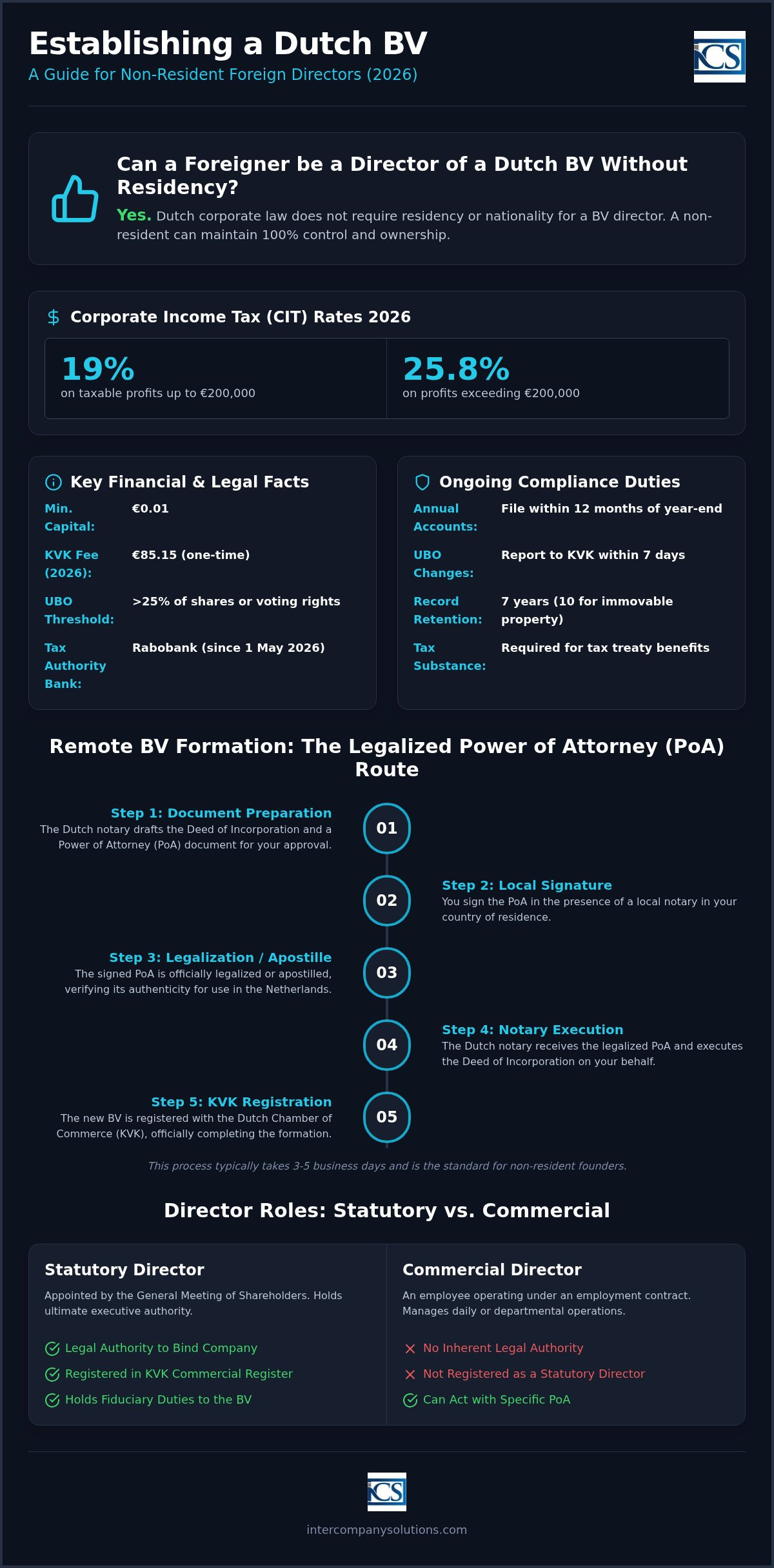
Under Book 2 of the Dutch Civil Code (Burgerlijk Wetboek), a statutory director holds the highest executive authority within a Dutch private limited company (BV). This position is distinct from a commercial manager or a standard employee. While a commercial manager operates under a contract of employment, a statutory director is appointed by the General Meeting of Shareholders and maintains a corporate relationship with the entity. This role carries specific fiduciary duties and legal responsibilities that extend beyond daily operations. To form a BV, the law requires a minimum of one shareholder and one director. A single individual can fulfill both roles, allowing for 100% ownership and control by a single person. This structure is the foundation of Dutch BV company formation for international entrepreneurs.
Residency Rules and Nationality
Dutch corporate law is inclusive regarding the nationality and residency of its board members. You don't need to be a Dutch citizen or a resident of the Netherlands to act as a foreign director Dutch BV. This openness applies to both EU and non-EU citizens. However, a clear distinction exists between the legal right to hold a directorship and the right to work or live in the country. Holding a director position doesn't automatically grant a residence permit or a work visa.
Your residency status also impacts the company's fiscal substance. To be considered a Dutch tax resident and access the extensive network of double taxation treaties, the Dutch Tax Authority (Belastingdienst) typically looks for a place of effective management. This often involves having at least 50% of the statutory directors residing in the Netherlands. If you manage the company entirely from abroad, the entity might be viewed as a tax resident in your home jurisdiction instead, which can affect the application of the 19% and 25.8% corporate tax rates.
Statutory vs. Commercial Directorship
A statutory director possesses "tekenbevoegdheid," which is the legal authority to represent the company and sign binding contracts. This authority is recorded in the Commercial Register of the Chamber of Commerce (KVK). In contrast, a commercial director might manage a department but lacks the legal power to bind the BV to third-party agreements unless the statutory board provides a specific power of attorney.
Every foreign director Dutch BV must be registered with the KVK, which involves a one-time registration fee of €85.15 in 2026. Additionally, directors must comply with the Ultimate Beneficial Owner (UBO) register requirements. Any individual holding more than 25% of the shares or voting rights is classified as a UBO. You must report any changes to UBO information within 7 days to avoid potential fines, which can start at €2,750 for non-compliance in 2026. Maintaining accurate records is a statutory duty, and these records must be retained for at least 7 years.
Remote Formation Process for Non-Resident Directors
The incorporation of a Dutch BV by a non-resident doesn't require a physical visit to the Netherlands. For a foreign director Dutch BV, the standard procedure is the legalized Power of Attorney (PoA) route. This method allows a Dutch notary to execute the deed of incorporation while the director remains in their home country. While legislative changes have introduced digital video incorporation, the PoA route remains the most reliable and professional standard for non-resident founders, particularly those from non-EU jurisdictions. This path ensures that all identification and authorization requirements are met to the satisfaction of the Dutch legal system.
The Legalized PoA Route Explained
The process begins with the preparation of a draft deed of incorporation. Once the board and shareholders approve the draft, the notary issues a Power of Attorney. The founder must sign this document in the presence of a local notary or competent authority in their country of residence. Depending on the jurisdiction, this document then requires legalization or an apostille to be recognized under Dutch law. If you're using a foreign legal structure as a corporate director, additional documentation regarding the foreign entity's registration and authority will be required to confirm who's authorized to sign on its behalf.
Required Documentation for Foreign Directors
To satisfy Dutch "Know Your Customer" (KYC) protocols, the notary requires specific documentation. This includes a legalized copy of your valid passport and a recent proof of residential address, such as a utility bill or bank statement not older than two months. You must also provide a clear description of the intended business activities and a shareholder checklist. These measures ensure compliance with the Anti-Money Laundering and Anti-Terrorist Financing Act (Wwft). Accurate documentation is the primary factor in maintaining the standard formation timeline.
Once the legalized PoA and supporting documents reach the notary in the Netherlands, the execution of the deed typically takes 3 to 5 business days. Immediately following the execution, the company's registered with the Chamber of Commerce (KVK). This registration incurs a one-time fee of €85.15 for 2026. After this step, the BV is legally established, and the director can proceed with tax registration and banking applications. If you have specific questions about document legalization in your country, you can request a procedural review from our specialists.
Using the PoA route ensures that every legal requirement for a foreign director Dutch BV is met with precision, providing a stable foundation for international growth. While a natural person is the most common choice for a director, corporate entities can also fill this role. In such cases, the notary must verify the entire chain of ownership up to the Ultimate Beneficial Owner (UBO) to comply with the mandatory UBO register, where anyone with an interest of more than 25% must be disclosed. Following this methodical approach prevents delays in the later stages of VAT and bank account applications.
Substance, Liability, and Tax Implications for Foreign Boards
Managing a Dutch entity as a foreign director Dutch BV involves more than operational oversight; it requires a focus on fiscal residency. The Dutch Tax Authority (Belastingdienst) determines a company's tax residency based on its "Place of Effective Management." If all board decisions occur outside the Netherlands, foreign tax authorities may claim the BV is a resident of the director's home country. This dual residency can lead to double taxation or the loss of Dutch tax treaty benefits. Maintaining a clear fiscal identity in the Netherlands is essential for accessing the 19% corporate tax rate on profits up to €200,000.
Establishing Tax Substance from Abroad
To mitigate residency risks, you should establish local substance. Having at least 50% of the board reside in the Netherlands is a primary indicator of Dutch management. Practical steps include holding board meetings within the country and ensuring major executive decisions are documented on Dutch soil. For business owners who want to refine their approach to management during this transition, you can visit Steven Stephania for coaching tailored to international leaders. Maintaining a local bank account, specifically with Rabobank since it became the Belastingdienst house bank on 1 May 2026, further supports your claim of a genuine economic presence. Without these ties, the company may struggle to prove it isn't a mere "conduit" for foreign activities.
Under Dutch law, directors aren't generally personally liable for the company's debts, but exceptions exist for mismanagement. External liability arises if you fail to report the BV's inability to pay taxes or social security contributions on time. If the company enters bankruptcy and the curator proves "manifestly improper management" occurred in the three years prior, the board can be held liable for the entire deficit. Protective measures, such as Directors and Officers (D&O) insurance, are standard for international boards. Proper administrative records are your best defense, as they demonstrate that decisions were made with due care.
Administrative precision is a statutory duty that protects the board from personal claims. You must retain all corporate records for 7 years, though this period extends to 10 years for records related to immovable property. Additionally, directors must manage the BV's fiscal limits, such as the interest deduction cap. For 2026, the deduction of net interest expenses is limited to 24.5% of the company's EBITDA. Our payroll and tax services can assist in maintaining these complex compliance standards while you manage the business from abroad. Ensuring these thresholds are monitored prevents unexpected tax assessments and maintains the company's standing with the Belastingdienst.
Banking and Financial Compliance for Foreign-Led BVs
Securing a corporate bank account is often the most significant hurdle for a foreign director Dutch BV. While the legal formation is straightforward, Dutch financial institutions operate under strict oversight from the Dutch Central Bank (DNB). This regulatory environment means that banks apply enhanced due diligence to entities where the management resides abroad. Compliance departments evaluate the high-risk status of an application based on the director's country of residence and the company's intended market. If your home jurisdiction is on a high-risk list, the onboarding process will be more rigorous and requires additional documentation to prove the legitimacy of your funds and business model.
Opening a Dutch Corporate Bank Account
Traditional banks like ING, ABN AMRO, and Rabobank remain the preferred choice for long-term stability. Since 1 May 2026, Rabobank has served as the house bank for the Belastingdienst, making it a central player in the Dutch fiscal system for tax payments and refunds. However, these traditional banks often require a physical meeting or significant local substance before opening an account. Many international entrepreneurs now opt for Electronic Money Institutions (EMIs) or fintech solutions as an initial step. These platforms provide a Dutch IBAN and allow for immediate operational capacity while the longer application for a traditional account proceeds. You'll still need to demonstrate a clear link to the Dutch market to satisfy their internal compliance checks.
UBO Register and Transparency Obligations
Transparency is a cornerstone of Dutch corporate governance. You're required to register all Ultimate Beneficial Owners (UBOs) with the Chamber of Commerce. A UBO is any individual who holds more than 25% of the shares, voting rights, or ownership interest in the BV. This requirement ensures that the actual persons in control are known to the authorities. Beyond the public register, every foreign director Dutch BV must maintain an up-to-date internal register of shareholders at the company's registered address, detailing the names, addresses, and shareholdings of all owners.
Compliance with the UBO register is strictly enforced in 2026. You must report any changes to UBO information or directorship within 7 days of the change. Failure to do so can result in administrative fines or even criminal charges for the directors. Similarly, once the bank account is active, you must finalize your tax registration. For entities with foreign ownership, the VAT (BTW) registration process typically takes 6 to 8 weeks. During this time, the Belastingdienst may request additional information regarding the company's activities and its local economic ties. Our secretarial services provide the necessary support to manage these timelines effectively and ensure all documentation meets the specific requirements of the tax authorities.
Ongoing Administrative Duties for the Non-Resident Director
Managing a business remotely requires strict adherence to the Dutch fiscal calendar. As a foreign director Dutch BV, you're legally responsible for the company's administrative integrity, regardless of where you're physically located. This includes ensuring that VAT returns are filed quarterly and that the company's records are retained for the mandatory 7 years. Records related to immovable property must be kept for 10 years. VAT rates in 2026 remain at 21% for standard goods, 9% for reduced-rate items, and 0% for specific international transactions. Timely VAT reporting is a prerequisite for maintaining a good standing with the Belastingdienst and avoiding administrative penalties.
Annual Financial Reporting and CIT
The board must prepare the company's annual financial statements within five months of the fiscal year-end. While shareholders may grant an extension for this preparation, the final deadline for filing the adopted accounts with the KVK is 12 months after the year-end. Failure to meet this deadline is considered an economic offense and can lead to personal liability for the directors in the event of bankruptcy. Accuracy in Accounting for Dutch BV structures is vital for calculating Corporate Income Tax (CIT). For the 2026 tax year, the CIT rate is 19% on taxable profits up to €200,000 and 25.8% on any amount exceeding this threshold. Every director must ensure these tax returns are filed within 5 months of the fiscal year-end unless an extension is granted.
Payroll and Staffing Considerations
If your BV hires employees, you must comply with Dutch labor laws, which require a written employment agreement for every staff member. A foreign director Dutch BV can manage payroll locally or utilize Payroll Services in the Netherlands to ensure compliance with social security contributions and wage tax withholdings. For qualifying international staff, the 30% tax ruling remains a significant incentive. This ruling allows a portion of the salary to be paid tax-free provided the minimum taxable salary of €48,013 for 2026 is met. The ruling applies only to income up to the €262,000 salary cap for 2026.
Proper management of these duties prevents administrative friction and supports the company's long-term growth. While the 19% CIT bracket offers a competitive advantage for SMEs, maintaining this benefit depends on accurate bookkeeping and the timely reporting of any UBO changes within the mandatory 7-day window. Our Accounting & Tax Services provide the specialized support needed to handle these recurring obligations with professional precision. Directors should also monitor the interest deduction cap, which is set at 24.5% of EBITDA for 2026, to ensure fiscal efficiency and compliance with current anti-tax avoidance measures.
Last reviewed: September 2026
Establishing Your Dutch Corporate Presence from Abroad
Managing a Dutch private limited company as a foreign director Dutch BV provides a stable foundation for international growth without the need for local residency. You've learned that the remote formation process, specifically the legalized Power of Attorney route, allows for a professional setup while you remain in your home country. Maintaining this structure requires a commitment to Dutch compliance, including the timely reporting of UBO changes within 7 days and the filing of annual accounts with the KVK within 12 months of the year-end.
We offer specialized support for non-resident founders and a 100% satisfaction guarantee on our incorporation services. Our team facilitates remote incorporation in 3 to 5 business days, ensuring your business meets all 2026 legal requirements from the start. We're ready to act as your proactive partner, bridging the gap between global entrepreneurship and the Dutch regulatory landscape. We look forward to helping you launch your enterprise with confidence and professional precision.
Last reviewed: September 2026
Frequently Asked Questions
Can a foreign director own 100% of the shares in a Dutch BV?
Yes, you can hold 100% of the shares and serve as the sole statutory director simultaneously. Dutch law doesn't require a local shareholder or partner for a private limited company. If you're evaluating the strategic differences between solo ownership and bringing in a co-owner, you can learn more about Founded Partners. The minimum share capital is set at €0.01, allowing for total ownership and control by a single person. This structure is the most common choice for international entrepreneurs, providing a clear path to full executive authority without local participation.
Do I need to travel to the Netherlands to be appointed as a director?
You don't need to travel to the Netherlands for your appointment. The standard remote formation process uses a legalized Power of Attorney route. You sign the necessary documents and provide a legalized copy of your passport in your home country. A Dutch notary then executes the deed of incorporation on your behalf. This allows for the full setup of your company without a physical visit, provided all documentation meets the notary's compliance standards.
What are the tax implications for a non-resident director?
Statutory directors must ensure the company complies with Corporate Income Tax (CIT) rates of 19% on profits up to €200,000 and 25.8% above that. The company should use Rabobank for tax payments, as it is the Belastingdienst house bank since 1 May 2026. Maintaining local substance is required to access tax treaties, which includes keeping records for 7 years and managing the 2026 interest deduction cap of 24.5% of EBITDA.
Is a local Dutch director required for VAT registration?
A local director isn't a legal requirement for VAT registration, but the process is more extensive for entities managed from abroad. The Belastingdienst typically takes 6 to 8 weeks to issue a VAT number to companies with only non-resident directors. You must demonstrate a real economic link to the Dutch market, such as local suppliers or clients, to satisfy the tax authority's assessment of the company's intended business activities.
How long does it take to register a foreign director with the KVK?
Registration with the Chamber of Commerce (KVK) occurs immediately after the notary executes the deed of incorporation. The total timeline is usually 3 to 5 business days once all legalized documents are received. This includes the payment of the one-time KVK registration fee of €85.15 for 2026. Your details will then be visible in the Commercial Register as the authorized representative, allowing you to commence business operations immediately.
Can a foreign company be the director of a Dutch BV?
A foreign legal entity can serve as a corporate director of a Dutch BV. In this case, the notary must verify the authority of the individuals representing that foreign company. You're also required to disclose the Ultimate Beneficial Owners (UBOs) who hold more than 25% of the interest. Any changes to UBO information must be reported to the KVK within 7 days to comply with mandatory transparency regulations and avoid potential fines.
What happens if a foreign director fails to file annual accounts?
Failing to file annual accounts with the KVK within 12 months of the year-end is an economic offense. This neglect can lead to administrative fines and the loss of limited liability protection. If the company becomes insolvent, the board can be held personally liable for the company's total debts if the failure to file is considered a sign of mismanagement. Proper record-keeping for at least 7 years remains a mandatory statutory duty.
Sources
- ICS Payroll - Dutch payroll services
- KVK - Registering with the Dutch Business Register
- Business.gov.nl - Private limited company (bv)
- Burgerlijk Wetboek Boek 2 (Dutch Civil Code, legal entities)
- Rijksoverheid - Ondernemen
- Belastingdienst - Corporate income tax rates
- Belastingdienst - Payroll taxes (loonheffingen)
- UWV - Employer obligations
- SVB - Social insurance in the Netherlands
- Belastingdienst - VAT (btw) for entrepreneurs
- European Commission - VAT rules and rates
- IND - Highly skilled migrant
- IND - Start-up residence permit
- De Nederlandsche Bank - Supervision
- AFM - Licences and registers
- CJEU, Cadbury Schweppes, C-196/04 (ECLI:EU:C:2006:544)
- Hoge Raad, ECLI:NL:HR:2021:1152
- PwC Worldwide Tax Summaries - Netherlands
- ICLG - Corporate Governance Laws and Regulations, Netherlands
Need more information on the Dutch BV company?
Contact an expertReady to start your company in the Netherlands?
| Formation time | Dutch BV formation completed in 3 to 5 business days |
|---|---|
| Process | Fully remote setup with step-by-step guidance |
| Compliance | Expert support for registration, VAT and compliance |
| Aftercare | Accounting, tax and legal support included |
| One partner | All of the above through one trusted formation partner |