


September 29, 2026 · 15 min read
Committing to Dutch operations before testing demand can create avoidable costs and compliance work. A decision to expand business to Netherlands should begin with evidence of market fit, not with company formation.
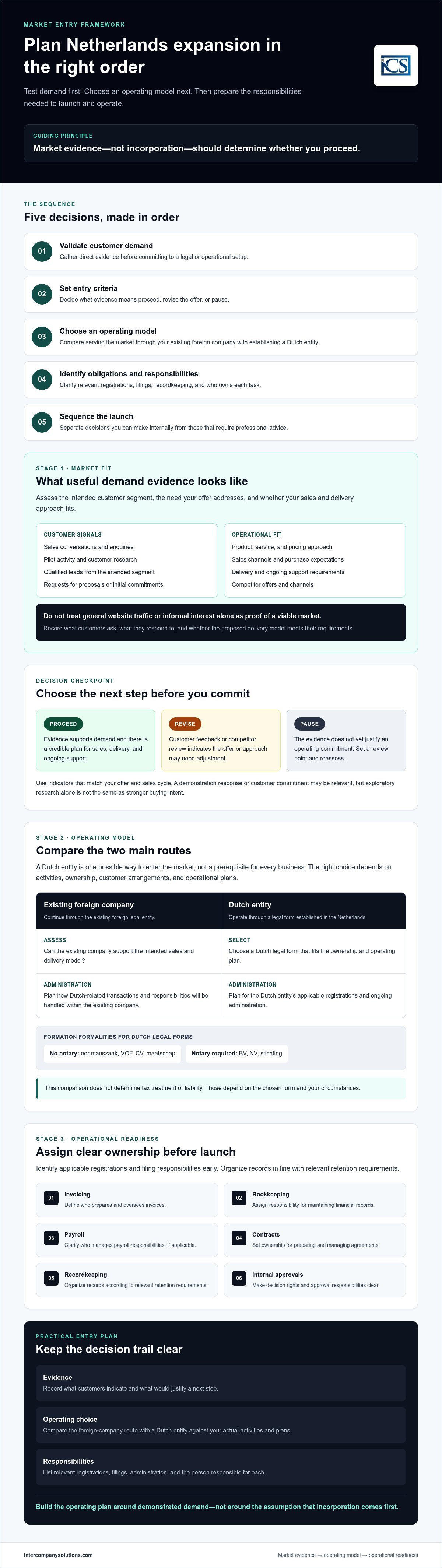
It’s reasonable to be unsure which operating model suits your plans, which Dutch obligations apply, and how to manage the business from abroad. This guide sets out a staged framework to help you assess demand before making significant commitments, compare the main operating models, and identify the compliance decisions relevant to your situation. It also explains how to sequence market research, setup, and ongoing administration so you can plan each step. The right route depends on factors such as your business activities, ownership, and whether you intend to establish a Dutch entity or serve the market from overseas. Work through these decisions in order so you can build a practical entry plan without treating incorporation as the first step.
Key Takeaways
- Validate customer demand before committing to a legal or operational setup.
- Compare operating through your existing foreign company with establishing a Dutch entity, then assess which model fits your circumstances.
- Identify applicable registrations and filing responsibilities early, and organize records in line with relevant retention requirements.
- Assign clear ownership for invoicing, bookkeeping, payroll, contracts, recordkeeping, and internal approvals before launch.
- Build a sequenced entry plan, and identify which decisions you can make internally and which require professional advice.
Table of Contents
- Expand your business to the Netherlands by testing market fit first
- Choose a Netherlands operating model before setting up
- Plan Dutch registrations, tax, and compliance before launch
- Prepare Dutch operations, staffing, and financial administration
- Turn the Netherlands expansion plan into a sequenced launch
Expand your business to the Netherlands by testing market fit first
Confirm the commercial case before committing to a legal or operational setup. Incorporating a Dutch entity can establish a local structure, but it does not show that customers will buy your product or service. If you intend to expand business to Netherlands, start by testing customer demand and the practical requirements of serving those customers.
Use evidence from your own sales conversations, enquiries, pilot activity, and customer research. Review the Economy of the Netherlands for background on industries and trade relationships, then assess what that context means for your specific offer. Market-entry readiness means evidence of demand combined with a workable operating plan.
Define the Dutch market opportunity
Specify who is most likely to buy, what need your offer addresses, and how you will reach those customers. Check whether your product, service, pricing approach, and sales process suit the target segment. Consider which channels you can use, how customers expect to purchase, and what delivery or support will require. Language capability and international accessibility can help communication, but neither guarantees demand.
Compare your assumptions with direct evidence. For example, record which customer groups respond to outreach, what questions they raise, and whether your proposed delivery model meets their requirements. Review competitors’ offers and channels to identify where your proposition is distinct and where it may need adjustment.
Set measurable entry criteria
Decide in advance what evidence would justify the next step. Possible indicators include qualified leads from your intended customer segment, repeat interest after a product demonstration, requests for proposals, or initial customer commitments. Choose measures that match your sales cycle and offer. General website traffic or informal interest alone is not proof of a viable market.
Exploratory research helps you form and test assumptions. Operating commitments require stronger evidence, such as clear buying intent and a credible plan for sales, delivery, and ongoing support. Set a review point and record what would lead you to proceed, revise the offer, or pause.
Once you have a clearer view of demand, use guidance on starting a business in the Netherlands to consider the practical setup questions that follow. Keep market validation separate from incorporation: make the operating decision because the evidence supports it, not because a company has already been formed.
Choose a Netherlands operating model before setting up
After assessing market demand, decide how you will conduct business before arranging a Dutch setup. You may continue operating through your existing foreign company or establish a Dutch entity. Neither option is automatically right. The choice depends on your activities, ownership, customer arrangements, and plans for managing operations. A Dutch entity is one possible way to enter the market, not a prerequisite for every business.
Compare the main operating models
Distinguish the operating model from the legal form. An existing foreign company may serve Dutch customers without creating a Dutch entity, but the consequences depend on the facts. A Dutch entity creates a local legal structure with its own formation and administration considerations.
| Decision criterion | Existing foreign company | Dutch entity |
|---|---|---|
| Legal structure | The business continues through its existing foreign legal entity. | The business operates through a legal form established in the Netherlands. |
| Setup decision | Assess whether the existing company can support the intended sales and delivery model. | Select a Dutch legal form that fits the ownership and operating plan. |
| Administration | Confirm how Dutch-related transactions and responsibilities will be handled within the existing company. | Plan for the Dutch entity’s applicable registrations and ongoing administration. |
| Formation formalities | Depend on the existing company’s jurisdiction and structure. | Eenmanszaak, VOF, CV, and maatschap do not require a notary; BV, NV, and stichting do. |
This high-level comparison does not determine tax treatment or liability. Those matters depend on the chosen form and your circumstances. Business.gov.nl’s overview of business structures is a useful starting point for comparing legal forms.
Decide whether a Dutch BV fits the plan
A BV may suit a business that needs a Dutch legal entity, but it is not an automatic requirement for market entry. The minimum share capital for a Dutch BV is €1. Consider the ownership structure, decision-making, and cross-border arrangements before choosing this form. If you have selected a BV, review the Dutch company formation requirements and confirm the formation route for your circumstances.
Where ownership, tax residence, or cross-border arrangements affect the decision, seek qualified legal or tax advice. You can also discuss your Dutch BV formation questions before committing to a structure.
Plan Dutch registrations, tax, and compliance before launch
Once you have selected an operating model, map its registrations and recurring duties to your actual business activities. Requirements can differ between a Dutch entity and a foreign company, and VAT treatment depends on the transactions and circumstances. Use this checklist to assign responsibility before trading begins.
- Identify applicable registrations. Check whether the business needs Dutch VAT registration and, if relevant to its activities, an EORI number. The Dutch Tax Administration provides guidance on VAT, while the Chamber of Commerce (KVK) explains business registration. Do not assume every expanding company has the same obligations.
- Assign filing ownership. Name the person or adviser responsible for each return, filing, and change notification. Record who prepares, reviews, and submits each item.
- Set up records and reporting dates. Create a process for storing invoices, contracts, transaction records, and correspondence, then add relevant filing dates to a shared calendar.
- Confirm obligations before launch. Check the rules that apply to the entity, activity, and cross-border arrangements rather than relying on a general checklist alone.
VAT registration is separate from a company’s other registrations and filing duties. For foreign-owned entities, VAT registration typically takes 6-8 weeks. Treat this as a planning estimate, not a guaranteed processing time or statutory deadline. VAT rates are 21%, 9%, or 0%, depending on the goods or services and transaction. Check the Dutch Tax Administration’s current VAT guidance for the specific treatment.
Build a compliance calendar and records process
Make filing ownership specific. For a Dutch BV, record the responsible person for corporate income tax matters, bookkeeping, annual accounts, and any applicable VAT returns. The stated corporate income tax rates are 19% up to €200,000 and 25.8% above that. Their application depends on the company’s taxable profit and circumstances; confirm the current rules with the Dutch Tax Administration.
For relevant Dutch entities, keep ownership information current: the UBO threshold is >25%, and UBO changes must be reported within 7 days. Check the KVK guidance on UBO registration for applicable reporting requirements. Records are retained for 7 years, or 10 years for immovable property. Annual accounts are filed with KVK within 12 months of year-end. Add each applicable date to the compliance calendar and verify the specific obligation against your entity’s circumstances.
Prepare Dutch operations, staffing, and financial administration
A workable entry plan needs clear ownership of day-to-day tasks, not just a chosen legal structure. Before trading, decide who will issue invoices, maintain bookkeeping, manage contracts, store records, and approve payments or other commitments. If your team is abroad, document how information will be transferred and who can act when a responsible person is unavailable.
Plan staffing and employment compliance
First determine whether you plan to employ staff or use another engagement model. These arrangements are not automatically interchangeable; the correct treatment depends on the actual working relationship and applicable rules. Employment requirements can also differ by worker status. In particular, work-authorization considerations vary for EU, EEA, and Swiss nationals compared with people from outside those groups. Check Dutch government guidance on employing staff and, where relevant, the IND’s work and residence information before agreeing start dates or responsibilities.
Set out who will collect employee information, prepare payroll inputs, review payments, and retain related records. If hiring is part of your plan, consult this guide to payroll in the Netherlands for issues to consider in your planning. Intercompany Solutions also offers payroll services for Dutch entities, including payroll administration and staffing support.
Assign responsibility for financial administration
Make each process explicit. Name a preparer and reviewer for bookkeeping, applicable VAT returns, annual filings, and financial reporting. Set internal deadlines ahead of formal due dates, and establish an approval process for invoices, supplier payments, and contracts. Clear responsibilities reduce the risk of missed handovers when administration is managed across jurisdictions.
Agree how source documents will reach the person maintaining the accounts, who checks transaction records, and where final records are stored. If owners or managers work in different countries, define who can approve commitments and how approvals are documented. Confirm the reporting duties that apply to your chosen entity and activities rather than assuming every business has the same filing calendar.
If opening a Dutch bank account is part of your plan, treat it as a separate workstream and confirm what documentation the provider requires. Intercompany Solutions offers bank-account assistance as part of its support for entrepreneurs establishing a Dutch company.
Turn the Netherlands expansion plan into a sequenced launch
Turn the decisions from your market assessment, operating model, compliance review, and operations plan into a sequence. This helps you identify what can be decided internally and where legal, tax, or regulatory advice is needed before you commit resources. A launch plan should assign an owner and deadline to each required decision.
Use a readiness checklist before committing
Before moving from planning to launch, confirm who you intend to serve, how you will deliver your offer, and who will make and approve key decisions. Check that someone is responsible for initial registrations, bookkeeping, invoicing, contracts, and any staffing arrangements. Identify unresolved questions about legal structure, tax, VAT, employment, or whether your specific activity is regulated. Do not assume licensing requirements without checking the activity and applicable rules.
Follow a sequenced action plan
- Validate demand. Use your customer research and sales evidence to decide whether there is a commercial case to proceed.
- Select an operating model. Decide whether to operate through your existing foreign company or establish a Dutch entity. If key facts remain unclear, revisit the market and model assessment rather than forming a company by default.
- Confirm registrations. Identify which registrations and filings apply to the chosen structure and business activities. Ask a qualified adviser to review questions that depend on cross-border ownership, tax, or regulated activities.
- Assign operational responsibilities. Name the people responsible for administration, financial records, staffing processes, contracts, and internal approvals.
- Review readiness. Check that decisions, documents, responsibilities, and next steps are in place before beginning Dutch operations.
Timing depends on the structure you choose, the documents required, ownership complexity, and third-party processes. Set internal target dates, but leave room to resolve outstanding questions rather than treating an estimated launch date as assured. Intercompany Solutions supports remote Dutch BV formation, with formation generally completed within 3-5 business days, depending on the process and circumstances.
If you have selected a BV, Dutch company formation support may be a relevant next step. If you are still deciding how to expand business to Netherlands, return to the evidence and operating-model questions first. For formation, VAT applications, accounting, or compliance support, you can contact Intercompany Solutions.
Make your Netherlands launch decision with a clear plan
Validate demand before committing to a structure, then choose an operating model that fits your business. Confirm which registrations and compliance duties apply, and assign clear ownership for administration, staffing, and financial records. If you plan to expand business to Netherlands, treating these as staged decisions can help you identify what is ready and where you need specialist advice.
Intercompany Solutions has assisted more than 2,000 founders worldwide and provides Dutch company formation, VAT applications, accounting, tax, and payroll services to support the needs of a business as it establishes and operates in the Netherlands.
With evidence, responsibilities, and next steps in place, you can move forward at a pace that suits your commercial plans.
Last reviewed: September 2026
Frequently Asked Questions
Is the Netherlands a suitable market for every international business?
No. Suitability depends on customer demand, delivery requirements, competition, and the resources you can commit. A Dutch incorporation by itself does not establish that customers want your offer. Test your assumptions with current market evidence, such as relevant customer enquiries and sales discussions, before making substantial operating commitments. If your proposed activities or structure could have tax or legal consequences, seek advice based on your specific circumstances.
Can I expand my business to the Netherlands without establishing a Dutch BV?
Yes, a BV is not automatically required for every market-entry plan. The appropriate model depends on your activities, ownership, tax position, and operational circumstances. Compare continuing through your existing foreign company with establishing a Dutch entity, and assess the implications for your particular business. Do not rely on a universal rule: qualified legal and tax advisers can help verify how the options apply to your cross-border arrangements.
How long does it take to register a Dutch BV as a foreign founder?
There is no single timeline that applies to every foreign founder. Timing depends on document readiness, ownership complexity, and the notarial process applicable to the formation. Non-EU founders commonly use a legalized Power of Attorney route for remote formation: the notary executes the deed, and the founder does not travel. Confirm the required documents and process with the notary or a qualified formation adviser before planning a launch date. Business.gov.nl explains Dutch business structures.
What registrations may a foreign-owned business need in the Netherlands?
Requirements depend on the business activity and operating model. Company registration is distinct from VAT registration or an EORI application, and a business should not assume it needs all three. Check with the KVK whether company registration applies to your setup, and review the Dutch Tax Administration’s VAT guidance for foreign entrepreneurs. Confirm any EORI requirement with the relevant official customs guidance.
How long does Dutch VAT registration take for a foreign-owned entity?
VAT registration for foreign-owned entities typically takes 6-8 weeks. This is an estimate, not a guaranteed deadline; timing can depend on the application and the circumstances of the business. Check the current process and applicable requirements with the Dutch Tax Administration’s guidance for foreign entrepreneurs. Allow for the registration process in your launch planning, and confirm whether VAT registration applies to your activities.
What should I arrange before hiring employees in the Netherlands?
Before hiring, plan the employment documentation, payroll responsibilities, and work-authorization checks that apply to each worker. Requirements differ by status: EU, EEA, and Swiss nationals are generally treated differently from other nationals for work-permit purposes. Check the current rules with Business.gov.nl’s work-permit guidance and confirm individual cases where needed. Do not assume one permit rule applies to every employee; the worker’s status and circumstances matter.
What records must a Dutch company retain?
Records are retained for 7 years, or 10 years for immovable property. The scope and application of these periods depend on the records and circumstances, so confirm the current requirements against Dutch Tax Administration guidance on keeping business records. Set up a reliable process for storing and retrieving relevant documents, and assign someone to manage it. Do not extend a retention period to other record categories without checking the applicable official guidance.
Sources
- ICS Payroll - Dutch payroll services
- KVK - Registering with the Dutch Business Register
- Business.gov.nl - Private limited company (bv)
- Burgerlijk Wetboek Boek 2 (Dutch Civil Code, legal entities)
- Rijksoverheid - Ondernemen
- Belastingdienst - Payroll taxes (loonheffingen)
- UWV - Employer obligations
- SVB - Social insurance in the Netherlands
- Belastingdienst - VAT (btw) for entrepreneurs
- European Commission - VAT rules and rates
- IND - Highly skilled migrant
- IND - Start-up residence permit
- De Nederlandsche Bank - Supervision
- AFM - Licences and registers
- RVO - Doing business internationally
- Belastingdienst Douane - Customs
- CJEU, Cadbury Schweppes, C-196/04 (ECLI:EU:C:2006:544)
- Hoge Raad, ECLI:NL:HR:2021:1152
- PwC Worldwide Tax Summaries - Netherlands
- ICLG - Corporate Governance Laws and Regulations, Netherlands
Need more information on the Dutch BV company?
Contact an expertReady to start your company in the Netherlands?
| Formation time | Dutch BV formation completed in 3 to 5 business days |
|---|---|
| Process | Fully remote setup with step-by-step guidance |
| Compliance | Expert support for registration, VAT and compliance |
| Aftercare | Accounting, tax and legal support included |
| One partner | All of the above through one trusted formation partner |