


November 2, 2026 · 18 min read
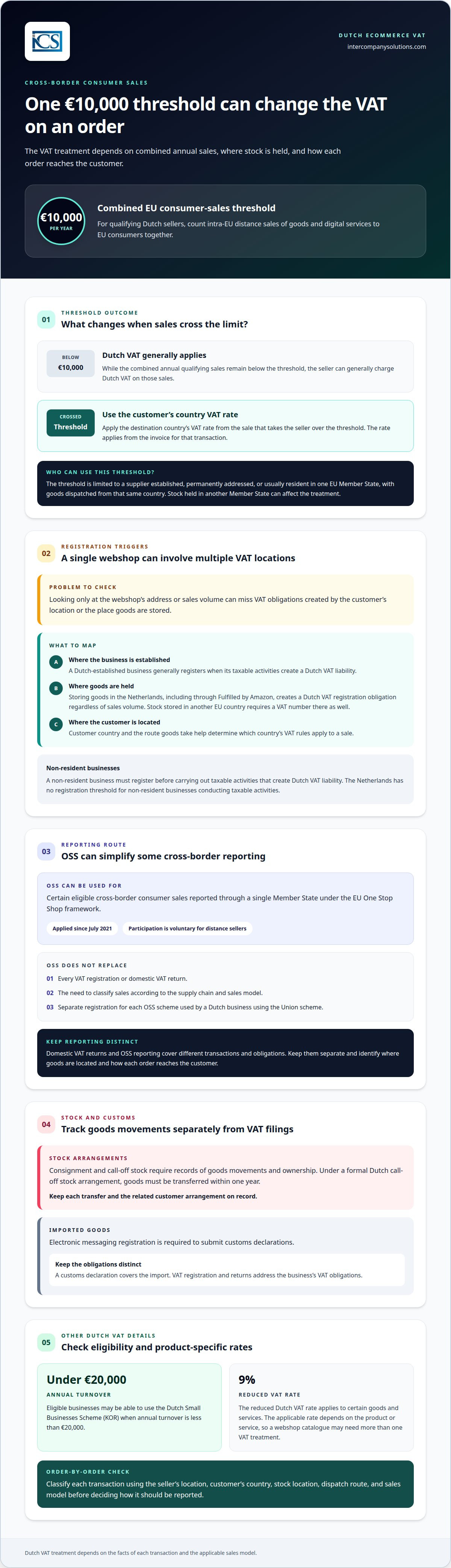
One EU sales threshold can change the VAT treatment of a Dutch webshop’s next order. A Dutch seller can generally charge Dutch VAT while its combined annual intra-EU distance sales and digital services to EU consumers remain below €10,000. Once it crosses that threshold, it must charge the customer’s country VAT rate from the sale that takes it over. EU VAT compliance for a Dutch ecommerce company also depends on where stock is held and how goods are shipped.
That means VAT treatment can vary from order to order, even within the same webshop. Returns, marketplace sales, and payment-provider records add another layer: each must reconcile with the figures reported in the relevant VAT return.
This article explains when Dutch VAT registration is required, how OSS and IOSS apply to different sales models, and which records and invoice details to maintain. It also shows how to reconcile sales, refunds, and returns so cross-border reporting reflects what actually happened.
Key Takeaways
- Map where your business, customers, and inventory are located to identify where VAT registration may apply.
- Assess whether OSS fits your cross-border consumer sales, while keeping domestic VAT reporting separate.
- For eligible imported consignments valued below €150, IOSS can bring VAT reporting into a monthly return.
- Keep VAT records for 7 years and retain invoice details that support how each sale was taxed.
- Reconcile webshop, marketplace, and payment-provider data with refunds and returns before filing VAT returns.
Table of Contents
- Dutch VAT registration for domestic and non-resident businesses
- EU cross-border distance-sale threshold and OSS
- Invoice details, tax points, and record retention
- Monthly VAT reporting and payment through IOSS
- Reconciliation of webshop, marketplace, and payment-provider sales with VAT returns
- Intercompany Solutions: Dutch BV Company Formation
Dutch VAT registration for domestic and non-resident businesses
VAT registration depends on where the seller is established, where the customer is located, and where goods are stored. These factors also determine which country’s VAT returns and reporting rules apply.
A Dutch-established ecommerce business generally registers when its taxable activities create a Dutch VAT liability. A non-resident business must register before carrying out taxable activities that create Dutch VAT liability. The Netherlands has no registration threshold for non-resident businesses conducting taxable activities, so low sales volume does not remove that obligation.
For eligible businesses, the Dutch Small Businesses Scheme, or KOR, may apply when annual turnover is less than €20,000. The Dutch Tax and Customs Administration states that the reduced VAT rate in the Netherlands is 9% for certain goods and services. The applicable rate depends on the product or service, so a webshop’s catalogue may require more than one VAT treatment.
Where inventory is held can create a separate registration obligation. A business storing goods in the Netherlands, including through Fulfilled by Amazon, must register for Dutch VAT regardless of sales volume. If it also stores stock in another EU country, it needs a VAT number there as well. An EU ecommerce company may therefore need several registrations, even when customers order through a single webshop.
Consignment and call-off stock arrangements require careful tracking of goods movements and ownership. Under a formal Dutch call-off stock arrangement, the goods must be transferred within one year. Record each transfer and the related customer arrangement to distinguish a qualifying arrangement from ordinary stock held in the Netherlands.
Customs procedures add a separate administrative step for imported goods. Electronic messaging registration is required to submit customs declarations. Keep this separate from VAT registration: a customs declaration covers the import, while VAT registration and returns address the business’s tax obligations. For businesses coordinating international supply chains and North American freight movement, freight forwarding providers like dubointl.com assist with moving cargo efficiently alongside required shipping paperwork.
OSS Registration and Reporting
The One Stop Shop (OSS) is an EU framework that lets eligible businesses report certain cross-border consumer sales through a single Member State. It has applied since July 2021, and participation is voluntary for distance sellers. A Dutch business using the OSS Union scheme must register separately for each OSS scheme it uses.
OSS can simplify reporting, but it does not replace every VAT registration or domestic return. Whether it applies depends on the supply chain and sales model. Before deciding which sales belong in an OSS return, identify where the goods are located and how each order reaches the customer.
VAT on Digital Products and Services
Dutch ecommerce companies selling digital products or services to EU consumers must consider the combined annual €10,000 threshold for intra-EU distance sales and digital services. A qualifying Dutch seller can generally charge Dutch VAT while those combined sales remain below the threshold. Once crossed, the seller must apply the consumer’s country VAT rate from the sale that takes it over.
The threshold applies only to suppliers established, permanently addressed, or usually resident in one EU country, with goods dispatched from that country. For digital sales, track consumer transactions alongside distance sales of goods. This helps determine when destination-country VAT applies and whether OSS reporting is relevant.
After registration, Dutch VAT returns must be filed electronically through the Belastingdienst portal. A non-resident business conducting taxable activities in the Netherlands does not have to appoint a fiscal representative for VAT registration. Keep domestic returns separate from OSS reporting because they cover different transactions and obligations.
EU cross-border distance-sale threshold and OSS
For eligible Dutch sellers, the EU-wide threshold determines when consumer sales shift from Dutch VAT to destination-country VAT. OSS can simplify reporting, but its scope depends on the transaction and supply chain.
Distance-Selling Rules Before July 2021
Before 1 July 2021, distance sellers generally had to register for VAT in a customer’s country when annual sales there exceeded €35,000, although some countries set higher thresholds. This country-by-country system meant an online seller could face different registration points across the EU. Knowing the former rule helps explain why the current framework uses a shared threshold, rather than separate national sales limits for eligible sellers.
The EU-Wide Distance-Sales Threshold
The current threshold is €10,000 per year for a qualifying supplier’s combined intra-EU distance sales of goods and digital services to EU consumers. A Dutch seller below it can generally charge Dutch VAT on those sales. Once the seller crosses it, the destination country’s VAT rate applies from the invoice for the transaction that takes the seller over the threshold.
This threshold is available only to a supplier established, permanently addressed, or usually resident in one EU Member State, with goods dispatched from that same country. A Dutch business holding stock in another Member State should not assume the threshold applies to sales dispatched from there. The place of establishment, stock location, dispatch route, and customer’s country all affect how a transaction is treated.
Cross-Border Supplies and Distance Sales
Distance sales to consumers and other cross-border supplies are different categories. For example, a Dutch webshop shipping goods to a private customer in another EU country must assess the distance-sale rules. A business-to-business sale must be classified separately, based on the customer’s status and the transaction details. This distinction matters because OSS does not cover every EU sale or remove every registration obligation.
The One Stop Shop (OSS) provides a way to report eligible cross-border consumer sales through one Member State. The EU scheme has applied since July 2021, and participation is voluntary for distance sellers. A Dutch seller using the Union scheme files a quarterly OSS return for relevant sales across participating EU countries.
OSS reporting sits alongside, rather than replacing, the seller’s usual Dutch VAT return. Dutch turnover remains in the domestic return, while eligible cross-border transactions are reported through OSS. The seller must register separately for each OSS scheme it uses. Before assigning orders to a return, classify them by customer, destination, goods location, and shipping route.
For a Dutch seller approaching the threshold, review combined annual sales of goods and digital services to EU consumers, not just orders from one destination. Identify the transaction that crosses €10,000 and apply destination-country VAT from that invoice. If stock is held in another Member State, assess those sales separately because the threshold’s eligibility conditions may not fit that supply chain.
Invoice details, tax points, and record retention
Accurate invoicing links each ecommerce order to its VAT treatment, payment, and return. For a Dutch business selling across a border, retain enough information to identify the customer, transaction, applicable rate, and supply date. Other EU countries may require specific invoice details, languages, or reporting formats, so one template may not fit every Member State.
For goods supplied in the Netherlands, the tax point is when the goods are delivered or the invoice is issued, whichever comes first. For services, it is the earlier of invoice issuance or completion. These dates determine the VAT period for the transaction. For example, if a webshop issues an invoice before dispatch, the invoice date may set the tax point for the goods.
Invoice timing also matters. A Dutch invoice for a service must generally be issued no later than the 15th day following the month in which the service is supplied. A single invoice may cover multiple services supplied to the same recipient for no more than one calendar month. If a customer makes a prepayment, issue the invoice before that prepayment becomes due.
In the Netherlands, electronic invoices require the recipient’s approval. Approval may be inferred if the recipient processes and pays an invoice without comment. For a batch sent to the same recipient, shared details may appear once if all the information remains accessible for each invoice. Keep individual invoices identifiable even when the system groups common data.
For Dutch VAT records, use this retention rule: records retained 7 years (10 for immovable property). Preserve invoices alongside order confirmations, credit notes, payment records, and evidence of delivery or service completion. That trail helps explain why the amount reported differs from the original order when a return, refund, or adjustment occurs.
Dutch mandatory B2B e-invoicing and digital reporting require attention to system readiness. The Dutch government has announced plans for mandatory e-invoicing and digital reporting, including near-immediate invoice-data reporting for covered intra-EU B2B transactions. Separate that planned framework from current invoice processes. Prepare ERP and ecommerce systems to retain structured invoice fields, tax-point dates, customer data, VAT rates, and correction links.
Before filing, check that the ERP export preserves the original invoice number and links each credit note to its source invoice. Confirm that order, dispatch, and invoice dates remain distinct, and that refunds are recorded. A clear data trail makes it easier to explain timing differences and reconcile invoice totals with VAT returns across countries.
Monthly VAT reporting and payment through IOSS
For imports, exports, and IOSS shipments, classify each transaction by origin, destination, customer, and consignment value. VAT is due when goods enter the EU; IOSS can change when VAT is collected for eligible shipments, while exports and domestic sales have their own reporting treatment.
Transactions Reported Through OSS and IOSS
OSS and IOSS cover different transaction types, so a Dutch seller should not combine their figures into one return. The OSS Union scheme covers eligible cross-border consumer sales, while IOSS covers distance sales of imported goods in consignments valued below €150. Sorting orders by dispatch location and customer destination helps assign each sale to the correct reporting route.
A business using the OSS Import scheme files its OSS VAT return monthly. Under IOSS, VAT due on eligible shipments can be reported monthly and paid in a single payment. Include the IOSS number in customs declarations submitted through DECO or DMS.
For qualifying shipments from outside the EU, IOSS means VAT is not paid at import. Without IOSS, import VAT is paid in the destination country. For a shipment worth more than €150, IOSS cannot be used, and import duties and import VAT are payable where the goods enter the EU.
VAT Bookkeeping and Reporting Systems
OSS does not replace the Dutch VAT return or accurate bookkeeping. A Dutch seller using OSS still reports domestic turnover through its usual Dutch return, while eligible cross-border consumer sales go into the applicable OSS return. Keep the reporting totals separate to avoid reporting the same sale twice.
Set up ecommerce and accounting records to preserve the transaction-level details required for each reporting route. Capture the customer type, dispatch and destination countries, goods value, VAT charged, and whether the transaction used OSS or IOSS. Link refunds and cancellations to the original order so each VAT adjustment can be traced.
Domestic Dutch VAT returns are usually filed quarterly, though monthly filing may apply based on turnover or upon request. Dutch businesses also submit monthly EC Sales Lists for intra-EU B2B supplies of goods and certain services. These lists are separate from OSS returns, so classify B2B transactions separately from consumer orders.
Before submitting a monthly IOSS return, reconcile eligible orders with customs declarations and payments collected. Compare the IOSS number, consignment value, destination, and VAT amount for each shipment. Keep import and export records separate from EU consumer sales to explain how each transaction was treated and reported.
Reconciliation of webshop, marketplace, and payment-provider sales with VAT returns
Before each VAT filing, reconcile sales across the webshop, marketplace, and payment provider. Compare transaction totals for the same reporting period, then account for refunds and returns.
Marketplace Sales, Refunds, and Returns
Marketplace statements, webshop orders, and payment-provider settlements record different stages of a sale. Match each order to its payment, VAT treatment, and any subsequent refund. A payout may be below gross sales because it includes refunds or other adjustments, so reconcile the underlying transactions rather than using the payout as the VAT figure.
Record each return or refund against its original order and retain the related credit note. For example, if a customer returns one item from a multi-item order, adjust the sales value and VAT for that item, not the entire order. This keeps the original sale and its correction traceable in the relevant VAT period.
Start by matching order references across the sales channel, payment record, and accounting ledger. Then compare gross sales, VAT charged, refunds, cancellations, and net settlements. Investigate differences before filing: a payment settlement date may fall in a different period from the invoice or supply date, and these dates are not interchangeable.
Keep marketplace sales identifiable by channel and transaction. This helps distinguish sales reported through a marketplace from direct webshop orders. It also supports consistent treatment when a marketplace processes a refund after the original sale has already been included in a VAT return.
OSS and Local VAT Returns
The OSS Union scheme reports eligible cross-border consumer sales, while the Dutch VAT return covers domestic turnover and other transactions that belong in that return. A Dutch seller using OSS must submit both reports when required. Separate transaction lists help prevent cross-border sales from being reported twice or left out of the appropriate filing.
Dutch VAT returns are usually filed quarterly, although monthly filing may apply based on turnover or by request. Monthly and quarterly returns are due by the last day of the month following the reporting period. Match ledger totals to the relevant return before filing, and keep OSS Union scheme figures separate from Dutch return totals.
If a business discovers that an incorrect or incomplete Dutch VAT return caused an underpayment, it must report the error to the Dutch tax authorities as soon as possible. Late filing may lead to penalties. Inaccurate returns may carry a penalty of up to €5,278 for careless errors, or up to 100% of VAT due in cases of fraud.
Use a period-end reconciliation record to show how source data became reported figures. Keep marketplace statements, payment records, return adjustments, and submitted VAT returns together. This makes it easier to explain differences between the checkout total, settlement amount, and taxable sales reported.
Intercompany Solutions: Dutch BV Company Formation
Intercompany Solutions helps foreign entrepreneurs establish a Dutch BV, including company registration and VAT applications. This can be a practical next step when setting up a Dutch entity and coordinating its formation with ecommerce compliance requirements.
After launch, ecommerce accounting can help organize webshop transactions, refunds, and VAT reporting. A Dutch BV does not remove the need to assess where stock is held, which VAT schemes apply, or what each return must include. Those obligations still depend on the business’s sales and supply chain.
For help with Dutch BV formation or ecommerce accounting, contact Intercompany Solutions.
Build VAT controls that can scale with your business
When your sales channels, product range, or stock locations change, review whether your VAT processes still reflect how orders are fulfilled. A new marketplace or warehouse can affect registration, transaction classification, and the records needed to support a return. Treat each operational change as a prompt to review your accounting workflow, rather than waiting for a filing discrepancy to expose a gap.
Reliable EU VAT compliance for a Dutch ecommerce company depends on connecting tax decisions to actual order data. Intercompany Solutions supports the wider business setup with Dutch BV Company Formation, Accounting & Tax Services, and Secretarial Services. These services can help when establishing a Dutch entity or managing its ongoing corporate and tax administration.
Choose a practical next step by identifying what your setup needs, whether that is establishing the company or strengthening its ongoing administration. Clear processes give your business a sound basis for managing future growth.
Frequently Asked Questions
For a business, VAT controls need to follow the actual route of each order. A sale fulfilled from a Dutch warehouse may need different records from one dispatched by a fulfilment centre in another country. Use the order record to connect the customer, dispatch location, invoice, payment, and any later adjustment. The Dutch Tax and Customs Administration’s VAT administration guidance explains the records businesses must maintain.
OSS is available to businesses making transactions covered by one of its schemes, with eligibility depending on the seller’s establishment and supply model. A Dutch seller should distinguish sales made from Dutch stock from sales involving stock held elsewhere. The European Commission’s OSS scheme guidance describes the schemes and their scope. This distinction helps determine whether OSS is relevant to the business’s cross-border consumer sales.
The schemes cover specified cross-border consumer transactions, not every sale recorded by an ecommerce platform. For example, a seller should classify a transaction involving goods dispatched from within the EU separately from an eligible sale of imported goods. The European Commission’s OSS overview sets out the scheme categories. Keep each order’s dispatch country, destination, and customer type available to support that classification.
For Dutch supplies, VAT rates 21%/9%/0% apply according to the product or transaction category. The Dutch Tax and Customs Administration states that the 9% rate applies to certain goods and services. Use its VAT rate guidance to assess the category before configuring product records. For cross-border sales, also identify the country whose VAT treatment applies to that transaction.
Registration is required when taxable activities create Dutch VAT liability. To apply, submit the appropriate registration form; the Dutch Tax and Customs Administration provides guidance on VAT registration. A non-resident business should distinguish Dutch taxable activities from sales taxed elsewhere. After registration, keep the VAT number connected to the legal entity and use it consistently on relevant invoices and tax records.
The assigned reporting frequency determines the relevant filing period, so use the schedule set for the business rather than assuming every seller files on the same cycle. Dutch returns are generally filed electronically, and the Dutch Tax and Customs Administration’s VAT return guidance explains filing and payment. Reconcile the return to the records for that period before submitting, including adjustments recorded after the original sale.
For a consumer order, determine where the goods are located before dispatch and where they are delivered. Those facts help establish which country’s VAT treatment applies and whether a local registration or a scheme return is relevant. A Dutch seller should also separate consumer sales from business-to-business supplies in its sales data. The European Commission’s OSS guidance outlines the framework for eligible cross-border consumer transactions.
Reconcile marketplace sales with webshop, payment-provider, refund, and return data before filing VAT returns. If goods are stored in the Netherlands through a service such as Fulfilled by Amazon, the seller must register for Dutch VAT regardless of sales volume; stock in another EU country can also require registration there.
Sources
- KVK - Registering with the Dutch Business Register
- Business.gov.nl - Private limited company (bv)
- Burgerlijk Wetboek Boek 2 (Dutch Civil Code, legal entities)
- Rijksoverheid - Ondernemen
- Belastingdienst - Corporate income tax rates
- Belastingdienst - VAT (btw) for entrepreneurs
- European Commission - VAT rules and rates
- RVO - Doing business internationally
- Belastingdienst Douane - Customs
- CJEU, Cadbury Schweppes, C-196/04 (ECLI:EU:C:2006:544)
- Hoge Raad, ECLI:NL:HR:2021:1152
- PwC Worldwide Tax Summaries - Netherlands
- ICLG - Corporate Governance Laws and Regulations, Netherlands
Need more information on the Dutch BV company?
Contact an expertReady to start your company in the Netherlands?
| Formation time | Dutch BV formation completed in 3 to 5 business days |
|---|---|
| Process | Fully remote setup with step-by-step guidance |
| Compliance | Expert support for registration, VAT and compliance |
| Aftercare | Accounting, tax and legal support included |
| One partner | All of the above through one trusted formation partner |