


August 31, 2026 · 17 min read
Maintaining a Dutch holding company can legally eliminate corporate income tax on qualifying international dividends and capital gains. This statutory mechanism is a cornerstone of the Netherlands' fiscal policy, designed specifically to prevent double taxation within corporate groups. For international entrepreneurs, the Dutch participation exemption provides a clear path to fiscal efficiency, provided the structure adheres to the 5% nominal paid-up capital threshold. It's a precise regulatory framework that rewards economic substance and transparency rather than acting as a mere tax loophole.
Managing international tax compliance is increasingly complex, especially with the introduction of EU anti-abuse directives and the 24.5% interest deduction cap. This guide offers a technical overview of the current rules for 2026, including the application of the 19% and 25.8% corporate income tax brackets. We'll examine the statutory requirements for the "motive" and "asset" tests, explain how the exemption applies to various benefits, and detail the legalized Power of Attorney route for forming a remote Dutch BV. Intercompany Solutions facilitates these formations and provides ongoing accounting and tax services to ensure your holding company meets all Belastingdienst standards from the outset.
Key Takeaways
- Learn how the Dutch participation exemption prevents double taxation on dividends and capital gains by exempting qualifying profits from corporate income tax.
- Understand the 5% minimum shareholding threshold and the specific asset and motive tests required to maintain tax-exempt status in 2026.
- Identify the structural advantages of a Dutch holding, including access to over 100 tax treaties and the 19% CIT rate for profits up to €200,000.
- Follow the legalized Power of Attorney route for remote BV formation, allowing international founders to establish a company in 3 to 5 business days without travel.
- Ensure long-term compliance by adhering to the 7-year record retention rule and filing annual accounts with the KVK within 12 months of year-end.
Table of Contents
Understanding the Dutch Participation Exemption Mechanism
The Dutch participation exemption (deelnemingsvrijstelling) serves as a primary structural element of the Dutch corporate tax system. Its fundamental purpose is to ensure that corporate profits are taxed only once within a group. Without this exemption, a parent company would pay tax on the same income already taxed at the subsidiary level, creating a prohibitive tax burden that discourages international expansion. By removing this layer of taxation, the Netherlands remains a preferred jurisdiction for global holding structures. Entrepreneurs often utilize Dutch BV company formation to establish these holdings, benefiting from a tax environment that supports long-term growth.
Elimination of Double Corporate Taxation
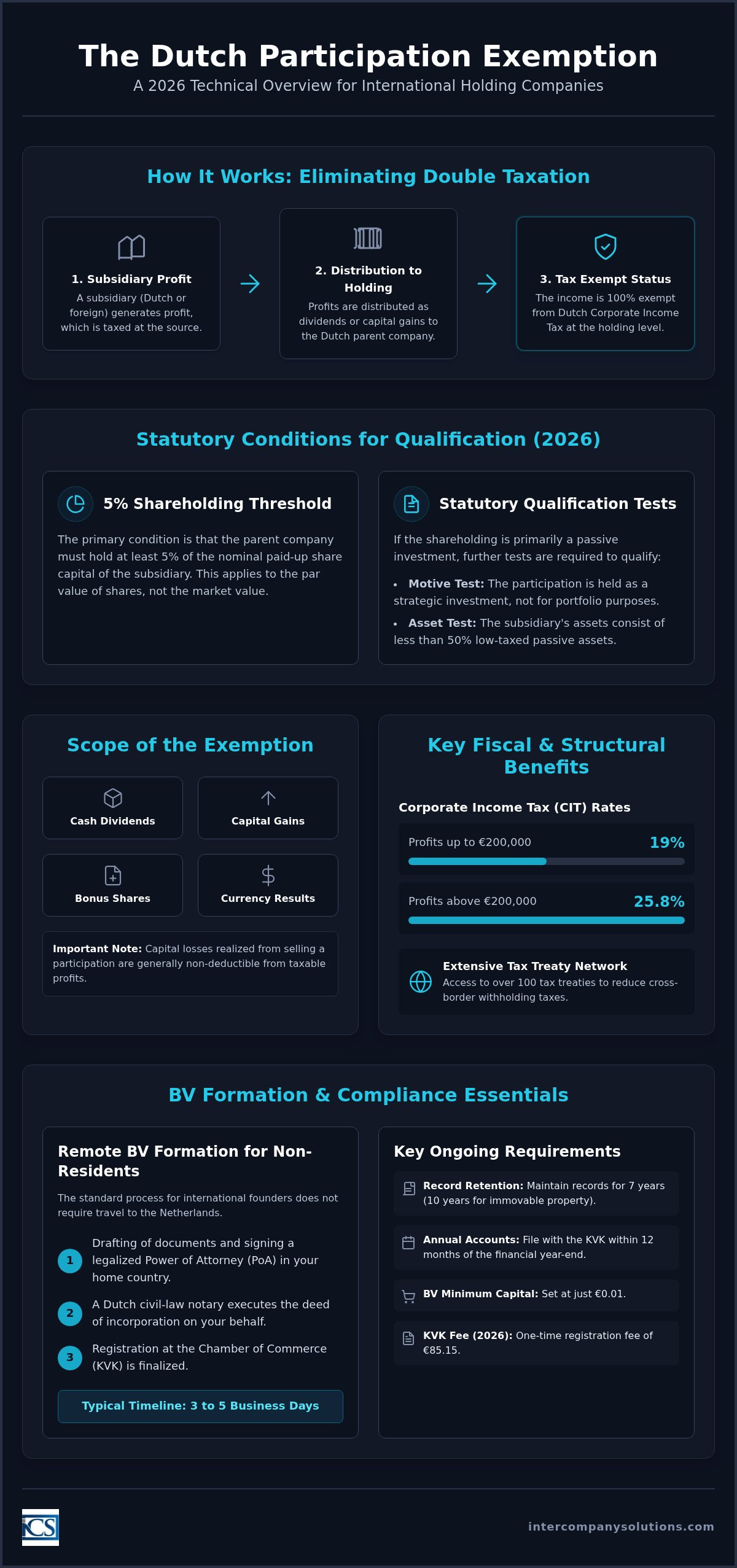
The exemption applies when a Dutch parent company receives profits from a subsidiary. If the subsidiary has already been subject to corporate income tax on its earnings, those same profits remain exempt when distributed to the Dutch holding. This rule applies regardless of whether the subsidiary is located in the Netherlands or abroad. In domestic scenarios, it prevents a chain of Dutch BVs from paying multiple rounds of CIT (19% for profits up to €200,000 and 25.8% for amounts above) on the same revenue stream. Internationally, it allows Dutch entities to repatriate foreign profits without additional local tax friction, provided the statutory conditions are met. It's essential for businesses engaged in cross-border trade, as this neutrality allows capital to flow freely back to the parent entity for reinvestment.
Dividends vs. Capital Gains Treatment
The exemption's scope is broad, covering several types of income protected from corporate tax:
- Cash Dividends: Regular profit distributions from the subsidiary.
- Bonus Shares: Additional shares issued to the parent company.
- Capital Gains: Profits realized when selling the participation.
- Currency Results: Gains or losses resulting from exchange rate fluctuations regarding the participation.
This 100% exemption ensures that the Dutch holding receives the full value of its investments. However, this statutory benefit comes with a specific limitation: capital losses are generally not deductible. If a parent company sells shares at a loss, that loss cannot be used to offset other taxable profits. An exception exists for liquidation losses, which may be deductible under strict conditions when a subsidiary is formally dissolved. Maintaining accurate records is vital for these calculations; Dutch law requires entities to retain corporate documentation for at least 7 years. Our Accounting & Tax Services help founders track these participations to ensure every distribution is correctly categorized under the Dutch participation exemption rules.
Statutory Conditions for Qualifying Participations in 2026
To qualify for the Dutch participation exemption, a parent company must satisfy several cumulative and alternative requirements. These rules ensure the exemption applies to genuine business participations rather than passive investment vehicles. The subsidiary must have its capital divided into shares, which includes the Dutch BV and NV, as well as foreign entities that meet similar legal criteria. If these conditions aren't met, distributions are taxed at the standard CIT rates of 19% for profits up to €200,000 and 25.8% for amounts above.
The 5% Shareholding Threshold
The parent company must hold at least 5% of the nominal paid-up share capital of the subsidiary. This threshold applies to the par value of the shares rather than their market value. In the context of a Dutch BV formation, where the minimum capital is €0.01, this 5% rule is straightforward for founders holding a majority stake. The requirement also extends to various share classes, including those with limited voting rights, provided they represent 5% of the nominal capital. While smaller holdings usually don't qualify, certain aggregation rules may apply if a related entity also holds shares in the same subsidiary, allowing the group to meet the threshold collectively.
The Three Alternative Qualification Tests
If a participation is considered a portfolio investment, meaning it's held primarily for passive returns, it must pass one of three tests to qualify for the Dutch participation exemption. These tests prevent the use of the Netherlands as a conduit for untaxed passive income. If you're unsure whether your international structure meets these specific requirements, you can request a technical assessment from our tax specialists.
- Motive Test: The parent company must demonstrate that the participation isn't held merely as a passive portfolio investment. If the holding company plays an active role in management or policy-making for the subsidiary, it typically satisfies this requirement.
- Asset Test: This test verifies that less than 50% of the subsidiary's assets consist of low-taxed passive investments. If the subsidiary is an active trading company, it generally passes this test regardless of the parent's motive.
- Subject-to-Tax Test: For passive participations that fail the first two tests, the subsidiary must be subject to a realistic profit tax in its home jurisdiction. According to Dutch standards, this tax must be at least 10% on a base similar to Dutch CIT rules.
Compliance with these tests is mandatory to maintain the tax-free status of dividends. Additionally, companies must monitor the interest deduction cap, which is limited to 24.5% of the company's EBITDA in 2026. This cap ensures that while dividends may be exempt, the financing of such participations remains within regulatory limits.
Last reviewed: August 2026
Strategic Benefits of a Dutch Holding Company Structure
The Dutch holding structure provides a stable framework for global asset management, supported by a network of approximately 100 double-taxation treaties. These treaties significantly reduce or eliminate withholding taxes on dividends, interest, and royalties flowing into the Netherlands. Unlike many other jurisdictions, the Netherlands abolished capital tax on share issuance in 2006. This policy lowers the entry cost for founders establishing a corporate group. For entities with diverse revenue streams, the 2026 corporate income tax (CIT) rate of 19% on profits up to €200,000 offers a competitive environment for managing group operations. There's also a general absence of Dutch withholding tax on outgoing interest and royalty payments, provided the recipient is not located in a designated low-tax jurisdiction.
Tax Efficiency for International Trade
Pooling international profits at the parent level without incurring additional tax liabilities is a primary advantage of this structure. Direct ownership by an individual often triggers immediate dividend withholding taxes in the subsidiary's country. A Dutch holding company avoids this by using the Dutch participation exemption to receive these funds tax-free. This mechanism facilitates the seamless repatriation and reinvestment of global earnings. For entrepreneurs seeking a remote setup, the Netherlands company formation process can be completed via a legalized Power of Attorney. This allows foreign founders to establish a compliant holding structure without physical travel.
Innovation and R&D Incentives
The Netherlands actively encourages high-value business activities through specific fiscal incentives that complement the holding structure. The Innovation Box allows companies to benefit from a reduced CIT rate of 9% on profits derived from qualifying intellectual property. This creates a functional link when combined with the Dutch participation exemption; capital gains from the sale of a tech subsidiary remain exempt at the parent level. Also, the 30% tax reimbursement ruling helps holdings attract international talent by allowing employers to provide a tax-free allowance for extraterritorial costs. The country's commitment to these standards is reflected in its 8th-place ranking in the 2025 Global Innovation Index. These factors, combined with the fact that Rabobank has served as the Belastingdienst house bank since 1 May 2026, provide a reliable financial infrastructure for international holdings.
Administrative and Compliance Requirements for Tax-Exempt Entities
Maintaining a Dutch holding company requires strict adherence to local reporting standards. While the Dutch participation exemption removes the tax liability on qualifying income, it doesn't remove the obligation to report that income correctly. Directors must ensure that annual accounts are filed with the KVK within 12 months of the financial year-end. Failure to meet this deadline can lead to personal liability for directors in the event of bankruptcy. Additionally, all corporate records, including participation data and transaction history, must be retained for at least 7 years. For immovable property, this requirement extends to 10 years. It's also vital to note that the Belastingdienst house bank is Rabobank since 1 May 2026, which impacts how tax payments and refunds are processed.
Corporate Income Tax (CIT) Filing Obligations
Entities benefiting from the Dutch participation exemption must still file an annual CIT return. This return must precisely detail exempt dividends and capital gains to ensure they aren't inadvertently included in the taxable base. For 2026, the CIT rates are 19% on profits up to €200,000 and 25.8% for any profits exceeding this threshold. Even if all income is exempt, the filing serves as a formal declaration of the company's fiscal position. Accurate accounting is the only way to avoid disputes with the tax authorities regarding the qualification of specific participations. This level of oversight ensures the integrity of the Dutch corporate system for all entrepreneurs starting a business in the Netherlands.
UBO and Transparency Compliance
All Dutch BV and NV entities must register their Ultimate Beneficial Owners (UBOs) in the national register maintained by the KVK. A UBO is defined as any individual holding more than 25% of the shares, voting rights, or ownership interest. Any changes to UBO information must be reported within 7 days to remain compliant. Transparency is a priority for the Dutch authorities, and non-compliance with UBO or KVK filing standards can result in significant fines or criminal sanctions. These regulations are designed to prevent the misuse of corporate structures while maintaining a clear and stable environment for legitimate international holdings.
Establishing a Tax-Efficient Dutch BV from Abroad
International entrepreneurs can establish a Dutch holding company without the requirement for physical travel to the Netherlands. This remote setup is particularly advantageous for founders intending to utilize the Dutch participation exemption for global profit management. The Dutch BV remains the primary vehicle for these structures due to its flexibility and the minimum share capital requirement of only €0.01. Once the necessary documentation is finalized and legalized, the incorporation process at the Dutch Chamber of Commerce (KVK) typically takes between 3 and 5 business days. Intercompany Solutions manages the full formation process, ensuring all statutory requirements are met to facilitate a smooth entry into the Dutch fiscal system.
The Legalized Power of Attorney (PoA) Route
The standard procedure for non-EU founders is the legalized Power of Attorney route. This process allows a Dutch notary to execute the deed of incorporation on behalf of the founder. The procedure begins with the preparation of the draft Articles of Association and the PoA document. The founder must then sign these documents in their home country in the presence of a local notary. To be recognized by Dutch authorities, these signed documents require legalization, usually via an Apostille or through a Dutch embassy, depending on the founder's country of residence. A local business address in the Netherlands is mandatory for KVK registration and subsequent VAT applications. This address serves as the official seat of the company where all legal and tax correspondence is received.
Post-Incorporation Steps for Holding Companies
After the notary executes the deed and the company is registered with the KVK (subject to a one-time fee of €85.15 in 2026), several administrative steps follow. Applying for a VAT number is a priority; for foreign-owned entities, this process typically takes 6 to 8 weeks. While a holding company may not always engage in VAT-taxable activities, a VAT registration is often necessary for group transactions and administrative compliance. Opening a corporate bank account is the next critical step. While international entrepreneurs often face strict "Know Your Customer" (KYC) protocols, Intercompany Solutions provides assistance in preparing the required business plans and documentation for banking applications.
For those starting a business in the Netherlands, aligning these formation steps with long-term tax planning is essential. This includes preparing for the 19% CIT rate on profits up to €200,000 and ensuring that Rabobank, which has served as the Belastingdienst house bank since 1 May 2026, is correctly integrated into the company's financial workflows. By following this structured approach, founders can ensure their holding company is fully compliant and ready to apply the Dutch participation exemption to its international subsidiaries.
Last reviewed: August 2026
Implementing a Tax-Efficient Holding Strategy for 2026
Establishing a holding company in the Netherlands provides a robust foundation for international tax planning. By meeting the 5% ownership threshold and the motive or asset tests, your business can fully utilize the Dutch participation exemption to eliminate double taxation on corporate profits. This statutory benefit ensures that dividends and capital gains are repatriated with maximum efficiency, allowing for reinvestment under the 19% CIT rate for profits up to €200,000.
Intercompany Solutions has specialized in foreign entrepreneurship since 2015, facilitating remote formation in 3 to 5 business days. Our team provides full VAT and accounting compliance support to ensure your records meet the mandatory 7-year retention period and KVK filing requirements. Since 1 May 2026, the Belastingdienst has utilized Rabobank as its house bank; we help synchronize your financial operations with these current standards.
We look forward to assisting you in building a stable and compliant presence in the Dutch market.
Last reviewed: August 2026
Frequently Asked Questions
Does the Dutch participation exemption apply to foreign subsidiaries?
Yes, the Dutch participation exemption applies to both domestic and foreign subsidiaries, provided they meet the statutory requirements. The subsidiary must be subject to a realistic profit tax in its home jurisdiction or pass the motive and asset tests. This flexibility makes the Netherlands a global hub for international holdings. It's essential to verify that the subsidiary's legal form is comparable to a Dutch BV or NV to ensure the exemption remains valid.
What is the minimum shareholding required to qualify for the exemption?
To qualify for the exemption, the parent company must hold at least 5% of the nominal paid-up share capital of the subsidiary. This requirement applies to both the par value of the shares and the voting rights in certain contexts. For a Dutch BV, which can be established with a minimum capital of €0.01, meeting this threshold is typically straightforward for most founders. Smaller holdings generally don't qualify unless specific aggregation rules for group entities apply.
Are capital losses on the sale of a subsidiary tax-deductible in the Netherlands?
Capital losses resulting from the sale or disposal of a qualifying participation are generally not tax-deductible in the Netherlands. This is the corollary to the fact that capital gains are 100% exempt from corporate income tax. However, a significant exception exists for liquidation losses. If a subsidiary is formally dissolved and liquidated, the resulting loss may be deductible under strict conditions. Proper documentation must be retained for at least 7 years to support such claims.
How does the 'motive test' affect my Dutch holding company?
The motive test determines whether a participation is held as a passive portfolio investment. If the holding company's primary intent is to generate a return similar to a regular bank deposit or stock market investment, the exemption may be denied. However, if the holding company actively manages the subsidiary or plays a role in its business policy, it passes the test. This ensures the structure reflects genuine economic activity rather than just tax-driven passive ownership.
Can I claim the participation exemption if my subsidiary is located in a low-tax jurisdiction?
You can still claim the exemption for a subsidiary in a low-tax jurisdiction if it passes the asset test. This test requires that less than 50% of the subsidiary's assets consist of low-taxed passive investments. If the subsidiary is an active trading or manufacturing company, the local tax rate is usually irrelevant for the Dutch participation exemption. If it fails the asset test, the subsidiary must be subject to a realistic tax of at least 10% locally.
Is there a minimum holding period required for the participation exemption?
There's no statutory minimum holding period required to benefit from the exemption. As long as you hold at least 5% of the nominal share capital at the time the dividend is distributed or the capital gain is realized, the exemption applies. This provides significant flexibility for corporate restructuring or the sale of assets. However, you must still meet the other statutory conditions, such as the motive or asset tests, regardless of how long the shares were held.
Do I need a physical office in the Netherlands to qualify for the tax exemption?
You don't need a dedicated physical office, but you must have a registered business address in the Netherlands. This address is necessary for KVK registration and VAT applications. To ensure the tax authorities recognize the holding's residency, the company should demonstrate sufficient substance. This often involves having local directors and making key management decisions within the country. Intercompany Solutions helps founders establish these structures remotely via the legalized Power of Attorney route while ensuring compliance.
Sources
- KVK - Registering with the Dutch Business Register
- Business.gov.nl - Private limited company (bv)
- Burgerlijk Wetboek Boek 2 (Dutch Civil Code, legal entities)
- Rijksoverheid - Ondernemen
- Belastingdienst - Corporate income tax rates
- Belastingdienst - VAT (btw) for entrepreneurs
- European Commission - VAT rules and rates
- De Nederlandsche Bank - Supervision
- AFM - Licences and registers
- BOIP - Trademark registration in Benelux
- WIPO - Madrid System
- RVO - Doing business internationally
- Belastingdienst Douane - Customs
- CJEU, Cadbury Schweppes, C-196/04 (ECLI:EU:C:2006:544)
- Hoge Raad, ECLI:NL:HR:2021:1152
- PwC Worldwide Tax Summaries - Netherlands
- ICLG - Corporate Governance Laws and Regulations, Netherlands
Need more information on the Dutch BV company?
Contact an expertReady to start your company in the Netherlands?
| Formation time | Dutch BV formation completed in 3 to 5 business days |
|---|---|
| Process | Fully remote setup with step-by-step guidance |
| Compliance | Expert support for registration, VAT and compliance |
| Aftercare | Accounting, tax and legal support included |
| One partner | All of the above through one trusted formation partner |