

September 10, 2026 · 17 min read
Selecting a provider based strictly on price often results in significant administrative friction and unexpected expenses during the legalization process. While searching through Dutch incorporation service for non-residents reviews, you'll find that the most successful setups prioritize procedural transparency over the lowest initial fee. It's common to feel anxious about managing the 2026 UBO regulations or the requirement to report ownership changes within seven days. You want a fully registered BV with VAT and EORI numbers without the stress of hidden costs or document rejection.
This guide provides a technical analysis of the criteria necessary for selecting a reliable incorporation partner and details the regulatory landscape for 2026. You'll learn the precise steps for remote formation via the Power of Attorney route, which avoids the need for international travel. We cover the shift of the Belastingdienst house bank to Rabobank as of 1 May 2026 and the 19% corporate tax threshold for profits up to €200,000. By the end of this article, you'll have a clear roadmap for achieving a compliant Dutch presence with a full understanding of annual maintenance obligations.
Key Takeaways
- Understand the role of a specialized facilitator in managing document legalization and tax registration for non-resident entrepreneurs.
- Analyze Dutch incorporation service for non-residents reviews to evaluate provider experience with remote formation protocols and fee transparency.
- Contrast the legalized Power of Attorney (POA) route with digital incorporation to determine the most secure path for non-EU business owners.
- Review the 2026 financial thresholds, including the €0.01 BV share capital requirement and the mandatory €85.15 KVK registration fee.
- Prepare for ongoing compliance by understanding the 2026 corporate tax rates and the transition to Rabobank as the tax authority's house bank.
Table of Contents
The Role of Specialized Dutch Incorporation Services
An incorporation agent functions as the primary facilitator between the international entrepreneur and the Dutch civil law notary. While a notary is legally required to execute the deed of incorporation for a Besloten vennootschap (BV), they typically do not manage the preliminary administrative hurdles or post-incorporation tax registrations. Specialized firms fill this gap by managing the technical workflow, ensuring all documentation aligns with both Dutch law and the founder's commercial goals. When evaluating Dutch incorporation service for non-residents reviews, look for providers that demonstrate expertise in cross-border administrative protocols rather than just basic registration. You can find detailed support through a professional Dutch BV company formation partner.
Legal and Administrative Facilitation
The core of the service involves coordinating with the notary to draft and finalize the articles of association. These documents must be precise to avoid future compliance issues or delays at the Chamber of Commerce. The agent ensures the business is correctly registered with the Kamer van Koophandel (KVK), which requires a one-time fee of €85.15 in 2026. Beyond the initial filing, the agent oversees the collection of Know Your Customer (KYC) data to satisfy Anti-Money Laundering (AML) regulations. This includes identifying Ultimate Beneficial Owners (UBOs) who hold more than 25% of the shares or voting rights. Any changes to this UBO status must be reported to the KVK within 7 days to maintain compliance.
Non-Resident Specific Support
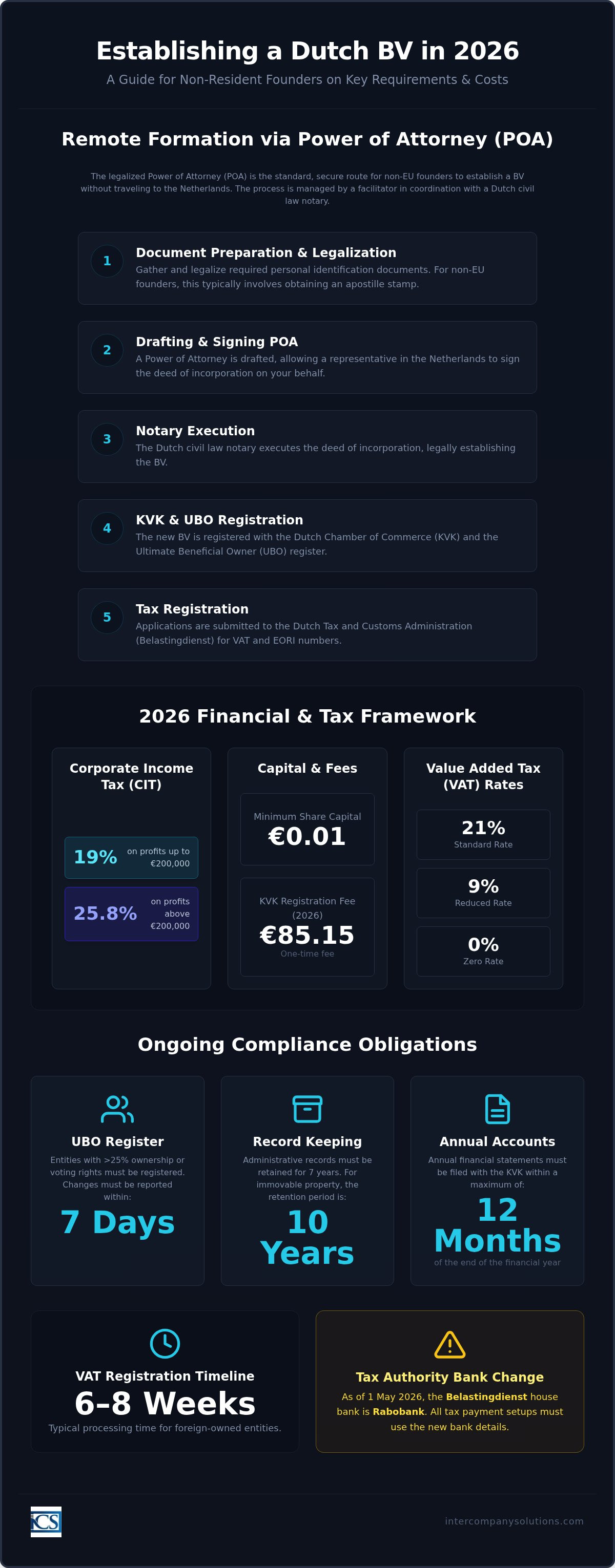
Non-resident founders face unique challenges, specifically regarding the legalization of foreign identification documents. A specialized service manages the apostille process and coordinates the legalized Power of Attorney (POA) route. This is the standard method for non-EU founders, allowing the notary to execute the deed without the founder traveling to the Netherlands. Once the BV is active, the agent coordinates with the Belastingdienst for VAT and EORI registrations. VAT applications for foreign-owned entities typically take 6 to 8 weeks. It is essential to recognize that as of 1 May 2026, the tax authority uses Rabobank as its house bank, so all initial tax payment setups must reflect this change to ensure successful processing.
For companies planning to relocate staff or hire international talent, specialized firms often provide guidance on the 30% tax reimbursement ruling. This fiscal incentive allows employers to provide a tax-free allowance of up to 30% of the gross salary to qualifying employees. Choosing a specialized firm over a general business consultant ensures that these specific, high-stakes tax and legal nuances are handled correctly from the first day of operations. This level of technical support is a common highlight in positive Dutch incorporation service for non-residents reviews from successful global entrepreneurs.
Evaluation Criteria for Non-Resident Incorporation Providers
Selecting a provider requires a technical assessment of their ability to manage complex cross-border scenarios. While many entrepreneurs rely on Dutch incorporation service for non-residents reviews, these testimonials should be evaluated for specific mentions of remote formation success. A provider's experience with non-EU founders is critical; the legalization of documents from abroad requires meticulous attention to detail to avoid delays. Transparency regarding the fee structure is another essential factor. A professional firm will provide a comprehensive breakdown that includes the notary fees and the 2026 Dutch Chamber of Commerce registration fee of €85.15.
Procedural Transparency and Speed
A reliable incorporation partner operates with a structured momentum. Standard remote BV formation typically takes between 3 and 5 business days once all legalized documents are received. You should prioritize firms that offer a 24-hour response time for international inquiries; this ensures that time zone differences don't stall your setup. A clear, step-by-step onboarding checklist is a hallmark of an efficient provider. It allows you to track the progress of your application from the initial document drafting to the final KVK filing. If you have specific questions about the timeline for your region, you can reach out to our specialists for a detailed assessment.
Post-Incorporation Compliance Capability
The registration of the BV is only the first step in maintaining a legal presence in the Netherlands. You must verify that the firm has the internal capacity to handle ongoing payroll and staffing or accounting services. Compliance in 2026 involves strict adherence to UBO regulations. Any changes to the Ultimate Beneficial Owner status must be reported within 7 days. Additionally, your provider should be prepared to handle Corporate Income Tax (CIT) filings, which are 19% for profits up to €200,000 and 25.8% for amounts exceeding that threshold.
Efficient firms also provide support for VAT applications, which usually take 6 to 8 weeks for foreign-owned entities. They will ensure your payment systems are updated to reflect that Rabobank is the Belastingdienst house bank as of 1 May 2026. Choosing a partner that offers a 100% satisfaction guarantee provides an additional layer of security for your investment. This commitment suggests that the firm values accuracy and legal integrity throughout the entire administrative lifecycle. By evaluating these technical benchmarks, you can move beyond surface-level Dutch incorporation service for non-residents reviews to find a truly capable partner.
Remote Formation Routes: POA vs. Digital Incorporation
The choice between remote formation routes depends on the founder's location and the complexity of the corporate structure. While researching Dutch incorporation service for non-residents reviews, you'll notice that the legalized Power of Attorney (POA) route is the most frequently cited method for successful remote setup. This route allows the Dutch notary to execute the deed of incorporation without the physical presence of the founder, provided the necessary documents are properly legalized abroad. Choosing the right route is a common topic in Dutch incorporation service for non-residents reviews, where founders highlight the importance of document accuracy.
The Legalized Power of Attorney Process
The POA process is a structured sequence that ensures legal integrity. First, the incorporation agent drafts the Power of Attorney in both Dutch and English. The founder must then sign this document in the presence of a local notary in their country of residence. This local notary verifies the identity of the signer and witnesses the signature. You can find more details on this procedure through our Dutch BV company formation services.
Following notarization, the document usually requires an apostille or further legalization by the local Ministry of Foreign Affairs or the Dutch embassy. This step confirms the authority of the local notary to the Dutch authorities. Once the original, legalized documents arrive in the Netherlands via courier, the Dutch notary executes the deed. This method is the standard for non-EU founders because it bypasses the technical and legal hurdles associated with cross-border digital identity verification.
Digital Incorporation Limitations for Non-Residents
Digital video incorporation is often discussed as a modern alternative, but it's not yet the default for non-resident founders. The primary barrier is the verification of foreign identification documents. Dutch notaries are bound by strict KYC (Know Your Customer) and AML (Anti-Money Laundering) regulations. Most digital platforms are optimized for Dutch or EU-based identification systems and may not support the high-security features of non-EU passports.
Technical requirements, such as specific electronic signature levels, can also lead to procedural friction. If the digital verification process fails, it often results in the founder having to restart the process via the POA route anyway. For non-resident entrepreneurs, the POA route remains the most reliable method to ensure a fully registered Dutch BV without the risk of technical rejection. It provides a clear, predictable path to obtaining a KVK number and initiating the mandatory registration with the tax authorities.
Regulatory Requirements and Costs for Dutch BVs in 2026
Establishing a Dutch BV in 2026 involves specific financial benchmarks and administrative fees that must be factored into your business plan. The minimum share capital is set at €0.01, allowing for a highly accessible entry point for international investors. Upon registration, the Dutch Chamber of Commerce (KVK) requires a one-time fee of €85.15. These figures are fixed for the 2026 fiscal year. Many entrepreneurs prioritize Dutch incorporation service for non-residents reviews that mention clear cost breakdowns, as this prevents unexpected expenses during the final stages of formation. For a comprehensive overview of the initial setup, you can review our guide on starting a business in the Netherlands.
Taxation and Filing Deadlines
The Netherlands maintains a competitive Corporate Income Tax (CIT) structure. For 2026, the CIT rate is 19% on taxable profits up to €200,000. Any profits exceeding this threshold are taxed at a rate of 25.8%. For foreign-owned entities, obtaining a VAT number typically takes between 6 and 8 weeks. The standard VAT rates are 21%, 9%, and 0%. It's essential to plan for this timeline if you intend to begin trading immediately. Compliance also requires the mandatory filing of annual accounts with the KVK within 12 months of the end of your financial year. Failing to meet this deadline can lead to administrative fines or personal liability for directors.
Banking and Financial Compliance
A significant change for 2026 is the transition of the Dutch Tax and Customs Administration (Belastingdienst) house bank. As of 1 May 2026, Rabobank serves as the primary bank for the tax authorities. All outgoing tax payments, including payroll and corporate tax, must be updated to reflect the new Rabobank IBANs to avoid processing errors. While the incorporation process is remote, you must maintain corporate records for a minimum of 7 years. This period extends to 10 years for records related to immovable property.
Compliance also extends to the Ultimate Beneficial Owner (UBO) register. A UBO is any individual who holds more than 25% of the shares, voting rights, or ownership interest in the BV. Under 2026 regulations, any change to your UBO status must be reported to the KVK within 7 days. This strict timeline is a recurring theme in Dutch incorporation service for non-residents reviews, highlighting the need for a proactive secretarial partner. While we do not provide banking services directly, assistance with applications at Dutch commercial banks or international neo-banks is a standard part of our support framework.
Selecting a Partner for Dutch BV Formation
The choice between a direct Dutch service provider and an international broker significantly impacts the long-term compliance of your BV. While brokers offer a wide range of jurisdictions, they often lack the direct accountability required for precise execution under Dutch law. When reading Dutch incorporation service for non-residents reviews, you'll find that entrepreneurs who work directly with a local firm experience fewer communication delays. A direct provider maintains immediate contact with the Dutch Chamber of Commerce (KVK) and the Belastingdienst, ensuring that your 2026 registration fee of €85.15 is processed correctly and that your UBO filings meet the strict seven-day reporting deadline.
Direct Expertise and Accountability
Direct coordination with Dutch authorities reduces the risk of administrative errors that can lead to fines. Specialized firms possess deep knowledge of Dutch business law, particularly for international trade and technology sectors where regulations are technical and frequently updated. You can find more about the specific procedural requirements in our guide to Dutch BV formation. This direct model ensures that your articles of association are drafted with precision, reflecting your specific business objectives while adhering to Dutch corporate standards.
Accountability is especially important when managing the transition to Rabobank as the Belastingdienst house bank as of 1 May 2026. A direct partner will ensure your accounting systems are configured to avoid payment failures. Professional Dutch incorporation service for non-residents reviews often highlight the peace of mind provided by a 100% satisfaction guarantee, which ensures the firm remains committed to your setup until the BV is fully active and compliant.
Comprehensive Business Support
A premium secretarial support package for the first year adds value by managing the mandatory filing of annual accounts with the KVK. This service ensures you meet all starting business in the Netherlands requirements without missing critical deadlines. Additionally, a partner with international tax expertise can help you understand the participation exemption. This fiscal rule is a cornerstone of the Dutch system, potentially exempting dividends and capital gains from corporate income tax when the BV holds at least 5% of the shares in a subsidiary.
If you plan to hire staff, integrating payroll services from the start simplifies your administrative burden. This includes managing the 30% tax reimbursement ruling for qualifying employees and ensuring compliance with Dutch labor laws. By selecting a partner that offers end-to-end support, you secure a stable foundation for your company's growth within the Dutch economy. This holistic approach is a key differentiator for firms that prioritize accuracy and legal integrity over simple volume-based registration. For those who wish to discover Ventureprise Acquisitions, similar levels of strategic consultancy are available to help entrepreneurs navigate the complexities of wealth structures and operational excellence in Dubai.
Establishing a Dutch BV remains a streamlined process for international entrepreneurs when the correct remote protocols are followed. The legalized Power of Attorney route ensures you can complete the registration within 3 to 5 business days without visiting the Netherlands. Success depends on adhering to the 2026 regulatory framework, including the updated Belastingdienst banking details at Rabobank and the mandatory UBO reporting timelines. You must also prepare for Corporate Income Tax filings, which are 19% for profits up to €200,000.
Evaluating Dutch incorporation service for non-residents reviews shows that founders value direct accountability and transparent fee structures. As a market leader for foreign entrepreneurs, we ensure all requirements, from the €85.15 KVK registration to VAT applications, are handled with technical precision. Our 100% satisfaction guarantee reflects our commitment to your company's stable entry into the European market.
We look forward to facilitating your business growth in the Netherlands.
Last reviewed: September 2026
Frequently Asked Questions
What is the minimum share capital for a Dutch BV in 2026?
The minimum share capital for a Dutch BV is €0.01. This requirement was significantly reduced from the previous €18,000 threshold to encourage entrepreneurship and simplify the formation process. While €0.01 is the legal minimum, founders can choose to issue more shares depending on their specific business needs and financial structure. The capital must be deposited into the company's bank account once it's opened. This low entry barrier makes the Netherlands an attractive destination for international investors.
Can I register a Dutch company remotely without traveling?
You can register a Dutch company remotely using the legalized Power of Attorney (POA) route. This process allows the Dutch notary to execute the deed of incorporation without the founder traveling to the Netherlands. It's the standard method for non-EU residents to ensure legal certainty. Successful setups are often highlighted in Dutch incorporation service for non-residents reviews, where founders appreciate the ability to manage the entire administrative process and notary coordination from their home country.
How much are the KVK registration fees for a new company?
The one-time registration fee with the Dutch Chamber of Commerce (KVK) is €85.15 for the 2026 fiscal year. This fee is mandatory for all new entities and is paid directly to the KVK upon registration. It covers the administrative costs of entering your company into the official trade register. You'll receive your unique KVK number immediately after the registration is finalized. This number is essential for all future corporate, tax, and banking activities in the Netherlands.
What are the Dutch corporate tax rates for 2026?
The Dutch corporate income tax (CIT) rates for 2026 are 19% for taxable profits up to €200,000 and 25.8% for profits exceeding that amount. These rates remain competitive within the European Union. Additionally, the Netherlands offers fiscal advantages like the participation exemption for qualifying subsidiaries. It's also vital to update your payment templates to reflect that Rabobank is the Belastingdienst house bank as of 1 May 2026, ensuring that all tax payments are processed without errors.
How long does the VAT registration process take for foreign owners?
VAT registration for foreign-owned entities typically takes between 6 and 8 weeks to complete. The Belastingdienst conducts a thorough review of the application to ensure the company has a genuine business interest and presence in the Netherlands. During this period, the tax authorities may request additional information regarding your planned activities. Once approved, you'll receive a VAT number and an EORI number, which is necessary for importing and exporting goods within the European Union.
What documents are required for non-resident incorporation?
Non-resident incorporation requires valid identification documents and a completed formation checklist. You must provide a legalized copy of your passport and proof of your residential address. If the shareholder is a foreign legal entity, an extract from the local trade register and the articles of association are necessary. These documents must be properly apostilled in your home country to be accepted by the Dutch notary. You must also retain these corporate records for a minimum of 7 years.
Do I need a Dutch director to incorporate a BV?
You don't need a Dutch resident director to incorporate a BV. The law allows for 100% foreign ownership and management. A single individual can serve as both the sole shareholder and the sole director, regardless of their nationality or place of residence. However, having a local presence can sometimes facilitate certain administrative processes, such as opening a commercial bank account. Many Dutch incorporation service for non-residents reviews suggest that professional secretarial support helps bridge this gap for international founders.
Sources
- ICS Payroll - Dutch payroll services
- KVK - Registering with the Dutch Business Register
- Business.gov.nl - Private limited company (bv)
- Burgerlijk Wetboek Boek 2 (Dutch Civil Code, legal entities)
- Rijksoverheid - Ondernemen
- Belastingdienst - Corporate income tax rates
- Belastingdienst - Payroll taxes (loonheffingen)
- UWV - Employer obligations
- SVB - Social insurance in the Netherlands
- Belastingdienst - VAT (btw) for entrepreneurs
- European Commission - VAT rules and rates
- De Nederlandsche Bank - Supervision
- AFM - Licences and registers
- RVO - Doing business internationally
- Belastingdienst Douane - Customs
- CJEU, Cadbury Schweppes, C-196/04 (ECLI:EU:C:2006:544)
- Hoge Raad, ECLI:NL:HR:2021:1152
- PwC Worldwide Tax Summaries - Netherlands
- ICLG - Corporate Governance Laws and Regulations, Netherlands
Need more information on the Dutch BV company?
Contact an expertReady to start your company in the Netherlands?
| Formation time | Dutch BV formation completed in 3 to 5 business days |
|---|---|
| Process | Fully remote setup with step-by-step guidance |
| Compliance | Expert support for registration, VAT and compliance |
| Aftercare | Accounting, tax and legal support included |
| One partner | All of the above through one trusted formation partner |