


September 1, 2026 · 17 min read
The formal withdrawal of the ATAD 3 proposal in June 2025 did not signal a relaxation of EU anti-abuse standards; it marked a shift toward more rigorous reporting under the DAC6 framework. Many international investors worry that their structures might lose access to the Netherlands' network of 95 double taxation treaties if they don't adapt to these changes. It's understandable to feel uncertain about how Dutch holding company substance requirements apply to remote management or entities with non-resident directors. Maintaining compliance is no longer a static exercise but a requirement of active economic reality and documented governance.
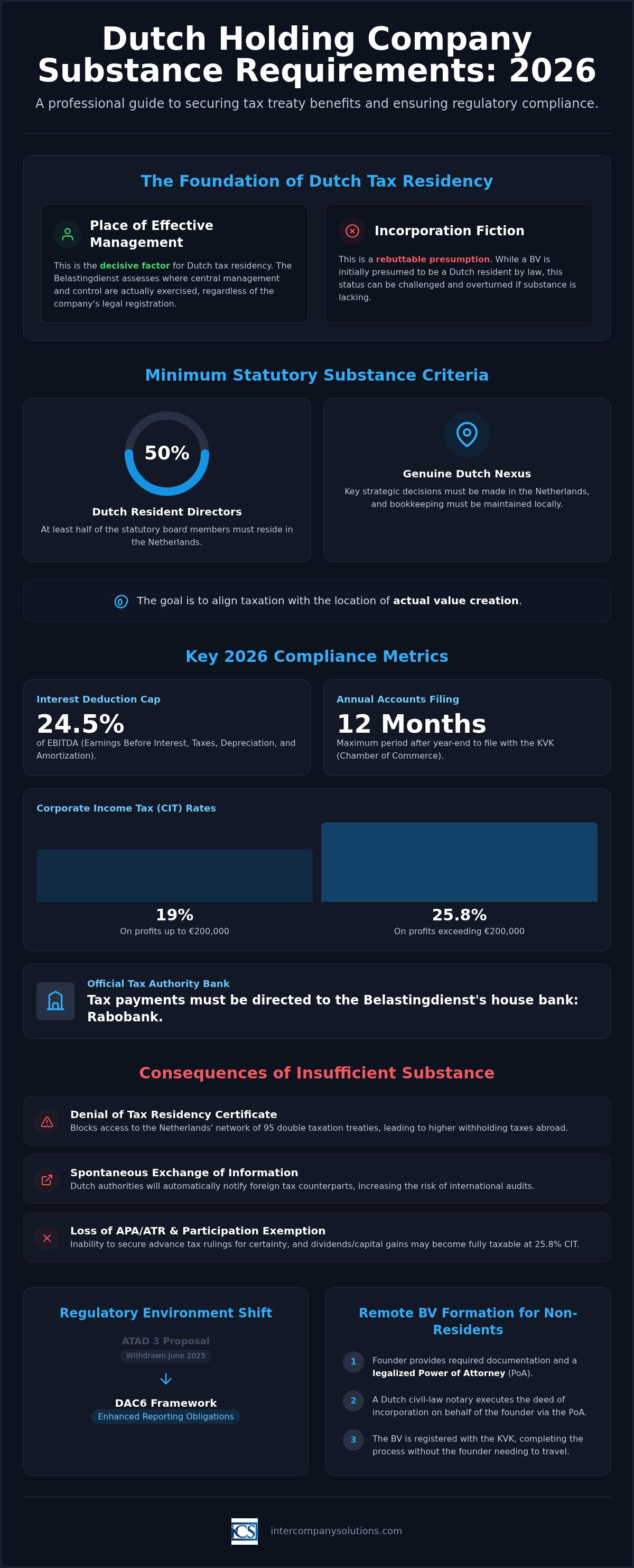
This guide provides a professional analysis of the economic substance criteria required for Dutch holding companies to secure tax treaty benefits and regulatory compliance in 2026. We outline the updated interest deduction cap, which remains at 24.5% of EBITDA for 2026, and the necessity of having at least 50% of directors residing in the Netherlands. This framework ensures your Dutch BV remains a robust vehicle for global operations while managing tax payments through Rabobank, the official house bank of the Belastingdienst since 1 May 2026.
Key Takeaways
- Determine the minimum Dutch holding company substance requirements, including the necessity for 50% Dutch residency among statutory directors to secure international tax treaty benefits.
- Apply the 2026 interest deduction cap of 24.5% of EBITDA to your corporate structure to maintain compliance with the latest Dutch anti-abuse and earnings stripping regulations.
- Establish a Dutch BV remotely using the legalized Power of Attorney route, which allows non-resident founders to complete the incorporation process without physical travel.
- Maintain long-term regulatory standing by filing annual accounts with the KVK within 12 months of the year-end and directing tax payments to the Rabobank house bank accounts.
- Navigate the shift from the withdrawn ATAD 3 proposal to the enhanced reporting obligations required under the current DAC6 framework for cross-border arrangements.
Table of Contents
Defining Economic Substance for Netherlands Holding Companies
Economic substance, in the Dutch tax context, refers to the genuine economic presence and activity of a legal entity within the Netherlands. It goes well beyond the question of where a company was incorporated. A BV registered in Amsterdam but managed entirely from Singapore carries Dutch legal form without Dutch economic reality, and that distinction matters significantly to the Belastingdienst.
Dutch tax law operates on the principle of the place of effective management rather than the incorporation fiction. Under the incorporation fiction, a BV is presumed to be a Dutch tax resident by virtue of its formation under Dutch law. However, the Belastingdienst and Dutch courts look beyond this presumption when assessing actual tax residency. If a company's central management and control are exercised outside the Netherlands, the entity may be treated as a foreign tax resident for treaty purposes, regardless of where it was incorporated. This distinction is not academic; it determines whether your holding structure can lawfully access the Dutch tax treaty network.
The Purpose of Substance in International Tax Law
The substance requirement is grounded in the international effort to combat Base Erosion and Profit Shifting (BEPS), the OECD-led framework targeting arrangements that shift profits to low-tax jurisdictions without corresponding economic activity. The Netherlands, as a jurisdiction with an extensive network of 95 double taxation treaties, has a particular obligation to ensure that entities using those treaties have a genuine nexus to Dutch territory. Without that nexus, the treaty network becomes a conduit for treaty shopping, which the Dutch Ministry of Finance actively works to prevent. Entities that lack real economic presence risk being classified as letterbox or conduit companies, a designation that triggers a range of adverse consequences.
Consequences of Insufficient Substance
Failing to meet Dutch holding company substance requirements produces concrete, measurable risks:
- Denial of a tax residency certificate: The Belastingdienst may refuse to issue a certificate of residence, which is the foundational document required to invoke treaty benefits such as reduced withholding tax rates on dividends, interest, and royalties.
- Spontaneous exchange of information: Dutch tax authorities are obliged to share information with foreign counterparts when they identify structures that may be used to avoid tax in those jurisdictions, increasing audit exposure abroad.
- Loss of APA and ATR access: Advance Pricing Agreements and Advance Tax Rulings, which provide certainty on transfer pricing and tax treatment, are unavailable to entities that cannot demonstrate sufficient substance. This removes a key risk-management tool for international groups.
- Denial of the participation exemption: The Dutch participation exemption exempts qualifying dividends and capital gains from corporate income tax. Where a holding structure is deemed abusive or lacks genuine substance, the Belastingdienst may challenge the exemption's application, exposing those receipts to the standard CIT rate of 25.8%.
These consequences reinforce why substance is a prerequisite rather than an optional enhancement. The following sections set out precisely what the Dutch authorities require in practice.
Minimum Statutory Substance Criteria for Tax Residency
To satisfy the Dutch tax authorities, a holding company must demonstrate that its management and control are firmly rooted in Dutch territory. These criteria align with the OECD's BEPS Action 5, which focuses on aligning taxation with the location of value creation. Meeting Dutch holding company substance requirements is necessary for an entity to be issued a certificate of tax residence, which serves as the key to accessing the Netherlands' network of 95 double taxation treaties. Without this recognition, dividend payments and capital gains may be subject to withholding taxes that would otherwise be mitigated.
Management and Governance Requirements
A primary requirement is that at least 50% of the statutory directors must be residents of the Netherlands. These directors must possess the professional expertise and decision-making authority required to manage the company's risks and assets. They cannot serve as passive figures; they must actively participate in the company's governance and have the legal capacity to bind the company. Key management decisions must be taken within the Netherlands, typically during board meetings held at the Dutch office. These decisions must be documented in local board minutes and administrative records. If a company fails to meet these governance standards, it risks being reclassified as a foreign tax resident or a shell entity, which triggers mandatory information exchange with foreign tax offices.
Operational and Infrastructure Requirements
The company must maintain a physical presence in the Netherlands through office space that is proportionate to its business activities. This space must be used for actual business operations and the storage of corporate records. It is not sufficient to have a mailing address; the office must be equipped to handle the administrative functions of a holding company. All bookkeeping and accounting must be performed and maintained within the Netherlands. Records must be retained for a minimum of 7 years, or 10 years if the company holds immovable property.
Financial integration is demonstrated through the use of a local bank account. According to the Belastingdienst, Rabobank has served as the house bank since 1 May 2026. Utilizing a local account for corporate transactions and tax payments provides a clear audit trail of Dutch economic activity. For entrepreneurs starting this process, our Dutch BV Company Formation services ensure that these operational foundations are established correctly from the beginning. If you have specific questions about director residency or professional qualifications, you may consult with our compliance specialists for a professional assessment of your structure.
Anti-Abuse Regulations and the Impact of ATAD 3
The regulatory environment in 2026 is defined by a rigorous approach to corporate transparency. While the original proposal for the Anti-Tax Avoidance Directive 3 (ATAD 3) was formally withdrawn in June 2025, the policy objectives behind it remain a central priority for the European Union. These objectives are now being integrated into amendments to the EU's Anti-Tax Avoidance Directive (ATAD) and the DAC6 framework. Maintaining economic reality is the primary safeguard against being classified as a high-risk or shell entity within this reporting landscape.
Compliance in 2026 requires adherence to strict financial ratios. According to the Belastingdienst, the interest deduction cap is 24.5% of EBITDA or a threshold of €1 million, whichever is higher. This limitation, often called the earnings stripping rule, prevents excessive debt-loading in holding structures. This rule applies to all Dutch BVs and is a critical factor when structuring intercompany loans or group financing arrangements.
Profits generated by the holding company are subject to Dutch CIT at 19% up to €200,000 and 25.8% above that amount. These rates have remained stable since 2023. Ensuring that substance standards are met protects these profits from being reassessed by foreign tax authorities who might otherwise challenge the company's residency status. Proper documentation provides the necessary evidence that the company is a functional business unit with a genuine economic link to the Netherlands.
Securing the Dutch participation exemption is often the primary goal for international holding structures. To qualify, the holding company must generally own at least 5% of the nominal paid-up share capital of a subsidiary. While the exemption applies to dividends and capital gains, its stability depends on the holding company's economic activity. Non-EU parent companies must demonstrate higher levels of local presence to satisfy anti-abuse tests when seeking dividend relief under the parent-subsidiary directive principles.
Last reviewed: September 2026
Practical Implementation: Building Real Presence in the Netherlands
Establishing a holding company that meets Dutch holding company substance requirements begins during the incorporation phase. For non-resident founders, the process must be handled with procedural precision to ensure the entity is recognized by the Belastingdienst and the KVK from the outset. A BV requires a minimum capital of only €0.01, making the structure accessible, but the regulatory obligations regarding management and presence remain strict. You must demonstrate that the company is a functional business unit rather than a dormant registration.
Remote Incorporation for Non-EU Founders
The standard route for remote Dutch BV formation is the legalized Power of Attorney (POA) method. This allows a Dutch notary to execute the deed of incorporation on your behalf, meaning you don't need to travel to the Netherlands for the formation. You must provide high-quality documentation, including a legalized copy of your identification and proof of address. Once the notary executes the deed, the company is registered with the Kamer van Koophandel (KVK). A one-time KVK registration fee of €85.15 applies in 2026. This fee must be settled promptly to finalize the registration process. Digital video incorporation is available but isn't the default for non-resident founders due to the specific legalization requirements often demanded by Dutch banks and the tax office.
Establishing Administrative Substance
Once incorporated, the focus shifts to ongoing governance and local integration. You must structure your board so at least 50% of the directors are Dutch residents. These individuals must have the professional capacity to manage the company's financial and legal affairs. Administrative substance also requires that all bookkeeping and corporate records are maintained locally. Records must be kept for 7 years, or 10 years if the company holds immovable property. If your holding company employs staff in the Netherlands, you must integrate payroll and staffing procedures to handle social security and wage tax obligations correctly. Compliance also extends to the UBO register. Any changes to Ultimate Beneficial Owners with a threshold greater than 25% must be reported to the KVK within 7 days. Maintaining this level of active management ensures your company isn't viewed as a passive shell, protecting your access to the participation exemption.
Maintaining Long-term Compliance and Regulatory Reporting
Operational stability for a BV relies on a consistent adherence to the Dutch regulatory calendar. Once the initial setup is complete, the focus shifts to annual obligations that validate the entity's standing with the Belastingdienst and the Kamer van Koophandel (KVK). Long-term adherence to Dutch holding company substance requirements is not merely about preserving tax benefits; it's a procedural necessity to avoid administrative penalties and potential audits. You must ensure that the company's financial and governance records accurately reflect its ongoing economic reality in the Netherlands.
Annual accounts must be filed with the KVK within 12 months of the financial year-end to remain in good standing. Failure to meet this deadline can lead to personal liability for directors in the event of bankruptcy. Regarding taxation, Corporate Income Tax (CIT) returns must be filed annually. Profits are taxed at 19% up to €200,000 and 25.8% above this threshold. Since 1 May 2026, all tax payments should be directed to the Rabobank accounts used by the Belastingdienst. Additionally, you must monitor the interest deduction cap, which is set at 24.5% of EBITDA for the 2026 tax year, to prevent unexpected tax leakage from excessive internal financing.
UBO and Transparency Requirements
Transparency remains a cornerstone of the Dutch corporate environment. You're required to maintain an accurate record in the UBO register for any individual holding more than 25% of the shares, voting rights, or ownership interest. Any changes to this information must be reported to the KVK within 7 days of the change occurring. In 2026, access to the UBO register remains regulated to balance privacy with the need for anti-money laundering oversight. Maintaining an updated register is a critical component of your secretarial duties and is often scrutinized during bank account reviews or when entering into new commercial contracts.
Annual Compliance Checklist
A structured review process helps maintain the integrity of your holding company. This checklist ensures that your governance remains robust:
- Board Minutes: Verify that board meeting minutes are physically drafted and signed in the Netherlands, documenting that key strategic decisions were made locally.
- Residency Monitoring: Confirm that at least 50% of your statutory directors maintain their primary residence in the Netherlands throughout the year.
- Bank Activity: Ensure the local bank account remains active with regular business transactions, reinforcing the company's economic nexus.
- Record Retention: Maintain all administrative records for 7 years, or 10 years if the company holds immovable property.
If you're looking for more details on administrative setup, our guide on starting a business in the Netherlands provides further insights into local compliance standards. Regular audits of these items will safeguard your participation exemption and ensure your Dutch holding company substance requirements are consistently met.
Last reviewed: September 2026
Securing Your Dutch Corporate Future in 2026
Establishing a robust corporate presence in the Netherlands is a strategic step that requires meticulous attention to detail. Success in 2026 depends on your ability to demonstrate genuine economic reality, moving beyond mere legal incorporation to active local governance. Meeting Dutch holding company substance requirements ensures your entity remains eligible for tax treaty benefits and the participation exemption, shielding your international investments from unnecessary scrutiny. By maintaining a board with 50% residency and adhering to the 24.5% EBITDA interest deduction cap, you build a foundation of regulatory reliability.
Managing the requirements for a BV, including the €85.15 KVK fee and the 2026 CIT rates of 19% and 25.8%, becomes straightforward when you have a structured compliance framework. Reliable governance involves more than filing annual accounts; it requires a commitment to local economic integration through Dutch-resident directors and active local banking. Our team provides specialized support for international entrepreneurs, ensuring your remote incorporation is completed in just 3-5 business days. We stand by our procedural expertise with a 100% Satisfaction Guarantee, allowing you to focus on growth while we manage the professional details.
Transitioning to a fully compliant holding structure is an investment in the long-term stability of your global business operations. We look forward to facilitating your entry into the Dutch market with the precision and professional standards your enterprise deserves.
Last reviewed: September 2026
Frequently Asked Questions
What is the minimum share capital for a Dutch holding BV in 2026?
The minimum share capital for a Dutch BV is €0.01. This threshold was introduced to facilitate easier entry for entrepreneurs and replaced the previous requirement of €18,000. While you can choose a higher amount, most international founders opt for a nominal sum to maintain financial flexibility. This capital must be deposited after the deed of incorporation is executed by the notary during the standard formation process.
Do Dutch holding companies need a physical office space for substance?
Yes, a Dutch holding company must have a physical presence through office space that is proportionate to its business activities. This space serves as the location where the board makes strategic decisions and where the company's administration is kept. Maintaining a real office helps demonstrate that the entity isn't a mere letterbox company, which is vital for meeting Dutch holding company substance requirements and securing tax residency certificates.
What are the corporate tax rates for Dutch holding companies in 2026?
For the 2026 tax year, the Corporate Income Tax (CIT) rate is 19% on the first €200,000 of taxable profits. Any profits exceeding this threshold are subject to a rate of 25.8%. These rates apply to all BVs, regardless of whether they're operational entities or holding structures. It's also possible to qualify for the participation exemption, which may exempt dividends and capital gains from these taxes entirely under specific conditions.
Can a non-resident be the sole director of a Dutch holding company?
Legally, a non-resident can be the sole director, but this arrangement often conflicts with Dutch holding company substance requirements. To be recognized as a Dutch tax resident, at least 50% of the statutory directors must reside in the Netherlands. If you're the sole director and reside abroad, the Belastingdienst may determine the place of effective management is outside the Netherlands, potentially resulting in the denial of international tax treaty benefits.
What is the interest deduction cap for Dutch entities in 2026?
The deductibility of net interest costs is limited to the higher of 24.5% of the company's EBITDA or a threshold of €1 million. This rule, known as the earnings stripping rule, applies to both internal and external financing arrangements. Monitoring this cap is essential for holding companies that rely on debt to finance subsidiaries, as exceeding these limits can lead to significant tax leakage and reduced net returns for the group.
How long does it take to register a Dutch holding company remotely?
Remote incorporation of a Dutch BV typically takes between 3 and 5 business days. This timeline begins once all required documentation, such as legalized identification and proof of address, is received and verified by the notary. The process is handled via a legalized Power of Attorney, allowing the notary to execute the deed without your physical presence. After incorporation, registration with the KVK and tax authorities follows as the final steps.
Is a Dutch bank account mandatory for substance requirements?
While not explicitly mandated by a single law, maintaining a Dutch bank account is a practical necessity for demonstrating economic substance. It provides evidence that the company's financial affairs are managed within the Netherlands. Since 1 May 2026, the Belastingdienst uses Rabobank as its house bank, so having a local account ensures efficient tax payments and reinforces your entity's nexus to the Dutch jurisdiction for treaty and compliance purposes.
What happens if my Dutch holding company fails the ATAD 3 substance test?
Although the original ATAD 3 proposal was formally withdrawn in June 2025, its objectives are now enforced through enhanced DAC6 reporting and existing anti-abuse rules. If your company lacks sufficient substance, it may be classified as a high-risk shell entity. This status can lead to the denial of residency certificates, the loss of tax treaty benefits, and the spontaneous exchange of information with foreign tax authorities. Maintaining documented economic reality is the only way to mitigate these risks.
Sources
- ICS Payroll - Dutch payroll services
- KVK - Registering with the Dutch Business Register
- Business.gov.nl - Private limited company (bv)
- Burgerlijk Wetboek Boek 2 (Dutch Civil Code, legal entities)
- Rijksoverheid - Ondernemen
- Belastingdienst - Payroll taxes (loonheffingen)
- UWV - Employer obligations
- SVB - Social insurance in the Netherlands
- De Nederlandsche Bank - Supervision
- AFM - Licences and registers
- RVO - Doing business internationally
- Belastingdienst Douane - Customs
- CJEU, Cadbury Schweppes, C-196/04 (ECLI:EU:C:2006:544)
- Hoge Raad, ECLI:NL:HR:2021:1152
- PwC Worldwide Tax Summaries - Netherlands
- ICLG - Corporate Governance Laws and Regulations, Netherlands
Need more information on the Dutch BV company?
Contact an expertReady to start your company in the Netherlands?
| Formation time | Dutch BV formation completed in 3 to 5 business days |
|---|---|
| Process | Fully remote setup with step-by-step guidance |
| Compliance | Expert support for registration, VAT and compliance |
| Aftercare | Accounting, tax and legal support included |
| One partner | All of the above through one trusted formation partner |