


September 15, 2026 · 17 min read
The 15% statutory Dutch dividend withholding tax is not merely a fixed cost of doing business but a manageable variable that requires strict procedural adherence to avoid double taxation. For many foreign entrepreneurs, the complexity of treaty applications and the fear of profit erosion often overshadow the operational benefits of a Dutch BV. You likely recognize that while the Netherlands facilitates global trade, the administrative burden of proving substance and meeting filing deadlines remains a significant priority for your corporate compliance strategy.
This guide provides a professional analysis of the 2026 tax environment, focusing on the precise application of the participation exemption and treaty-based reductions. We outline the specific conditions required to secure a 0% rate for qualifying EU and treaty-resident shareholders, while also addressing the 25.8% conditional rate applicable to low-tax jurisdictions. By following this roadmap, you will gain clarity on the one-month filing window and the technical requirements for remitting payments to the Belastingdienst Rabobank account. This ensures your profit distributions remain efficient and fully compliant with the latest Dutch regulatory standards.
Key Takeaways
- Identify the 15% standard rate for 2026 and how it functions as a preliminary tax on corporate profit distributions.
- Apply for a 0% rate on Dutch dividend withholding tax by meeting the specific requirements of the participation exemption or applicable international tax treaties.
- Align your distribution strategy with the 2026 corporate income tax tiers of 19% on profits up to €200,000 and 25.8% for higher margins.
- Execute mandatory tax filings within the one-month deadline to remain compliant with Belastingdienst electronic reporting standards.
- Utilize the legalized Power of Attorney route for remote BV formation with a minimum share capital of only €0.01.
Table of Contents
Understanding the Dutch Dividend Withholding Tax (WHT) Framework
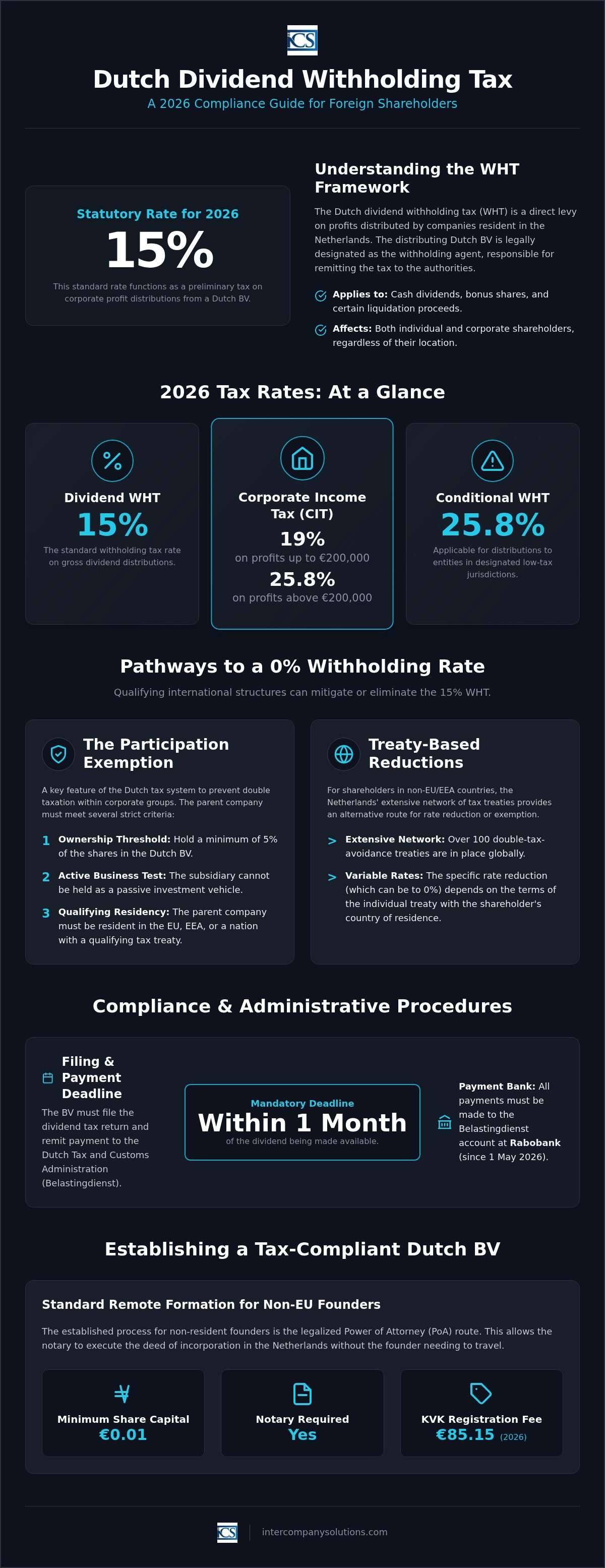
The Dutch dividend withholding tax is a direct levy on profit distributions made by companies resident in the Netherlands. For the 2026 tax year, the statutory rate is fixed at 15%. This tax acts as a preliminary levy for Dutch residents, who can often credit it against their income tax; however, for foreign investors, it frequently represents a final tax unless a treaty provides relief. The scope of this tax extends to several forms of distribution, including cash dividends, bonus shares issued from profit reserves, and liquidation proceeds that exceed the company's average contributed capital.
Within the broader Dutch Corporate Tax Framework, the distributing Dutch BV holds the legal status of a withholding agent. This means the company, not the shareholder, is responsible for the administrative accuracy of the withholding process. The tax applies to distributions made to both individual and corporate shareholders, regardless of their location, provided the distributing entity is considered a Dutch resident for tax purposes. Ensuring your entity is properly structured from the outset is essential, and our specialists often assist with Netherlands company formation to establish a compliant foundation for future profit distributions.
Taxable Basis and Payment Responsibility
Calculating the correct amount requires identifying the gross dividend value before any deductions. When a distribution is approved, the BV must withhold 15% of the gross amount and remit it to the Belastingdienst. This obligation also covers non-cash distributions, such as assets transferred to shareholders at a value below market rates. In these instances, the difference is treated as a "deemed dividend" and is subject to the same 15% rate. The company must file the dividend tax return and complete the payment within one month of the dividend being made available. Since 1 May 2026, all such payments must be directed to the Belastingdienst house bank, Rabobank.
Tax Residency and Withholding Obligations
A Dutch BV is generally subject to withholding obligations by default because the Netherlands applies the incorporation principle. Any company formed under Dutch law is considered a tax resident. For foreign shareholders, this results in receiving a net distribution. While the 15% rate is the standard, many international investors reduce this through the application of double tax treaties or the Dutch participation exemption. You should verify specific jurisdictional rates on belastingdienst.nl to ensure compliance. If the shareholder is a Dutch resident company, the withheld tax can typically be offset against its own corporate income tax liability, which is 19% on profits up to €200,000 and 25.8% on the remainder.
Exemptions and Reductions for International Holding Structures
While the statutory 15% rate remains the standard, the Dutch tax system provides significant relief for qualifying international structures. Understanding Dutch dividend tax basics is vital for foreign investors aiming to implement a 0% domestic withholding rate. This exemption typically applies when dividends are paid to corporate shareholders resident in the EU, EEA, or a country with a qualifying tax treaty with the Netherlands. The primary goal is to prevent the cascading effect of taxation within corporate groups, ensuring that profits are only taxed once at the final recipient level.
The Participation Exemption Checklist
The participation exemption is a cornerstone of the Netherlands' appeal as a global holding jurisdiction. To utilize this exemption in a cross-border context, the parent company must meet several strict criteria. The parent must hold a minimum interest of 5% in the Dutch BV. Additionally, the subsidiary cannot be held as a passive investment; it should ideally be an active operational entity. Documentation is a critical component of compliance. During a tax audit, you must present the following records to the Belastingdienst:
- Updated shareholder registers proving the 5% ownership threshold.
- Proof of the parent company's active business operations in its home jurisdiction.
- Documentation regarding the commercial rationale for the holding structure.
Treaty-Based Rate Reductions
For shareholders resident in non-EU countries, the extensive network of over 100 Dutch double-tax-avoidance treaties offers an alternative route for reduction. These treaties often lower the Dutch dividend withholding tax to 5% or 10%, and in specific cases involving substantial participations, to 0%. If your company has already paid the full 15% rate, you can initiate a refund process through the Dutch Tax Administration. By 2026, the impact of the Multilateral Instrument (MLI) has become more pronounced. Structures must now pass the "Principal Purpose Test" to qualify for treaty benefits. This ensures that the arrangement isn't artificial and serves a genuine business function.
Meeting these substance requirements is mandatory to avoid the application of anti-abuse provisions. If you're currently planning a new venture, our advisors can assist with Netherlands company formation to ensure your entity is structured for compliance from the start. If you require a specific analysis of how these treaties apply to your jurisdiction, you can contact our tax department for a professional assessment.
Interaction with Dutch Corporate Income Tax (CIT) in 2026
The corporate income tax (CIT) environment in 2026 directly dictates the available pool for profit distributions. For a Dutch BV, the primary tax liability is calculated based on two tiers. You'll pay 19% on taxable profits up to €200,000 and 25.8% on any amount exceeding this threshold. Because dividends are paid from the net profit remaining after CIT, your distribution strategy must account for these rates. Effective tax planning ensures that the Dutch dividend withholding tax is managed alongside these corporate obligations to maintain liquidity. Accurate reporting prevents the accumulation of interest or penalties from the Belastingdienst.
Taxable Profit Calculation and Deductions
Determining your net profit requires a precise calculation of allowable deductions. For 2026, compliance includes adhering to the interest deduction cap, which is set at 24.5% of the company's EBITDA. However, a threshold of €1 million applies; you can always deduct interest up to this amount even if it exceeds the EBITDA percentage. This rule prevents excessive debt-loading and ensures that the tax base remains stable. You must retain all financial records, including invoices, bank statements, and contracts, for at least 7 years to support both CIT and WHT filings. This documentation is vital during audits to justify the expenses used to arrive at the taxable profit figure. If your records involve immovable property, the retention period extends to 10 years.
Fiscal Unity and Dividend Distributions
Establishing a fiscal unity (fiscale eenheid) can streamline the movement of capital between a Dutch parent and its subsidiaries. When companies form a fiscal unity for CIT purposes, the tax administration treats them as a single taxpayer. This structure has a direct impact on profit movements. Internal dividend flows between entities within the same fiscal group are typically ignored for tax purposes. This effectively results in the elimination of the Dutch dividend withholding tax for distributions made within the group. It's a procedural advantage that simplifies internal treasury management.
Managing these complex interactions requires structured bookkeeping. You can find more details on maintaining these standards in our guide on Accounting for Dutch BV. By aligning your CIT reporting with your distribution timeline, you reduce the risk of administrative errors. This alignment ensures that the BV meets its obligations to the Belastingdienst Rabobank account while maximizing the efficiency of the group's overall tax position.
Compliance Deadlines and Administrative Procedures
Adhering to the strict timeline set by the Dutch Tax Administration is essential for maintaining your corporate standing. Once a dividend is made available to shareholders, the distributing BV must file a Dutch dividend withholding tax return and remit the payment within exactly one month. This deadline is non-negotiable. Missing this window leads to administrative fines and the accrual of interest charges from the Belastingdienst. All filings must be completed electronically through the official tax portal, requiring current digital credentials for your company's representative.
Beyond tax-specific filings, the BV must maintain its general corporate compliance with the Chamber of Commerce (KVK). Annual accounts must be filed with the KVK within 12 months of the financial year-end. Failure to do so is considered an economic offense and can lead to director liability. These administrative layers ensure that the company's financial health is transparent to the public and regulatory bodies. Proper documentation also supports the validity of any exemptions you claim under the participation exemption or tax treaties.
Banking and Payment Logistics
A critical update for 2026 involves the Belastingdienst's primary banking partner. Since 1 May 2026, the official house bank for the Dutch Tax Administration is Rabobank. If you're initiating an international wire transfer for a Dutch dividend withholding tax payment, you must ensure your records are updated to reflect this change. Using outdated banking information from previous years will result in rejected payments and potential late-filing penalties. Ensure that your payment reference includes the correct assessment number provided during the electronic filing process.
For newly formed entities, managing the initial KVK registration fee of €85.15 is the first step in the administrative process. This one-time fee is separate from the annual compliance costs but is required to activate the company's registration. Our team often handles these logistics during Netherlands company formation via the legalized Power of Attorney route. This ensures that non-resident founders meet all initial requirements without the need for international travel.
UBO Reporting and Transparency
Transparency regarding Ultimate Beneficial Owners (UBOs) is directly linked to your eligibility for tax treaty benefits. You must report any changes to UBOs who hold a threshold of more than 25% of the shares or voting rights to the KVK within 7 days of the change. The Belastingdienst cross-references UBO data with dividend tax filings to verify that the recipient is the actual beneficial owner and not a conduit entity. A failure to keep this registry updated can trigger a tax audit or the denial of a 0% withholding rate.
Maintaining a clear record of ownership and personnel is also vital for other administrative areas, such as payroll services in the Netherlands. Accurate UBO and employee data ensure that the company remains compliant across all regulatory fronts. This integrated approach to compliance protects your investment and simplifies future profit distributions.
Establishing a Tax-Compliant Dutch Entity Remotely
Establishing a compliant foundation is the first step toward efficient profit distribution. For non-resident founders, the standard approach is the legalized Power of Attorney (PoA) route. This method allows the notary to execute the deed of incorporation in the Netherlands without the founder's physical presence. A Dutch BV requires a minimum share capital of only €0.01, making it an accessible structure for various business scales. When you work with a professional agent for Dutch BV formation, the typical timeline for remote incorporation is 3-5 business days. This speed does not compromise the meticulous attention to detail required to ensure the entity is ready for future Dutch dividend withholding tax compliance.
Remote Incorporation Steps
The process follows a logical sequence to ensure legal validity. First, you must legalize the necessary identification documents and execute the PoA in your home country. These documents are then sent to the Netherlands for the second step: the notarial execution of the deed of incorporation. Unlike an eenmanszaak or VOF, a BV strictly requires a notary for its formation. Finally, the entity is registered with the KVK and the tax authorities. This registration triggers the one-time KVK fee of €85.15 and the issuance of your VAT and CIT numbers. This structured approach ensures your business meets all entry requirements while preparing for the administrative duties of a resident taxpayer.
Ongoing Compliance Support
Maintaining your entity's tax-compliant status requires consistent administrative oversight. You'll need to manage quarterly VAT filings and prepare annual CIT returns based on the 2026 rates of 19% up to €200,000 and 25.8% above. When the company is ready to distribute profits, you must file the Dutch dividend withholding tax return within one month of the distribution date. All payments must be remitted to the Belastingdienst Rabobank account to avoid penalties.
All financial records must be retained for at least 7 years to meet statutory requirements. If your BV holds immovable property, this retention period is extended to 10 years. Keeping these records organized is vital for justifying participation exemptions or treaty-based rate reductions during future audits. By integrating these compliance habits from the start, you protect the company's ability to distribute profits to international shareholders with minimal tax friction.
Last reviewed: September 2026
Securing Your Dutch Distribution Strategy for 2026
Efficiently managing the Dutch dividend withholding tax requires precise coordination between your corporate structure and the latest regulatory requirements. By utilizing the network of over 100 tax treaties and the domestic participation exemption, you're able to protect your profits from unnecessary erosion. Successful compliance involves meeting the one-month filing deadline and ensuring all payments reach the Rabobank account of the Belastingdienst on time. These procedural steps are vital for maintaining your entity's standing and avoiding administrative fines.
Intercompany Solutions acts as a proactive partner for global entrepreneurs, offering remote BV formation in 3-5 business days via legalized Power of Attorney. With over 2,000 successful incorporations globally, we provide expert accounting support for CIT filings and periodic dividend tax returns. This professional oversight ensures your entity meets the 2026 standards for substance and transparency from its first day of operation.
We're ready to facilitate your growth and help you establish a stable, compliant presence in the Netherlands.
Last reviewed: September 2026
Frequently Asked Questions
What is the Dutch dividend withholding tax rate for 2026?
The statutory Dutch dividend withholding tax rate for 2026 is 15% on profit distributions made by a Dutch company. This rate applies to cash dividends, bonus shares, and liquidation proceeds exceeding the average contributed capital. While the BV acts as the withholding agent, the tax is technically a levy on the recipient. For Dutch residents, it's a preliminary tax that's offset against their final income or corporate tax assessment.
Can foreign entrepreneurs apply for a 0% dividend tax rate?
Foreign entrepreneurs can often secure a 0% rate if they meet the requirements for the participation exemption or a specific tax treaty. This generally applies to corporate shareholders resident in the EU, EEA, or a treaty country who hold at least 5% of the shares. You must demonstrate that the structure isn't artificial and that the holding company has genuine economic substance in its home jurisdiction to qualify for this reduction.
How does the participation exemption work for a Dutch BV?
The participation exemption ensures that profits already taxed at the subsidiary level aren't taxed again when distributed to the parent Dutch BV. To qualify, the parent company must hold at least 5% of the subsidiary's share capital. Additionally, the subsidiary must be an active operational entity rather than a vehicle for passive investment. This mechanism is essential for maintaining a tax-efficient international holding structure and avoiding the cascading effect of multiple tax layers.
What is the deadline for paying Dutch dividend tax?
The legal deadline for filing the return and remitting the Dutch dividend withholding tax is within one month of the distribution date. Since 1 May 2026, all tax payments must be made to Rabobank, which serves as the house bank for the Belastingdienst. Missing this window results in administrative fines and interest charges. It's vital to coordinate with your accounting team to ensure the electronic filing and wire transfer are completed before the deadline.
Do I need to travel to the Netherlands to file my tax returns?
You don't need to travel to the Netherlands to manage your tax filings or incorporate your company. All tax returns, including those for VAT, CIT, and dividends, are submitted electronically via the tax administration's portal. For the initial setup, we utilize the legalized Power of Attorney route, allowing the notary to execute the deed while you remain abroad. This remote process typically takes 3 to 5 business days for a standard Dutch BV.
How do tax treaties affect the 15% withholding tax?
Tax treaties often reduce the standard 15% withholding rate to 10%, 5%, or even 0% for qualifying international investors. The Netherlands maintains a network of approximately 100 double-tax-avoidance treaties that prioritize the prevention of double taxation. However, since the implementation of the Multilateral Instrument, you must satisfy the Principal Purpose Test. This ensures that the primary reason for the investment structure isn't merely to obtain a tax benefit, requiring documented commercial rationale.
What records must a Dutch BV retain for tax compliance?
A Dutch BV is legally required to retain its financial records for a period of 7 years to ensure tax compliance. These records include bank statements, invoices, contracts, and shareholder registers used to calculate the Dutch dividend withholding tax. If your company owns or manages immovable property, the retention requirement extends to 10 years. Maintaining organized digital or physical archives is essential for supporting your position during a potential audit by the Dutch Tax Administration.
What is the corporate income tax bracket for a Dutch BV in 2026?
The corporate income tax brackets for 2026 are divided into two tiers based on the company's taxable profit. You'll pay 19% on profits up to the threshold of €200,000. For any amount exceeding this €200,000 limit, the tax rate increases to 25.8%. These rates apply to the net profit after accounting for business expenses and the interest deduction cap, which is currently set at 24.5% of the company's EBITDA for the fiscal year.
Sources
- KVK - Registering with the Dutch Business Register
- Business.gov.nl - Private limited company (bv)
- Burgerlijk Wetboek Boek 2 (Dutch Civil Code, legal entities)
- Rijksoverheid - Ondernemen
- ICS Payroll - Dutch payroll services
- Belastingdienst - Payroll taxes (loonheffingen)
- UWV - Employer obligations
- SVB - Social insurance in the Netherlands
- Belastingdienst - VAT (btw) for entrepreneurs
- European Commission - VAT rules and rates
- De Nederlandsche Bank - Supervision
- AFM - Licences and registers
- RVO - Doing business internationally
- Belastingdienst Douane - Customs
- CJEU, Cadbury Schweppes, C-196/04 (ECLI:EU:C:2006:544)
- Hoge Raad, ECLI:NL:HR:2021:1152
- PwC Worldwide Tax Summaries - Netherlands
- ICLG - Corporate Governance Laws and Regulations, Netherlands
Frequently Asked Questions
Need more information on the Dutch BV company?
Contact an expertReady to start your company in the Netherlands?
| Formation time | Dutch BV formation completed in 3 to 5 business days |
|---|---|
| Process | Fully remote setup with step-by-step guidance |
| Compliance | Expert support for registration, VAT and compliance |
| Aftercare | Accounting, tax and legal support included |
| One partner | All of the above through one trusted formation partner |