


September 20, 2026 · 17 min read
Failing to report a change in the Ultimate Beneficial Owner (UBO) register within seven days can trigger administrative fines even if the oversight was unintentional. It's common to feel concerned about language barriers or the technicalities of Dutch authorities when managing a BV from abroad. For many international entrepreneurs, the administrative burden leads to uncertainty regarding KVK filing deadlines and the complexities of maintaining statutory records. Utilizing Dutch company secretarial services allows you to address these challenges while ensuring your company remains in good standing without the risk of penalties for late submissions or inaccurate data.
This article provides a professional overview of the statutory requirements, corporate governance standards, and compliance obligations for Dutch BV entities. This guide covers the essential 2026 regulatory landscape, including specific timelines for filing annual accounts and the procedural clarity needed for remote administrative management. You'll gain a clear understanding of the steps required to keep your entity compliant while focusing on your global business growth.
Key Takeaways
- Understand that Dutch company secretarial services manage administrative compliance, helping non-resident directors meet local requirements without the need for a mandatory statutory officer.
- Learn the strict requirements for maintaining the shareholder register and reporting UBO changes (>25% threshold) within seven days to avoid administrative penalties.
- Identify the necessary steps for organizing the Annual General Meeting (AGM) and drafting formal resolutions to document corporate actions according to Dutch law.
- Discover the process for updating company records with the KVK, including director changes and address updates, to ensure full regulatory synchronization.
- Explore how secretarial support facilitates essential applications for VAT numbers and bank accounts for foreign entrepreneurs using the Power of Attorney formation route.
Table of Contents
The Function of Company Secretarial Services in the Netherlands
In the Dutch legal framework, the role of a company secretary differs significantly from common law jurisdictions like the UK or the US. For a Dutch BV, appointing a company secretary isn't a mandatory statutory requirement. Instead, Dutch company secretarial services function as a specialized layer of administrative compliance management. While the executive management board holds legal responsibility for the company's actions, the secretarial function ensures that the entity remains in "good standing" through meticulous record-keeping and timely regulatory filings. This support acts as a bridge between the company's commercial operations and the strict procedural demands of Dutch law.
The distinction between executive management and secretarial support is vital for proper corporate governance. Board members focus on the strategic and operational direction of the business, while secretarial services handle the procedural execution of board decisions. This includes ensuring that resolutions are correctly drafted, signed, and archived. By maintaining this separation, a company ensures that its administrative foundation is robust, which is essential when the entity undergoes audits or seeks external financing. It's a proactive approach to governance that prevents the accrual of penalties for administrative oversights.
Administrative Support for Non-Resident Directors
Managing a BV from outside the European Union presents specific challenges, particularly regarding statutory deadlines and language barriers with local authorities. Non-resident directors often find it difficult to coordinate directly with the Dutch Chamber of Commerce (KVK) or the Tax Office (Belastingdienst). Professional secretarial support facilitates these interactions, often utilizing the legalized Power of Attorney route for Dutch BV company formation and subsequent corporate changes. This allows founders to execute necessary deeds and filings remotely, ensuring that documentation meets Dutch legal standards without requiring frequent travel to the Netherlands.
Scope of Corporate Secretarial Duties
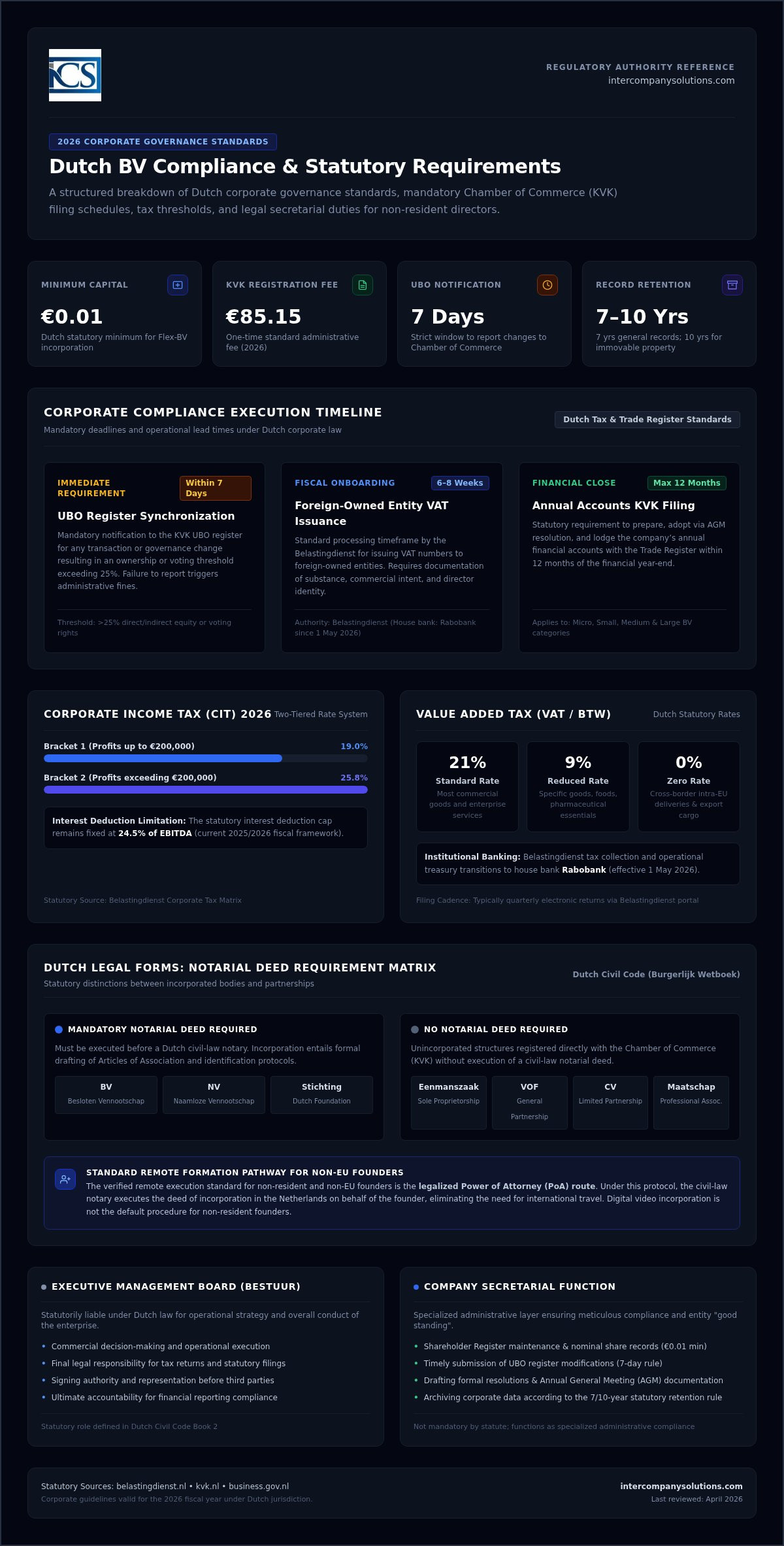
The scope of Dutch company secretarial services extends beyond simple filing. It involves the methodical coordination of shareholder meetings, the drafting of formal resolutions, and the maintenance of the company's internal registers. A primary responsibility includes ensuring adherence to the 7-year record retention rule for all corporate data, or 10 years for immovable property. Secretarial teams also provide specialized assistance during the 6 to 8-week window typically required for VAT applications for foreign-owned entities. They also assist with bank account applications, ensuring all documentation is prepared for Rabobank, which has served as the Belastingdienst house bank since 1 May 2026. These tasks collectively safeguard the entity against administrative fines, such as those resulting from failing to report UBO changes within 7 days.
Statutory Record-Keeping and UBO Compliance
Every Dutch BV has a legal obligation to maintain an accurate shareholder register. This document must reside at the company's office and contain the names and addresses of all shareholders, the number of shares held, and the amount paid up on each share. While the minimum capital for a BV is only €0.01, the administrative precision required for the register remains high. Accurate record-keeping is a core component of Dutch company secretarial services, ensuring that the entity's internal structure matches the information filed with the Chamber of Commerce (KVK).
Managing the Ultimate Beneficial Owner (UBO) register is a critical compliance task. Under Dutch UBO registration requirements, any individual who owns or controls more than 25% of the shares, voting rights, or ownership interest in a company is considered a UBO. This threshold applies to both direct and indirect ownership. If no individual meets these criteria, a "pseudo-UBO", usually the senior managing officials, must be registered instead to ensure transparency.
The Dutch UBO Register Requirements
The KVK maintains the UBO register to prevent financial crimes. Companies must report changes to UBO information within 7 days of the change occurring. This timeline is strict. Failure to comply can result in administrative fines or criminal prosecution. While some UBO data is accessible to the public, such as the name and the nature of the interest, other details remain private and are only accessible by competent authorities. For international founders, managing these updates remotely requires a structured process to ensure the 7-day window isn't missed. If you require assistance with your filing obligations, you can contact our specialists for guidance.
Corporate Archive and Data Retention
Dutch law sets specific timelines for how long corporate records must be preserved. General business records, including the shareholder register, correspondence, and financial data, must be retained for at least 7 years. If the BV owns immovable property, this retention period extends to 10 years for all related documentation. These records can be stored digitally, provided the integrity and accessibility of the data are guaranteed throughout the retention period. Maintaining a structured corporate archive is essential for demonstrating compliance during tax audits or due diligence processes. Professional secretarial support ensures that these archives are organized and compliant with Dutch standards, even when directors are based abroad.
Corporate Governance: Meetings and Resolutions
Effective corporate governance for a Dutch BV relies on the formalization of all significant management decisions. While the daily operations are handled by the board, the legal validity of these actions depends on proper documentation. Professional Dutch company secretarial services ensure that every board meeting and shareholder vote is recorded in compliance with the company's Articles of Association and Book 2 of the Dutch Civil Code. This creates a transparent audit trail, which is particularly important during annual audits or when preparing for a potential sale of the business. Maintaining this structure prevents internal disputes and ensures that directors operate within their granted authority.
The Annual General Meeting (AGM) Process
Every Dutch BV must hold at least one Annual General Meeting per year. The primary purpose of this meeting is to discuss the annual report and approve the financial statements. According to Dutch law, annual accounts must be filed with the KVK within 12 months of the end of the financial year. The secretarial team manages the timeline for these meetings, ensuring that notice periods, typically 15 days, are strictly followed. During the AGM, shareholders also decide on the discharge of directors (decharge), which limits the board's liability for the management conducted during the reported period. For non-resident shareholders, the secretarial function includes the preparation of proxies, allowing for legal representation without the need for physical travel to the Netherlands. Following KVK registration and filing guidelines is essential during this stage to ensure the commercial register accurately reflects the approval of the accounts.
Documenting Board Decisions
Significant corporate actions, such as changing the business strategy, issuing new shares, or appointing new directors, require formal board resolutions. These documents serve as the official record of the board's intent and are often requested by banks or tax authorities to verify corporate authority. In 2026, the legal validity of electronic signatures and remote resolutions is well-established in the Netherlands, allowing for efficient decision-making across different time zones. Secretarial support involves drafting these resolutions with precise legal language and maintaining the corporate minute book. This book must be kept up to date and retained for at least 7 years as part of the company's statutory records. When starting a business in the Netherlands, establishing these governance habits early protects the directors from personal liability and ensures the company remains compliant with evolving administrative standards.
Managing Corporate Changes and KVK Filings
Maintaining a Dutch BV requires proactive management of the commercial register to ensure all data remains current. When a company appoints a new director or changes an authorized representative, these updates must be reported to the Chamber of Commerce (KVK) immediately. This transparency is vital for third parties, such as banks and suppliers, who rely on the KVK extract to verify who can legally sign on behalf of the company. Similarly, updating the company's registered address is a mandatory step that ensures synchronization between the KVK and the tax authorities. For new entities or those undergoing specific updates in 2026, the KVK registration fee is €85.15 as a one-time, non-recurring cost.
One of the most critical deadlines for any Dutch entity is the submission of annual accounts. These must be filed with the KVK within 12 months of the end of the financial year. Missing this statutory deadline is considered an economic offense and can lead to significant administrative fines or even personal liability for the directors. Professional Dutch company secretarial services track these dates meticulously, ensuring that the financial data is prepared and submitted in the correct digital format required by the Dutch authorities. This oversight prevents unnecessary legal friction and maintains the company's reputation for compliance.
Interaction with the Dutch Chamber of Commerce
Most corporate amendments are processed through secure e-filing protocols, which have replaced traditional paper submissions for the majority of routine tasks. Secretarial support includes the regular monitoring of the company's public extract. This ensures that the representation of the board and the registered business activities accurately reflect the current reality of the business. If an entrepreneur decides to exit the Dutch market, the secretarial team manages the formal deregistration or liquidation process. This involves drafting the necessary resolutions and ensuring the KVK records are closed according to legal requirements, preventing the accrual of ongoing administrative obligations.
The Role of the Dutch Notary
While many administrative updates are handled directly with the KVK, certain structural changes require the involvement of a Dutch notary. Changes that necessitate a notarial deed include share transfers, amendments to the Articles of Association, or a formal change in the company's legal name. For non-resident founders, Dutch company secretarial services coordinate these efforts through the legalized Power of Attorney route. This allows the notary to execute the deed on behalf of the shareholders or directors without requiring them to travel to the Netherlands. This coordination ensures that the notary receives the correct documentation to update the Dutch BV company formation records, maintaining a seamless link between legal requirements and the commercial register.
Strategic Administrative Support for International BVs
Strategic administrative support extends beyond statutory filings to address the operational barriers international founders face. For many foreign-owned entities, obtaining a VAT number typically takes 6 to 8 weeks, a process that requires precise documentation and direct communication with the Belastingdienst. Dutch company secretarial services facilitate these complex applications by ensuring all corporate data aligns with tax authority expectations. This support is equally vital for bank account applications, where secretarial teams prepare the necessary folders to meet strict KYC (Know Your Customer) requirements. Having a specialist manage these interactions reduces the risk of rejection and ensures the entity is ready for commercial activity as quickly as possible.
Integration with payroll and Employer of Record (EOR) services represents another strategic layer for companies hiring Dutch staffing. For businesses seeking to relocate talent, coordination with the Immigration and Naturalisation Service (IND) for Highly Skilled Migrant (HSM) visa applications is essential. Secretarial teams act as the primary point of contact, ensuring that the company's sponsorship status is maintained and that all employment contracts comply with Dutch labor laws. They handle the administrative burden of reporting obligations to the IND, which is a mandatory requirement for recognized sponsors. This comprehensive approach prevents regulatory friction and supports long-term stability for the international board.
The Premium Secretarial Support Package
New entities benefit from a dedicated 10-hour support package during their first year of operation. This assistance covers the setup of essential trade tools, such as EORI applications for international trade compliance. A significant focus is placed on coordinating Rabobank applications, as Rabobank has served as the Belastingdienst house bank since 1 May 2026. This package provides a structured bridge for non-EU founders who utilize the Power of Attorney route, offering the procedural clarity needed to manage a Dutch entity from a distance. It's an efficient way to handle the high volume of administrative tasks that typically arise immediately after incorporation.
Ongoing Corporate Health Checks
Maintaining a BV in good standing requires periodic reviews of corporate records and financial thresholds. These health checks monitor the 24.5% of EBITDA interest deduction cap established in 2025 to ensure tax efficiency. They also track the company's position relative to CIT thresholds, where a 19% rate applies up to €200,000 and 25.8% applies to profits above that amount. For entrepreneurs moving from Dutch BV formation to active operations, these checks serve as a safeguard against administrative oversights. By identifying potential compliance gaps early, Dutch company secretarial services help directors avoid fines and maintain the entity's professional integrity in the eyes of Dutch authorities.
Last reviewed: October 2024
Securing Long-Term Compliance for Your Dutch BV
Success in the Dutch market depends on more than commercial growth; it requires a meticulous approach to statutory administration. Maintaining an accurate UBO register with seven-day reporting windows and ensuring annual accounts are filed within 12 months are non-negotiable obligations for every director. By integrating Dutch company secretarial services into your corporate structure, you establish a reliable bridge between your international operations and local regulatory demands. These processes ensure your entity remains in good standing while you manage your business from abroad.
As a market leader in foreign entrepreneur incorporation with over nine years of experience, we ensure your entity meets every procedural standard with a 100% satisfaction guarantee. We prioritize efficiency and reliability, offering a 24-hour response time to address your administrative inquiries and filing needs. Our team manages the technicalities so your focus remains on expanding your enterprise across the European Union. We're committed to providing the procedural clarity needed for your long-term success.
Your professional interests are in capable hands. We're ready to help you maintain your company in good standing while simplifying the path to regulatory adherence in the Netherlands.
Last reviewed: October 2024
Frequently Asked Questions
Is a company secretary mandatory for a Dutch BV?
No, a company secretary is not a mandatory statutory officer for a Dutch BV under the Dutch Civil Code. While common in other jurisdictions, the Dutch legal framework assigns administrative and compliance responsibilities to the board of directors. Many international entrepreneurs choose to engage Dutch company secretarial services to manage these duties effectively, ensuring that statutory records and KVK filings remain accurate without the need for a formal appointment.
What is the UBO register and what are the reporting deadlines?
The UBO register is a mandatory database managed by the Chamber of Commerce (KVK) to identify individuals who own or control more than 25% of a company. All Dutch BVs must register their Ultimate Beneficial Owners and report any changes to this information within 7 days. Failure to meet this deadline can result in administrative fines or criminal sanctions. This transparency requirement applies to both direct and indirect ownership structures.
How long must a Dutch company retain its administrative records?
Most administrative records for a Dutch BV must be retained for at least 7 years. This statutory retention period applies to the shareholder register, financial bookkeeping, and corporate correspondence. If the company owns immovable property in the Netherlands, the retention requirement for all related documentation extends to 10 years. These records can be kept in digital format, provided the data remains accessible and the integrity of the information is guaranteed for the full period.
What are the KVK filing fees for 2026?
The KVK registration fee for a new or updated entity is €85.15 in 2026. This is a one-time, non-recurring fee charged by the Dutch Chamber of Commerce during the initial registration process or when specific structural changes occur. While most annual filings, such as the submission of financial statements, don't incur additional KVK fees, the initial registration cost is mandatory for all legal entities including BVs, NVs, and foundations.
Can corporate secretarial tasks be managed remotely for a Dutch BV?
Yes, corporate secretarial tasks can be managed fully remotely through a legalized Power of Attorney (PoA) route. This allows professional service providers to execute deeds and file updates with the KVK on behalf of the directors without requiring them to travel to the Netherlands. This method is the standard approach for non-resident founders and ensures that Dutch company secretarial services can maintain the company's good standing from a distance while adhering to local legal standards.
What happens if a Dutch company misses the annual account filing deadline?
Missing the annual account filing deadline is classified as an economic offense in the Netherlands. Financial statements must be filed with the KVK within 12 months of the end of the financial year. Failure to comply can lead to significant administrative fines and may result in personal liability for the directors if the company becomes insolvent. Timely filing is a critical component of corporate compliance and a key indicator of a company's good standing.
What is the corporate tax rate for a Dutch BV in 2026?
The corporate income tax (CIT) rate for a Dutch BV is 19% on profits up to €200,000. For taxable profits exceeding this threshold, a rate of 25.8% applies. These rates are current for 2026 and reflect the standard tax burden for Dutch private limited companies. Directors should also account for the interest deduction cap, which is set at 24.5% of EBITDA in 2025, to ensure accurate tax planning and compliance with the Belastingdienst.
Sources
- ICS Payroll - Dutch payroll services
- KVK - Registering with the Dutch Business Register
- Business.gov.nl - Private limited company (bv)
- Burgerlijk Wetboek Boek 2 (Dutch Civil Code, legal entities)
- Rijksoverheid - Ondernemen
- Belastingdienst - Corporate income tax rates
- Belastingdienst - Payroll taxes (loonheffingen)
- UWV - Employer obligations
- SVB - Social insurance in the Netherlands
- Belastingdienst - VAT (btw) for entrepreneurs
- European Commission - VAT rules and rates
- IND - Highly skilled migrant
- IND - Start-up residence permit
- De Nederlandsche Bank - Supervision
- AFM - Licences and registers
- RVO - Doing business internationally
- Belastingdienst Douane - Customs
- CJEU, Cadbury Schweppes, C-196/04 (ECLI:EU:C:2006:544)
- Hoge Raad, ECLI:NL:HR:2021:1152
- PwC Worldwide Tax Summaries - Netherlands
- ICLG - Corporate Governance Laws and Regulations, Netherlands
Frequently Asked Questions
Need more information on the Dutch BV company?
Contact an expertReady to start your company in the Netherlands?
| Formation time | Dutch BV formation completed in 3 to 5 business days |
|---|---|
| Process | Fully remote setup with step-by-step guidance |
| Compliance | Expert support for registration, VAT and compliance |
| Aftercare | Accounting, tax and legal support included |
| One partner | All of the above through one trusted formation partner |