


September 23, 2026 · 15 min read
Commercial transparency in the Netherlands is governed by strict statutory oversight, making corporate verification indispensable before executing any cross-border transaction. Finding and reviewing official filings through the Dutch company register requires an understanding of local administrative procedures, especially since access to beneficial ownership records now requires a demonstrated legitimate interest. If you manage an international enterprise, dealing with unfamiliar registry protocols and filing systems can easily cause administrative friction.
You likely want straightforward clarity on which corporate details remain publicly accessible, what documentation your business must submit to commercial authorities, and how to avoid costly compliance penalties. In this guide, you'll learn how the Trade Register operates, how to search records effectively, and how statutory compliance obligations apply to companies across the Netherlands. We outline the procedural steps to inspect an official company profile, the formal documentation required for commercial registration, and the exact filing deadlines governing annual accounts and ownership disclosures.
Key Takeaways
- Understand how the Dutch company register operates under the KVK and which corporate records remain publicly accessible versus restricted under legitimate-interest standards.
- Learn the exact search criteria required to verify corporate profiles and retrieve digitally certified extracts for due diligence.
- Distinguish between business structures requiring formal notarial execution and unincorporated forms that register directly with commercial authorities.
- Comply with ongoing statutory obligations, including the 12-month deadline for filing annual accounts and the 7-day notification window for beneficial ownership changes.
- Follow the established legal framework for remote corporate formation, allowing non-resident founders to incorporate through a legalized Power of Attorney without local travel.
Table of Contents
- Understanding the Dutch Company Register: Role and Legal Framework
- How to Search the Dutch Business Registry and Order Official Extracts
- Mandatory Registration Requirements: Notarial Versus Non-Notarial Entities
- Statutory Registry Obligations: Annual Accounts, UBO Filing, and Data Retention
- Registering a Dutch BV: Remote Legal Procedures and Tax Integration
Understanding the Dutch Company Register: Role and Legal Framework
The Handelsregister serves as the official statutory commercial registry of the Netherlands, providing legal certainty for all commercial activities. Administered by the Kamer van Koophandel (KVK), the register maintains comprehensive records of every active enterprise, legal partnership, and corporate body nationwide. Dutch commercial law stipulates that critical corporate events, including director appointments, capital adjustments, and corporate restructuring, gain definitive third-party enforceability only once officially enrolled in the Dutch company register. Without proper entry, counter-parties can hold former directors personally responsible for ongoing corporate transactions.
Statutory Objectives of the Commercial Register Act
The Dutch Commercial Register Act (Handelsregisterwet 2007) forms the primary statutory framework governing commercial recordkeeping. Its principal function is legal security through constructive notice. Once corporate details enter the register, the law presumes the public has direct knowledge of those facts. This public authentication prevents fraudulent contracts by officially validating the following criteria:
- The legal capacity and statutory representation rights of registered managing directors.
- The exact legal form under Dutch corporate law, whether incorporated or unincorporated.
- The active, suspended, or dissolved legal status of the registered commercial entity.
Publicly Disclosed Information Versus Protected Personal Data
The Dutch company register balances business transparency with statutory privacy protections under European data directives. While fundamental enterprise details are accessible for commercial due diligence, personal privacy controls restrict certain sensitive data points.
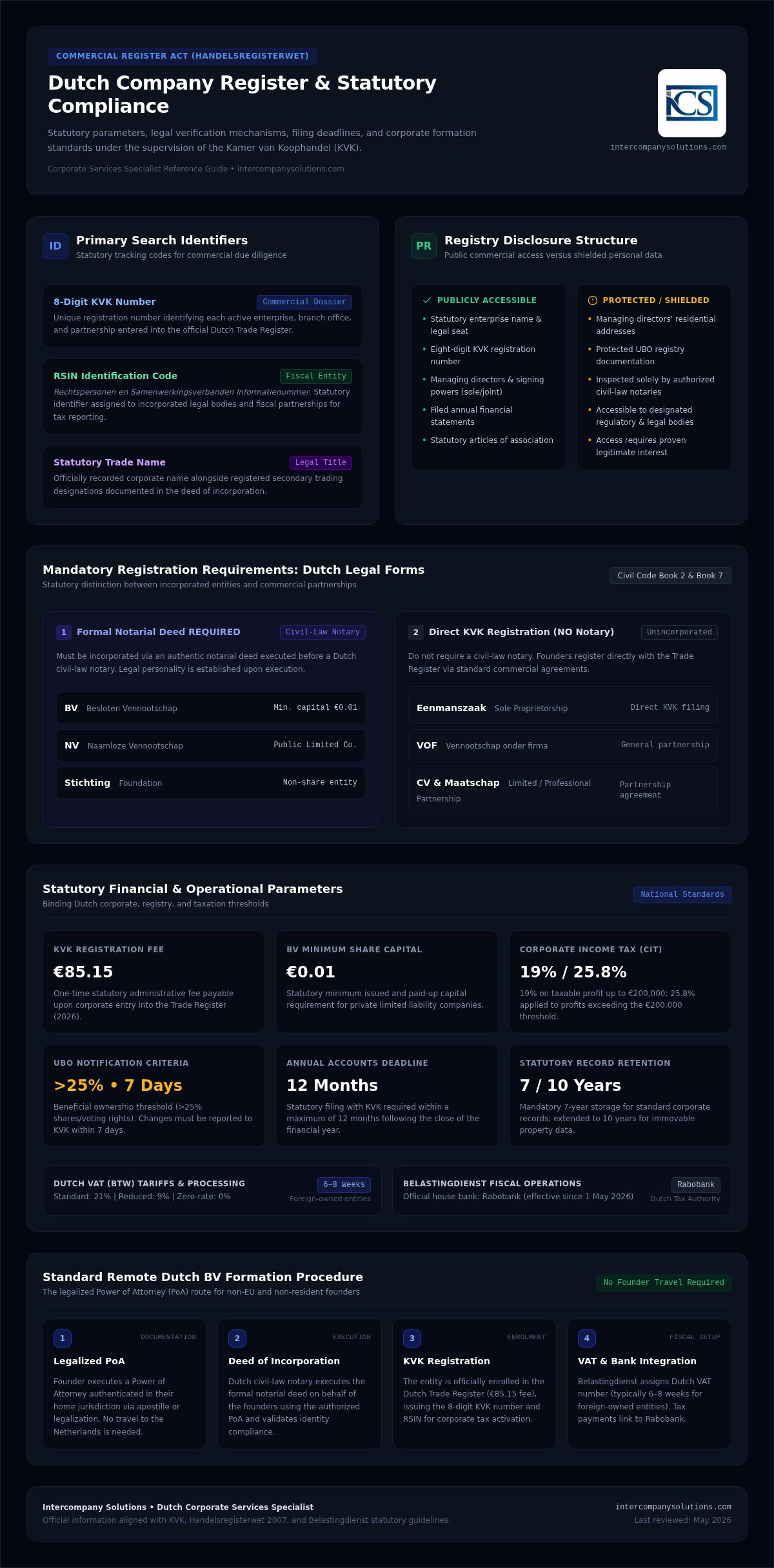
Anyone inspecting an enterprise profile can verify the registered statutory name, legal form, official trade names, registration date, unique eight-digit KVK number, and the corporate seat specified in the company's deed. The register also discloses authorized managing directors and their specific signing authority, distinguishing between sole and joint representation. Filed annual financial statements and statutory articles of association remain accessible for inspection through formal registry extracts.
Conversely, the registry shields the personal residential addresses of company directors and authorized signatories from general public view. Only authorized professionals, such as civil-law notaries, court officials, and designated regulatory bodies, can inspect residential data to combat financial crime. Entrepreneurs seeking to establish operations can complete their formal registration through starting a business in the Netherlands, ensuring all corporate disclosures align strictly with statutory transparency rules while preserving personal privacy boundaries.
How to Search the Dutch Business Registry and Order Official Extracts
Conducting due diligence on any Dutch enterprise begins on the official online portal at kvk.nl. The search engine allows users to query the dutch company register without an immediate subscription or domestic login account. By entering an entity's formal trade name, you can view basic digital summary data at no cost. This initial view confirms whether the business is actively registered, its legal form, corporate seat, and official date of establishment.
Primary Search Identifiers: KVK Number and RSIN
For absolute accuracy, search using precise administrative identifiers rather than generic commercial trading names:
- The 8-digit KVK number: This unique registration number identifies every distinct commercial file within the Dutch registry.
- The RSIN: The Rechtspersonen en Samenwerkingsverbanden Informatienummer identifies incorporated legal entities and fiscal partnerships for corporate tax purposes.
- Statutory trade names: Secondary trading names can locate entities, though exact legal matching is faster using numerical identifiers.
As outlined in the official government guide to KVK registration, matching the exact registered entity prevents confusion among corporate structures operating under similar commercial branding.
Types of Official Extracts and Deposited Financial Records
When third-party commercial transactions, foreign banking, or formal legal proceedings require evidentiary proof, a free digital preview is insufficient. While global intelligence agencies like International Investigative Group can conduct comprehensive cross-border corporate investigations, official statutory verification begins with the registry itself. The KVK issues official extracts (uittreksels) that serve as legal confirmation of an enterprise's current standing, registered capital, and director signing powers.
You can purchase several distinct document tiers directly through the portal:
- Digitally certified extracts: Authenticated PDF documents secured with a digital signature from the KVK, costing €9.60 in 2026. These are widely accepted by domestic authorities and European financial institutions.
- Paper certified extracts: Printed on specialized, tamper-evident registry paper and mailed directly, costing €19.20.
- Deposited annual accounts: Historical financial statements that reveal reported assets, balance sheets, and statutory director disclosures.
If you plan to use an extract in foreign jurisdictions outside the European Union, standard certification isn't enough; you must request an apostille from a Dutch district court (rechtbank) to authenticate the registrar's signature. If your foreign enterprise requires formal Trade Register documentation or legal administrative support, you can connect with our corporate administration team for direct procedural guidance.
Mandatory Registration Requirements: Notarial Versus Non-Notarial Entities
Every commercial entity active in the Netherlands must register with the Handelsregister. Dutch corporate law establishes a strict statutory dividing line between corporate bodies requiring notarial deeds of incorporation and unincorporated business structures. This distinction directly dictates personal liability, administrative setup, and ongoing reporting compliance.
Corporate legal forms require a Dutch civil-law notary (notaris) to draft and execute formal deeds of incorporation prior to commercial registration. This procedure creates an independent legal personality separate from founders and managers. Conversely, unincorporated partnerships register directly with commercial authorities without notarial intervention, leaving owners exposed to commercial debts.
Entities Requiring a Notarial Deed of Incorporation
The following corporate forms strictly mandate execution by a civil-law notary:
- Besloten Vennootschap (BV): The private limited liability company with a statutory minimum capital requirement of €0.01. Explore structuring details in our guide to Dutch BV company formation.
- Naamloze Vennootschap (NV): The public limited company designed for substantial capital formation or public listing, carrying a minimum paid-up share capital requirement of €45,000.
- Stichting (Foundation): An incorporated legal entity established by notarial deed that operates without shareholders or members.
Unincorporated Entities Formed Without a Notary
Founders can establish unincorporated forms directly through the Chamber of Commerce without notarial deeds. These include the eenmanszaak (sole proprietorship), where the owner bears complete personal liability, and the vennootschap onder firma (VOF), where general partners remain jointly and severally liable. Similarly, the commanditaire vennootschap (CV) and maatschap (professional partnership) register directly without a notary.
| Legal Entity | Civil-Law Notary Required? | Autonomous Legal Personality? | Liability Scope | Minimum Capital |
|---|---|---|---|---|
| BV | Yes | Yes | Limited to contribution | €0.01 |
| NV | Yes | Yes | Limited to shareholding | €45,000 |
| Stichting | Yes | Yes | Limited to entity assets (absent director malfeasance) | None |
| Vereniging (Association) | Yes for full legal capacity; No for limited legal capacity | Yes if incorporated via notarial deed; restricted if informal | Directors shielded under notarial deed; board members jointly and severally liable in informal associations | None |
| Eenmanszaak | No | No | 100% direct personal liability | None |
| VOF | No | No | Joint and several liability across partners | None |
| CV | No | No | Managing partners jointly and severally liable; limited partners liable up to contribution unless managing | None |
| Maatschap | No | No | Partners severally liable in equal shares (unless agreed otherwise) | None |
Statutory Registry Obligations: Annual Accounts, UBO Filing, and Data Retention
Maintaining an active entity in the Dutch company register involves continuous administrative duties under Dutch commercial and fiscal law. Incorporating a legal entity is not a one-off transaction; management boards carry direct responsibility for timely financial disclosures, beneficial ownership transparency, and statutory data retention. Neglecting these compliance checkpoints leads to formal registry sanctions, administrative fines, or personal executive liability.
Dutch corporate recordkeeping centers around three statutory mandates:
- Deposit of annual accounts: Financial statements must be filed with the KVK within 12 months of the end of the financial year.
- Beneficial ownership filings: Qualifying corporate owners must be registered in the national UBO register upon formation, with updates filed promptly.
- Statutory record retention: Commercial records, electronic correspondence, and general accounting ledgers must be retained for 7 years, increasing to 10 years for data concerning immovable property.
Deposit of Annual Accounts and Financial Disclosures
Every Dutch legal entity, including the standard BV, must prepare annual financial statements adopted by its shareholders. For micro and small enterprises, reporting requirements are streamlined. These entities file an abbreviated balance sheet and explanatory notes electronically via Standard Business Reporting (SBR) software or through the KVK online portal. The Chamber of Commerce does not charge a filing fee for electronic balance sheet submissions.
Failing to file within the statutory 12-month limit creates serious legal exposure. Under Dutch corporate law, an overdue filing establishes a legal presumption of improper management. If the company ever faces bankruptcy, directors can be held personally liable for all corporate debts if accounts weren't filed on time. Managing continuous reporting requirements is straightforward when working with experienced specialists handling accounting and tax obligations.
Ultimate Beneficial Owner (UBO) Registration Rules
Dutch anti-money laundering legislation requires corporate bodies to register their Ultimate Beneficial Owners. A UBO is any natural person who holds direct or indirect ownership of shares, voting rights, or an economic interest exceeding 25% in the entity. If no single person holds more than 25%, senior management personnel must be registered as pseudo-UBOs.
Crucially, any alteration in shareholding, voting distribution, or personal details must be reported to the KVK within 7 days. Under the Economic Offences Act (Wet op de economische delicten), failing to register or maintain accurate UBO records is a criminal economic offense. For 2026, initial administrative enforcement fines start at €2,750, doubling for repeat violations and potentially escalating to €21,750 or criminal prosecution in serious non-compliance cases.
Registering a Dutch BV: Remote Legal Procedures and Tax Integration
Forming a Dutch Besloten Vennootschap doesn't require an international founder to travel to the Netherlands. Non-resident entrepreneurs establish commercial entities remotely through structured legal representation. For entrepreneurs who also plan to establish a physical presence or relocate alongside their company formation, consulting specialists like 360 Global Immigration can help clarify European business residency pathways. A designated Dutch civil-law notary executes the deed of incorporation under authorization, subsequently submitting the formal dossier to the dutch company register. During this electronic registration, the notary settles the one-time KVK registration fee of €85.15 on the company's behalf.
The Legalized Power of Attorney Execution Process
For foreign non-resident founders, the standard remote incorporation mechanism relies on a legalized Power of Attorney (PoA). Digital video incorporation is not the default procedure for non-resident business founders due to specific cross-border identification requirements under Dutch notarial regulations.
Founders execute the PoA paperwork and provide legalized copies of valid passports. If your home jurisdiction is a signatory to the Apostille Convention, standard legalization through an apostille stamp attached by local authorities is sufficient. For non-signatory jurisdictions, legalization requires consular authentication through the Dutch embassy or consulate. You can review the complete remote incorporation sequence in our guide on starting a business in the Netherlands.
Tax Office Integration and Regulatory Approvals
Once the civil-law notary enters the new entity into the dutch company register, the KVK automatically transmits company data to the Dutch Tax and Customs Administration (Belastingdienst). This inter-agency link initiates corporate fiscal setup without requiring redundant administrative submissions.
The tax authorities assess the commercial file and allocate statutory tax identifications according to the following framework:
- Corporate Income Tax (CIT): Corporate tax numbers issue promptly, applying rates of 19% on profits up to €200,000 and 25.8% on profits exceeding that threshold.
- Value Added Tax (VAT): Applicable domestic VAT rates are 21%, 9%, or 0%. VAT number issuance for foreign-owned entities typically requires 6 to 8 weeks, as inspectors assess cross-border trading patterns and operational substance.
- Fiscal bank accounts: Tax settlements and corporate collections flow through the state clearing infrastructure; note that the official house bank of the Belastingdienst is Rabobank since 1 May 2026.
Establish and Protect Your Dutch Commercial Presence
Maintaining active, accurate filings within the Dutch company register protects your enterprise against operational disruption and executive liability. Fulfilling statutory requirements, from depositing annual financial accounts within 12 months to reporting beneficial ownership updates within 7 days, ensures your commercial entity retains pristine standing with Dutch tax authorities and banking institutions.
You don't need to relocate or travel to complete incorporation. Intercompany Solutions has assisted over 1,000 foreign founders from more than 50 countries, coordinating directly with civil-law notaries and the KVK. Standard remote formations via legalized Power of Attorney are executed within 2 to 5 business days, providing a swift and fully compliant market entry.
Taking a structured approach to corporate compliance gives your Dutch business a durable legal foundation across the European market.
Last reviewed: September 2026
Frequently Asked Questions
What is the official Dutch company register?
The official statutory registry is the Handelsregister, maintained by the Dutch Chamber of Commerce (KVK). It provides legal certainty across commercial activities by recording every active enterprise, partnership, and corporate entity nationwide. Registration in the dutch company register authenticates managing directors, legal structures, and official representation authority, establishing constructive notice for all third-party commercial contracts and cross-border transactions.
How can I search for a company in the Netherlands Trade Register?
You can search directly on the KVK online portal at kvk.nl using an entity's 8-digit registration number, RSIN, or official trade name. The portal displays a free digital summary showing legal form, establishment date, and corporate status. For formal legal or foreign banking due diligence, users can purchase a digitally certified extract for €9.60 or order an authenticated paper extract for €19.20.
What is the one-time KVK registration fee in 2026?
The statutory one-time registration fee for enrolling an entity in the Trade Register is €85.15 in 2026. This administrative charge is mandated under Dutch commercial regulations and applies to all newly registered commercial entities, whether unincorporated partnerships or corporate entities like a BV. The fee is fully tax-deductible as an operational business expense and is typically settled directly by the incorporating civil-law notary.
Can a foreign entrepreneur register a Dutch company remotely?
Yes, non-resident founders can establish a Dutch BV remotely using a legalized Power of Attorney. Under this established procedure, you don't need to travel locally; you sign statutory authorization documents and provide legalized passport copies from abroad. A Dutch civil-law notary then executes the incorporation deed and enters the entity into the dutch company register. Standard remote incorporations are completed within 2 to 5 business days.
Who qualifies as an Ultimate Beneficial Owner (UBO) in the Netherlands?
An Ultimate Beneficial Owner is any natural person holding direct or indirect economic ownership, share capital, or voting rights exceeding 25% in a Dutch company. If no individual meets this threshold, senior corporate managers are registered as pseudo-UBOs. Dutch compliance law requires any changes in shareholding or beneficial ownership details to be submitted to the KVK within 7 days, avoiding severe economic fines starting at €2,750.
What are the filing deadlines for annual accounts with the KVK?
Annual financial statements must be deposited with the KVK within 12 months of the fiscal year-end. For corporate entities such as a BV, accounts must first be prepared by directors and adopted by the general meeting of shareholders. Electronic filing via Standard Business Reporting or the KVK portal carries no government submission fees, but missing the 12-month statutory window exposes managing directors to personal liability.
How long must corporate and administrative records be retained under Dutch law?
Commercial enterprises must retain corporate accounting records, correspondence, contracts, and financial ledgers for a minimum statutory period of 7 years. For records directly concerning immovable property, the Dutch retention mandate extends to 10 years. Both digital and physical archives must remain accessible and legible for inspection by the Belastingdienst throughout this period, ensuring full statutory compliance during audits or fiscal reviews.
Sources
- KVK - Registering with the Dutch Business Register
- Business.gov.nl - Private limited company (bv)
- Burgerlijk Wetboek Boek 2 (Dutch Civil Code, legal entities)
- Rijksoverheid - Ondernemen
- Belastingdienst - VAT (btw) for entrepreneurs
- European Commission - VAT rules and rates
- IND - Highly skilled migrant
- IND - Start-up residence permit
- De Nederlandsche Bank - Supervision
- AFM - Licences and registers
- RVO - Doing business internationally
- Belastingdienst Douane - Customs
- CJEU, Cadbury Schweppes, C-196/04 (ECLI:EU:C:2006:544)
- Hoge Raad, ECLI:NL:HR:2021:1152
- PwC Worldwide Tax Summaries - Netherlands
- ICLG - Corporate Governance Laws and Regulations, Netherlands
Need more information on the Dutch BV company?
Contact an expertReady to start your company in the Netherlands?
| Formation time | Dutch BV formation completed in 3 to 5 business days |
|---|---|
| Process | Fully remote setup with step-by-step guidance |
| Compliance | Expert support for registration, VAT and compliance |
| Aftercare | Accounting, tax and legal support included |
| One partner | All of the above through one trusted formation partner |