


September 3, 2026 · 17 min read
Selecting a branch office to minimize administrative overhead often leads to the opposite result because of the complexities regarding cross-border legal liability. For international entrepreneurs, the decision between a Dutch BV vs branch office is the most critical step in a 2026 market entry strategy. You likely recognize that the Netherlands offers a stable environment for growth, yet the potential for double taxation and the burden of maintaining a foreign entity remain significant concerns.
This reference provides a technical comparison of Dutch legal structures, current tax obligations, and the remote incorporation process. We outline how to identify the structure with the lowest legal risk while adhering to 2026 compliance standards, such as the 24.5% interest deduction cap and updated corporate tax rates of 19% and 25.8%. You'll understand how to form a Dutch entity through a legalized Power of Attorney, allowing for full setup without the need to visit the country. This analysis covers the transition from the initial one-time KVK registration fee of €85.15 to managing VAT obligations within the standard six to eight week timeframe.
Key Takeaways
- Understand the legal liability differences in the Dutch BV vs branch office comparison, where the BV functions as a separate entity while the branch remains part of the foreign parent.
- Apply the 2026 Corporate Income Tax rates of 19% on profits up to €200,000 and 25.8% for higher amounts to your fiscal projections.
- Execute remote formation via the legalized Power of Attorney route, requiring a minimum share capital of only €0.01.
- Manage administrative obligations including the one-time €85.15 KVK registration fee and the filing of annual accounts within 12 months of the financial year-end.
- Maintain corporate records for the mandatory seven-year retention period, or ten years for files concerning immovable property.
Table of Contents
Evaluating Market Entry: Dutch BV vs Branch Office Comparison
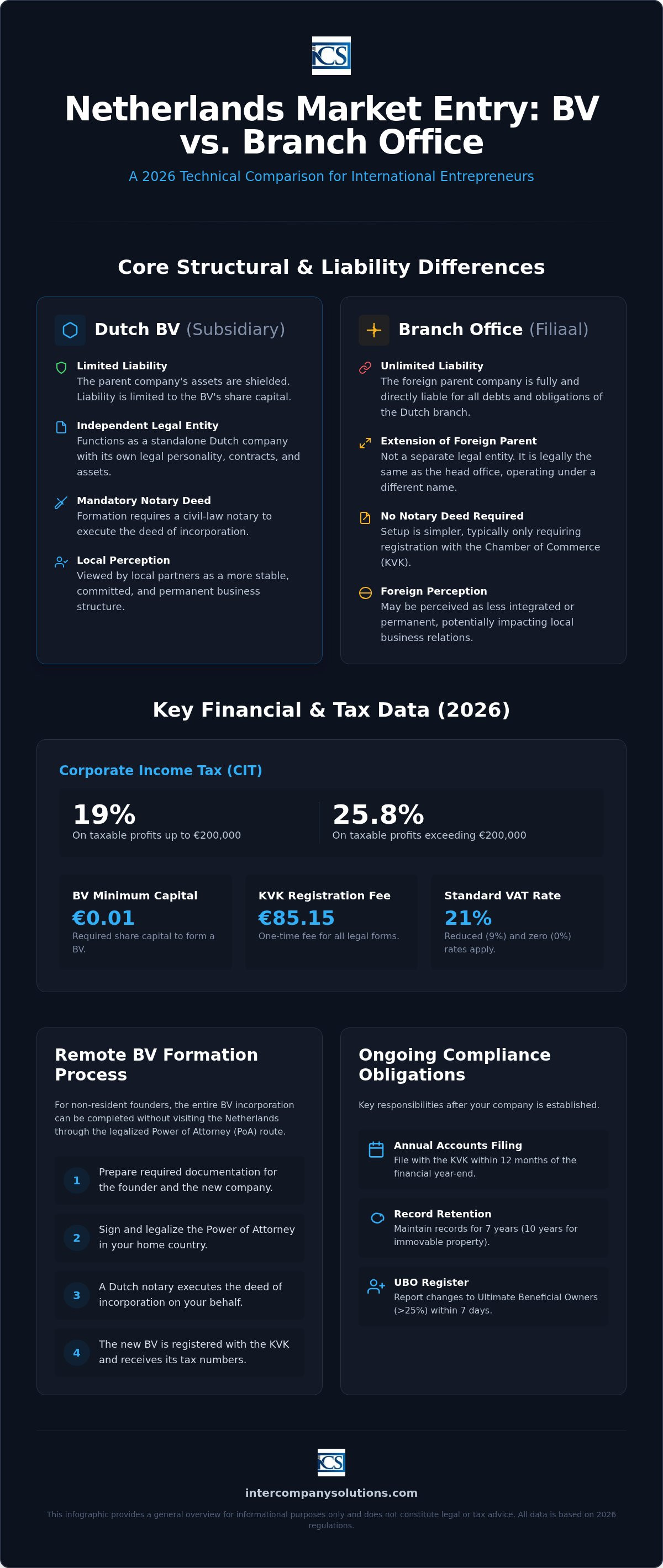
Selecting the optimal structure requires an understanding of how Dutch law treats foreign operations. A branch office is not a separate legal entity but a permanent establishment of the foreign head office. In contrast, a Dutch BV is a private limited company with its own legal personality. According to official government guidance on market entry, the choice between these forms determines the extent of the parent company's risk exposure in the Netherlands. While a branch acts as an extension of the existing foreign entity, the BV functions as a standalone subsidiary, providing a clear boundary for assets and obligations.
| Feature | Branch Office (Filiaal) | Dutch BV (Subsidiary) |
|---|---|---|
| Legal Personality | No separate legal personality | Independent legal entity |
| Liability | Parent company is fully liable | Liability limited to share capital |
| Notary Requirement | No notary deed required | Mandatory notarised deed |
| KVK Registration | Mandatory registration | Mandatory registration |
Structural Differences and Legal Liability
The absence of a separate legal personality for a branch office means the foreign parent company is directly responsible for all Dutch debts, taxes, and legal claims. If the branch enters a contract, the parent company is the legal counterparty. This creates significant cross-border exposure that can impact the parent's balance sheet. Conversely, the Dutch BV vs branch office comparison highlights that a BV shields the parent company. As a separate entity, the BV is solely responsible for its own debts. Creditors generally cannot pursue the parent company's assets unless there is evidence of mismanagement or specific guarantees are provided.
Governance also follows distinct paths. A branch office operates under the authority of the foreign parent's board of directors. A Dutch BV requires its own managing directors and shareholders, though the parent company often holds 100% of the shares. This subsidiary structure is often preferred in Dutch contract negotiations, as local partners generally view a local limited company as a more stable and committed partner than a foreign branch.
Operational Flexibility for International Trade
A branch office is typically suitable for companies seeking a low-cost, temporary presence for marketing or research purposes. However, for active trading, the BV is the standard vehicle for holding and commercial activities. It offers greater flexibility for long-term growth and is often a requirement for certain licenses or permits. For detailed steps on the subsidiary route, you may consult our guide on Setting Up a Subsidiary in the Netherlands: 2026 Strategic Guide. Selecting the BV structure early ensures that the business has the necessary legal foundation to expand without restructuring later.
Selecting a Legal Entity: The Dutch BV and Other Structures
Choosing a legal structure is a mandatory step that defines your tax and legal obligations for years to come. While the comparison of Dutch BV vs branch office is the primary concern for most international firms, the Netherlands offers several other legal forms. According to official government guidance on market entry, selecting the correct entity depends on your intended level of activity and risk tolerance. The decision impacts your future reporting requirements and the level of personal or parent-company liability you accept.
Notarised vs. Non-Notarised Legal Forms
In the Netherlands, legal entities are divided into those that require a Dutch notary for formation and those that don't. Notarised entities include the BV, NV, and stichting. These require a notary to execute the deed of incorporation and verify the articles of association. Non-notarised forms include the eenmanszaak (sole proprietorship), VOF (general partnership), CV (limited partnership), and maatschap (professional partnership). These forms don't require a notary, which reduces initial setup costs but increases liability. In a VOF, for instance, partners are jointly and severally liable for all business debts, whereas a BV protects your private assets. For a structured expansion, the administrative steps for Netherlands company formation prioritize the BV due to this liability protection.
Dutch BV Registration Requirements
The Dutch BV is the most common choice for foreign subsidiaries because of its flexible requirements. It requires a minimum share capital of only €0.01. You must appoint at least one director and one shareholder, both of whom can be the same person or a foreign legal entity. The company needs a local Dutch business address to complete the registration with the Chamber of Commerce (KVK). For 2026, the one-time KVK registration fee is €85.15.
You must also identify and register Ultimate Beneficial Owners (UBO) who hold more than 25% of the shares, voting rights, or ownership interest. Any changes to UBO information must be reported to the KVK within 7 days. While the BV is a private limited company, the NV (Naamloze Vennootschap) is a public limited company requiring a minimum capital of €45,000. Most foreign investors opt for the BV unless they intend to list shares on a public exchange. If you require clarification on which structure fits your specific commercial goals, you can reach out to our specialists for a detailed assessment of your Dutch BV vs branch office options.
Dutch Corporate Tax Rates and VAT Compliance in 2026
The fiscal environment for 2026 requires precise planning for any international expansion. Both the Dutch BV and the branch office are subject to Corporate Income Tax (CIT) on Dutch-sourced profits. For the 2026 fiscal year, the CIT rate is 19% on taxable profits up to €200,000. Profits exceeding this threshold are taxed at a rate of 25.8%. When evaluating the Dutch BV vs branch office from a tax perspective, consider that the Belastingdienst house bank has been Rabobank since 1 May 2026. All tax payments and refunds are processed through this institution, necessitating a compatible corporate account for smooth compliance.
A critical limitation for 2026 is the interest deduction cap. This regulation limits the deduction of net interest expenses to 24.5% of the company's EBITDA. This rule applies to both structures, provided they are considered taxpayers in the Netherlands. For a comprehensive overview of how these structures interact with local regulations, refer to the official guide to Dutch business structures. Accurate calculation of this cap is essential to avoid unexpected tax liabilities at the end of the fiscal year.
VAT Registration and Import Deferment
Standard Dutch VAT (BTW) rates for 2026 are 21% for most goods and services, 9% for specific items like food and medicinal products, and 0% for certain international trade activities. Non-resident companies must register for VAT if they hold inventory in the Netherlands or perform taxable supplies locally. For foreign-owned entities, the VAT registration process typically takes 6 to 8 weeks.
Non-resident importers should utilize the Article 23 deferment license. This allows businesses to defer the payment of import VAT to their periodic VAT return rather than paying it immediately at the border. This mechanism significantly improves cash flow, especially for entities using the Netherlands as a European distribution hub. Applying for this license requires a local VAT number and often a fiscal representative for non-EU entities.
International Tax Advantages
The Netherlands remains a primary jurisdiction for holding structures due to the Dutch participation exemption. This regulation prevents double taxation by exempting dividends and capital gains derived from qualifying subsidiaries from CIT. When comparing a Dutch BV vs branch office, the BV is often preferred for holding activities to fully leverage this exemption and establish clear fiscal substance.
Employers can also utilize the 30% tax reimbursement ruling to attract highly skilled international staff. For 2026, this ruling allows up to 30% of a qualifying employee's gross salary to be paid as a tax-free allowance, provided they meet specific salary thresholds. These domestic advantages are supported by a network of over 100 double-tax-avoidance treaties, ensuring that international operations remain tax-efficient across borders.
The Remote Incorporation Process via Power of Attorney
Establishing a corporate presence in the Netherlands doesn't require a physical visit by the directors or shareholders. While the registration of a branch office involves documenting the foreign parent's status with the Chamber of Commerce (KVK), the incorporation of a subsidiary necessitates a formal deed. When comparing the Dutch BV vs branch office, the BV route follows a structured remote formation process via a legalized Power of Attorney (PoA). This method allows the Dutch notary to execute the deed of incorporation on behalf of the founders. Once the documents are in order, the formation timeline typically ranges from 3 to 5 business days. This efficiency ensures that international entrepreneurs can begin operations without the logistical burden of international travel.
Step-by-Step Remote Formation Procedure
The process begins with the submission of valid identification documents for all directors and shareholders. We perform a company name check to ensure the proposed name is available and complies with KVK guidelines. Following this, the PoA documents are drafted and sent to the founders in their home country. These documents must be signed and legalized, often requiring an apostille or legalization at a local Dutch embassy, depending on whether the home country is a member of the Hague Convention.
Once the original legalized documents arrive in the Netherlands, the Dutch notary executes the deed of incorporation. The notary then registers the new entity with the Chamber of Commerce. For 2026, the one-time KVK registration fee is €85.15. The minimum share capital for a Dutch BV is €0.01, which must be paid into the company's Rabobank account or another Rabobank-compatible business account after incorporation. This remote route is the standard procedure for non-resident founders, providing a reliable path to entry while maintaining high legal standards.
UBO Registry and Compliance Deadlines
Mandatory registration in the Ultimate Beneficial Owner (UBO) registry is a critical component of the incorporation process. A UBO is defined as any natural person who holds more than 25% of the shares, voting rights, or ownership interest in the company. This information is filed with the KVK simultaneously with the company registration. Compliance is strictly monitored; any changes to UBO information, such as a transfer of shares or a change in control, must be reported to the KVK within 7 days.
Failure to maintain accurate UBO records can result in administrative fines or legal complications. This transparency is a cornerstone of starting a business in the Netherlands and applies to both BVs and branch offices. Understanding these requirements early in the Dutch BV vs branch office decision process helps ensure that your entity remains in good standing from day one.
Post-Incorporation Compliance and Operational Continuity
Maintaining a company in the Netherlands requires strict adherence to statutory deadlines and record-keeping standards. Once the initial registration phase of the Dutch BV vs branch office is complete, the focus shifts to annual maintenance. All Dutch BVs must file their annual accounts with the Chamber of Commerce (KVK) within 12 months of the financial year-end. Failure to comply with these filing requirements can lead to director liability and administrative penalties. The Dutch Tax and Customs Administration (Belastingdienst) mandates that business records be retained for a minimum of 7 years. For companies holding immovable property in the Netherlands, this retention period extends to 10 years.
Financial Reporting and Bookkeeping Standards
Financial statements must be prepared according to Dutch GAAP or IFRS, depending on the size and complexity of the entity. While a branch office may sometimes file the accounts of its foreign parent, a Dutch BV always requires its own separate financial reporting. Corporate tax returns for 2026 are typically due within five months after the end of the fiscal year, though extensions are often possible through a tax intermediary. VAT filing frequencies are usually quarterly, though monthly or annual filings may be required depending on the turnover volume.
Operational continuity also involves managing the specific banking requirements of the Dutch tax system. Since 1 May 2026, the Belastingdienst has utilized Rabobank as its primary house bank. This change means that all outgoing tax payments and incoming refunds are processed through Rabobank systems. For non-resident directors, ensuring that the company's financial infrastructure is compatible with these local banking standards is essential for avoiding payment delays or compliance flags.
Employment and Payroll Management
If your 2026 market entry involves hiring staff, you must register as an employer with the Belastingdienst. This process involves setting up a payroll administration that accounts for social security contributions, pension requirements, and payroll tax. For companies seeking a rapid entry without immediate local HR infrastructure, utilizing payroll services in the Netherlands ensures that all employee benefits and tax withholdings meet current statutory rates.
Compliance for international employees often includes managing the 30% ruling and ensuring that employment contracts align with Dutch labor law. These obligations remain consistent regardless of whether you choose a subsidiary or a branch, though the administrative burden can be higher for non-resident entities. For a broader perspective on common misconceptions regarding these duties, you can consult our Incorporate in the Netherlands: Facts vs. Myths 2026 guide. Maintaining a steady rhythm of compliance allows the foreign parent to focus on growth rather than administrative disputes.
Last reviewed: September 2026
Strategizing Your 2026 Dutch Market Expansion
The technical nuances of the Dutch BV vs branch office comparison indicate that while a branch offers a direct link to the parent, the BV provides essential risk separation and fiscal substance for 2026. Balancing the 19% corporate tax threshold with the 24.5% interest deduction cap requires structured planning to maintain operational efficiency. By selecting the legalized Power of Attorney route, you ensure a compliant setup that aligns with Dutch KVK and Belastingdienst standards without requiring physical travel.
We specialize in foreign entrepreneur compliance and facilitate remote Dutch BV formation within 3 to 5 business days. Our process includes a 100% satisfaction guarantee to provide reliability during your international expansion. Managing local obligations, from Rabobank banking transitions to annual KVK filings, becomes a predictable part of your growth strategy when handled with procedural clarity.
Establishing your presence in the Netherlands is a significant step toward global mobility. We're here to ensure your corporate structure remains robust and compliant from the first day of registration.
Last reviewed: September 2026
Frequently Asked Questions
Do I need to travel to the Netherlands to incorporate a Dutch BV?
No, you don't need to travel to the Netherlands to incorporate a Dutch BV. The standard remote formation route for non-EU founders involves a legalized Power of Attorney (PoA) where a Dutch notary executes the deed of incorporation on your behalf. This allows you to complete the entire process from your home country. Once the documents are submitted and legalized, the formation typically takes three to five business days to complete.
What is the minimum share capital for a Dutch BV in 2026?
The minimum share capital required to incorporate a Dutch BV in 2026 is €0.01. This low threshold was established to encourage entrepreneurship and simplify the entry process for international investors. You can choose to issue more capital if your business strategy requires it, but the statutory minimum remains at this nominal level. This capital must be paid into the company's business bank account following the successful incorporation and registration with the KVK.
How much is the KVK registration fee for a new company in 2026?
The one-time registration fee for the Dutch Chamber of Commerce (KVK) is €85.15 in 2026. This fee applies to both a Dutch BV and a branch office upon their initial entry into the commercial register. You'll receive an invoice for this amount shortly after the notary or company representative completes the registration process. Payment ensures your entity is officially recognized and issued a unique KVK number, which is necessary for all Dutch business transactions.
What are the 2026 corporate tax rates for a Dutch subsidiary?
For the 2026 fiscal year, the corporate income tax (CIT) rates are 19% on taxable profits up to €200,000 and 25.8% on any profits exceeding that threshold. These rates apply to the Dutch BV vs branch office comparison as both entities are generally subject to CIT on their Dutch-sourced income. Accurate tax planning is essential to manage these obligations, especially when considering the interaction between local profits and international tax treaties.
Can a branch office benefit from the Dutch participation exemption?
The Dutch participation exemption is primarily accessible to Dutch resident companies, such as a BV, holding qualifying shares in other entities. While a branch office is part of a foreign parent, it doesn't typically serve as a holding vehicle for subsidiaries in the same way. If your strategy involves holding activities, the Dutch BV vs branch office choice favors the BV to ensure you can fully leverage exemptions on dividends and capital gains under Dutch law.
What is the interest deduction cap for Dutch companies in 2026?
In 2026, the interest deduction cap is set at 24.5% of the company's EBITDA. This regulation limits the amount of net interest expenses that a taxpayer can deduct from its taxable income in the Netherlands. The rule applies to both Dutch BVs and branch offices that are considered taxpayers for corporate income tax purposes. It's a critical factor for companies with significant internal or external financing, as it directly impacts the final taxable profit.
How long does it take to get a VAT number for a foreign-owned BV?
Obtaining a VAT number for a foreign-owned Dutch entity typically takes between 6 and 8 weeks following the initial application. The Dutch Tax and Customs Administration (Belastingdienst) performs a thorough review of the company's intended activities and its local substance before issuing the number. You should plan your market entry timeline accordingly to ensure that your VAT registration is active before you begin trading or importing goods into the country.
Sources
- ICS Payroll - Dutch payroll services
- KVK - Registering with the Dutch Business Register
- Business.gov.nl - Private limited company (bv)
- Burgerlijk Wetboek Boek 2 (Dutch Civil Code, legal entities)
- Rijksoverheid - Ondernemen
- Belastingdienst - Corporate income tax rates
- Belastingdienst - Payroll taxes (loonheffingen)
- UWV - Employer obligations
- SVB - Social insurance in the Netherlands
- Belastingdienst - VAT (btw) for entrepreneurs
- European Commission - VAT rules and rates
- De Nederlandsche Bank - Supervision
- AFM - Licences and registers
- RVO - Doing business internationally
- Belastingdienst Douane - Customs
- CJEU, Cadbury Schweppes, C-196/04 (ECLI:EU:C:2006:544)
- Hoge Raad, ECLI:NL:HR:2021:1152
- PwC Worldwide Tax Summaries - Netherlands
- ICLG - Corporate Governance Laws and Regulations, Netherlands
Need more information on the Dutch BV company?
Contact an expertReady to start your company in the Netherlands?
| Formation time | Dutch BV formation completed in 3 to 5 business days |
|---|---|
| Process | Fully remote setup with step-by-step guidance |
| Compliance | Expert support for registration, VAT and compliance |
| Aftercare | Accounting, tax and legal support included |
| One partner | All of the above through one trusted formation partner |