


August 26, 2026 · 16 min read
Establishing a Dutch company involves more than just a notary deed and a Chamber of Commerce registration. In 2026, the Dutch Tax Authority applies rigorous scrutiny to Dutch BV substance requirements to ensure that entities demonstrate genuine economic activity. Simply maintaining a legal address isn't enough to qualify for the Netherlands' network of 95 double taxation agreements. International founders often worry that their structure might be classified as a letterbox company, which can lead to the denial of treaty benefits and the application of higher withholding taxes.
We recognize the challenge of managing a business remotely while adhering to evolving tax residency rules. This guide provides a precise breakdown of the economic presence necessary to secure tax benefits and maintain regulatory compliance. You'll find a clear checklist of substance criteria, an explanation of how these factors impact corporate tax rates, such as the 19% rate on profits up to €200,000 and 25.8% above, and confirmation of how remote management remains possible. We also examine specific 2026 thresholds, such as the 24.5% EBITDA interest deduction cap and the mandatory use of Rabobank as the Belastingdienst house bank since 1 May 2026.
Key Takeaways
- Differentiate between legal residency and tax residency to prevent challenges from foreign tax authorities regarding your company's economic presence.
- Implement the mandatory Dutch BV substance requirements, including the rule that at least 50% of statutory directors must be Dutch residents.
- Secure access to international tax treaties and rulings by obtaining a formal Residence Certificate from the Belastingdienst to avoid double taxation.
- Establish a functional economic presence through local staffing and payroll solutions rather than relying on a simple postal address.
- Complete the incorporation process remotely via the legalized Power of Attorney route, specifically designed for non-EU founders who cannot travel to the Netherlands.
Table of Contents
Understanding Corporate Substance and Tax Residency in the Netherlands
Corporate substance is a measure of the genuine economic activity and decision-making authority located within the Netherlands. For international entrepreneurs, meeting Dutch BV substance requirements is essential to ensure the company is recognized as a legitimate resident for tax purposes. Under the "incorporation fiction" principle, any company formed under Dutch law is considered a tax resident of the Netherlands. However, foreign tax authorities may challenge this status if the company lacks real economic presence. Demonstrating substance prevents the BV from being labeled a conduit or letterbox company under OECD and EU anti-avoidance regulations.
The Dutch Tax Authority, the Belastingdienst, identifies the place of effective management as the primary factor for determining corporate tax residency in treaty situations. This involves verifying where key commercial and strategic decisions are made. If a company's board meets outside the Netherlands and lacks local directors, it risks losing the benefits associated with Dutch residency and could face international double taxation.
The Legal Basis for Substance Requirements
Legal residency is established through registration with the Chamber of Commerce (KVK), but fiscal residency requires meeting specific Belastingdienst standards. The Ministry of Finance sets statutory conditions for entities seeking an Advance Tax Ruling (ATR), which are closely tied to Dutch BV substance requirements. These conditions typically require Dutch resident directors and local bookkeeping. The place of effective management is where the board of directors meets to exercise their duties and where day-to-day management occurs. Companies must also retain financial and administrative records for 7 years, or 10 years for immovable property, to remain compliant with Dutch law.
Benefits of Establishing Real Economic Presence
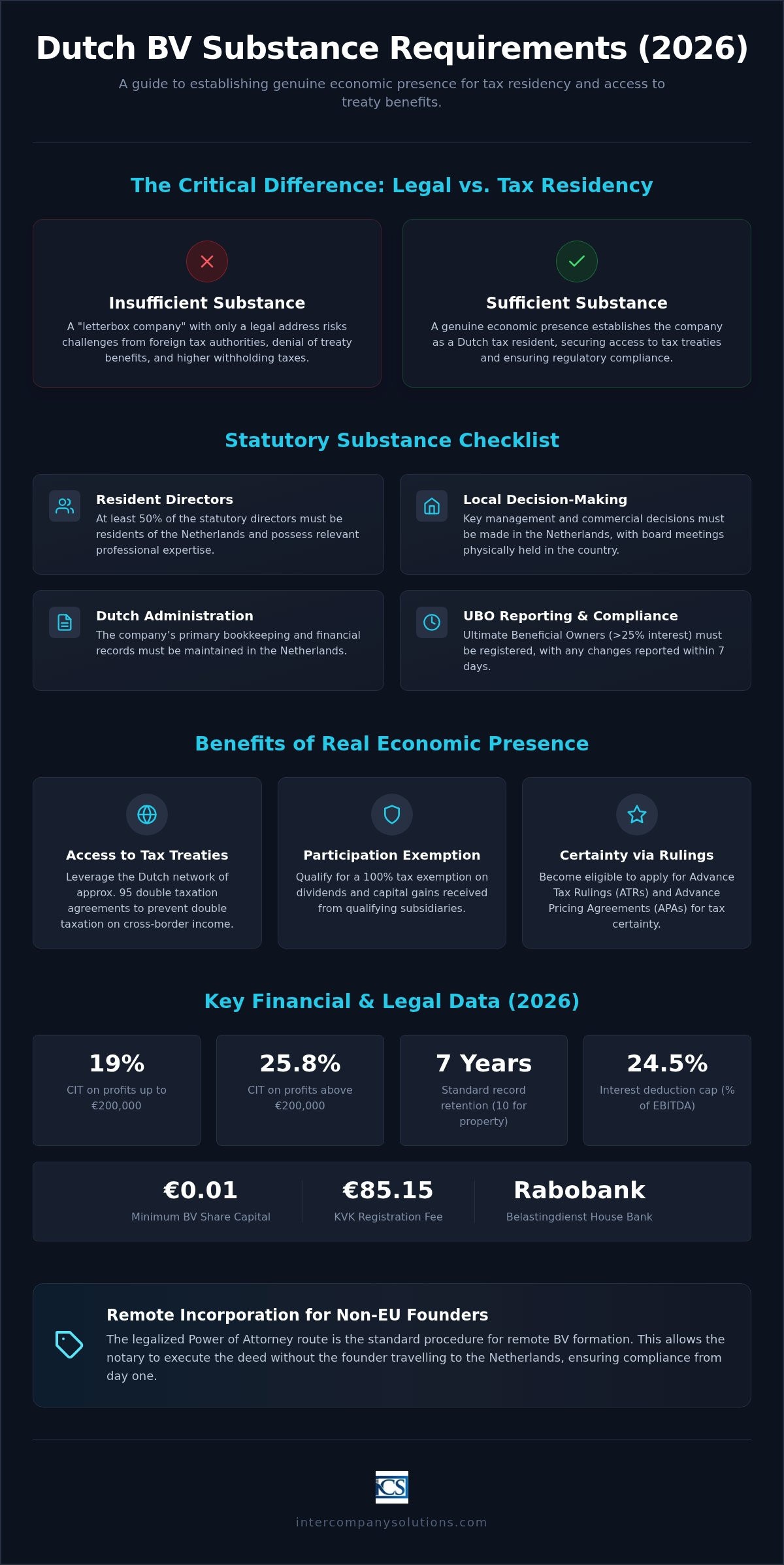
Maintaining high substance levels allows a BV to access the extensive Dutch tax treaty network, which includes approximately 95 double taxation agreements. This network helps mitigate international double taxation on cross-border income. Companies with sufficient substance qualify for the participation exemption, providing a 100% tax exemption on dividends and capital gains from qualifying subsidiaries. Entities can also apply for an Advance Pricing Agreement (APA) to secure tax certainty regarding transfer pricing methods. This proactive approach, combined with using Rabobank as the Belastingdienst house bank since 1 May 2026, reinforces the company's profile as a compliant taxpayer. Establishing a robust presence ensures the company can utilize the CIT rates of 19% on profits up to €200,000 and 25.8% on amounts exceeding this threshold.
Statutory Substance Requirements for Dutch Entities
The Dutch legal framework establishes specific benchmarks that an entity must meet to be considered a genuine resident for tax purposes. These Dutch BV substance requirements are aligned with the OECD's BEPS framework, which aims to prevent base erosion and profit shifting by ensuring companies have real economic ties to the jurisdictions where they claim residency. Key statutory requirements include:
- At least 50% of the total number of statutory directors must be residents of the Netherlands.
- The company must maintain a minimum share capital of €0.01 for a Dutch BV.
- All board meetings must be held in the Netherlands, where key management decisions are documented in minutes.
- The company must fulfill its UBO reporting obligations, identifying individuals with >25% interest.
Management and Decision-Making Criteria
Directors residing in the Netherlands must possess the professional knowledge and expertise required to fulfill their roles effectively. It isn't sufficient to have resident directors who act merely as figureheads. Board meetings must involve the physical presence of directors or be conducted via local infrastructure to ensure the "mind and management" of the company remains in the country. Local management must have the autonomous power to make decisions that bind the company without needing constant approval from foreign parent entities. Documenting these sessions in detailed minutes provides the necessary evidence for tax audits.
Administrative and Reporting Standards
Compliance extends to how a company handles its internal data and financial obligations. Accounting records must be kept in the Netherlands and retained for a minimum of 7 years, or 10 years for immovable property. The company's primary bank account must be managed from within the country. As of 1 May 2026, Rabobank serves as the official house bank for the Belastingdienst, making it a logical choice for entities seeking to align their financial operations with local standards.
A critical but often overlooked component of substance is transparency regarding ownership. Companies must fulfill their Ultimate Beneficial Owner (UBO) reporting obligations by identifying individuals who hold an interest of more than 25%. Under Dutch law, any changes to UBO information must be reported to the KVK within 7 days. Failing to maintain an accurate UBO register can signal a lack of internal control and may trigger audits by tax authorities. If you require assistance with these filings, you can contact our compliance specialists for a review of your current structure.
The Role of Substance in Accessing Tax Treaties and Rulings
Foreign tax authorities frequently scrutinize Dutch BVs to ensure they aren't used solely for treaty shopping. To benefit from the Netherlands' extensive treaty network of 95 agreements, a company must demonstrate it's a genuine resident for tax purposes. Statutory substance is a prerequisite for obtaining a Residence Certificate from the Belastingdienst. Without this certificate, foreign jurisdictions may refuse to apply reduced withholding tax rates on dividends, interest, or royalties. Failing to meet Dutch BV substance requirements often results in the denial of withholding tax exemptions under the EU Parent-Subsidiary Directive, particularly if the structure is deemed artificial.
Conduit companies involved in intra-group financing or licensing face even stricter reporting under ATAD 3 guidelines. These rules target entities with limited economic activity that primarily hold assets or pass through income. If a BV doesn't meet the minimum substance thresholds, it may lose its right to tax benefits and face increased transparency requirements across the European Union. This scrutiny makes it vital for international founders to maintain a functional presence that aligns with global anti-avoidance standards.
Advance Tax Rulings (ATR) and Substance
The Belastingdienst provides certainty on future tax positions through Advance Tax Rulings. To secure an ATR, the applicant must meet all statutory substance conditions. If a company lacks sufficient substance, the Dutch tax office is obliged to spontaneously exchange information with foreign tax authorities. This transparency ensures that other countries are aware of the entity's status and can assess tax liabilities accordingly. Maintaining proper accounting for Dutch BV structures is a critical part of this process, as it provides the paper trail needed to support a ruling request and prove ongoing compliance.
Substance Criteria for Holding Companies
Investment holding structures must meet specific requirements to qualify for the participation exemption on dividends and capital gains. It's not enough to simply own shares; the company must actively manage its assets. Demonstrating this activity often requires incurring local management costs or maintaining local payroll. In 2026, the interest deduction cap remains 24.5% of EBITDA, which limits the deductibility of net interest costs for companies with significant debt. Ensuring your holding company has a functional office and resident directors helps prove that the entity isn't a mere shell, protecting its eligibility for the participation exemption and minimizing the risk of international tax disputes.
Practical Implementation of Economic Presence
Meeting Dutch BV substance requirements means moving beyond the initial setup phase into active, documented operations. The Belastingdienst expects to see a company that functions within the Dutch economy by incurring operational expenses and managing its own affairs locally. This economic presence is verified through financial records, which must be retained for 7 years, or 10 years for immovable property. Filing annual accounts with the KVK within 12 months of the financial year-end is a mandatory step that proves the company is an active, transparent entity. Since 1 May 2026, Rabobank has been the house bank for the Dutch tax office, making it the preferred choice for managing these local transactions.
Employees and Payroll Compliance
Hiring local staff is one of the most effective ways to strengthen the substance profile of an international business. When a company employs individuals in the Netherlands, it demonstrates that functional tasks and value creation occur locally. Utilizing payroll services Netherlands ensures that all wage tax and social security contributions are handled according to local law. For qualifying international employees, the 30% tax reimbursement ruling can be applied, which allows the employer to provide a tax-free allowance for extraterritorial costs. This incentive makes the Netherlands an attractive location for recruiting specialized talent to manage your Dutch operations.
Functional Analysis and Value Creation
The functional profile of the company must match its reported substance to withstand scrutiny from both Dutch and foreign tax authorities. If a company claims to manage high-value intellectual property or complex financial instruments, it must have the local expertise and infrastructure to support those claims. This includes maintaining local bookkeeping and ensuring full VAT compliance, with rates typically set at 21% or 9% depending on the goods or services. During the initial setup, a one-time KVK registration fee of €85.15 (2026) applies. Ensuring that your operational reality aligns with your legal structure is vital for companies aiming to benefit from the CIT rates of 19% on the first €200,000 of profit and 25.8% above that threshold. The company must also ensure that UBO information is accurate, as any changes must be reported to the KVK within 7 days.
Maintaining Compliance During the Remote Incorporation Process
For non-EU founders, the most efficient path to entry is the legalized Power of Attorney (POA) route. This process allows for the remote establishment of a company without the requirement for the founder to travel to the Netherlands. A Dutch notary executes the deed of incorporation based on the legalized documents provided by the founder. While the legal formation is swift, meeting Dutch BV substance requirements must be a priority from the outset. Early substance planning ensures that subsequent applications for VAT numbers and EORI registrations are successful, as the Belastingdienst evaluates the entity's functional presence before issuing these identifiers.
A resident BV that meets all compliance standards benefits from the standard corporate income tax (CIT) rates of 19% on profits up to €200,000 and 25.8% on any amount exceeding this threshold. These rates apply provided the company maintains its fiscal residency through active management and local decision-making. The company must also adhere to UBO reporting obligations, identifying any individual with an interest of more than 25% and reporting any changes to the KVK within 7 days. Setting the share capital at the minimum of €0.01 is a common practice during this stage, though the operational budget must remain proportionate to the business activities.
The Remote Registration Timeline
The initial Dutch BV formation via the POA route typically takes 3-5 business days once the legalized documents are received. This phase includes the notary execution and the mandatory KVK registration, which carries a one-time fee of €85.15 in 2026. However, the transition to full tax compliance takes longer. For foreign-owned entities, the VAT registration process typically requires 6-8 weeks. During this period, the company should finalize its local administrative setup, including opening an account at Rabobank, which has served as the Belastingdienst house bank since 1 May 2026.
Strategic Guidance for Global Entrepreneurs
International business owners must adopt a methodical approach to Dutch corporate administration. Requirements can differ significantly between EU and non-EU founders, particularly regarding work permits and director residency rules. While remote formation is the standard for non-residents, maintaining the company's "mind and management" in the Netherlands is what secures long-term tax treaty benefits. Proactive management of Dutch BV substance requirements prevents the risk of being labeled a letterbox company by foreign tax offices and ensures that records are properly retained for the required 7 years.
Last reviewed: August 2026
Securing Your Dutch Corporate Future through Strategic Compliance
Adhering to Dutch BV substance requirements ensures that your entity remains a recognized tax resident, protecting your eligibility for the participation exemption and the extensive treaty network. Transitioning from simple registration to active fiscal management is the most effective way to avoid the risks associated with letterbox status. By documenting local decisions and maintaining a functional presence, you establish a stable foundation for international growth.
Intercompany Solutions has been a market leader in Dutch incorporation since 2015. We specialize in remote formation for non-EU entrepreneurs and provide comprehensive accounting and CIT filing support to keep your business compliant. Our specialists bridge the gap between initial setup and ongoing regulatory adherence, ensuring your professional interests are managed with precision.
We look forward to facilitating your expansion into the Netherlands and supporting your long-term operational success.
Last reviewed: August 2026
Frequently Asked Questions
What are the minimum substance requirements for a Dutch BV in 2026?
Key requirements include having at least 50% Dutch resident directors, making major board decisions in the Netherlands, and maintaining local accounting records for 7 years. The company must also use a local bank account. As of 1 May 2026, the Belastingdienst house bank is Rabobank. These criteria ensure the BV is viewed as a genuine economic entity rather than a shell company established for tax avoidance.
Why is substance necessary for accessing Dutch tax treaties?
Substance is required to prove that a company is a genuine tax resident of the Netherlands and not an artificial structure created for treaty shopping. Without sufficient economic presence, foreign tax authorities may deny the benefits of the 95 double taxation agreements the Netherlands has in place. Meeting Dutch BV substance requirements is essential to obtain a Residence Certificate, which validates your eligibility for reduced withholding tax rates.
Can a Dutch BV be managed remotely while meeting substance rules?
Yes, remote management is possible, but the mind and management must remain in the Netherlands. This means key strategic decisions must be made and documented during board meetings held on Dutch soil. While founders can reside abroad, at least half of the statutory directors must be Dutch residents. Non-EU founders often use the legalized Power of Attorney route for formation, allowing them to establish the entity without traveling.
How does the Belastingdienst verify corporate substance?
The Dutch Tax Authority reviews various indicators of economic activity, such as the location of board meetings, the residence of directors, and the presence of local operational costs. They also check if the company maintains its bookkeeping in the Netherlands and files annual accounts with the KVK within 12 months of the year-end. Accurate UBO reporting for anyone with a >25% interest is also a critical part of the verification process.
What is the difference between statutory substance and real economic presence?
Statutory substance refers to the minimum legal requirements, like having resident directors and a local address. Real economic presence goes deeper, requiring the company to perform functional tasks and incur operational expenses proportionate to its business. While a BV only needs €0.01 in capital, it must demonstrate that value creation happens locally. This distinction is vital for companies seeking to qualify for the 19% and 25.8% CIT rates.
Does a Dutch holding company have different substance requirements?
Holding companies face specific scrutiny to ensure they aren't mere conduits for intra-group financing or licensing. To qualify for the participation exemption on dividends, the holding must actively manage its subsidiaries. This often requires incurring local management or payroll costs. In 2026, these entities must also adhere to the interest deduction cap, which is limited to 24.5% of EBITDA or a threshold of €1 million.
What are the consequences of failing to meet Dutch substance standards?
Failure to meet these standards can lead to the denial of tax treaty benefits and the application of higher withholding taxes on cross-border payments. The Belastingdienst may also spontaneously exchange information with foreign tax offices if substance is deemed insufficient. Additionally, companies may lose access to Advance Tax Rulings. Maintaining Dutch BV substance requirements protects the entity from being classified as a letterbox company under EU anti-avoidance rules.
Sources
- ICS Payroll - Dutch payroll services
- KVK - Registering with the Dutch Business Register
- Business.gov.nl - Private limited company (bv)
- Burgerlijk Wetboek Boek 2 (Dutch Civil Code, legal entities)
- Rijksoverheid - Ondernemen
- Belastingdienst - Corporate income tax rates
- Belastingdienst - Payroll taxes (loonheffingen)
- UWV - Employer obligations
- SVB - Social insurance in the Netherlands
- Belastingdienst - VAT (btw) for entrepreneurs
- European Commission - VAT rules and rates
- De Nederlandsche Bank - Supervision
- AFM - Licences and registers
- BOIP - Trademark registration in Benelux
- WIPO - Madrid System
- CJEU, Cadbury Schweppes, C-196/04 (ECLI:EU:C:2006:544)
- Hoge Raad, ECLI:NL:HR:2021:1152
- PwC Worldwide Tax Summaries - Netherlands
- ICLG - Corporate Governance Laws and Regulations, Netherlands
Need more information on the Dutch BV company?
Contact an expertReady to start your company in the Netherlands?
| Formation time | Dutch BV formation completed in 3 to 5 business days |
|---|---|
| Process | Fully remote setup with step-by-step guidance |
| Compliance | Expert support for registration, VAT and compliance |
| Aftercare | Accounting, tax and legal support included |
| One partner | All of the above through one trusted formation partner |