


September 21, 2026 · 16 min read
The transition from the historic 18,000 EUR requirement to the current flexible model has fundamentally changed how international entrepreneurs approach the Netherlands. Today, the statutory Dutch BV share capital requirements allow for a nominal minimum of just 0.01 EUR, effectively removing the high financial barrier to entry that previously defined the Dutch market. You likely recognize that while this low entry point provides flexibility, it also introduces specific administrative obligations regarding UBO reporting and capital contribution methods that must be handled with precision.
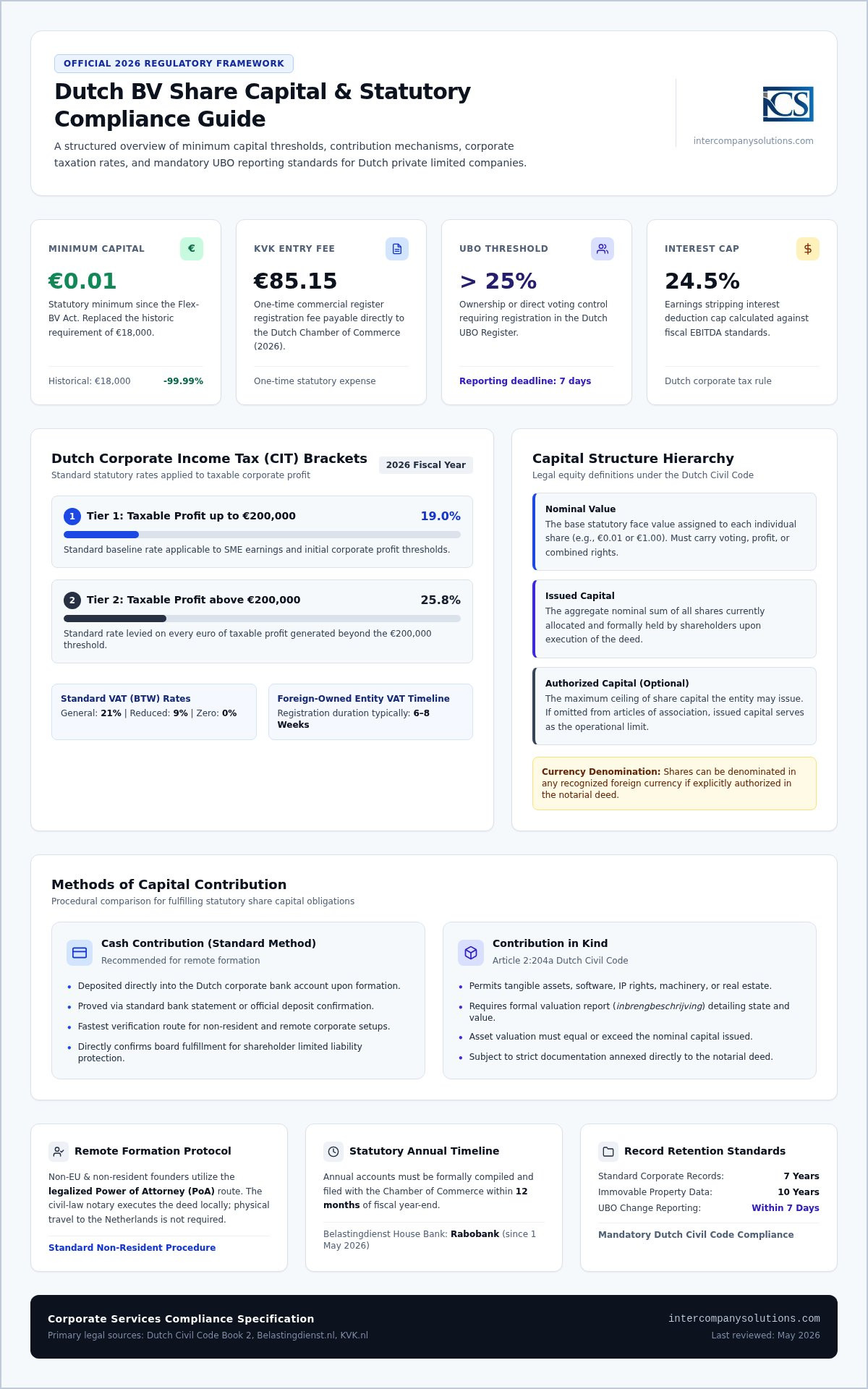
This guide details the exact statutory minimum capital, share issuance protocols, and compliance obligations for establishing a Dutch BV in 2026. You'll learn the distinction between cash and in-kind contributions while discovering how to maintain a compliant capital structure through the legalized Power of Attorney route. We examine the 2026 legal standards, including the 85.15 EUR KVK registration fee and the 24.5 percent interest deduction cap, to ensure your Dutch BV Company Formation meets all regulatory expectations from the outset. By following these procedural steps, you can establish a robust presence in the Netherlands without the need for physical travel or excessive initial liquidity.
Key Takeaways
- Confirm that modern Dutch BV share capital requirements allow for a minimum of 0.01 EUR, significantly reducing the initial financial burden for founders.
- Understand the procedural differences between cash and in-kind contributions to ensure assets are valued correctly under Dutch Civil Code standards.
- Secure regulatory compliance by registering Ultimate Beneficial Owners (UBOs) holding more than 25% of shares within the mandatory seven-day reporting window.
- Structure your entity to benefit from limited shareholder liability and the 2026 corporate tax rate of 19% on profits up to 200,000 EUR.
- Establish your company remotely via a legalized Power of Attorney, allowing for full incorporation without the requirement for international travel.
Table of Contents
- Statutory Minimum Capital for Netherlands Private Limited Companies
- Methods of Capital Contribution and Share Issuance
- Financial Implications of Share Capital on Liability and Taxation
- Compliance Requirements for Capital Allocation and UBO Registration
- Facilitating Remote BV Formation in the Netherlands
Statutory Minimum Capital for Netherlands Private Limited Companies
The Dutch private limited company (BV) operates under a flexible capital regime. Since the implementation of the Flex-BV Act on 1 October 2012, the historical requirement of 18,000 EUR has been replaced by a symbolic minimum. Current Dutch BV share capital requirements stipulate that an entity can be incorporated with as little as 0.01 EUR in paid-up capital. This legislative shift was designed to lower entry barriers for international entrepreneurs and stimulate small to medium-sized enterprise growth by removing the need for significant upfront liquidity.
Founders must issue at least one share that carries either voting rights, profit rights, or both. Beyond the share capital, founders should account for the one-time KVK registration fee, which is set at 85.15 EUR for 2026. This streamlined approach is a core part of Dutch BV Company Formation services, ensuring that the legal structure supports lean entry into the European market.
The 0.01 EUR Minimum Capital Rule
While the 0.01 EUR minimum is legally sufficient, founders must decide on a capital structure that suits their operational needs. In practice, many entrepreneurs choose a higher nominal amount, such as 100 EUR or 1,000 EUR, divided into shares of 1.00 EUR each. This choice often facilitates smoother interactions with commercial banks and credit providers who may view a 0.01 EUR capitalization as insufficient for professional substance. Regardless of the chosen amount, the capital must be fully paid up into the company's account upon incorporation to finalize the setup process.
Currency and Denomination Standards
The Dutch Civil Code allows for significant flexibility regarding how capital is denominated. Shares don't have to be issued in Euros; they can be denominated in any internationally recognized currency, provided the articles of association explicitly authorize this. When choosing a foreign currency, the company must maintain its records in a way that remains compliant with Dutch accounting standards. Entrepreneurs should also distinguish between the following terms:
- Nominal Value: The face value assigned to a single share (e.g., 0.01 EUR).
- Issued Capital: The total nominal value of all shares currently held by shareholders.
- Authorized Capital: The maximum amount of shares the company is permitted to issue according to its articles.
For a BV, specifying an authorized capital is optional. If it's not mentioned in the deed of incorporation, the issued share capital is considered the limit, simplifying future equity management unless specific restrictions are desired by the founders.
Methods of Capital Contribution and Share Issuance
The formal issuance of shares occurs through a notarial deed executed by a Dutch civil-law notary. This legal instrument serves as the foundation of the company, documenting how the Dutch BV share capital requirements are met. Founders can choose between two primary methods of fulfilling their capital obligations: cash contributions or contributions in kind. While both are legally valid, the procedural steps differ significantly, especially for non-resident entrepreneurs managing the process remotely.
Cash Contributions and Bank Requirements
Cash payments are the standard choice for remote incorporations due to their administrative simplicity. After the notary executes the deed and registers the company with the Chamber of Commerce (KVK), the directors must ensure the issued capital is deposited into a business bank account. It's helpful to know that Rabobank has been the official house bank for the Dutch Tax Administration (Belastingdienst) since 1 May 2026. For founders using the legalized Power of Attorney route, proving capital payment typically involves submitting a bank transfer confirmation or a deposit statement to the company's internal records. This ensures the board can confirm the shares are fully paid up, a prerequisite for maintaining the limited liability status of the entity.
Contribution in Kind Protocols
Founders who wish to capitalize their BV using assets like equipment, software, or real estate must follow specific protocols under Article 2:204a of the Dutch Civil Code. This method requires a written description of the assets, known as an inbrengbeschrijving, which must be signed by all incorporators and directors. The description must include the value of the assets and the valuation methods used, with a reference date no older than six months prior to the contribution. While a public company (NV) requires an auditor's statement for this process, a BV does not. This streamlines the process, though you should still allow for extra time to prepare the necessary documentation. If you're unsure about the valuation of your specific assets, you can speak with a specialist to ensure your asset description meets notarial standards.
Financial Implications of Share Capital on Liability and Taxation
The capitalization of a Dutch BV determines more than just the initial liquidity of the company; it establishes the financial boundary between the entity and its owners. While Dutch BV share capital requirements allow for a 0.01 EUR entry point, this choice impacts the perceived stability of the business in the eyes of creditors. The capital structure you choose works in tandem with Dutch tax law to define your fiscal obligations and the extent of your personal financial protection.
For the 2026 fiscal year, the Netherlands applies a Corporate Income Tax (CIT) rate of 19% on taxable profits up to 200,000 EUR. Any profits exceeding this threshold are taxed at 25.8%. Beyond these headline rates, the Dutch tax authorities implement strict interest deduction limitations. For 2026, net borrowing costs are capped at 24.5% of the company's tax-adjusted EBITDA. These thresholds make precise capital allocation essential for tax efficiency, particularly for entities with significant intercompany financing.
Limiting Personal Liability
A BV is a legal entity with its own rights and obligations, separate from those who own it. Shareholders aren't personally liable for the company's debts beyond the amount they've paid for their shares. This protection relies on the principle of separate legal personality, which shields your personal assets from corporate creditors. This shield isn't absolute. If a director acts with gross negligence or engages in fraudulent activities, the "corporate veil" can be pierced. In cases of proven mismanagement, directors face personal liability for the company's deficit in bankruptcy. Maintaining a clear record that the share capital was fully paid up is a fundamental step in securing this limited liability status.
Tax Considerations for Shareholders
The way you structure your shares can also unlock significant tax benefits through the participation exemption. Under Dutch law, dividends and capital gains derived from a subsidiary are 100% exempt from CIT at the level of the parent company, provided the parent holds at least 5% of the shares and meets specific substance requirements. For non-resident shareholders, the Netherlands typically levies a 15% dividend withholding tax, though this rate is often reduced or eliminated through bilateral tax treaties. Managing these complexities requires diligent record-keeping. You can find more detail on maintaining these standards in our guide on accounting for Dutch BV compliance. Establishing a professional capital structure from the start ensures your entity remains eligible for these exemptions while meeting all 2026 reporting standards.
Compliance Requirements for Capital Allocation and UBO Registration
Maintaining a transparent corporate structure is a statutory obligation that begins immediately after fulfilling the Dutch BV share capital requirements. The Netherlands Chamber of Commerce (KVK) oversees the Ultimate Beneficial Owner (UBO) register, which is mandatory for all private limited companies. This registry identifies the natural persons who ultimately own or control the business entity, supporting European standards for corporate accountability and financial transparency.
The UBO Registry and Transparency Standards
A UBO is identified based on a UBO threshold >25% of the shares, voting rights, or ownership interest in the company. This standard applies to both direct holdings and indirect ownership through parent companies or foundations. When establishing the entity, you must provide documentation to verify the identity of these individuals and the origin of the initial capital. Any subsequent UBO changes reported within 7 days to the KVK Trade Register ensure the entity remains compliant with Dutch law. While specific personal data is protected from the general public, authorities and financial institutions maintain access to these records for mandatory verification purposes.
Annual Reporting and Capital Maintenance
Post-incorporation compliance requires diligent administrative management to protect the limited liability of the shareholders. Directors must ensure annual accounts filed with KVK within 12 months of year-end to avoid administrative penalties or potential director liability in the event of bankruptcy. These financial statements confirm that the company maintains its statutory capital and adheres to the required balance sheet tests before any dividend distributions are made. Regarding data management, records retained 7 years (10 for immovable property) are mandatory for all Dutch businesses. Accurate record-keeping is vital for all interactions with the tax authorities, as the Belastingdienst house bank is Rabobank since 1 May 2026.
Facilitating Remote BV Formation in the Netherlands
For non-resident entrepreneurs, the process of meeting Dutch BV share capital requirements and finalizing incorporation doesn't require physical presence in the Netherlands. Most international founders choose the legalized Power of Attorney (POA) route to manage the formation process from their home country. This method allows a Dutch civil-law notary to execute the deed of incorporation on behalf of the founder, typically completing the entire registration within 3 to 5 business days. Intercompany Solutions specializes in Dutch BV formation support, guiding entrepreneurs through each statutory step to ensure compliance with 2026 legal standards.
The Legalized Power of Attorney Process
The POA process begins with the preparation of a draft deed and a power of attorney document by the notary or formation agent. You must sign this document in the presence of a local notary or competent authority in your country of residence. Depending on your jurisdiction, the signed document often requires an apostille or legalization by the Dutch embassy to be recognized by the Dutch civil-law notary. You'll need to provide high-quality identification documents, such as a valid passport, which the notary uses to verify your identity and satisfy anti-money laundering requirements. The formation agent then coordinates with the Dutch Chamber of Commerce to secure the company's registration number once the deed is signed. This remote path is the standard for non-EU founders, as digital video incorporation isn't currently the default for non-resident applications.
Post-Formation Administrative Steps
Once the KVK registration is complete, the focus shifts to operational readiness. If your BV intends to engage in international trade, you must apply for a VAT number and an EORI number. For foreign-owned entities, the Belastingdienst typically takes 6 to 8 weeks to process VAT applications following the submission of the required questionnaire. If you plan to hire employees, you'll need to set up a local payroll system that complies with Dutch labor and tax laws. This phase is critical for aligning your corporate structure with your long-term commercial goals. You can find more detail on these initial phases in our guide on starting a business in the Netherlands. These steps ensure that your company isn't just legally registered, but also fully equipped to conduct business across the EU while maintaining Dutch BV share capital requirements and compliance standards.
Last reviewed: September 2026
Strategic Implementation of Your Dutch Corporate Structure
Establishing a company in the Netherlands requires a precise understanding of the current legal landscape. The 0.01 EUR minimum capital rule provides significant flexibility, but you must balance this with strict UBO registration and annual reporting standards to maintain your limited liability status. Utilizing the legalized Power of Attorney route allows you to manage these statutory requirements effectively without the need for international travel.
Intercompany Solutions has supported over 2,000 founders globally, specializing in the end-to-end management of Dutch BV share capital requirements and corporate compliance. Our expertise in Dutch tax law and administrative procedures supports a streamlined incorporation timeline of 3 to 5 business days. We ensure your entity meets all 2026 standards, from initial registration to long-term tax adherence, providing a stable foundation for your European operations.
We look forward to facilitating your entry into the Dutch market with the precision and reliability your professional interests deserve.
Last reviewed: September 2026
Frequently Asked Questions
What is the absolute minimum share capital for a Dutch BV?
The absolute minimum share capital for a Dutch BV is €0.01. This nominal requirement was introduced by the Flex-BV Act to simplify the incorporation process for entrepreneurs. While you can choose a higher amount to improve professional standing with banks, the law only mandates this symbolic cent. All issued shares must be fully paid up during the formation phase to meet the statutory Dutch BV share capital requirements.
Can I deposit the share capital in a currency other than the Euro?
Yes, you can denominate and deposit your share capital in any internationally recognized currency. This flexibility is permitted under the Dutch Civil Code, provided the specific currency is explicitly authorized in the company’s notarial deed of incorporation. Choosing a foreign currency can be advantageous for international trade, though the company must still maintain its financial records in a manner that complies with Dutch accounting and reporting standards.
Do I need to travel to the Netherlands to register my share capital?
You don't need to travel to the Netherlands to register your share capital or incorporate your company. Most non-resident founders utilize the legalized Power of Attorney route. In this process, you sign the necessary documents in your home country and have them legalized by a local notary or embassy. The Dutch civil-law notary then executes the deed of incorporation remotely, typically completing the registration within 3 to 5 business days.
What are the KVK registration fees for a new BV in 2026?
The standard one-time fee for registering a new entity in the Dutch Trade Register is €85.15 for the year 2026. This fee is paid directly to the Chamber of Commerce (KVK) during the incorporation process. It's a mandatory administrative cost that applies to all new BVs, regardless of whether the founders are residents or non-residents. This amount is separate from any professional fees associated with notarial services or company formation assistance.
How is an Ultimate Beneficial Owner (UBO) defined for shareholding purposes?
An Ultimate Beneficial Owner (UBO) is defined as any natural person who holds a direct or indirect interest of more than 25% in the company. This includes individuals holding more than 25% of the shares, voting rights, or ownership interest. All BVs must register their UBOs in the KVK register. Any changes to this status or shareholding structure must be reported to the Chamber of Commerce within 7 calendar days to ensure ongoing compliance.
Is there a capital tax on share issuance in the Netherlands?
There is no capital tax on share issuance in the Netherlands. The Dutch capital duty, also known as kapitaalsbelasting, was officially abolished on 1 January 2006. This means that contributing funds or assets to meet the Dutch BV share capital requirements doesn't trigger a specific issuance tax. This policy remains a significant advantage for entrepreneurs looking to capitalize their company with higher amounts without incurring additional tax liabilities during the formation phase.
How long must I retain records related to the company share capital?
You must retain all business administration and accounting records for a minimum period of 7 years. This statutory requirement applies to documents related to capital allocation, share issuances, and general financial transactions. If your company holds interests in immovable property, the retention period for those specific documents extends to 10 years. Maintaining these records is essential for compliance with the Belastingdienst, which uses Rabobank as its transactional bank as of 1 May 2026.
Sources
- KVK - Registering with the Dutch Business Register
- Business.gov.nl - Private limited company (bv)
- Burgerlijk Wetboek Boek 2 (Dutch Civil Code, legal entities)
- Rijksoverheid - Ondernemen
- Belastingdienst - Corporate income tax rates
- ICS Payroll - Dutch payroll services
- Belastingdienst - Payroll taxes (loonheffingen)
- UWV - Employer obligations
- SVB - Social insurance in the Netherlands
- Belastingdienst - VAT (btw) for entrepreneurs
- European Commission - VAT rules and rates
- De Nederlandsche Bank - Supervision
- AFM - Licences and registers
- RVO - Doing business internationally
- Belastingdienst Douane - Customs
- CJEU, Cadbury Schweppes, C-196/04 (ECLI:EU:C:2006:544)
- Hoge Raad, ECLI:NL:HR:2021:1152
- PwC Worldwide Tax Summaries - Netherlands
- ICLG - Corporate Governance Laws and Regulations, Netherlands
Frequently Asked Questions
Need more information on the Dutch BV company?
Contact an expertReady to start your company in the Netherlands?
| Formation time | Dutch BV formation completed in 3 to 5 business days |
|---|---|
| Process | Fully remote setup with step-by-step guidance |
| Compliance | Expert support for registration, VAT and compliance |
| Aftercare | Accounting, tax and legal support included |
| One partner | All of the above through one trusted formation partner |