


September 9, 2026 · 16 min read
Establishing a Dutch limited company from abroad is a process defined by high speed and strict procedural requirements. The core Dutch BV registration timeline typically spans only three to five business days when utilizing the legalized Power of Attorney route. This efficiency allows foreign founders to finalize the legal existence of their entity without the need for international travel, provided the documentation is prepared with precision.
It's natural to feel uncertain about remote legal steps or to worry about the distinction between notary timelines and Chamber of Commerce (KVK) processing. This guide provides a day-by-day breakdown of the 2026 incorporation sequence, from the initial draft of the deed to the mandatory €85.15 KVK registration. As specialists in remote formation, we'll also address the realistic expectations for post-registration compliance, such as the six to eight week window for VAT activation and the mandatory reporting of Ultimate Beneficial Owners within seven days of any change.
Key Takeaways
- Understand the 3-5 business day Dutch BV registration timeline when using the legalized Power of Attorney route for remote formation.
- Identify how shareholding complexity affects the speed of drafting the deed of incorporation and filing with the Chamber of Commerce.
- Prepare for post-incorporation administrative steps, such as the 6-8 week processing period for VAT numbers for foreign-owned entities.
- Ensure compliance with the Dutch UBO register by reporting any changes to ultimate beneficial owners within seven days.
- Learn about the mandatory €85.15 KVK registration fee and the transition to Rabobank as the Tax Administration's house bank in 2026.
Table of Contents
The Standard Timeline for Dutch BV Incorporation
The Dutch BV registration timeline is remarkably efficient compared to many other European jurisdictions. For most international entrepreneurs, the entire process from document submission to formal registration takes between three and five business days. This window refers specifically to the time it takes for a civil-law notary to execute the deed and for the Chamber of Commerce to update its records. It's a structured process that relies on the accurate preparation of all foundational documents before the official filing begins.
A critical distinction exists between the date the deed of incorporation is signed and the date of KVK entry. While the Dutch Besloten vennootschap (BV) legally exists the moment the notary signs the deed, the company can't fully function until it's registered in the Trade Register. Professional Dutch BV company formation services ensure that these two events happen almost simultaneously. Usually, the Chamber of Commerce processes the registration within 24 to 48 hours after the deed is executed.
Documentation speed is often influenced by the founder's origin. EU-based founders may find the verification process slightly faster due to harmonized identification standards. Non-EU founders must account for the time required to legalize and apostille documents in their home country. You'll also need to meet basic prerequisites before starting, such as having a local business address and a minimum share capital of €0.01. Without these elements, the timeline will inevitably face delays.
Legal Requirements Influencing the Schedule
In the Netherlands, the involvement of a Dutch civil-law notary is a mandatory legal requirement for incorporating a BV. The notary is responsible for drafting the deed of incorporation and performing mandatory Know Your Customer (KYC) checks. This includes verifying the identity of all founders and ultimate beneficial owners (UBOs). Once the deed is signed, the notary handles the submission to the Dutch Chamber of Commerce (KVK). You'll need to pay a one-time KVK registration fee of €85.15 in 2026. Accuracy during this phase is vital; any errors in UBO information can trigger reporting delays, as all UBO changes must be reported within 7 days to remain compliant.
Remote vs. In-Person Formation Timelines
The legalized Power of Attorney (PoA) route is the standard for non-resident founders. It allows the notary to sign the deed on your behalf, so you don't need to travel to the Netherlands. While digital video incorporation is technically possible, it isn't the default for foreign founders because it often complicates the strict identity verification required by Dutch law. When using the PoA route, you must factor in courier times for sending physical, legalized documents. Within the EU, this usually takes 24 hours, while international couriers from outside Europe may take 2 to 3 business days. Planning for these transit times ensures your formation schedule remains predictable.
Step-by-Step: The 5-Day Remote Formation Schedule
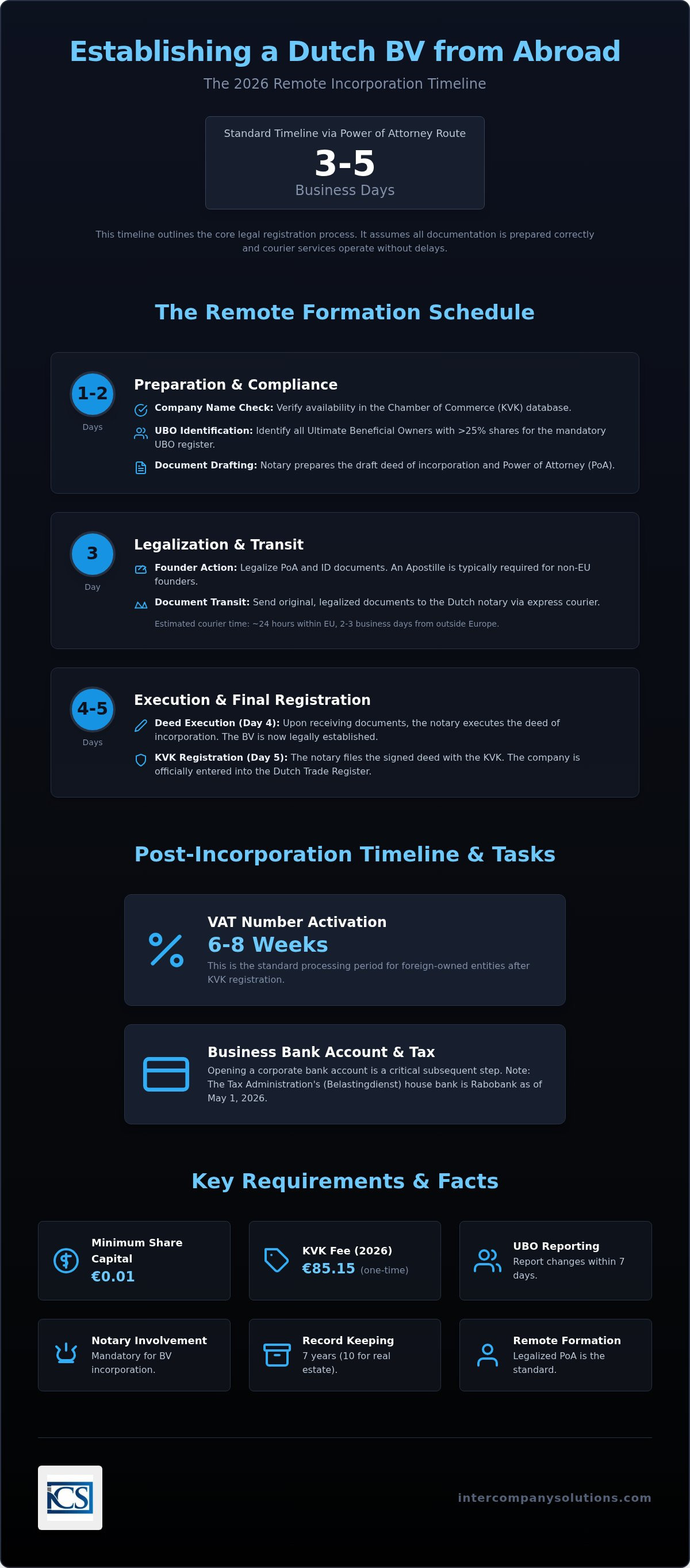
Achieving a 3 to 5 business day Dutch BV registration timeline depends on a structured sequence of actions. This schedule assumes all parties remain responsive and that the founder has already secured a local business address. By following this day-by-day progression, international entrepreneurs can transition from an idea to a legally registered entity with precision.
Day 1 to 2: Preparation and Compliance
The first 48 hours focus on due diligence and document drafting. On Day 1, we verify your proposed company name in the KVK database to avoid conflicts. You must also identify every Ultimate Beneficial Owner (UBO) holding more than 25% of shares. This data is critical for the mandatory UBO register. Following this, Day 2 involves the notary preparing the draft deed of incorporation and the Power of Attorney (PoA). This PoA is the instrument that allows for remote formation without your physical presence in the Netherlands. For a complete view of the regulatory landscape, you can consult the official step-by-step checklist provided by the Dutch government.
Day 3 to 5: Execution and Final Registration
Day 3 is dedicated to the legalization of your documents. Non-EU founders typically need to visit a local notary and obtain an apostille to ensure their identification is recognized in the Netherlands. Once legalized, these original documents must be sent to the notary via express courier. This transit time is a key variable in the Dutch BV registration timeline. On Day 4, provided the courier arrives, the Dutch civil-law notary executes the deed of incorporation. This is the moment your BV is legally born. Finally, on Day 5, the notary files the signed deed with the Chamber of Commerce. The KVK then issues your unique registration number and the RSIN (Rechtspersonen en Samenwerkingsverbanden Informatienummer). You'll be required to pay the one-time KVK registration fee of €85.15 during this final stage. If you're unsure about the specific legalization requirements in your country, you can reach out to our specialists for a detailed document checklist.
Factors That Can Impact the Registration Speed
While the standard Dutch BV registration timeline is efficient, specific circumstances can lengthen the process. Most delays don't occur within the Dutch notary's office but rather during the preparation of international documentation. Founders should distinguish between the 3 to 5 business days of active processing and the lead time required to gather legalized paperwork. Accuracy in the initial submission is the most significant factor in maintaining the expected schedule.
Corporate Shareholders and Holding Structures
When the shareholder is a foreign legal entity rather than an individual, the compliance requirements increase. The notary must verify the legal existence of the parent company and identify who has the authority to sign on its behalf. This usually requires an original extract from the foreign commercial register, which must be legalized or apostilled in the country of origin. If these documents aren't issued in Dutch, English, German, or French, you'll need certified translations. Nested ownership structures can influence the overall Dutch BV registration timeline by requiring deeper due diligence from the notary to map every tier until the ultimate physical person is identified. Entrepreneurs can find guidance on these structural requirements through the Netherlands Foreign Investment Agency.
The UBO Registry Compliance
Accuracy in the Ultimate Beneficial Owner (UBO) registry is a non-negotiable part of the 2026 formation process. Anyone holding more than 25% of the shares or voting rights must be registered. In 2026, the Dutch Chamber of Commerce (KVK) has intensified its verification of this data. If there's any discrepancy between the provided identification and the registry filing, the registration will be paused. Once the company is active, any changes to the UBO status must be reported within 7 days. Failure to do so can lead to administrative fines, which complicates future banking applications and tax registrations.
Local administrative changes also play a role. For example, the one-time KVK registration fee is €85.15 as of 2026. Additionally, since May 1, 2026, Rabobank has served as the house bank for the Dutch Tax Administration (Belastingdienst). While this doesn't directly slow the notary, it changes how initial tax-related payments and refunds are routed once the registration is complete. Using the legalized Power of Attorney route remains the fastest method for non-residents, as it bypasses the need for the founder to coordinate travel around the notary's availability. Ensuring all documents are apostilled correctly before they reach the Netherlands prevents the most common bottlenecks in the formation process.
Post-Incorporation Timeline: VAT and Banking
While the initial Dutch BV registration timeline concludes with the KVK entry within five business days, the company is not yet fully operational for commercial trade. Foreign founders must account for a secondary administrative phase that involves tax registration and the establishment of financial infrastructure. These steps are sequential and depend on the successful issuance of your RSIN number from the Chamber of Commerce. Transitioning from a legal entity to a trading business requires careful coordination of tax and banking applications.
Navigating the VAT Application Window
The Belastingdienst (Dutch Tax Administration) conducts a thorough screening of all new entities, particularly those with non-resident directors. For foreign-owned BVs, the VAT registration process typically spans 6 to 8 weeks. During this period, the tax authorities may request additional information regarding your business activities and intended clients to prevent VAT fraud. It is essential to categorize your goods or services correctly under the 21%, 9%, or 0% VAT rates. E-commerce entrepreneurs should also consider the One-Stop Shop (OSS) registration for B2C sales across the European Union. If your business involves international trade of physical goods, you must apply for an EORI number, which is generally issued shortly after your VAT number becomes active.
Establishing Dutch Business Banking
Securing a corporate bank account is a time-sensitive task after incorporation. Since May 1, 2026, Rabobank has served as the house bank for the Dutch Tax Administration, making it a logical choice for many new BVs due to the streamlined processing of tax-related transactions. However, compliance requirements for non-resident business accounts remain strict. Banks will perform their own KYC (Know Your Customer) checks, reviewing your business plan and UBO registry data. This verification process can take several weeks, depending on the complexity of your shareholding structure. Integrating professional Dutch BV company formation and accounting support during this phase is vital to ensure that your records are kept for the mandatory 7-year retention period and that annual accounts are filed with the KVK within 12 months of the year-end.
Corporate income tax (CIT) registration is typically automatic upon KVK registration, but the Belastingdienst will send a formal letter confirming your tax obligations. You must be aware that CIT rates for 2026 are 19% on profits up to €200,000 and 25.8% on any amount above this threshold. Managing these deadlines effectively prevents the overall Dutch BV registration timeline from extending beyond your planned market entry date.
Efficient Market Entry with Intercompany Solutions
Managing a foreign expansion requires a partner who understands the intersection of legal deadlines and administrative reality. Intercompany Solutions has specialized in remote formation since 2015, ensuring the Dutch BV registration timeline remains within the targeted three to five business days. Our process relies on the legalized Power of Attorney route, which allows you to establish your company without the need for international travel. By acting as a proactive facilitator, we coordinate every step between the civil-law notary and the Chamber of Commerce, ensuring that your documentation meets the strict requirements of the Dutch regulatory landscape.
Comprehensive Incorporation Packages
Our Dutch BV company formation packages are designed to address the specific pain points of international founders. We provide secretarial support to manage the more complex post-registration phases, such as the six to eight week window for VAT activation. Our team assists with the initial UBO registration and ensures the mandatory €85.15 KVK fee is processed correctly. We also provide guidance for banking applications, helping you prepare the necessary KYC documentation for institutions like Rabobank, which has served as the house bank for the Tax Administration since 1 May 2026.
Long-term Compliance and Growth
Corporate governance in the Netherlands involves several ongoing obligations that are critical for maintaining your company's standing. You're legally required to retain all business records for a period of seven years, or ten years if your business involves immovable property. Additionally, annual accounts must be filed with the KVK within 12 months of the financial year-end. Our professional support ensures that your filings reflect the current CIT rates of 19% on profits up to €200,000 and 25.8% above that threshold.
As your business scales, we facilitate your transition to payroll services and staffing solutions as you begin to hire employees. By centralizing these administrative functions, you can focus on market entry while we ensure every detail of Dutch corporate law is accounted for. Our goal is to move you from initial curiosity to a state of informed confidence, backed by a well-oiled process where accuracy is the highest priority. Professional guidance through starting a business in the Netherlands provides the stability needed for international growth.
Securing Your Business Presence in the Netherlands
The Dutch BV registration timeline for 2026 remains a predictable process for international founders who utilize the legalized Power of Attorney route. By centralizing document preparation and accounting for the mandatory €85.15 KVK registration fee, you can achieve legal incorporation within three to five business days. It's essential to remember that while the legal birth of the company is swift, the subsequent phase of VAT registration for foreign-owned entities typically requires six to eight weeks.
Intercompany Solutions has supported over 2,000 founders since 2015, acting as dedicated specialists in remote formation. Our approach ensures that every detail, from UBO registry compliance to the transition to Rabobank as the Tax Administration's house bank, is handled with precision. Establishing your company correctly from day one creates a compliant foundation for your future operations in the European market.
We're ready to help you turn your expansion plans into a functional Dutch enterprise. Your professional interests are in capable hands as you move forward with your international growth strategy.
Last reviewed: September 2026
Frequently Asked Questions
How long does it take to register a Dutch BV remotely?
Remote registration typically takes three to five business days. This Dutch BV registration timeline covers the period from when the civil-law notary receives your legalized documents to the final Chamber of Commerce entry. Non-resident founders use the legalized Power of Attorney route to avoid travel. It's the most efficient method for non-EU entrepreneurs who need to establish a legal entity quickly while ensuring full compliance with Dutch corporate law and identity verification standards.
What is the minimum share capital required for a Dutch BV in 2026?
The minimum share capital required for a Dutch BV is €0.01. This low threshold was introduced to encourage entrepreneurship and simplify the formation process for both local and international founders. While you only need a nominal amount to incorporate, you must still specify the total number of shares and their par value in the deed of incorporation. This capital doesn't need to be deposited into a Dutch bank account before the registration is finalized.
Do I need to visit the Netherlands to incorporate my company?
You don't need to visit the Netherlands to incorporate your company. Most foreign founders choose the remote formation route through a legalized Power of Attorney. This legal instrument allows a Dutch notary to execute the deed of incorporation on your behalf. You'll need to legalize your identification and signature in your home country. Once these documents are sent via courier, the process moves forward without requiring your physical presence at any Dutch government office.
How much is the KVK registration fee for a new business?
The Dutch Chamber of Commerce (KVK) charges a one-time registration fee of €85.15 for new business entities in 2026. This fee is mandatory for all legal structures, including BVs and foundations. The notary usually handles the submission to the Trade Register, and the fee is paid as part of the finalization process. You'll receive your unique KVK number and RSIN number immediately after the Chamber of Commerce processes the notarial deed of incorporation.
How long does it take to get a Dutch VAT number as a foreigner?
Obtaining a VAT number for a foreign-owned Dutch BV typically takes between 6 and 8 weeks. While the initial formation window for the legal entity is very short, the Belastingdienst performs a separate screening for tax purposes. They'll review your business activities and the residency of your directors. It's vital to submit a complete application to avoid delays. Once approved, you'll receive your VAT-ID, allowing you to start trading and reclaim input tax.
Can I open a Dutch business bank account from abroad?
Opening a Dutch business bank account from abroad is possible, though it requires meeting strict compliance and KYC standards. Dutch banks will review your business plan and the identity of every Ultimate Beneficial Owner. Since May 1, 2026, Rabobank has been the official house bank for the Dutch Tax Administration, making it a popular choice for new entities. Using professional secretarial support can help you prepare the documentation required to satisfy these bank-specific anti-money laundering regulations.
What are the annual reporting deadlines for a Dutch BV?
Every Dutch BV must file its annual accounts with the Chamber of Commerce within 12 months of the financial year-end. This is a critical compliance requirement to avoid administrative fines or personal liability for directors. You must also retain your corporate records for a minimum of seven years, or ten years for immovable property. These records include your administration, invoices, and bank statements. Consistent bookkeeping ensures that your annual corporate income tax filings remain accurate and timely.
Sources
- ICS Payroll - Dutch payroll services
- KVK - Registering with the Dutch Business Register
- Business.gov.nl - Private limited company (bv)
- Burgerlijk Wetboek Boek 2 (Dutch Civil Code, legal entities)
- Rijksoverheid - Ondernemen
- Belastingdienst - Corporate income tax rates
- Belastingdienst - Payroll taxes (loonheffingen)
- UWV - Employer obligations
- SVB - Social insurance in the Netherlands
- Belastingdienst - VAT (btw) for entrepreneurs
- European Commission - VAT rules and rates
- De Nederlandsche Bank - Supervision
- AFM - Licences and registers
- RVO - Doing business internationally
- Belastingdienst Douane - Customs
- CJEU, Cadbury Schweppes, C-196/04 (ECLI:EU:C:2006:544)
- Hoge Raad, ECLI:NL:HR:2021:1152
- PwC Worldwide Tax Summaries - Netherlands
- ICLG - Corporate Governance Laws and Regulations, Netherlands
Need more information on the Dutch BV company?
Contact an expertReady to start your company in the Netherlands?
| Formation time | Dutch BV formation completed in 3 to 5 business days |
|---|---|
| Process | Fully remote setup with step-by-step guidance |
| Compliance | Expert support for registration, VAT and compliance |
| Aftercare | Accounting, tax and legal support included |
| One partner | All of the above through one trusted formation partner |