


October 2, 2026 · 14 min read
A Dutch BV holding structure does not automatically make a business safer or more tax-efficient. It works best when ownership, business activities, and assets are assigned deliberately, with a clear purpose for each company.
In a typical arrangement, a holding BV owns shares in one or more operating BVs, while an operating BV carries out day-to-day commercial activities. This distinction can affect where profits are held and which company enters into operational agreements, but it also creates additional accounting and reporting responsibilities.
This article explains how the two BVs relate, what the structure may offer, and what it cannot guarantee. It covers asset separation and the participation exemption, as well as the formation, tax, and reporting decisions to consider. The aim is to help you assess whether a holding structure serves your business rather than adding entities without a clear purpose.
Key Takeaways
- A Dutch BV holding structure separates share ownership from day-to-day business activity, but a holding BV is a role, not a separate legal form.
- Map who owns the shares, conducts each activity, and holds key assets before deciding which BV should perform each role.
- Weigh potential risk separation and growth flexibility against the additional administration, costs, and governance responsibilities of multiple BVs.
- Separate BVs do not guarantee protection from claims, insolvency, or director liability.
- Plan for compliance in each BV, including UBO threshold >25%; UBO changes reported within 7 days.
Table of Contents
What Is a Dutch BV Holding Structure?
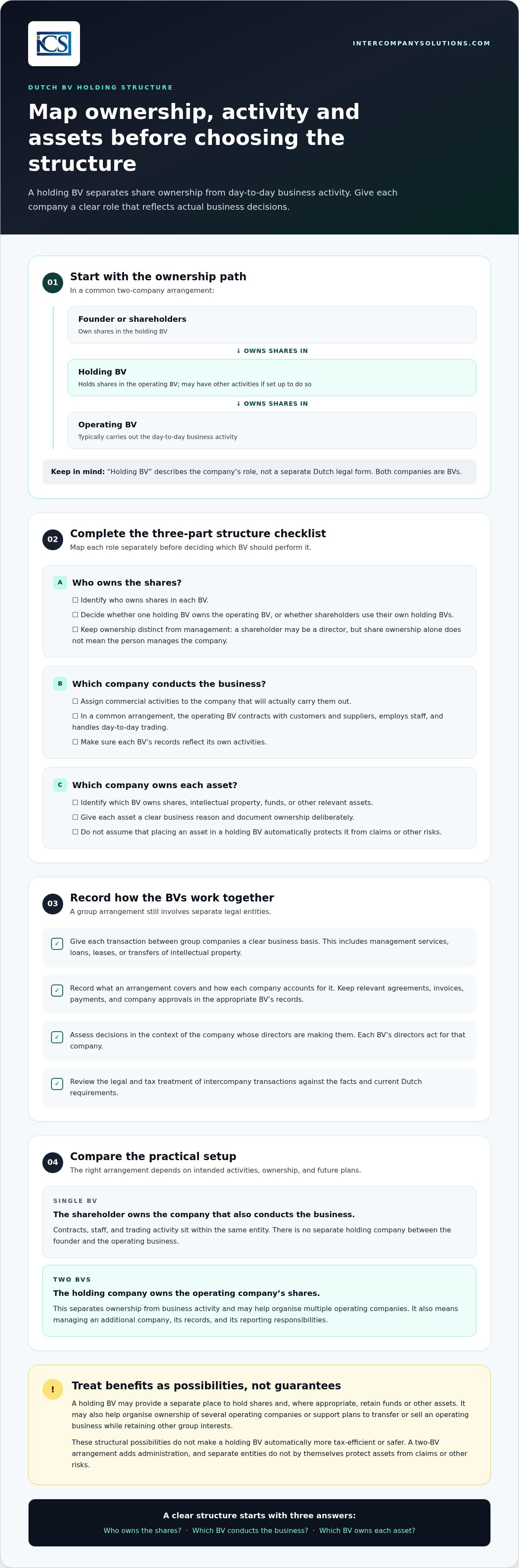
A Dutch BV holding structure usually consists of a holding BV that owns shares in an operating BV, while the operating BV conducts the business activities. “Holding BV” describes the company’s role, not a separate Dutch legal form. Both entities are BVs, or private limited companies. The Dutch Chamber of Commerce’s guide to setting up a BV explains the legal form used for each company in this arrangement.
A common setup has two BVs, but the appropriate ownership arrangement depends on the founder’s plans. A holding may own shares in more than one operating company, or several shareholders may each hold their shares through their own holding BV. Start by distinguishing who owns the shares from which company carries out the work.
Basic ownership: Founder or shareholders → Holding BV → Operating BV
How Do the Holding BV and Operating BV Relate?
The holding BV is the shareholder of the operating BV. The founder owns shares in the holding BV, alone or with other shareholders. In a common arrangement, the operating BV contracts with customers and suppliers, employs staff, and handles day-to-day trading. The holding BV’s role is ownership, although it may also carry out separate activities if set up to do so.
Ownership and management are distinct roles. A founder may be a shareholder, a director, or both, but being a shareholder does not by itself mean that the person manages the company. Each BV is a separate legal entity, so its directors act for that company and its records should reflect its own activities.
What Is Different About a Single-BV Setup?
With one BV, the shareholder owns shares in the company that also conducts the business. Contracts, staff, and trading activity sit within that same entity. There is no separate holding company between the founder and the operating business.
With two BVs, the holding company owns the operating company’s shares, creating separate entities for ownership and business activity. This can support a more deliberate ownership plan, but it also means managing an additional company and its records. A holding structure is not necessary for every founder; the decision depends on the intended activities, ownership, and future plans.
How Do Dutch Holding Structures Work in Practice?
Map three things separately: who owns the shares, which company conducts the business, and which company owns each asset. These roles can sit in different BVs, but the arrangement should reflect actual business decisions and be recorded clearly. Each BV is a separate legal entity under the Dutch Civil Code, which treats a legal person as equivalent to a natural person for property and legal relationships Dutch Civil Code, Book 2, Article 5.
Where Do Shares, Business Activities, and Assets Sit?
Consider a hypothetical software business. Its founder owns shares in a holding BV, and that holding BV owns the shares in an operating BV. The operating BV sells subscriptions, signs customer contracts, and employs the development team. The holding BV owns the shares and might also hold certain assets, such as intellectual property or accumulated funds, where there is a clear business reason.
This example is illustrative, not legal or tax advice. Decide and document asset ownership deliberately. Placing an asset in a holding BV does not automatically protect it from claims or other risks. The legal and financial position depends on the facts, including how the asset was transferred and how each company is managed.
How Should Related BVs Document Their Relationship?
Transactions between group companies should have a clear business basis, rather than being treated as informal movements of money or property. If one BV provides management services, lends funds, leases an asset, or transfers intellectual property to another, record what the arrangement covers and how each company accounts for it. Dutch corporate tax law includes rules for transactions between related entities; the applicable treatment depends on the facts Dutch Corporate Income Tax Act.
Keep separate accounting records for each BV. Record relevant agreements, invoices, payments, and company approvals in the appropriate entity’s records. Before proceeding with an intercompany transaction, review its legal and tax treatment against current Dutch requirements. A transfer between related companies is still a transaction between separate legal entities.
Directors should assess decisions in the context of the company they manage. Dutch Civil Code, Book 2, Article 9 addresses directors’ responsibilities toward the legal entity they manage (Dutch Civil Code, Book 2). Clear records help show why a decision was made and which company entered into the arrangement.
For a proposed group setup, an early review of the ownership chart, activities, and intended asset transfers can identify questions to resolve before documents are prepared. You can discuss your Dutch BV structure in light of your plans.
Dutch Holding BV Benefits and Limits: What the Structure Does Not Guarantee
A holding BV can provide a separate place to hold shares and, where appropriate, retain funds or other assets. It may also make ownership of several operating companies easier to organise. These are structural possibilities, not automatic financial or tax benefits. Assess the structure against its additional administration and your actual plans.
When Might a Holding BV Be Useful?
A holding arrangement may be worth assessing if you plan to:
- Reinvest profits in another business activity or keep funds within the corporate group.
- Own multiple operating companies through one parent company.
- Prepare for a possible transfer or sale of an operating business while retaining other group interests.
These scenarios do not establish that a holding is the right choice. Profits retained in a company remain subject to applicable legal and tax rules, and moving money or assets between BVs requires appropriate treatment and documentation. The tax outcome depends on the companies, ownership, and transactions involved.
The Dutch participation exemption may prevent qualifying dividends or gains from a subsidiary from being taxed again as corporate profits at the holding level. It is subject to conditions and does not make all group profits tax-free. Review the Belastingdienst guidance on the participation exemption against the specific shareholding and circumstances.
What Are the Trade-Offs and Common Misconceptions?
Two BVs mean two entities to administer. Each needs its own records, accounting, governance, and applicable filings. Weigh the additional work and professional administration against the purpose of separating ownership from operations.
| One BV | Holding and operating BVs |
|---|---|
| Ownership and business activity sit in one entity. | One BV owns shares; another conducts the operating business. |
| Fewer entities to administer. | Separate administration and governance are required for each BV. |
| No separate company for holding group assets or shares. | Assets may be held separately where legally and commercially appropriate. |
Separation is not a guarantee against claims, insolvency, or director liability. Each BV is a distinct entity, but the structure does not remove every legal or financial exposure. Nor does every founder need two BVs, and a holding does not automatically reduce tax or qualify for the participation exemption. Review ownership plans, activities, risk, and ongoing administration before choosing the structure.
How to Assess Whether a Dutch Holding Structure Fits Your Plans
Match each company to a clear business purpose. A Dutch BV holding structure may suit a particular ownership or growth plan, but the additional entity also brings separate administration. Use this framework before deciding:
- Map ownership. Identify each proposed shareholder, their intended ownership percentage, and who will act as director of each BV.
- Separate activities. List the planned business activities and decide which company will enter customer and supplier contracts and employ staff.
- Place assets deliberately. Consider where intellectual property, equipment, funds, and other assets will sit, and document the business reason for that arrangement.
- Test the growth plan. Distinguish current plans from possibilities. Do you expect multiple activities, outside investors, a business sale, or reinvestment of profits? Consider whether those plans justify separate entities now.
- Compare administration with purpose. A single BV has fewer entities to administer. A holding and operating BV separate ownership from business activity, but each company has its own governance and records.
Resolve the Structure Before Incorporation
Write down the proposed shareholders, directors, ownership percentages, activities, contracts, staff, and assets for each BV. Identify which decisions are settled and which are future possibilities. A potential sale or new venture may matter to planning, but a speculative plan alone may not justify adding another company at the outset.
| Consideration | Single BV | Holding and operating BVs |
|---|---|---|
| Ownership | Shareholders own the operating company directly. | The holding BV owns shares in the operating BV. |
| Business activity | The same BV owns and conducts the business. | The operating BV conducts the business; the holding BV owns its shares. |
| Administration | One company’s records and governance. | Separate records and governance for each BV. |
Plan the Formation Route
A Dutch BV requires a notarial deed. For non-EU founders, the standard remote route is a legalized Power of Attorney: the notary executes the deed, and the founder does not travel. The appropriate process depends on the founders and proposed shareholding. KVK’s guidance on setting up a BV provides official formation information.
BV minimum capital €0.01. This does not remove other incorporation requirements or replace planning for the company’s activities, ownership, and governance. For further formation context, see this Dutch BV formation guide.
Dutch Holding BV Compliance and Practical Next Steps
A holding structure involves separate companies, so compliance must be organised for each BV rather than handled as if the group were one entity. The holding and operating BV each need records that reflect their own activities, transactions, and decisions. Tax treatment and filing duties depend on the company and its circumstances.
Which Ongoing Duties Apply to the BVs?
Maintain separate bookkeeping and governance records for each BV. Each company must also address its applicable tax filings and annual accounts. Plan for the following responsibilities:
| Area | Practical requirement |
|---|---|
| Bookkeeping | Keep records for each BV that reflect its own transactions and activities. |
| Corporate income tax | Assess each BV’s tax position and filing obligations separately. |
| Annual accounts | Annual accounts filed with KVK within 12 months of year-end. |
| UBO information | UBO threshold >25%; UBO changes reported within 7 days. |
CIT 19% up to €200,000 and 25.8% above. These rates apply to taxable profits, but each BV’s tax position and obligations depend on its circumstances. Consult the Belastingdienst corporate income tax guidance for current official information.
Consider the UBO threshold and reporting deadline for each company’s ownership and control arrangements. KVK provides guidance on UBO registration and changes. For annual accounts filing, refer to KVK’s annual accounts guidance.
How Can Founders Move from Structure Planning to Setup?
Before preparing incorporation documents, set out the proposed shareholders and ownership, each BV’s intended activities, and where contracts, staff, and assets will sit. Decide how the companies will document transactions between them and who will maintain each company’s accounting and governance records. This gives the notary and tax advisers a clear structure to review.
Keep a compliance calendar for each BV that records its filing responsibilities and due dates. Review the calendar against current official guidance, particularly when ownership, activities, or intercompany arrangements change.
Make the Structure a Deliberate Business Decision
A Dutch BV holding structure separates share ownership from business operations, but it is useful only when that separation serves a clear purpose. Decide which company will own shares and assets, which will conduct business, and whether plans such as reinvestment, additional activities, or a sale justify the extra administration.
Keep the limits in view. Separate BVs do not guarantee protection from claims or director liability, and tax treatment depends on the companies and transactions involved. A holding does not automatically make profits tax-free or reduce the overall tax burden.
Intercompany Solutions supports international entrepreneurs with Dutch BV formation and ongoing accounting and compliance support. A free initial consultation is a practical starting point for discussing how your ownership plans, activities, and reporting responsibilities fit together.
Discuss your Dutch BV structure with our team today.
Resolve the key questions before formation so you can choose an arrangement that fits your plans and manage its responsibilities clearly.
Last reviewed: October 2026
Frequently Asked Questions
What is the difference between a holding BV and an operating BV?
A holding BV primarily owns shares in one or more companies. An operating BV generally conducts the commercial activity, such as contracting with customers, selling products or services, and employing staff. These roles can be arranged differently where the business has a reason to do so. The founder may be a shareholder, a director, or both, but ownership and management are distinct roles.
Is a Dutch holding BV necessary for every business?
No. A founder may operate through a single BV, with ownership and business activities in the same company. A holding BV may be useful where the ownership plan includes multiple operating companies, reinvestment, or a possible sale, but it also adds administration and governance work. Compare the purpose of a second entity with its ongoing responsibilities. The appropriate setup depends on the founder’s circumstances and plans.
Does a holding BV automatically protect business assets?
No. Holding assets in a separate BV can distinguish ownership from the operating company’s activities, but it does not guarantee protection from claims, insolvency, or director liability. The legal and financial effect depends on the facts, including how assets are owned, transferred, and managed. Treat each transfer as a transaction between separate companies, document its business basis, and review the consequences before acting.
Does a Dutch holding structure automatically reduce corporate tax?
No. A holding structure does not automatically reduce tax or make profits tax-free. The participation exemption may apply to qualifying dividends or gains from a subsidiary, but it has eligibility conditions. Other tax consequences depend on the companies, ownership, and transactions involved. Assess the specific arrangement under current Dutch tax rules before relying on a tax outcome. The structure itself is not a guarantee of tax relief.
Can a non-EU founder establish a Dutch holding BV remotely?
Yes. A non-EU founder can generally use the standard remote formation route based on a legalized Power of Attorney. Under this route, the notary executes the deed and the founder does not travel. A Dutch BV requires a notary, and the formation process depends on the proposed ownership and documentation. Plan for both the holding and operating BV when establishing a two-company structure, since each is a separate legal entity.
Sources
- KVK - Registering with the Dutch Business Register
- Business.gov.nl - Private limited company (bv)
- Burgerlijk Wetboek Boek 2 (Dutch Civil Code, legal entities)
- Rijksoverheid - Ondernemen
- Belastingdienst - Corporate income tax rates
- BOIP - Trademark registration in Benelux
- WIPO - Madrid System
- RVO - Doing business internationally
- Belastingdienst Douane - Customs
- CJEU, Cadbury Schweppes, C-196/04 (ECLI:EU:C:2006:544)
- Hoge Raad, ECLI:NL:HR:2021:1152
- PwC Worldwide Tax Summaries - Netherlands
- ICLG - Corporate Governance Laws and Regulations, Netherlands
Need more information on the Dutch BV company?
Contact an expertReady to start your company in the Netherlands?
| Formation time | Dutch BV formation completed in 3 to 5 business days |
|---|---|
| Process | Fully remote setup with step-by-step guidance |
| Compliance | Expert support for registration, VAT and compliance |
| Aftercare | Accounting, tax and legal support included |
| One partner | All of the above through one trusted formation partner |