


October 4, 2026 · 15 min read
A Dutch BV can be used for contracting work, but it doesn’t by itself establish that you qualify as an independent contractor. That depends on the working relationship, not just the legal form you choose, as explained in the Dutch government’s guidance on false self-employment.
If you’re weighing a BV, you may also be comparing it with a sole proprietorship or another simpler business form. The right choice depends on factors such as liability, expected profits, how you plan to take income from the business, and the administration you’re prepared to manage.
This guide explains how a Dutch BV for independent contractors can be used, how it compares with other Dutch legal forms, and which responsibilities come with operating one. It also outlines the legal, tax, and practical questions to resolve before you decide, so you can assess whether a BV fits your contracting activity and plans.
Key Takeaways
- A Dutch BV for independent contractors is a company structure, not proof of independent contractor status; the actual working relationship remains relevant.
- Keep contracts, invoicing, service delivery, and company records consistent with the BV being the contracting party.
- Compare the BV with an eenmanszaak by considering notarial formation, administration, and your business circumstances.
- Plan for the formation steps and ongoing company obligations before deciding whether a BV fits your contracting work.
- For non-EU founders, the standard remote formation route uses a legalized Power of Attorney so the notary can execute the deed without the founder travelling.
Table of Contents
What a Dutch BV means for an independent contractor
A Dutch BV is a private limited company and a legal entity that can conduct business in its own name, separate from its owner. “Independent contractor” describes a person’s work status in a particular relationship, not a company form. A BV is a legal structure; contractor status depends on how the work is actually arranged and performed. This distinction is central when considering a Dutch BV for independent contractors. The Dutch government’s guidance on the private limited company explains the BV’s legal form.
How a BV relates to independent contractor status
Three roles may be involved: the BV is the legal entity, its owner holds shares, and a person performs the contracted services. One individual can be both the BV’s owner and the person doing the work, but those roles remain distinct. A client may contract with the BV while the individual delivers the service on its behalf.
The paperwork alone doesn’t settle whether the relationship is genuinely independent. The client relationship and working practices must be considered under the applicable rules. Dutch government guidance on false self-employment explains that the actual relationship matters when assessing whether someone is working independently or as an employee. Incorporating a BV does not, by itself, change the substance of that relationship.
For example, a consultant might sign a service agreement in the BV’s name, have the BV invoice the client, and personally carry out the project. Those arrangements should reflect how the work is genuinely organised. If the working relationship points to employment, placing the contract or invoices through a BV does not alone make it independent contracting.
When contractors consider operating through a company
A contractor may consider a BV as their business grows or commercial arrangements make a company structure more practical. It can also provide a formal framework for managing contracts, revenue, and business administration separately from the individual’s affairs. These are reasons to assess the structure, not guarantees that it will be suitable or reduce tax.
Consider a consultant whose work expands from occasional projects to a continuing portfolio of client engagements. Before choosing a BV, the consultant can review who will sign agreements, how services will be delivered, and whether the company’s ongoing administration fits the business plan. Compare those considerations with simpler legal forms and obtain advice on the tax and legal consequences for the specific circumstances. The right choice depends on more than the label used in a contract.
How a Dutch BV works when delivering independent services
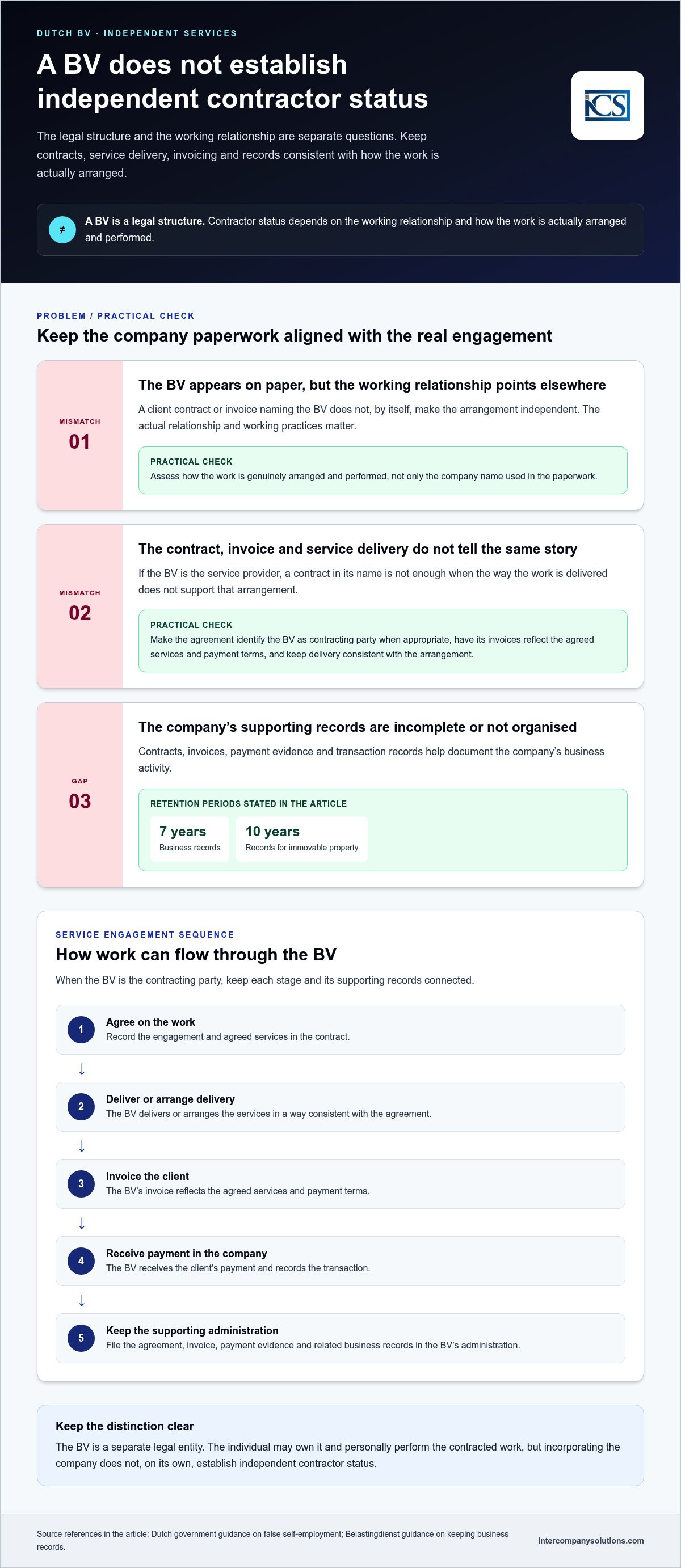
A service engagement through a BV should have a clear sequence: the parties agree on the work, the BV delivers or arranges delivery, the BV invoices the client, and payment is received by the company. The BV then records the agreement, invoice, payment, and related business transactions in its administration. The Dutch private limited company (BV) is a separate legal entity, but it is the contracting party only when the contract and actual arrangements support that position. This sequence is central to deciding whether a Dutch BV for independent contractors fits the engagement.
A BV’s legal form does not determine whether the person performing the work is an independent contractor or an employee. The Dutch Tax Administration assesses the working relationship based on the facts and circumstances, not just the contract label or the presence of a company. Its guidance on false self-employment explains the distinction. So, setting up a Dutch BV for independent contractors doesn’t, on its own, establish independent status.
Contracts, invoices, and business records
Make the paperwork match the work. If the BV is the service provider, the agreement should identify it as the contracting party, and its invoices should reflect the agreed services and payment terms. The way the work is delivered should also be consistent with that arrangement. A contract naming the BV is not enough if the real working practices point elsewhere. This alignment is a practical part of operating a Dutch BV for independent contractors.
Keep the company’s supporting records organised, including contracts, invoices, payment evidence, and transaction records. Dutch tax administration rules require business records to be retained for the applicable period: records retained 7 years (10 for immovable property). See the Belastingdienst guidance on keeping business records for the scope of the retention rules.
How the BV structure differs from the contractor personally
The company receives its business income and meets obligations in its own name. Its owner is a separate person, even when that owner also performs the contracted work and manages the business. This distinction matters for contracts, bookkeeping, and decisions about how the owner receives remuneration. It doesn’t mean the owner is protected from every possible liability; the legal position depends on the circumstances.
Tax treatment depends on the company’s position and the owner’s circumstances, so a general article can’t determine the correct treatment for an individual contractor. Review current Belastingdienst business tax guidance and obtain advice that takes your arrangements into account. For support with the practical implications of setting up and operating a BV, you can discuss your situation with a Dutch corporate services specialist.
Dutch BV or sole proprietorship: compare the structures before choosing
For a solo contractor, the main choice is often between operating as an individual through an eenmanszaak or setting up a BV as a separate legal entity. The practical difference is the structure behind the work: an eenmanszaak is tied to the individual, while a BV is a company with its own legal identity and formalities. Neither option establishes independent contractor status by itself.
| Factor | Eenmanszaak | BV |
|---|---|---|
| Legal form | An individual operates the business. | A separate legal entity operates the business. |
| Notary | Not required to establish this legal form. | Required to incorporate the company. |
| Administration | Business records and tax obligations still apply. | Company records and corporate filing obligations apply, in addition to relevant tax obligations. |
| Contractor decision factors | May suit a solo activity where a simpler structure is preferred. | May suit plans that call for a separate company structure, provided the owner can manage its formalities. |
These are structural distinctions, not a universal recommendation. A BV can limit the shareholder’s liability in some circumstances, but that protection is not absolute. Review the Dutch government’s explanations of the BV and sole proprietorship before deciding. The KVK legal-structure guidance also helps frame the choice around your business plans and responsibilities.
BV versus eenmanszaak for a solo contractor
An eenmanszaak does not require a notary; a BV does. The BV also has company-level formalities, including maintaining its own administration and filing annual accounts with the Chamber of Commerce. An eenmanszaak has no separate legal entity between the business and its owner, while a BV’s legal separation does not remove every possible personal liability. For a contractor, consider who will sign client agreements, how the business may develop, and whether the additional company administration is manageable.
Which other Dutch legal forms should contractors understand?
If you plan to work with others, compare the partnership forms as well. A VOF is a general partnership, a CV distinguishes managing and limited partners, and a maatschap is commonly used by professionals working together. Eenmanszaak, VOF, CV, and maatschap do not require a notary; a BV does. The appropriate form depends on how the participants intend to work together and allocate responsibilities.
In short, an eenmanszaak links the business directly to the individual, while a BV places it in a separate company structure with additional formalities. The right choice depends on your contracts, business plans, and capacity for ongoing administration, not on a promise of tax savings or automatic protection.
What a contractor must plan for before and after BV formation
Plan the formation and ongoing administration as one process. A BV requires a notarial deed, and registration is only the starting point. Before proceeding, decide whether a BV fits your contracting arrangements, identify the proposed company and its key people, and consider how contracts, invoicing, tax obligations, and record-keeping will be managed.
Preparation and remote formation for international contractors
- Set the company details. Prepare the information needed about the company, its activities, and the people involved. The notary uses the relevant details to prepare the deed of incorporation.
- Arrange incorporation. A notary must execute the BV’s deed. BV minimum capital €0.01. This is distinct from the KVK registration fee: KVK registration fee €85.15 (2026, one-time). See the Dutch government’s BV guidance and KVK fee information.
- Plan the remote process if you are a non-EU founder. The standard remote route is a legalized Power of Attorney. The notary executes the deed, so the founder does not travel to the Netherlands for that step. Read the guide to remote Dutch BV formation for an overview of the process.
- Complete registration and tax setup. After incorporation, ensure the company’s registration and relevant tax matters are addressed. Whether VAT registration applies depends on the business’s activities and circumstances.
Recurring administration a contractor should anticipate
Once the BV begins trading, keep company transactions and supporting documents organised. Maintain records of contracts, invoices, payments, expenses, and other business activity. Records retained 7 years (10 for immovable property). The Belastingdienst explains record-retention requirements.
Where VAT registration applies, use the correct VAT treatment for the service and transaction. The standard rates are 21%/9%/0%, with the applicable rate depending on the goods or services and circumstances. For foreign-owned entities, VAT registration typically takes 6-8 weeks. Review the Belastingdienst VAT guidance for the rules relevant to your situation.
The BV must also prepare and file annual accounts. Annual accounts filed with KVK within 12 months of year-end. Keep the ownership information current as well: UBO threshold >25%; UBO changes reported within 7 days. Check KVK’s UBO guidance for the applicable registration requirements.
Set up a bookkeeping process that allows the company to meet its tax and filing responsibilities throughout the year, rather than gathering records only at year-end.
Deciding on a Dutch BV and taking the next step
A BV may fit a contractor whose business plans and commercial arrangements call for a separate company structure, provided they’re prepared to manage its formalities. It isn’t automatically the right choice. Compare the structure with your actual client relationships, the way you deliver services, and the administration your business can sustain.
A practical decision checklist for independent contractors
Before choosing, work through these points:
- Business plans: Does a separate company structure support your expected activities and development?
- Commercial arrangements: Do your contracts and working practices reflect the BV as the service provider, where that is the intended arrangement?
- Ongoing administration: Can you maintain company records and meet recurring filing and tax obligations?
- Advice needs: Have you considered the legal-form choice separately from tax treatment and the assessment of your contractor status?
These are related but distinct decisions. A BV doesn’t determine whether a working relationship is independent or employment. The Dutch government’s false self-employment guidance explains why the actual working relationship matters. For the legal-form comparison, consult the KVK guidance on choosing a business structure. Check current rules with the relevant Dutch authorities, and seek tax or legal advice for questions that depend on your circumstances.
How to move from a decision to formation
If your review points towards a BV, the next step is to prepare the company information and formation process, including the notarial deed and registration. International founders should also plan for any additional steps that apply to their circumstances. A decision is stronger when you understand both the formalities of formation and the ongoing administration before proceeding.
Intercompany Solutions supports international entrepreneurs with Dutch BV formation. The guide to starting a business in the Netherlands provides further context on the broader setup process.
Arrange a free initial consultation to discuss Dutch BV formation for your contracting activity.
Last reviewed: October 2026
Make a considered decision and plan your next steps
A Dutch BV for independent contractors is a company structure, not a determination of contractor status. Your actual client relationships and working practices still matter. Before choosing a BV, compare it with an eenmanszaak, consider whether the company structure fits your contracts and business plans, and assess whether you can manage its ongoing administration.
A BV involves formalities at formation and continuing responsibilities after registration. The potential benefits of operating through a separate legal entity should be weighed against those obligations, with tax and contractor-status questions assessed separately. Check current guidance from Dutch government authorities and get advice based on your circumstances before proceeding.
Intercompany Solutions supports international entrepreneurs with Dutch BV formation, including remote formation support. A free initial consultation can help you discuss the formation process and the practical considerations for your plans.
With the right preparation, you can choose a structure that aligns with your contracting work and move forward with clarity.
Frequently Asked Questions
Can an independent contractor work through a Dutch BV?
Yes. A contractor can provide services through a Dutch BV when the contract and actual business arrangements support the BV acting as the service provider. The BV may agree the work, invoice the client, and receive payment, while an individual performs the services on its behalf. The company structure does not settle whether the working relationship is genuinely independent. The facts of that relationship remain relevant under Dutch rules.
Is a Dutch BV better than an eenmanszaak for a freelancer?
Not necessarily. A BV is a separate legal entity and requires a notary to incorporate, while an eenmanszaak is operated by an individual and does not require a notary. A BV also has company-level administration and filing responsibilities. Compare the structures against your client arrangements, business plans, expected administration, and tax circumstances. Neither form is automatically more suitable or tax-efficient for every freelancer.
Does forming a Dutch BV make me an independent contractor?
No. Forming a BV establishes a company, but it doesn’t determine the status of the person doing work for a client. The Dutch Tax Administration considers the actual working relationship when assessing whether a person is working independently or as an employee. Contract wording and invoices are relevant to the business arrangement, but they don’t override the way the work is genuinely organised and performed.
Do I need a notary to set up a Dutch BV?
Yes. A Dutch BV must be established by a notarial deed, which the notary executes. This differs from an eenmanszaak, which does not require a notary. The notary prepares the incorporation deed using information about the proposed company and its participants. For current details on BV formation requirements, consult the Dutch government’s Business.gov.nl guidance and the relevant notarial process.
Can a non-EU contractor form a Dutch BV without travelling to the Netherlands?
Yes. The standard remote route for a non-EU founder is to provide a legalized Power of Attorney, allowing the notary to execute the deed without the founder travelling to the Netherlands for that step. The founder still needs to provide the information and documents required for the formation process. Requirements can depend on the founder’s circumstances, so confirm the applicable process before proceeding.
What ongoing obligations does a Dutch BV have?
A BV must maintain company records and meet its applicable tax and filing responsibilities. Records retained 7 years (10 for immovable property). Annual accounts filed with KVK within 12 months of year-end. VAT obligations depend on the company’s activities and situation. UBO threshold >25%; UBO changes reported within 7 days. Check current KVK and Belastingdienst guidance for the requirements that apply to your company.
Sources
- KVK - Registering with the Dutch Business Register
- Business.gov.nl - Private limited company (bv)
- Burgerlijk Wetboek Boek 2 (Dutch Civil Code, legal entities)
- Rijksoverheid - Ondernemen
- Belastingdienst - Corporate income tax rates
- Belastingdienst - VAT (btw) for entrepreneurs
- European Commission - VAT rules and rates
- CJEU, Cadbury Schweppes, C-196/04 (ECLI:EU:C:2006:544)
- Hoge Raad, ECLI:NL:HR:2021:1152
- PwC Worldwide Tax Summaries - Netherlands
- ICLG - Corporate Governance Laws and Regulations, Netherlands
Need more information on the Dutch BV company?
Contact an expertReady to start your company in the Netherlands?
| Formation time | Dutch BV formation completed in 3 to 5 business days |
|---|---|
| Process | Fully remote setup with step-by-step guidance |
| Compliance | Expert support for registration, VAT and compliance |
| Aftercare | Accounting, tax and legal support included |
| One partner | All of the above through one trusted formation partner |