


September 16, 2026 · 17 min read
Did you know that missing the final December 31 deadline for filing your annual accounts can result in immediate administrative fines and even personal liability for company directors? For international entrepreneurs, the intricate web of dutch b.v. company financial reporting requirements often feels like a barrier to growth rather than a standard administrative task. You aren't alone if the transition to mandatory digital reporting or the nuances of the Dutch tax system seem daunting.
We understand that your focus should be on scaling your business, not deciphering complex legal jargon from the Belastingdienst. This guide provides a comprehensive technical breakdown of the statutory filing deadlines, accounting standards, and tax obligations you must meet in 2026. You'll gain a clear understanding of the updated size classifications for micro, small, and medium entities, alongside a step-by-step calendar to ensure your Dutch BV remains in perfect standing with the authorities. From understanding the 19% corporate tax bracket to navigating the reinstated UBO registry enforcement, we've simplified the path to total compliance and professional peace of mind.
Key Takeaways
- Learn the critical dual-track filing deadlines for both the Chamber of Commerce (KVK) and the Tax Office to avoid administrative penalties.
- Understand how your entity size—micro, small, or medium—directly dictates specific dutch b.v. company financial reporting requirements and audit obligations.
- Navigate the 2026 corporate tax structure, applying the 19% rate on profits up to €200,000 and the 25.8% rate on amounts exceeding that threshold.
- Maintain organizational transparency by fulfilling mandatory UBO registry updates and adhering to the seven-year financial record retention rule.
- Discover how international founders can manage all bookkeeping, tax filing, and secretarial duties remotely through a legalized Power of Attorney.
Table of Contents
The Regulatory Framework for Dutch BV Financial Reporting
Every Besloten Vennootschap (BV) incorporated in the Netherlands is bound by the strict legal standards set forth in Book 2 of the Dutch Civil Code. These regulations ensure that corporate entities maintain transparency for shareholders, creditors, and the public. Understanding the dutch b.v. company financial reporting requirements starts with recognizing that compliance isn't optional. It's a mandatory administrative pillar for every director. Even if your company is dormant or currently generates no turnover, you're still legally required to prepare and file annual accounts.
Standard financial years in the Netherlands align with the calendar year, running from January 1 to December 31. However, founders have the flexibility to establish a "broken fiscal year" during the Netherlands company formation process. This is often done to align with a parent company's reporting cycle or to account for a partial first year of operations. Regardless of the chosen cycle, the dual-track reporting system remains the same, requiring submissions to two distinct government bodies.
The Role of the Kamer van Koophandel (KVK)
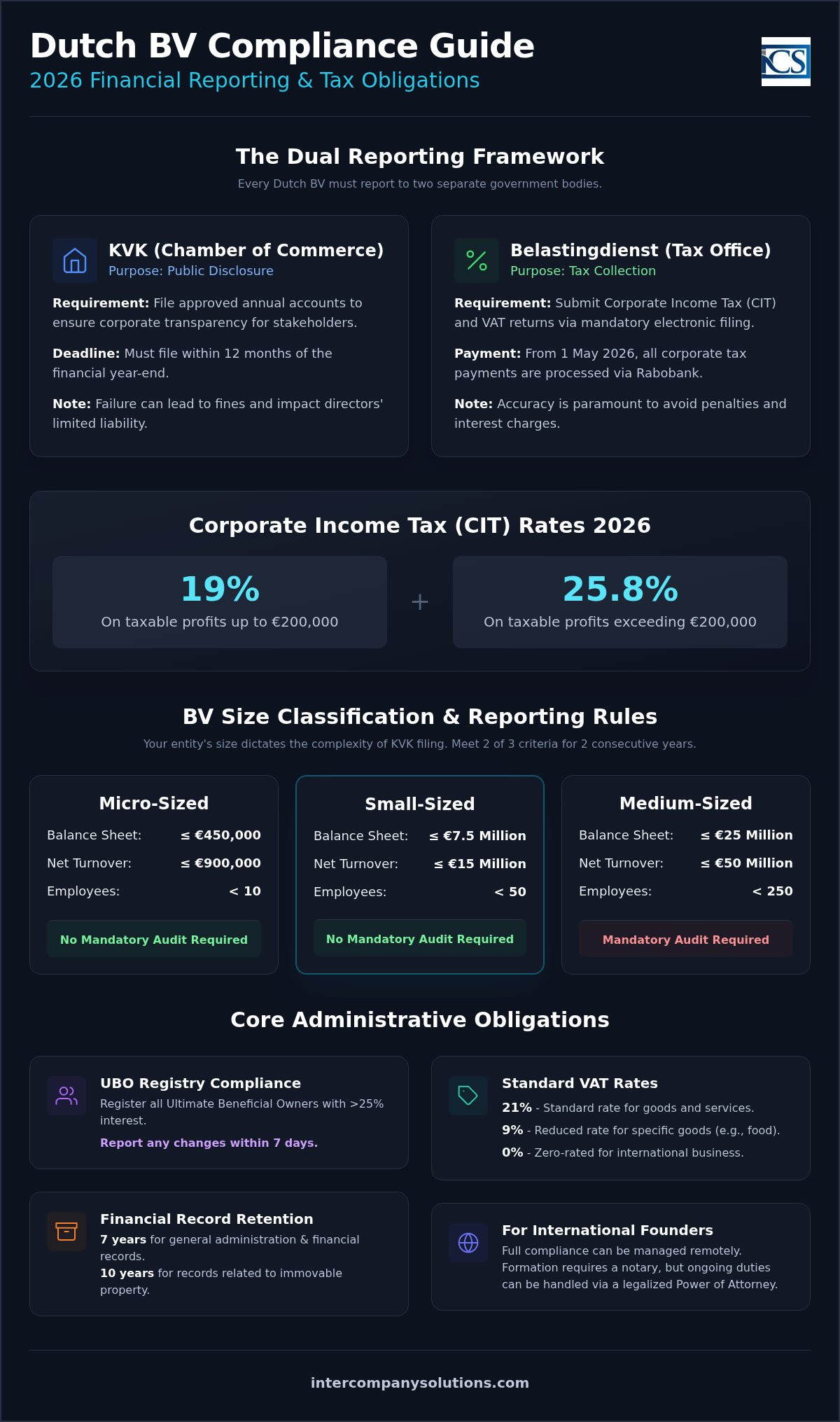
The Chamber of Commerce, or KVK, acts as the central repository for corporate data. Its primary purpose in financial reporting is public disclosure. By making specific financial details accessible, the KVK protects stakeholders and maintains trust in the Dutch business ecosystem. For the 2026 fiscal year, the initial registration fee is €85.15. Directors must ensure that the adopted annual accounts are filed with the KVK within 12 months of the financial year-end. Failure to meet this deadline can lead to immediate fines and may impact the limited liability status of the directors.
The Role of the Belastingdienst
While the KVK focuses on transparency, the Belastingdienst (Dutch Tax Office) focuses on revenue. This authority handles the collection of Corporate Income Tax (CIT) and Value Added Tax (VAT). Your dutch b.v. company financial reporting requirements include submitting detailed tax returns through mandatory electronic filing systems. Accuracy is paramount. As of 1 May 2026, Rabobank serves as the official house bank for the Dutch government, facilitating all corporate tax-related payments. This shift streamlines the financial interaction between your BV and the state, provided your internal bookkeeping is kept in precise order.
Classification of Dutch BVs and Annual Account Requirements
Not all Dutch BVs are treated equally by the Chamber of Commerce. The intensity of your dutch b.v. company financial reporting requirements depends entirely on your entity's classification. This tiered system ensures that smaller enterprises aren't overwhelmed by administrative costs while larger corporations provide the transparency necessary for market stability. Most foreign entrepreneurs starting a new venture will find their company categorized as "Micro" or "Small" during the initial years of operation.
To determine your category, the Dutch authorities look at three specific metrics. You must meet at least two of the following criteria for two consecutive financial years to be locked into a specific classification. This "two-year rule" is vital. It prevents a single year of exceptional growth or unexpected loss from immediately changing your legal obligations, providing stability for your internal accounting processes.
Determining Your Entity Size Category
For the 2026 reporting cycle, the thresholds remain as follows:
- Micro-sized: Balance sheet total less than or equal to €450,000; net turnover less than or equal to €900,000; fewer than 10 employees.
- Small-sized: Balance sheet total less than or equal to €7.5 million; net turnover less than or equal to €15 million; fewer than 50 employees.
- Medium-sized: Balance sheet total less than or equal to €25 million; net turnover less than or equal to €50 million; fewer than 250 employees.
- Large-sized: Exceeds at least two of the criteria for a medium-sized company.
Exemptions and Audit Requirements
The classification dictates the complexity of your Dutch annual financial statement filing. Micro and Small entities enjoy significant relief. They aren't required to undergo a mandatory external audit by a registered auditor (RA or AA). Instead, they can submit a simplified balance sheet and limited notes to the KVK. This reduced burden is a key reason why the Netherlands remains attractive for international startups and e-commerce ventures.
Medium and Large entities face much stricter rules. They must appoint a registered Dutch auditor to verify their accounts. These companies also need to provide a comprehensive management report and a full profit and loss statement for public record. If you're unsure where your company stands or need help preparing these documents, you can reach out to our compliance team for a technical review. Understanding these thresholds early helps you plan for future growth without facing compliance shocks as your turnover increases.
Corporate Income Tax (CIT) and VAT Filing Obligations
Managing the tax obligations of a Dutch BV requires a proactive approach to both annual and periodic reporting. Corporate Income Tax (CIT) is levied on the global taxable profit of your entity. For the 2026 fiscal year, the Dutch tax system operates with a two-tier bracket structure. You'll pay a 19% tax rate on taxable profits up to €200,000. Any profit exceeding this threshold is taxed at 25.8%. These rates are a fundamental component of the dutch b.v. company financial reporting requirements that every director must monitor to ensure accurate tax provisioning.
A critical technical detail for 2026 involves the interest deduction limitation. To prevent excessive debt financing, the Dutch government limits interest deductions to 24.5% of the entity's EBITDA (earnings before interest, taxes, depreciation, and amortization). This cap is a vital consideration for BVs with significant intercompany loans or external financing. If your interest expenses exceed this percentage, the excess won't be deductible from your taxable profit, potentially increasing your effective tax rate. We recommend reviewing your debt-to-equity ratios early in the fiscal year to avoid unexpected tax liabilities.
VAT Registration and Compliance
Value Added Tax (VAT), or BTW, is a transactional tax that requires regular attention. Most BVs are subject to the standard 21% VAT rate. However, a reduced 9% rate applies to specific goods like food and books, while a 0% rate is used for exports and certain international services. If you've recently completed your Netherlands company formation, expect a wait of 6 to 8 weeks for your VAT number to be issued by the Belastingdienst. Once active, you must file VAT returns electronically. While quarterly filing is the standard, you can opt for monthly returns if your turnover is high or annual returns if your VAT liability is minimal.
CIT Filing Deadlines and Extensions
The standard deadline for filing your CIT return is June 1 of the year following the fiscal year. For a company following the calendar year, your 2025 return is due by June 1, 2026. The Belastingdienst often issues provisional assessments early in the year based on your previous performance or estimated figures. It's essential to pay these promptly to avoid interest charges. If you require more time to finalize your accounts, tax intermediaries can request a filing extension of up to 12 additional months. This extension provides the necessary breathing room to ensure that complex international tax positions are accurately reported without risking non-compliance penalties.
Administrative Maintenance: UBO Registry and Record Retention
Compliance in the Netherlands isn't just about the numbers you report to the KVK or Belastingdienst. It also encompasses the underlying data and the transparency of your corporate structure. Meeting the dutch b.v. company financial reporting requirements in 2026 demands meticulous record-keeping and proactive management of the Ultimate Beneficial Owner (UBO) registry. These administrative tasks form the foundation upon which your financial statements are built. Without them, your annual filings lack the necessary legal standing and integrity.
Effective administrative maintenance protects your entity from unnecessary scrutiny. It ensures that when you're asked to prove the source of funds or the validity of a transaction, the evidence is readily available. For international entrepreneurs, this means establishing digital systems that bridge the gap between local operations and global management. This structure is not just a burden; it's a safeguard for your limited liability status.
UBO Registry Reporting Requirements
The UBO registry is designed to prevent money laundering and ensure corporate accountability. A UBO is any individual who ultimately owns or controls more than 25% of the shares, voting rights, or ownership interest in your Dutch BV. If no individual meets this threshold, a "pseudo-UBO", usually a senior managing official, must be registered instead. This registration is a public record, though access was restricted in recent years to parties with a legitimate interest.
The Dutch authorities are particularly strict regarding updates. You must report any change in UBO status or personal details to the KVK within exactly seven days of the change becoming effective. This is a much shorter window than many other administrative deadlines. Failure to comply can result in heavy administrative fines and, in severe cases, criminal sanctions for the company directors. We recommend reviewing your ownership structure quarterly to ensure the registry remains accurate.
Statutory Record-Keeping Standards
Maintaining a robust paper trail is a legal necessity. You are required to retain all primary documentation, including invoices, bank statements, and contracts, for a minimum of seven years. This period ensures that the Belastingdienst can conduct audits or verify past tax filings. However, if your BV holds immovable property, the law extends this retention requirement to ten years for those specific records. Integrity is key. Data must remain unalterable and readable throughout the entire period.
Digital storage is perfectly acceptable and often more efficient for remote founders. Invoices received electronically should be stored in their original format to preserve their legal validity. Beyond financial records, you should also preserve shareholder registers and minutes from general meetings. These documents provide the legal context for the financial decisions reflected in your books. For a deeper look at how to structure these systems, see our guide on Accounting for Dutch BV: Compliance and Tax Obligations in 2026.
Managing Compliance for Foreign-Owned Dutch Entities
Operating a business in the Netherlands as a non-resident founder offers significant strategic advantages, but it requires a structured approach to administration. You don't need to be physically present in the country to maintain full adherence to the law. Specialized agents can manage all dutch b.v. company financial reporting requirements remotely, acting as your local technical partner. This setup is particularly effective for entrepreneurs who want to leverage the Dutch business ecosystem while remaining based in their home country.
The foundation of this remote management is the legalized Power of Attorney (PoA) route. This legal mechanism allows for Netherlands company formation without the need for international travel. Once the entity is established, usually within 2 to 5 days, the focus shifts to ongoing compliance. By utilizing professional bookkeeping services, you ensure that every VAT and CIT filing aligns perfectly with Dutch GAAP (Generally Accepted Accounting Principles). This alignment is crucial for maintaining the credibility of your financial statements during future audits or investment rounds.
Strategic Benefits of Centralized Accounting
Centralizing your accounting and secretarial services creates a single point of accountability. When one partner handles your bookkeeping, payroll, and corporate filings, the risk of missed deadlines or data discrepancies drops significantly. This integrated approach allows for real-time monitoring of your CIT thresholds. If your profits approach the €200,000 mark, your advisors can provide timely guidance on tax optimization strategies before the 25.8% rate applies. Coordination between your payroll and corporate tax filings also ensures that social security contributions and wage taxes are correctly deducted and reported.
For more details on setting up your entity with a focus on long-term stability, consult our Professional Guide to Dutch BV Formation.
Next Steps for Dutch BV Owners
Success in the Dutch market depends on early preparation. We recommend taking these three concrete steps to secure your 2026 compliance status:
- Conduct an entity size assessment: Review your projected assets and turnover to determine if you'll fall into the Micro or Small category, as this dictates your specific filing burden.
- Implement a compliant storage system: Establish a digital archive that meets the 7-year record retention rule, ensuring all invoices and bank statements are stored in their original integrity.
- Evaluate staffing incentives: If you plan to hire international talent, recruitment services like Amplify Yourself, LLC can help you find skilled virtual assistants, while you consult with a specialist regarding the 30% ruling to reduce your overall tax burden and improve recruitment outcomes.
By taking these steps now, you transition from reactive management to proactive growth. A well-maintained BV is not just a compliant entity; it's a valuable asset that's ready for global mobility and expansion.
Securing Your Dutch BV’s Future Through Proactive Compliance
Managing a Dutch company effectively requires a clear understanding of how reporting obligations scale with your business size. From the simplified filings allowed for micro-entities to the rigorous audit standards for medium-sized firms, staying ahead of these tiers is essential for long-term stability. You must ensure that your annual accounts are filed with the KVK and that your CIT returns reach the Belastingdienst before the June 1 deadline. By mastering the dutch b.v. company financial reporting requirements, you protect your limited liability status and maintain transparency with all stakeholders.
With over 2,000 founders served worldwide, Intercompany Solutions provides the A-Z compliance support needed to manage your business remotely. Our specialists handle everything from initial formation to ongoing bookkeeping and tax filing; this ensures your entity remains in perfect standing. We're dedicated to simplifying the administrative path so you can focus on scaling your international venture with confidence. We look forward to helping you navigate the Dutch regulatory landscape with ease.
Frequently Asked Questions
What is the deadline for filing annual accounts with the KVK?
A Dutch BV must file its annual accounts with the Chamber of Commerce (KVK) within 12 months after the financial year ends. For a standard calendar year, the final deadline is December 31, 2026. Directors must prepare the accounts within five months of year-end, though shareholders can grant a five-month extension. Once the accounts are adopted, they must be filed within eight days to ensure full compliance.
Does a Dutch BV need an audit every year?
Not every Dutch BV requires a statutory audit. This obligation only applies to companies classified as "medium" or "large" for two consecutive years. Your company meets the threshold if it exceeds at least two of these limits: a balance sheet total of €7.5 million, a net turnover of €15 million, or an average of 50 employees. Most international startups fall into the micro or small categories and are therefore exempt.
What is the minimum share capital for a Dutch BV in 2026?
The minimum share capital for a Dutch BV in 2026 is just €1. This requirement was significantly reduced from the previous €18,000 threshold to make the Netherlands more accessible for international entrepreneurs. You can divide this capital into shares of any nominal value, such as €0.01 per share. This flexibility allows founders to establish their corporate structure with minimal initial investment while still benefiting from limited liability.
How long must a Dutch company keep its financial records?
You must retain your company's financial records and primary documentation for a minimum of seven years. This includes all invoices, bank statements, contracts, and digital correspondence related to your business transactions. However, if your BV holds immovable property, the retention period for those specific records is ten years. Maintaining these records is a core part of the dutch b.v. company financial reporting requirements to facilitate potential audits.
What are the corporate tax rates for a Dutch BV in 2026?
For the 2026 fiscal year, the Dutch corporate income tax (CIT) is applied in two brackets. You'll pay a 19% tax rate on taxable profits up to €200,000. Any profits exceeding this €200,000 threshold are subject to a rate of 25.8%. It's important to monitor these profit levels throughout the year, as your tax liability increases significantly once you cross into the second bracket, affecting your overall net return.
Who is considered a UBO in a Dutch private limited company?
An Ultimate Beneficial Owner (UBO) is any individual who ultimately owns or controls more than 25% of a company's shares or voting rights. This also applies to individuals who have a 25% ownership interest in the entity. If no person meets these specific criteria, a senior managing official must be registered as a "pseudo-UBO." All BVs must register this information with the KVK to ensure organizational transparency and legal compliance.
Can I manage my Dutch BVs financial reporting remotely?
You can manage all your dutch b.v. company financial reporting requirements remotely through a specialized service provider. By using a legalized Power of Attorney (PoA), you don't need to travel to the Netherlands for incorporation or ongoing administration. Professional agents can handle your bookkeeping, VAT returns, and annual accounts digitally. This allows international founders to maintain a fully compliant Dutch presence while operating from anywhere in the world.
What is the interest deduction cap for Dutch companies?
The interest deduction cap for Dutch companies is set at 24.5% of the entity's EBITDA. This rule limits the amount of interest you can deduct from your taxable profit to prevent excessive debt financing. If your interest expenses exceed this percentage, the surplus is not deductible in the current year. It's a technical requirement that requires careful financial planning, especially for BVs that rely on intercompany loans or external debt to fund operations.
Sources
- ICS Payroll - Dutch payroll services
- KVK - Registering with the Dutch Business Register
- Business.gov.nl - Private limited company (bv)
- Burgerlijk Wetboek Boek 2 (Dutch Civil Code, legal entities)
- Rijksoverheid - Ondernemen
- Belastingdienst - Corporate income tax rates
- Belastingdienst - Payroll taxes (loonheffingen)
- UWV - Employer obligations
- SVB - Social insurance in the Netherlands
- Belastingdienst - VAT (btw) for entrepreneurs
- European Commission - VAT rules and rates
- CJEU, Cadbury Schweppes, C-196/04 (ECLI:EU:C:2006:544)
- Hoge Raad, ECLI:NL:HR:2021:1152
- PwC Worldwide Tax Summaries - Netherlands
- ICLG - Corporate Governance Laws and Regulations, Netherlands
Frequently Asked Questions
Need more information on the Dutch BV company?
Contact an expertReady to start your company in the Netherlands?
| Formation time | Dutch BV formation completed in 3 to 5 business days |
|---|---|
| Process | Fully remote setup with step-by-step guidance |
| Compliance | Expert support for registration, VAT and compliance |
| Aftercare | Accounting, tax and legal support included |
| One partner | All of the above through one trusted formation partner |