


October 5, 2026 · 14 min read
Complete bookkeeping is the foundation for meeting a Dutch BV’s reporting obligations. For international owners, Dutch BV bookkeeping requirements can be harder to manage when records are collected across borders. Everyday transactions feed into VAT returns, annual accounts and tax reporting, so gaps in the records can affect several filings.
A clear process makes these obligations easier to manage. This guide explains which financial and digital records a BV should maintain, how long to retain them, and how bookkeeping supports VAT and annual reporting. It also distinguishes the main filing obligations, so you can plan for them separately rather than treating them as one task.
You’ll find practical steps for organizing records throughout the financial year, coordinating information remotely and preparing for recurring deadlines. With a consistent workflow, your BV can keep its administration ready for reporting and make compliance more predictable.
Key Takeaways
- Keep bookkeeping separate from filing VAT returns, corporate income tax returns and annual accounts. Each is a distinct reporting task.
- Organize invoices, bank records, receipts, contracts and relevant payroll records so transactions can be traced and reviewed.
- Apply the record-retention period consistently: 7 years, or 10 years for immovable property.
- Use complete transaction records to prepare and review VAT returns, applying the relevant VAT rate: 21%/9%/0%.
- Build recurring checks into your workflow, including the UBO threshold >25% and the requirement to report UBO changes within 7 days.
Table of Contents
- What Dutch BV bookkeeping covers, and how it differs from filing accounts
- Which records a Dutch BV should keep and how long to retain them
- How Dutch BV bookkeeping supports VAT records and returns
- A practical Dutch BV bookkeeping workflow for recurring compliance
- Managing Dutch BV bookkeeping as an international founder
What Dutch BV bookkeeping covers, and how it differs from filing accounts
A Dutch BV is a private limited company, or Besloten vennootschap. Its financial administration is an ongoing responsibility, not just a year-end task. Bookkeeping means recording financial transactions and retaining the documents that support them. The records behind reporting are part of the Dutch BV bookkeeping requirements, not just the reports submitted to authorities.
Which responsibilities sit within bookkeeping?
Record business transactions consistently and organize the documents that explain them. For example, a sales invoice records revenue owed by a customer, while the related bank entry shows whether and when payment arrived. A supplier invoice and proof of payment support the recording of a business expense. Connecting these items makes it easier to trace figures back to their source.
The Belastingdienst describes business administration as the basis for tax returns and requires businesses to keep it available for inspection. Its guidance covers supporting records, including digital records. Belastingdienst guidance on keeping business records explains the retention obligation. Bookkeeping prepares and supports reporting, but it does not itself submit a VAT return or corporate income tax return on the BV’s behalf.
How bookkeeping connects to BV reporting
Bookkeeping records and organizes the evidence; reporting uses those records to prepare and submit returns and annual accounts. The underlying transactions must be recorded accurately before a filing can be prepared and reviewed.
For VAT, bookkeeping provides the sales and purchase information used to prepare the return. For corporate income tax, the accounts and supporting records provide information for the tax calculation. Annual accounts summarize the BV’s financial position and results for the financial year. These are separate reporting tasks, even though they rely on the same underlying administration.
Annual accounts filed with KVK within 12 months of year-end is the applicable filing deadline for a BV. KVK explains the obligation and process in its guidance on filing annual accounts. Complete, traceable records make it easier to compile the accounts, investigate differences and understand the company’s financial performance. They also help the BV respond to questions about figures in a return or report.
Which records a Dutch BV should keep and how long to retain them
A BV’s administration should let someone trace a recorded transaction back to the document or information that supports it. The requirements apply to an organized body of records, not only to invoices or paper documents. The categories below are practical examples to organize, not an exhaustive statutory checklist.
Core financial documents to organize
Group records by the activity they support. This makes it easier to verify entries, investigate differences and prepare information for reporting.
- Sales: customer invoices, credit notes and related payment information.
- Purchases and expenses: supplier invoices, receipts and documents that explain the business purpose of a cost.
- Bank activity: statements and transaction details that help match incoming and outgoing payments to recorded items.
- Contracts: agreements that support or explain transactions, such as recurring services or significant purchases.
- Employee-related transactions: relevant payroll records and documents supporting amounts recorded for staff.
Where practical, keep supporting records connected to the relevant transaction. For example, a supplier invoice, payment entry and bank transaction should be identifiable as parts of the same expense. Digital records, including relevant emails and downloaded bank statements, can also form part of the administration. The Belastingdienst guidance on keeping business records explains the administration and retention requirements.
Record retention periods for Dutch businesses
Records retained 7 years (10 for immovable property). The Belastingdienst sets a standard retention period of 7 years for business records and a 10-year period for records relating to immovable property. The longer period applies to the relevant property records, not automatically to every document held by a BV. The retention period starts when the information is no longer current.
Organize records so they remain retrievable throughout the applicable period. Use clear categories and consistent file names, and preserve the connection between supporting documents and bookkeeping entries. This helps the BV respond to questions about a transaction without relying on memory or searching unrelated files. Professional accounting support can also help a BV organize its financial records and related reporting.
How Dutch BV bookkeeping supports VAT records and returns
VAT reporting depends on connecting the figures in a return to the underlying business transactions. A well-organized ledger brings sales and purchases together with invoices, credit notes and payment records. This makes it easier to review whether transactions have been recorded consistently before the BV prepares its VAT return.
What bookkeeping records help substantiate VAT reporting?
For a sale, match the sales invoice and any later adjustment, such as a credit note, to the corresponding accounting entry. For a purchase, link the supplier’s invoice to the expense entry and relevant payment information. These connections can help identify missing documents, duplicate entries or differences between the administration and reported figures.
Keep each transaction record clear enough to explain what was supplied or purchased and how the amount was recorded. The documents required to support a particular transaction can depend on its circumstances, so do not treat one example as a complete evidence checklist. The Belastingdienst explains how businesses file VAT returns and provides guidance on VAT rates and exemptions.
How to handle different VAT rates in the records
The Dutch VAT rates are 21%/9%/0%. This rate set does not, by itself, tell you which rate applies to a particular product or service. The correct VAT treatment depends on the transaction, so verify the applicable rate and treatment against current Belastingdienst guidance before recording and reporting it.
The table shows examples of records to connect with transactions. It does not assign a VAT rate to a particular supply; assess each transaction on its own facts.
| Transaction type | Typical supporting record | VAT treatment to verify |
|---|---|---|
| Sale by the BV | Sales invoice and any related credit note | Check the applicable VAT treatment for the specific supply. |
| Purchase by the BV | Supplier invoice and related payment record | Check the VAT shown and the applicable treatment for the purchase. |
| Adjustment to a recorded sale or purchase | Credit note or other document explaining the adjustment | Check how the adjustment affects the VAT records and return. |
Use a consistent bookkeeping process as a practical control: each VAT figure in the administration should be traceable to the relevant transaction and its supporting record. Check the treatment against official guidance rather than assuming that a familiar rate or a previous transaction automatically applies again.
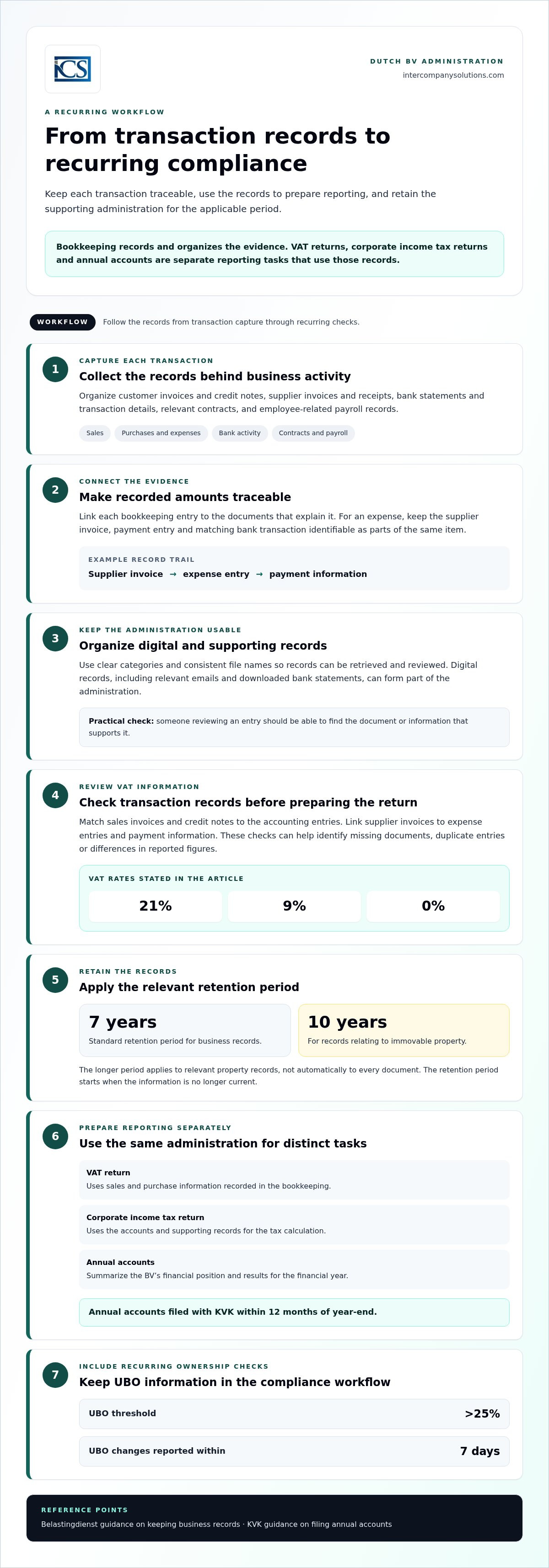
A practical Dutch BV bookkeeping workflow for recurring compliance
A repeatable process helps keep transaction records current and makes it easier to prepare reports from the same underlying administration. The steps below are a practical workflow, not a prescribed filing schedule. Set a collection and review rhythm that fits the BV’s activity and reporting needs.
A repeatable recordkeeping routine
- Collect and classify documents. Gather sales and purchase invoices, receipts, contracts, bank records and, where relevant, payroll documents. File them by transaction type or accounting period so they can be found again.
- Record each transaction. Enter income, expenses and other business transactions in the bookkeeping system, linking entries to their supporting records.
- Reconcile bank activity. Compare recorded receipts and payments with bank transactions. Investigate unmatched items instead of leaving differences unexplained.
- Review for gaps and inconsistencies. Check for missing documents, duplicate entries or amounts that do not agree with source records. Resolving these during routine reviews can reduce delays when reports are prepared.
- Prepare reporting information. Use the reviewed records to prepare VAT returns, corporate income tax reporting and annual accounts. These are separate obligations; completing one does not replace the others.
Track UBO changes and annual accounts separately
Keep ownership and control information as a distinct company-compliance checkpoint. The UBO threshold is >25%. UBO changes must be reported within 7 days. KVK’s UBO register guidance explains registration and changes. This update is separate from routine bookkeeping and tax filings.
Annual accounts follow a separate year-end process. Annual accounts filed with KVK within 12 months of year-end is the applicable deadline. Use the BV’s financial-year end to plan preparation, approval and submission, and consult KVK guidance on filing annual accounts for the process. Track VAT returns, UBO updates and annual accounts independently because each has a different purpose and trigger.
A consistent workflow helps owners identify missing information early and maintain a clear path from source documents to reporting.
Managing Dutch BV bookkeeping as an international founder
Managing a Dutch BV from another country can make it harder to collect documents from people in different locations, keep records current and coordinate reporting preparation. The same recordkeeping process applies, but owners can decide how to organize the work and who handles each step. A clear division of responsibilities helps prevent missing information from surfacing only when a return or annual report is due.
What to prepare before handing bookkeeping to a specialist
Owners can make the process more orderly by gathering the BV’s transaction records and providing relevant company details in a consistent format. A practical handover may include:
- Sales and purchase invoices, receipts and related credit notes;
- Bank statements or transaction information for the period;
- Contracts or other documents that explain significant or recurring transactions;
- Relevant payroll information, if the BV has employees; and
- Company details and prior reporting records needed to understand the administration.
Use predictable file names and group documents by period or transaction type. Submit new information regularly according to an agreed working routine, rather than letting documents accumulate across multiple reporting periods. These are practical coordination measures, not separate statutory deadlines. For a fuller explanation of accounting records, consult a dedicated guide to accounting for a Dutch BV alongside official Belastingdienst guidance on VAT registration where relevant.
When professional accounting support can help
Owners may keep routine records internally and seek specialist support when they need help reviewing entries, preparing VAT returns, handling annual tax filings or compiling annual reporting. This can be useful when administration is managed across borders, responsibility is divided among several people, or the owner needs one process to connect transaction records with reporting tasks. The scope of support can be matched to the work the company retains internally.
Intercompany Solutions provides accounting support for bookkeeping, VAT returns, annual tax filings and annual reporting. A free initial consultation gives founders an opportunity to discuss their recordkeeping process and the support they need.
Make your BV’s bookkeeping a repeatable process
Reliable bookkeeping begins with complete, retrievable records. Keep source documents organized and retain them for the required period: 7 years, or 10 years for immovable property. Use those records to prepare and review VAT reporting, while tracking tax filings and annual accounts as separate obligations.
A consistent routine helps whether you manage the administration yourself or coordinate it from abroad. Collect documents regularly, reconcile transactions against bank activity and review gaps before reporting is prepared. This gives you a clearer view of the company’s records and a structured basis for compliance decisions.
For support with bookkeeping, VAT returns, annual tax filings and annual reporting, arrange a free initial consultation with Intercompany Solutions.
Build a repeatable process for your BV’s financial administration and reporting.
Frequently Asked Questions
What bookkeeping records must a Dutch BV keep?
A Dutch BV should keep records that explain its financial transactions, including sales and purchase invoices, receipts, bank information, contracts and relevant payroll documents. The precise records depend on the company’s activities, so these examples are practical categories rather than an exhaustive legal list. Organized source documents help trace bookkeeping entries and support accurate reporting. Consult the Belastingdienst guidance on business records for current requirements.
How long must a Dutch BV keep its records?
Records retained 7 years (10 for immovable property). The 10-year period applies to records relating to immovable property and should not be generalized to all other BV records. The retention period begins when the information is no longer current. Keep records organized and retrievable throughout the applicable period. The Belastingdienst explains the retention rules and their scope.
Does a Dutch BV need to file annual accounts every year?
Yes. A BV must prepare and file annual accounts with the Dutch Chamber of Commerce, KVK, for its financial year. Annual accounts filed with KVK within 12 months of year-end meets the filing deadline. Bookkeeping records support preparation of the accounts, but those records are not the same as the filed annual accounts. See the current KVK guidance on filing annual accounts for details of the process.
What VAT rates should a Dutch BV record in its bookkeeping?
The Dutch VAT rates are 21%/9%/0%. This rate set does not determine which rate applies to a particular product or service. The correct VAT treatment depends on the specific supply and transaction circumstances, so verify each case against current Belastingdienst guidance before recording it or including it in a return. The Belastingdienst VAT rates guidance explains the rates and their application.
How often does a Dutch BV need to update its bookkeeping?
A BV should maintain its bookkeeping regularly as a practical way to keep records complete and ready for review. There is no single bookkeeping frequency stated here as a legal deadline. Keep this routine distinct from VAT return schedules and annual reporting dates, which follow their own applicable requirements. Collecting documents consistently and checking recorded transactions against bank activity can help identify missing information before preparing a filing.
What happens if a Dutch BV’s UBO information changes?
The UBO threshold is >25%, and UBO changes must be reported within 7 days. This reporting obligation is separate from routine bookkeeping and filing annual accounts. A BV should monitor changes in ownership or control and keep company compliance records distinct from financial transaction records. Consult the current KVK guidance on the UBO register for reporting details and applicable requirements.
Can an international founder manage Dutch BV bookkeeping remotely?
Yes. An international founder can coordinate bookkeeping remotely by organizing invoices, bank information and other source documents for consistent exchange and review. A recurring process helps the owner and anyone preparing the accounts identify missing information in time for reporting. Specialist accounting support can assist with bookkeeping, VAT returns, annual tax filings and annual reporting, while the BV remains responsible for ensuring its records and filings are managed appropriately.
Last reviewed: October 2026
Sources
- ICS Payroll - Dutch payroll services
- KVK - Registering with the Dutch Business Register
- Business.gov.nl - Private limited company (bv)
- Burgerlijk Wetboek Boek 2 (Dutch Civil Code, legal entities)
- Rijksoverheid - Ondernemen
- Belastingdienst - Corporate income tax rates
- Belastingdienst - Payroll taxes (loonheffingen)
- UWV - Employer obligations
- SVB - Social insurance in the Netherlands
- Belastingdienst - VAT (btw) for entrepreneurs
- European Commission - VAT rules and rates
- CJEU, Cadbury Schweppes, C-196/04 (ECLI:EU:C:2006:544)
- Hoge Raad, ECLI:NL:HR:2021:1152
- PwC Worldwide Tax Summaries - Netherlands
- ICLG - Corporate Governance Laws and Regulations, Netherlands
Need more information on the Dutch BV company?
Contact an expertReady to start your company in the Netherlands?
| Formation time | Dutch BV formation completed in 3 to 5 business days |
|---|---|
| Process | Fully remote setup with step-by-step guidance |
| Compliance | Expert support for registration, VAT and compliance |
| Aftercare | Accounting, tax and legal support included |
| One partner | All of the above through one trusted formation partner |