


September 17, 2026 · 17 min read
Failure to file annual accounts with the Kamer van Koophandel (KVK) within the statutory twelve month window can lead to personal liability for directors, even for those managing their companies from abroad. Maintaining compliance requires more than just meeting a deadline; it involves a precise synchronization of financial statements, tax filings, and administrative updates. Understanding the specific Dutch BV annual reporting requirements is essential for any foreign entrepreneur who wants to avoid penalties and protect their corporate veil in 2026.
You likely recognize that the Dutch regulatory environment is rigorous and demands meticulous attention to detail. This guide simplifies that complexity by providing a clear compliance calendar for the 2026 fiscal year. We have outlined the exact deadlines for financial statements, the Corporate Income Tax (CIT) rates of 19% up to 200,000 Euros and 25.8% above, and the necessary steps for keeping the UBO registry current. By following this structured overview, you can ensure your Dutch entity fulfills its statutory obligations while you focus on international growth.
Key Takeaways
- Identify the deadlines for Dutch BV annual reporting requirements, ensuring annual accounts are filed with the KVK within 12 months of the year-end.
- Determine 2026 Corporate Income Tax obligations, which are 19% up to €200,000 and 25.8% above this threshold.
- Implement a record-keeping system where administrative records are retained for 7 years, or 10 years for documentation concerning immovable property.
- Maintain the UBO registry by reporting changes within 7 days for any individual with an interest threshold exceeding 25%.
- Manage all statutory filings remotely via the legalized Power of Attorney route with professional accounting and secretarial services.
Table of Contents
The Statutory Framework for Dutch BV Annual Reporting
A Dutch BV operates as a separate legal entity. This status provides limited liability for its shareholders, but it also imposes strict transparency obligations. The Dutch Civil Code, specifically Book 2, establishes the legal basis for these disclosures. Compliance with Dutch BV annual reporting requirements is not optional; it's a statutory mandate designed to protect creditors, shareholders, and the public interest.
The board of directors holds the ultimate responsibility for ensuring that all financial and administrative filings are accurate and submitted on time. When a company fails to meet these obligations, the consequences are severe. Directors may face administrative fines from the Belastingdienst or the KVK. In the event of bankruptcy, a failure to comply with reporting standards can lead to a presumption of director mismanagement, potentially resulting in personal liability for the company's debts.
Classifying Your BV: Micro, Small, Medium, or Large
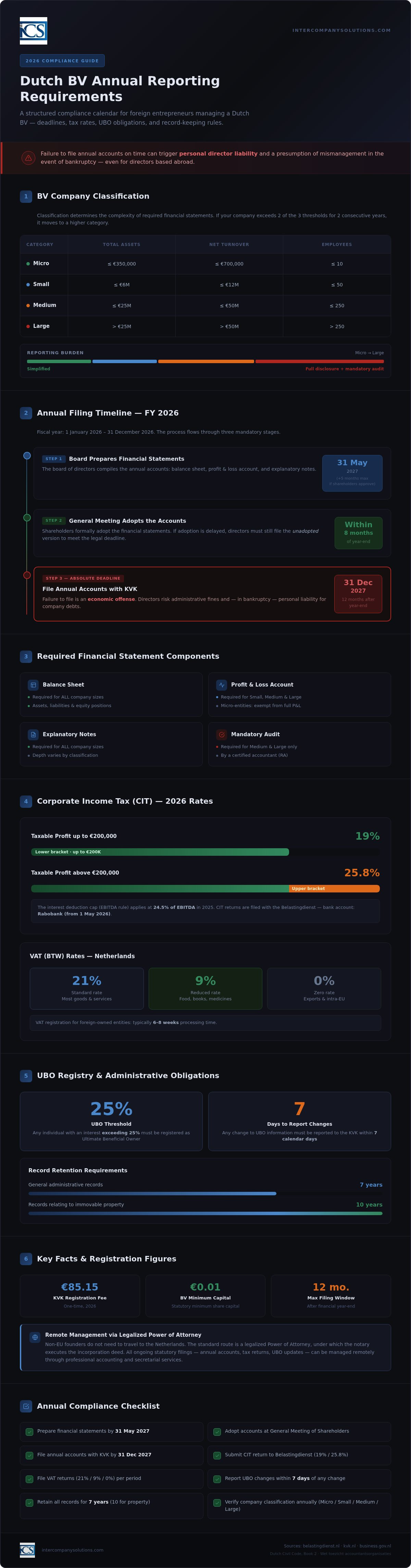
The Dutch government classifies companies into four categories: micro, small, medium, and large. This classification depends on three specific criteria: the total value of assets, the net annual turnover, and the average number of employees. Most foreign entrepreneurs launching a Dutch BV start within the micro or small categories.
Classification is significant because it dictates the complexity of the financial statements you must prepare. Micro and small entities benefit from simplified reporting regimes, requiring fewer notes to the accounts and less detailed balance sheets. If your company exceeds two of the three thresholds for two consecutive years, it moves to a higher category, increasing the disclosure burden and potentially requiring a mandatory audit by a certified accountant.
The Role of the Dutch Chamber of Commerce (KVK)
The Kamer van Koophandel (KVK) serves as the official registry for all Dutch corporate entities. It's the central point for filing annual accounts, making this information accessible to the public. This transparency allows potential partners and creditors to verify the financial health of a business before engaging in transactions. Providing this data is a fundamental part of the Dutch BV annual reporting requirements.
For new entities established in 2026, the KVK registration fee is a one-time payment of €85.15. Once registered, the BV must maintain its records in the Trade Register. This includes keeping the UBO registry current, where any individual with an interest exceeding 25% must be identified. Statutory records, including these filings, must be retained for 7 years, while records related to immovable property require a 10-year retention period.
Preparation and Filing of Annual Financial Statements
The financial year for a Dutch BV typically follows the calendar year, beginning on 1 January and ending on 31 December. Unless your company's articles of association specify a different fiscal period, you must adhere to this standard cycle. The reporting process begins with the preparation of the annual accounts by the board of directors. Once these accounts are prepared, they must be presented to the general meeting of shareholders for adoption. Following adoption, the final accounts must be submitted to the Kamer van Koophandel (KVK) to fulfill the transparency obligations of the entity.
Standard Filing Deadlines for 2026
For a financial year ending on 31 December 2026, the board must prepare the financial statements by 31 May 2027. Dutch law allows for a specific extension of up to five months for this preparation phase if the shareholders approve it. This extension is often necessary for complex international structures, but it does not change the final publication deadline. The absolute deadline to file annual accounts with the KVK is 12 months after the end of the financial year. For the 2026 fiscal year, this date is 31 December 2027.
Strict adherence to these dates is vital. If the shareholders fail to adopt the accounts on time, the directors must still file the unadopted version of the statements to meet the 12-month requirement. Failure to file constitutes an economic offense and can lead to significant fines. You can contact our specialized team to coordinate these deadlines and ensure your Dutch BV annual reporting requirements are met without delay.
Components of the Financial Report
The specific documents required in your annual filing depend on whether your BV is classified as micro, small, medium, or large. At a minimum, all companies must provide a balance sheet and explanatory notes. Small companies and larger entities must also include a profit and loss account. While micro-entities are exempt from publishing their profit and loss data, they are still required to maintain these records for their internal administration and tax obligations.
- Micro and Small: Simplified balance sheet and limited notes. No audit required.
- Medium and Large: Full balance sheet, profit and loss account, and a director's report.
- Audit Requirements: Only applicable to companies meeting two of the three legal thresholds regarding assets, turnover, and employee count.
Records must be retained for 7 years in a format that remains accessible for inspection by the Dutch authorities. For entities holding immovable property, this retention period increases to 10 years. Ensuring these components are accurately compiled is a core part of maintaining your company's standing in the Netherlands.
Corporate Income Tax (CIT) and VAT Compliance in 2026
Corporate Income Tax (CIT) is a mandatory annual filing for every Dutch BV, regardless of its size or activity level. While the previous section focused on public disclosure via the KVK, CIT returns are submitted directly to the Belastingdienst (the Dutch Tax Office). These filings must accurately reflect the taxable profit of the company, which often differs from the commercial profit shown in the annual accounts due to specific fiscal adjustments required by Dutch tax law.
2026 Tax Rates and Thresholds
The Dutch corporate tax system uses a two-tier bracket structure. For the 2026 fiscal year, the rates remain stable to provide a predictable environment for international investors. This tiered approach ensures that smaller enterprises and startups benefit from a lower tax burden on their initial profits.
| Taxable Profit Bracket | Applicable CIT Rate (2026) |
|---|---|
| Up to €200,000 | 19% |
| Above €200,000 | 25.8% |
Beyond the base rates, directors must account for specific limitations on deductions. The interest deduction cap is 24.5% of EBITDA for the 2026 period. This rule prevents excessive debt-loading and is a critical component of Dutch BV annual reporting requirements for companies with significant financing. Additionally, Value Added Tax (VAT) compliance is vital. Most BVs file VAT returns on a quarterly basis, though the Belastingdienst may mandate monthly filings for high-volume entities. For foreign-owned entities, VAT registration typically takes 6-8 weeks. Standard VAT rates are 21%, 9%, or 0%, depending on the nature of the goods or services provided.
Payment Procedures and the Belastingdienst Bank Change
Filing your return is only the first half of compliance; the subsequent payment must reach the authorities through the correct channels. A significant procedural change occurred that all directors must observe. The Belastingdienst house bank is Rabobank since 1 May 2026. All payments for CIT, VAT, or payroll tax must be sent to the updated IBANs associated with this institution to ensure they are processed correctly.
When making a payment, you must use the exact payment reference provided on the assessment. This 16-digit code ensures that the funds are allocated to your specific tax debt. Without this reference, the Belastingdienst systems may not recognize the transaction, leading to unallocated funds and potential late payment penalties even if the money left your account on time. Maintaining a clear trail of these payments is necessary, as business records must be retained for 7 years to satisfy audit requirements. Professional Accounting & Tax Services can help manage these electronic filings and payment schedules to ensure continuous compliance.
Statutory Administrative Obligations and UBO Registry
Beyond the public filing of accounts and tax returns, every Dutch BV must maintain a comprehensive internal administration. This record-keeping serves as the evidentiary basis for all financial disclosures and tax positions. According to Dutch law, business records must be retained for a minimum of 7 years in a readable and accessible format. This includes all primary documents such as invoices, bank statements, contracts, and correspondence. If your BV owns or manages immovable property, the law requires a longer retention period of 10 years for all related documentation. This internal maintenance is a fundamental component of Dutch BV annual reporting requirements that directors must oversee throughout the year.
Maintaining the Corporate Administration
Modern Dutch BVs typically favor digital storage for their administration. The Belastingdienst permits digital records provided the integrity and authenticity of the data are guaranteed and the records remain readily available for inspection. A complete administration is not limited to a ledger of transactions; it must encompass all underlying evidence that justifies the company's financial status. You can find more details on these standards in our guide on accounting for Dutch BV compliance and tax obligations.
Directors should ensure that digital archives are backed up and that the transition from physical to digital does not result in the loss of metadata required for audit purposes. Failure to present a complete administration during a tax audit can lead to the reversal of the burden of proof. In such cases, the tax authorities may estimate your liability based on their own calculations, which often results in higher tax assessments. Maintaining organized records is the most effective way to protect the company's fiscal interests.
Compliance with the UBO Registry
The Ultimate Beneficial Owner (UBO) registry is a mandatory disclosure system designed to prevent money laundering and ensure corporate transparency. For a Dutch BV, any individual who holds more than 25% of the shares, voting rights, or ownership interest is considered a UBO. This applies to both direct and indirect control, such as shares held through a holding company or a foundation. While some UBO data is accessible to the public, such as the name and the nature of the interest, more sensitive information like the citizen service number (BSN) and residential address remains private and accessible only to authorized authorities.
A critical aspect of Dutch BV annual reporting requirements is the obligation to keep this registry current. Any changes to UBO information, such as a transfer of shares or a change in the owner's residential address, must be reported to the KVK within 7 days. This is a significantly shorter window than the annual filing deadlines and requires proactive management by the board of directors. During 2026, the KVK and the Bureau Economische Handhaving (BEH) will continue to monitor registry compliance closely. Failing to report changes within the 7-day period is an economic offense that can result in administrative fines or criminal prosecution.
Managing Dutch Compliance Remotely with ICS
Managing a Dutch company from abroad requires a reliable local partner. Since our establishment in 2015, we've supported over 1,000 foreign entrepreneurs in maintaining their corporate standing. The legalized Power of Attorney route allows non-resident directors to fulfill all Dutch BV annual reporting requirements without traveling to the Netherlands. This remote approach ensures that statutory obligations, from the initial deed execution to annual account filings, are handled with meticulous precision by professionals who understand the local administrative landscape.
Accounting and Tax Retainer Services
Effective compliance starts with consistent bookkeeping throughout the year. A dedicated accounting retainer simplifies the 2026 reporting cycle by ensuring that all transactions are recorded in real-time. This proactive data management allows for a seamless transition from the fiscal year-end on 31 December to the preparation of annual accounts. Our team coordinates the preparation of these statements and ensures that CIT returns are filed according to the 19% and 25.8% tiered rates. For businesses with active Dutch staff, integrating payroll services ensures that wage tax and social security contributions are reconciled with the annual corporate filings.
Expert Guidance for International Founders
The Dutch regulatory environment is structured but requires specific local expertise. We act as a bridge for non-resident directors, providing the procedural clarity needed to manage a BV effectively. This includes monitoring the UBO registry to ensure any changes are reported within the mandatory 7-day window. We also verify that all tax payments are directed to Rabobank, which has served as the Belastingdienst house bank since 1 May 2026. This level of oversight prevents administrative errors that could lead to fines or director liability.
Reliability and accuracy are the pillars of our consultancy. By entrusting your Dutch BV annual reporting requirements to experienced specialists, you maintain a clean corporate record and protect your company's reputation in the European market. Our team provides ongoing monitoring of KVK data to ensure your entity remains in good standing throughout the fiscal year. We invite you to contact our specialists for a free initial consultation to discuss your specific compliance needs for 2026.
Last reviewed: October 2023
Securing Your Dutch BV’s Standing for 2026 and Beyond
Adhering to the Dutch BV annual reporting requirements is a cornerstone of successful international business operations. By ensuring that your annual accounts are filed with the KVK within 12 months of the financial year-end and that CIT payments are directed to the updated Rabobank accounts, you protect your company from administrative penalties. Maintaining a current UBO registry through seven-day updates and adhering to the seven-year record retention period further solidifies your compliance posture. These steps are essential for any director managing a Dutch entity from abroad.
With over 2,000 founders served worldwide, we offer the expertise needed to manage these complex filings remotely. Our team can facilitate Dutch BV formation in just 3-5 business days, and our 100% Satisfaction Guarantee ensures your professional interests are handled with the highest degree of accuracy. Whether you require assistance with annual tax returns or ongoing secretarial support, our team provides the steady momentum needed to keep your business compliant. We look forward to facilitating your continued growth in the Dutch market.
Last reviewed: October 2023
Frequently Asked Questions
What is the deadline for filing Dutch BV annual accounts in 2026?
Annual accounts must be filed with the KVK within 12 months of the financial year-end. For a standard fiscal year ending on 31 December 2026, the absolute deadline for publication is 31 December 2027. This period includes the initial five months for preparation and any approved extensions. Missing this final date is considered an economic offense and can lead to personal director liability or administrative fines from the Chamber of Commerce.
Do I need a Dutch auditor for my small BV annual reporting?
Most small and micro BVs don't require a mandatory audit by a certified accountant. An audit is only necessary if your company meets at least two of three criteria: assets over 6 million Euros, net turnover over 12 million Euros, or an average of 50 or more employees. Since most startups fall below these thresholds, they can fulfill Dutch BV annual reporting requirements using simplified financial statements that don't include an auditor's statement.
What are the corporate tax rates for a Dutch company in 2026?
The corporate income tax (CIT) rates for 2026 are 19% on taxable profits up to €200,000 and 25.8% on any profits exceeding that amount. These rates apply to all Dutch BVs, regardless of whether the shareholders are residents or non-residents. Directors must ensure that tax returns are filed annually with the Belastingdienst and that payments are sent to the correct Rabobank accounts following the 1 May 2026 banking transition.
How long must I keep my Dutch business records?
Standard business records, including invoices, bank statements, and contracts, must be retained for at least 7 years in a readable format. If your Dutch BV holds or manages immovable property, the law extends this retention period to 10 years for all related documentation. These records must be available for inspection by the Dutch tax authorities upon request. Maintaining an organized digital or physical archive is necessary to support the accuracy of your annual filings.
Can I file my Dutch BV annual reports remotely as a non-resident?
Non-resident directors can manage all annual reporting and tax compliance remotely through a legalized Power of Attorney. This route allows a professional service provider to handle the submission of accounts to the KVK and tax returns to the Belastingdienst on your behalf. You don't need to be physically present in the Netherlands to meet the Dutch BV annual reporting requirements, provided you maintain clear communication with your accounting partner and provide necessary documentation.
What happens if my Dutch BV misses the KVK filing deadline?
Missing the 12-month filing deadline is treated as an economic offense in the Netherlands. The company may face administrative fines, and the board of directors risks personal liability for company debts in the event of bankruptcy. This failure is viewed as a presumption of mismanagement. It's vital to file even unadopted accounts if the shareholders haven't reached a final decision to ensure the publication deadline is met and the company stays in good standing.
Is UBO registration mandatory for all Dutch BVs in 2026?
Registering the Ultimate Beneficial Owner (UBO) is mandatory for every Dutch BV. Any individual with more than 25% interest, voting rights, or ownership must be identified in the registry maintained by the KVK. Directors are also legally required to report any changes to UBO information within 7 days of the change occurring. This system ensures transparency and assists the authorities in preventing financial crimes like money laundering or terrorism financing within the corporate structure.
Sources
- ICS Payroll - Dutch payroll services
- KVK - Registering with the Dutch Business Register
- Business.gov.nl - Private limited company (bv)
- Burgerlijk Wetboek Boek 2 (Dutch Civil Code, legal entities)
- Rijksoverheid - Ondernemen
- Belastingdienst - Payroll taxes (loonheffingen)
- UWV - Employer obligations
- SVB - Social insurance in the Netherlands
- Belastingdienst - VAT (btw) for entrepreneurs
- European Commission - VAT rules and rates
- De Nederlandsche Bank - Supervision
- AFM - Licences and registers
- RVO - Doing business internationally
- Belastingdienst Douane - Customs
- CJEU, Cadbury Schweppes, C-196/04 (ECLI:EU:C:2006:544)
- Hoge Raad, ECLI:NL:HR:2021:1152
- PwC Worldwide Tax Summaries - Netherlands
- ICLG - Corporate Governance Laws and Regulations, Netherlands
Frequently Asked Questions
Need more information on the Dutch BV company?
Contact an expertReady to start your company in the Netherlands?
| Formation time | Dutch BV formation completed in 3 to 5 business days |
|---|---|
| Process | Fully remote setup with step-by-step guidance |
| Compliance | Expert support for registration, VAT and compliance |
| Aftercare | Accounting, tax and legal support included |
| One partner | All of the above through one trusted formation partner |