


October 12, 2026 · 16 min read
Accurate corporate tax reporting depends on more than completing a return. A corporate tax accountant in the Netherlands should connect your company’s bookkeeping, tax calculations, filings, and operating context, particularly when ownership or transactions cross borders. Before choosing support, clarify which tasks are included, what records you must provide, and who reviews and approves the filings.
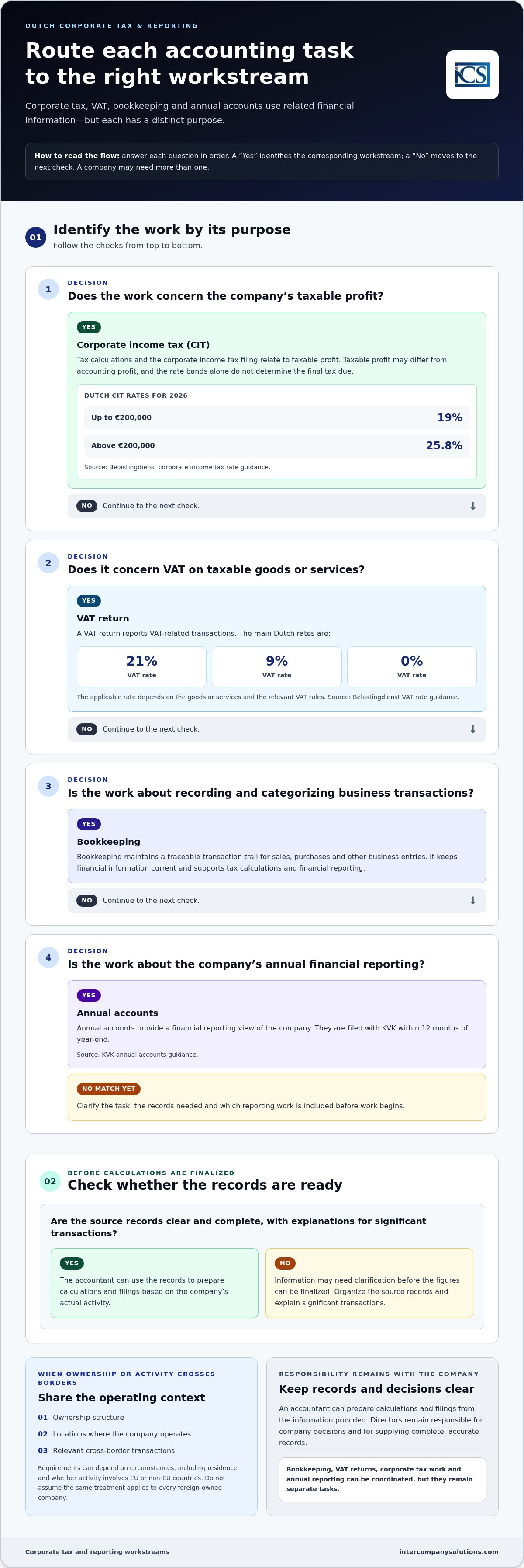
Start by identifying the work your company needs covered. A corporate income tax return, VAT returns, bookkeeping, and annual accounts each serve a different purpose, even though they draw on some of the same financial information.
This guide explains the role and limits of corporate tax accounting support, the company information and records to organize, and the points to consider when selecting an accountant. It also shows how tax filings can fit into wider bookkeeping and accounting support, so you can plan for ongoing compliance with a clearer view of your company’s responsibilities.
Key Takeaways
- A corporate tax accountant can support tax calculations and filings, while bookkeeping, VAT returns, and annual reporting have distinct roles.
- For 2026, Dutch CIT rates are 19% up to €200,000 and 25.8% above €200,000; taxable profit may differ from accounting profit.
- Compare in-house, software-led, and external support by scope, continuity, responsibility for records, and access to tax expertise.
- Organize financial records, categorize transactions, and share relevant company context. Records are retained 7 years, or 10 years for immovable property.
- Map accounting and tax tasks before work begins, and use an initial consultation to discuss your company’s needs and the proposed scope.
Table of Contents
- What a Corporate Tax Accountant in the Netherlands Handles
- Dutch Corporate Tax and Reporting Duties an Accountant Coordinates
- How to Compare Corporate Tax Accountant Support for a Dutch Company
- Records and Information to Prepare for Your Dutch Tax Accountant
- Working With Intercompany Solutions on Dutch Corporate Tax
What a Corporate Tax Accountant in the Netherlands Handles
A corporate tax accountant helps organize tax-relevant records, calculate taxable results, prepare corporate income tax filings, and coordinate related reporting. A bookkeeper primarily records and categorizes transactions. These roles can overlap, but tax work uses the underlying records to address calculations and filing requirements, while bookkeeping keeps financial information current and traceable.
The scope depends on the company’s structure, activities, and reporting needs. An accountant can prepare calculations and filings from the information provided, but directors remain responsible for company decisions and for supplying complete, accurate records. Professional support does not replace management’s responsibility for the company’s information and choices. The Dutch Tax Administration’s corporate income tax guidance explains the tax framework. For broader background, see Corporate tax in the Netherlands.
Corporate tax filing versus ongoing accounting
A tax return is one part of a wider financial record and reporting cycle. Bookkeeping maintains a transaction trail for sales, purchases, and other business entries. Those records support tax calculations and financial reporting, but recording a transaction is not the same as determining its tax treatment.
Corporate income tax and VAT are separate obligations. Corporate income tax relates to a company’s taxable profit; VAT relates to taxable supplies of goods or services and the VAT charged or accounted for on relevant transactions. The calculations, returns, and rules differ. A company may need its bookkeeping, VAT returns, corporate tax work, and annual reporting coordinated, but these remain separate tasks. An accountant can help connect them and identify the information needed for each.
When international ownership affects the working relationship
International ownership alone does not determine every Dutch tax obligation. Relevant details can include who owns the company, where it operates, and whether it has related-party or cross-border transactions. These facts help identify which records and explanations are relevant. Requirements can differ depending on circumstances, including whether an owner or entity is resident or non-resident and whether activity involves EU or non-EU countries. For companies maintaining entities across jurisdictions, such as in the UAE, engaging specialists like Account Dubai ensures local accounting, audit, and tax compliance stay aligned with broader group reporting. Do not assume that one foreign-owned company’s treatment applies to another.
At the start of the working relationship, share the ownership structure, the company’s operating locations, and a clear description of cross-border transactions. This gives the accountant context to assess the records and reporting needs without assuming that all foreign-owned businesses follow the same rules. Founders planning their structure and entry steps can also review the guide to starting a business in the Netherlands, then use that company context to inform ongoing accounting and tax work.
Dutch Corporate Tax and Reporting Duties an Accountant Coordinates
A Dutch company’s tax and reporting work draws on the same underlying financial information, but each obligation has its own purpose and filing process. An accountant can coordinate the records and calculations needed for these tasks. The company must still keep its information complete and review decisions affecting its accounts and tax position.
Corporate income tax calculations and filings
For 2026, the Dutch corporate income tax rates are 19% up to €200,000 and 25.8% above €200,000, as set out in the Belastingdienst guidance on corporate income tax rates. These rate bands are only one part of the calculation, not a complete estimate of a company’s final tax due.
Taxable profit is not automatically the same as accounting profit. Bookkeeping records transactions and supports financial statements; tax calculations then apply the relevant tax treatment to the company’s results. To prepare a return based on actual activity, the accountant needs clear source records and explanations for significant transactions. If information is incomplete, the figures may need clarification before the return can be finalized.
Corporate income tax returns have their own filing requirements. Because the filing deadline can depend on the company’s circumstances, use the current Belastingdienst instructions for corporate income tax returns rather than relying on a general date. Keep the return, supporting calculations, and bookkeeping aligned so figures can be traced to the company’s records.
VAT and annual reporting in the broader compliance picture
VAT is separate from corporate income tax. A VAT return reports VAT-related transactions, while a corporate income tax return concerns taxable profit. The main Dutch VAT rates are 21%, 9%, and 0%; the applicable rate depends on the goods or services and the relevant VAT rules. The Belastingdienst VAT rate guidance explains the rates and their application. Do not use a VAT rate to estimate corporate income tax or treat a VAT return as part of the corporate income tax return.
Annual accounts are another distinct reporting obligation. Annual accounts are filed with KVK within 12 months of year-end, as described in KVK’s annual accounts guidance. They provide a financial reporting view of the company, while tax filings apply tax rules to relevant financial information. Coordinating bookkeeping, VAT, tax calculations, and annual reporting helps maintain consistent records across these separate processes.
If your company’s filing responsibilities or records need to be assessed together, you can discuss your accounting and tax requirements with Intercompany Solutions.
How to Compare Corporate Tax Accountant Support for a Dutch Company
The right support model depends on the work your company needs covered and the capacity available internally. A Dutch BV with limited transactions may need a different arrangement from a company with employees, cross-border activity, or several reporting processes to coordinate. Software can help organize information, but it cannot replace situation-specific tax judgment or supply missing business context on its own.
Use this comparison to see where work sits and where additional support may be useful. The options can also be combined. For example, a company may keep bookkeeping in-house while using external support for tax and reporting.
| Support model | Scope and continuity | Records and tax expertise |
|---|---|---|
| In-house staff | Can cover routine finance tasks continuously, subject to staff capacity, role coverage, and handovers. | Company staff maintain or coordinate records. Access to Dutch tax expertise depends on the team’s experience and any external advice used. |
| Software-led administration | Can support repeatable bookkeeping workflows and organize transaction data. Continuity depends on correct use, regular input, and access to the system. | Company personnel remain responsible for the quality of information entered. Software can flag or process data, but does not independently assess every company-specific tax treatment. |
| External accounting support | Can provide an agreed scope of recurring bookkeeping, tax, or reporting assistance. Continuity depends on the agreed workflow and timely sharing of information. | The company supplies complete records and relevant explanations. Tax expertise is available within the agreed scope, while directors retain responsibility for company decisions and approvals. |
Match support to company structure and activity
Assess the work rather than relying on the legal form alone. Consider transaction volume, cross-border sales or purchases, related-party activity, employees, and reporting needs. A straightforward Dutch BV with limited activity may be manageable with a narrower support arrangement. More varied operations can require closer coordination between bookkeeping, VAT, payroll, tax calculations, and annual reporting. Company type alone does not establish a particular tax outcome or guarantee a saving.
Check the scope of accounting and tax coordination
Before work begins, map the tasks and handoffs. Bookkeeping organizes the underlying transactions; VAT returns and annual tax filings use relevant financial information for separate reporting purposes; annual reporting presents the company’s financial position and results. Agree who provides source documents, explains unusual transactions, reviews draft figures, approves filings, and responds to follow-up questions. Clear ownership reduces gaps, especially when directors and finance staff work across locations or time zones.
Intercompany Solutions provides accounting and tax support for Dutch entities, including internationally owned businesses. A company comparing its options can discuss its accounting and tax requirements to define a practical scope that fits its activity and internal capacity. Make sure responsibilities, records, and review steps are clear from the outset.
Records and Information to Prepare for Your Dutch Tax Accountant
Prepare records in a clear sequence so transactions can be traced and questions resolved efficiently. Complete, timely source documents support bookkeeping and tax work, but no checklist replaces a review of your company’s activities, ownership, and circumstances. The records below are practical examples, not a fixed list of documents required in every case.
- Organize the source records. Collect available invoices, bank statements, expense documentation, and records of company transactions. Keep documents in a consistent folder structure and make the relevant period easy to identify. If a bank payment covers several items, retain enough supporting detail to connect it to the underlying transactions.
- Categorize transactions and explain unusual items. Group records in line with your bookkeeping process, then flag entries that may need context, such as a large one-off expense, a payment involving a shareholder, or a transaction with a related company. Add a short, factual description of what the transaction concerned and its business purpose. Clear explanations help the accountant assess how to record an item and whether further information is needed.
- Share company context and changes. Provide a current picture of the company’s activities, ownership, operating locations, and relevant changes during the period. Explain new business lines, changes in how the company operates, or transactions that differ from its usual activity. The information required depends on the company’s facts, so discuss unclear or unusual items rather than assuming their treatment.
Retention and ownership information
Keep business records for 7 years, or 10 years for immovable property, in line with the Belastingdienst record-retention guidance. Retention supports future reference to underlying records; it does not mean every document has the same role in a tax calculation.
Ownership details also matter. For Dutch UBO registration, the threshold is >25%; changes to UBO details must be reported within 7 days, as stated in KVK’s UBO guidance. These duties relate to actual ownership and control information. Assess whether a change in your company’s circumstances affects its registration rather than assuming every internal update is reportable.
If your company is a BV, its structure and governance form part of the context for reviewing ownership and transactions. Founders can refer to the Dutch BV formation guide for background on setting up that company type.
Organized records give an accountant a starting point to review the facts relevant to your company’s filings and reporting. Keep a list of open questions alongside the records, especially where a transaction’s purpose or ownership connection is not clear from the documents alone.
Working With Intercompany Solutions on Dutch Corporate Tax
Dutch tax and reporting work is connected. Bookkeeping maintains the company’s transaction records, which provide a basis for tax calculations and reports. VAT filings and annual tax filings address separate obligations, while annual reporting presents the company’s financial information in the required format. Coordinating these tasks helps keep information consistent across the reporting cycle.
Intercompany Solutions provides accounting and tax support to Dutch entities, including internationally owned businesses. The scope can bring bookkeeping, VAT filings, annual tax filings, and annual reporting into a coordinated working arrangement. The appropriate tasks depend on the company’s activities, existing processes, and reporting needs. Start by establishing what is already being handled and where support is required.
What to cover in an initial consultation
The free initial consultation is an opportunity to explain your company’s situation and discuss a suitable scope. Prepare a concise overview of the following:
- Company activities: Describe what the company does, where it operates, and any material changes to its activities.
- Ownership context: Summarize the ownership structure and explain any relevant changes or cross-border relationships.
- Transactions and records: Give a general picture of transaction volume, the records available, and how documents are currently organized.
- Existing arrangements: Explain who currently handles bookkeeping, VAT filings, tax work, and annual reporting, including any software or internal processes in use.
- Upcoming reporting needs: Identify known reporting requirements or periods that need attention, without assuming a deadline that may depend on the company’s circumstances.
This information gives the discussion a practical starting point and helps identify which points need further review. Where an answer depends on the company’s activities, ownership, or taxpayer status, assess the applicable treatment against those facts rather than assuming it from a general example.
A clear next step for ongoing support
After the initial discussion, define the working scope and information flow. Agree which records the company will provide, how questions about transactions will be handled, and which filings and reporting tasks are included. Directors should remain involved in reviewing company information and making decisions; the accountant supports the agreed accounting and tax work using the records supplied.
For a foreign founder, a consistent process can make it easier to connect Dutch compliance tasks with the company’s wider operations. Similarly, if your enterprise also operates in jurisdictions like New Zealand, partnering with regional SME specialists such as Proledger can help maintain seamless bookkeeping and compliance standards. Keep the company overview and available records ready, identify existing arrangements, and list questions that require a company-specific answer. This provides a clear basis for discussing ongoing support without assuming that every Dutch entity has the same requirements.
Set Up a Clear Path for Ongoing Compliance
As your company develops, its operating model may change. New markets, ownership changes, or a growing team can affect the questions that need attention. Schedule regular reviews of these changes so company administration stays aligned with current circumstances.
Use the next discussion to identify what has changed, what may be coming next, and where you need clarity. A focused review can turn those priorities into a practical plan for the company’s Dutch operations.
With a clear next step, you can move forward with a defined plan for your company’s ongoing arrangements.
Frequently Asked Questions
What does a corporate tax accountant in the Netherlands do?
A corporate tax accountant helps interpret company financial information for tax purposes and prepare related filings. The accountant may identify transactions that need clarification, reconcile figures across records, and organize information for reporting. This differs from simply entering transactions into bookkeeping software. Directors remain responsible for company decisions and must ensure the information they provide is complete and accurate.
Does a Dutch BV need a corporate tax accountant?
A Dutch BV needs an approach that keeps its records and reporting work in order, but it does not necessarily need the same level of external support as another company. Consider who can maintain the administration, assess tax-related questions, and manage reporting tasks as the business changes. For example, adding staff or new cross-border transactions may increase the coordination required. The appropriate arrangement depends on the BV’s actual activity and internal capacity.
What are the Dutch corporate income tax rates in 2026?
The applicable 2026 rates are 19% up to €200,000 and 25.8% above €200,000. The rate that applies to a company’s taxable profit depends on the relevant tax rules and the company’s circumstances; the headline rates alone do not establish its final tax due. Review the Belastingdienst’s current corporate income tax guidance for details on application and reporting.
How much does a corporate tax accountant cost in the Netherlands?
Fees depend on the agreed work and the company’s circumstances. A quote may differ depending on whether support covers a single filing or also includes recurring bookkeeping, VAT work, and annual reporting. The condition and organization of existing records can affect the work involved. To discuss the scope, prepare a short overview of your company’s activities, current accounting arrangements, and the tasks you want covered.
Can a foreign-owned Dutch company use an accountant remotely?
Yes. A foreign-owned Dutch company can coordinate its accounting work remotely by sharing business records and company context with its accountant. The owner’s location alone does not determine how the company is taxed. EU or non-EU ownership may be relevant to particular circumstances, but it should not substitute for reviewing the entity, its transactions, and the status of the parties involved.
How long must a Dutch company keep its accounting records?
Keep business records for 7 years, or 10 years for immovable property. Organize and retain them so the company can trace entries to their supporting documents. The Belastingdienst’s record-retention guidance provides details, including how the rules apply to specific records.
Last reviewed: October 2026
Sources
- KVK - Registering with the Dutch Business Register
- Business.gov.nl - Private limited company (bv)
- Burgerlijk Wetboek Boek 2 (Dutch Civil Code, legal entities)
- Rijksoverheid - Ondernemen
- Belastingdienst - Corporate income tax rates
- ICS Payroll - Dutch payroll services
- Belastingdienst - Payroll taxes (loonheffingen)
- UWV - Employer obligations
- SVB - Social insurance in the Netherlands
- Belastingdienst - VAT (btw) for entrepreneurs
- European Commission - VAT rules and rates
- CJEU, Cadbury Schweppes, C-196/04 (ECLI:EU:C:2006:544)
- Hoge Raad, ECLI:NL:HR:2021:1152
- PwC Worldwide Tax Summaries - Netherlands
- ICLG - Corporate Governance Laws and Regulations, Netherlands
Need more information on the Dutch BV company?
Contact an expertReady to start your company in the Netherlands?
| Formation time | Dutch BV formation completed in 3 to 5 business days |
|---|---|
| Process | Fully remote setup with step-by-step guidance |
| Compliance | Expert support for registration, VAT and compliance |
| Aftercare | Accounting, tax and legal support included |
| One partner | All of the above through one trusted formation partner |