


September 22, 2026 · 17 min read
Securing a commercial extract from the Dutch Chamber of Commerce does not mean your enterprise is ready to trade. Most international founders discover too late that treating formation as a simple linear checklist creates severe operational friction. Identifying the common mistakes when setting up a Dutch BV early is the single best way to protect your timeline, your capital, and your director liability.
You probably already recognize the Netherlands as an ideal European base, but working with unfamiliar statutory institutions can quickly turn frustrating. Foreign directors routinely face multi-month corporate bank account reviews, delayed VAT numbers from the Belastingdienst, and procedural snarls when legalizing powers of attorney abroad. These setbacks rarely stem from rigid company law, but rather from treating legal deeds, tax registrations, and banking compliance as isolated steps.
This guide highlights the critical legal, fiscal, and administrative errors foreign business owners face and provides actionable safeguards against them. You'll learn how to coordinate the Dutch civil-law notary, the trade register, and tax authorities concurrently, ensuring smooth operational readiness without administrative penalties in 2026.
Key Takeaways
- Avoiding common mistakes when setting up a Dutch BV begins with understanding mandatory notarial deed execution and using legalized Powers of Attorney for remote formation.
- Chamber of Commerce registration does not grant immediate tax access, as foreign-owned entities face a 6-to-8-week Belastingdienst review to secure Dutch VAT numbers.
- Statutory compliance requires registering ultimate beneficial owners holding over 25% interest, with any subsequent ownership changes reported to the trade register within 7 days.
- Corporate banking onboarding under Dutch anti-money laundering laws requires thorough documentation for non-resident directors rather than treating it as an automatic formality.
- Coordinating notarial deeds, tax administration filings, and commercial onboarding simultaneously prevents prolonged operational delays and protects directors from unnecessary liability.
Table of Contents
- Core Legal and Notarial Errors During Dutch BV Formation
- Dutch Tax Registration Pitfalls: VAT Delays and Corporate Tax Miscalculations
- Regulatory and Register Oversights: UBO Filings and Statutory Filings
- Operational Traps: Corporate Banking Setup and Director Payroll Errors
- Compliant Formation Roadmap: Establishing a Dutch BV Without Costly Rectification
Core Legal and Notarial Errors During Dutch BV Formation
Underestimating statutory formalities stands among the most frequent common mistakes when setting up a Dutch BV. Foreign business owners often assume company registration in the Netherlands mirrors the rapid, unvetted digital filings common in common-law jurisdictions. Dutch company law enforces rigorous procedural safeguards that require direct civil-law notary intervention.
Entity Selection: BV Versus Unincorporated Legal Forms
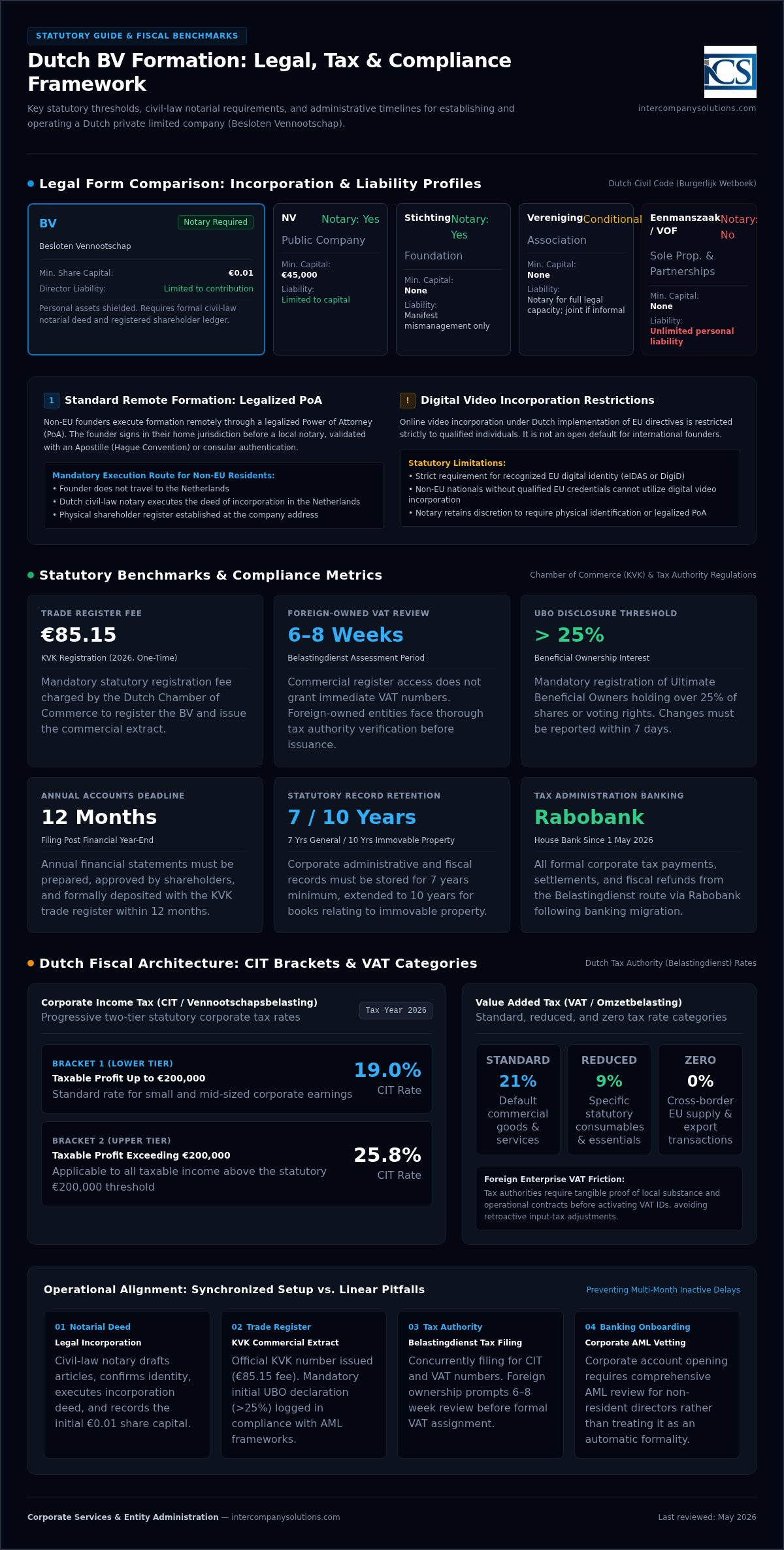
Choosing an incompatible legal structure creates immediate balance sheet exposure. International operators frequently confuse unincorporated models with incorporated entities. Sole proprietorships and partnerships register directly with the Chamber of Commerce (KVK) without notarial deeds, but they leave founders exposed to direct personal liability.
| Legal Form | Notary Required? | Founder & Director Liability | Minimum Capital |
|---|---|---|---|
| BV (Besloten Vennootschap) | Yes | Limited to capital contribution; personal assets shielded | €0.01 |
| NV (Naamloze Vennootschap) | Yes | Limited to capital contribution | €45,000 |
| Stichting (Foundation) | Yes | Limited legal personality; board liable only for manifest mismanagement | None |
| Vereniging (Association) | Only for full legal capacity | Joint and several liability if informal; limited if executed by notarial deed and registered | None |
| Eenmanszaak (Sole Proprietorship) | No | Unlimited personal liability for all business debts | None |
| VOF / CV / Maatschap (Partnerships) | No | Joint and several personal liability (CV limited partners shielded up to contribution) | None |
Establishing a private limited company requires executing a formal deed of incorporation. Governed by the Dutch Besloten vennootschap legal framework, a BV shields personal assets behind corporate legal personality. The civil-law notary acts as an impartial state gatekeeper, legally obligated to draft the articles of association, verify capital contributions, and assess the legitimacy of the enterprise.
The Legalized Power of Attorney Remote Formation Route
A frequent error is assuming digital video incorporation serves as an accessible default for foreign nationals. Dutch implementation of EU directives restricts video incorporation strictly to individuals holding recognized EU digital identities (eIDAS or DigiD). Non-EU founders cannot use this route.
The standard remote procedure relies on a legalized Power of Attorney (PoA). Foreign founders sign an authorization in their home country, which is witnessed by a local notary and authenticated with an Apostille under the Hague Convention, or through consular legalization. The Dutch civil-law notary then executes the incorporation deed locally on your behalf. Coordinating with an expert in Dutch BV company formation ensures that identification documents, legal translations, and power of attorney verifications meet the notary's exacting standards without costly procedural rejections.
Share Capital Formalities and Shareholder Register Precision
Since the introduction of the Flex-BV legislation, statutory minimum share capital is exactly €0.01. Setting arbitrary share denominations without documenting the actual capital contribution into the corporate treasury can compromise corporate limited liability. The BV must formally issue shares against real consideration, whether settled via cash deposit or assets in kind.
Directors must also maintain an accurate physical shareholder register at the company's address from day one. Failing to record share classes, transfer dates, and paid-in capital creates major legal friction during audits, share transfers, or future investor due diligence.
Dutch Tax Registration Pitfalls: VAT Delays and Corporate Tax Miscalculations
Assuming corporate tax onboarding happens automatically upon company incorporation ranks among the costliest common mistakes when setting up a Dutch BV. While the Dutch Chamber of Commerce issues a Legal Entities and Partnerships Information Number (RSIN) immediately upon registration, this number does not grant an active VAT identification code. Treating the trade register extract as an immediate operational green light stops trade before it starts.
The Belastingdienst VAT Registration Timeline for Foreign Owners
Domestic companies with resident directors often receive their VAT paperwork within two weeks. For foreign-owned entities, the Belastingdienst initiates a manual risk assessment that typically takes 6 to 8 weeks. Dutch tax inspectors issue detailed questionnaires to evaluate whether the business possesses genuine economic presence, physical nexus, and commercial activity in the country. If you fail to demonstrate commercial contracts or intended business transactions, the tax authorities can refuse to issue a turnover tax number.
Applying the wrong VAT rates also triggers rapid fiscal audits. Dutch tax law divides transactions into three statutory brackets:
- 21% standard rate: Applies to the vast majority of commercial goods and standard business services.
- 9% reduced rate: Reserved for specific essential categories, including foodstuffs, pharmaceuticals, books, and qualifying passenger transport.
- 0% rate: Applies primarily to cross-border supplies within the EU (intra-Community supplies) and export transactions outside the European Union.
Engaging professional Dutch BV company formation services ensures that the initial Belastingdienst questionnaires are completed correctly, preventing prolonged delays or immediate tax office rejections. If you face unexpected inquiries regarding local substance, you can consult an experienced incorporation specialist to align your documentation with Dutch fiscal regulations.
Corporate Income Tax (CIT) Brackets and Profit Calculations
Accurate corporate tax forecasting requires strict adherence to the two statutory profit brackets defined in the KVK guide to Dutch BV formation. Taxable annual profits up to €200,000 incur a Corporate Income Tax rate of 19%. All profits exceeding that €200,000 threshold are taxed at 25.8%. Financial planners must also factor in the interest deduction limitation under the anti-tax avoidance earnings-stripping rules, which strictly caps deductible net borrowing costs at 24.5% of tax-adjusted EBITDA.
Remittance Banking Changes: The 1 May 2026 Transition
Operational compliance requires staying current with systemic banking updates. Effective 1 May 2026, the Belastingdienst transitioned its central house banking operations exclusively to Rabobank. Remitting corporate income tax, wage tax, or periodic VAT payments to legacy state treasury bank accounts results in automated payment rejections and severe processing delays. Directors must verify that all outward electronic transfers reflect current Rabobank payment details alongside the unique 16-character payment reference assigned to each specific tax assessment.
Regulatory and Register Oversights: UBO Filings and Statutory Filings
Failing to fulfill continuous trade register obligations is one of the most persistent common mistakes when setting up a Dutch BV. Entrepreneurs frequently focus all their administrative energy on obtaining the initial notarial deed, only to neglect statutory registry maintenance once operations begin. The Dutch Chamber of Commerce (KVK) enforces strict regulatory compliance, and oversights can result in substantial administrative penalties or the loss of corporate liability protections.
UBO Register Compliance and the >25% Ownership Rule
Under Dutch anti-money laundering legislation, corporate entities must register every Ultimate Beneficial Owner (UBO). According to official Dutch UBO registration compliance requirements, any natural person holding more than 25% (>25%) of the shares, voting rights, or direct ownership interest qualifies as an ultimate beneficial owner. If no single individual meets this ownership threshold, the BV's statutory managing directors must be formally registered as pseudo-UBOs.
A critical oversight involves reporting ongoing equity adjustments. Whenever a change in beneficial ownership or voting structure occurs, corporate officers must file an update with the KVK within 7 days. Missing this statutory 7-day reporting window constitutes an economic violation and exposes managing directors to formal compliance notices or direct administrative fines.
Annual Financial Statement Filings with the Trade Register
Every Dutch private limited company must deposit its approved annual financial statements (jaarrekening) with the KVK. Incorporating a new business incurs a one-time KVK registration fee of €85.15 in 2026, after which annual filings become the primary register obligation. Article 2:394 of the Dutch Civil Code mandates that financial accounts must be submitted within a strict maximum of 12 months after the close of the financial year.
Neglecting this filing deadline triggers immediate legal vulnerabilities. If the company becomes insolvent, delinquent filings establish an irrefutable legal presumption of managerial misconduct (onbehoorlijk bestuur) under Article 2:248 BW. In this scenario, managing directors can be held personally liable for all corporate debts. Reviewing professional corporate governance support through starting business in the Netherlands guidance ensures your corporate filings remain fully compliant from the outset.
Statutory Record Retention Obligations
Dutch corporate law imposes unambiguous administrative retention periods. Managing directors must retain all financial books, invoices, contracts, and operational correspondence for a baseline statutory period of 7 years. Records that concern immovable property or European cross-border electronic and telecommunications services must be retained for 10 years. Electronic archives must remain structured, tamper-proof, and immediately accessible for Belastingdienst inspections upon request.
Operational Traps: Corporate Banking Setup and Director Payroll Errors
Securing the deed and tax numbers means little if your business cannot process payments or manage payroll legally. Falling into administrative disarray around treasury and remuneration is among the classic common mistakes when setting up a Dutch BV. International directors frequently find that operational execution inside Dutch borders requires navigating rigid banking protocols and strict labor tax rules.
Corporate Banking Roadblocks for International Founders
Treating business bank account acquisition as an automatic formality leads to months of stalled operations. Traditional Dutch retail banks enforce aggressive Know Your Customer (KYC) and Anti-Money Laundering (Wwft) vetting. When applications feature non-resident directors, high-street banks routinely take between 2 and 4 months to conduct risk assessments, frequently concluding with outright rejections.
These denials stem from three primary documentation gaps:
- Unclear European commercial nexus: Failing to prove real business transactions with EU-based suppliers, partners, or customers.
- Opaque ownership structures: Complex intermediate foreign holding companies that obscure the source of funds or ultimate control.
- Lack of resident operational representation: Operating without any local management presence or commercial substance inside the Netherlands.
Many international enterprises mitigate these delays by utilizing European electronic money institutions (EMIs) for operational liquidity while traditional retail applications process.
The Customary Salary Rule (Gebruikelijkloonregeling) for DGAs
A severe fiscal trap involves managing director remuneration. Dutch tax legislation mandates that an individual who holds a substantial interest (at least 5% of shares) and performs work for the BV is classified as a Director-Major Shareholder (Directeur-Grootaandeelhouder, or DGA). Under the gebruikelijkloonregeling, the DGA must receive a statutory minimum customary salary, set at €58,000 gross per year in 2026.
Assuming that zero corporate revenue justifies paying zero wages is a dangerous error. Ministry of Finance evaluations show that over 40% of newly formed small BVs fail to report or adjust director remuneration to this statutory wage threshold without formal advance clearance. The Belastingdienst treats non-compliance by issuing severe retroactive payroll tax assessments alongside administrative fines. Operating below the €58,000 threshold requires formal written dispensation (vooroverleg) proving cash-flow limitations, submitted to the tax authorities before filing annual returns.
Employment Contracts and Expatriate Tax Concessions
Hiring staff or formalizing director positions requires statutory Dutch employment agreements that comply fully with local labor law, mandatory holiday allowances, and social security withholdings. If you relocate specialized foreign talent to the Netherlands, the 30% ruling provides substantial tax relief by exempting 30% of gross salary from wage tax, subject to statutory wage criteria and the 2026 cap of €262,000. Leveraging specialist payroll services in the Netherlands prevents payroll reporting errors and safeguards access to statutory expatriate tax concessions.
Compliant Formation Roadmap: Establishing a Dutch BV Without Costly Rectification
Preventing the common mistakes when setting up a Dutch BV requires synchronizing legal, tax, and commercial workstreams rather than executing them consecutively. Waiting for one statutory agency to complete its review before initiating the next guarantees costly operational downtime. A disciplined roadmap aligns these requirements from the start, protecting foreign founders from administrative revisions.
Remote Formation Protocol: Pre-Incorporation Checklist
A compliant setup begins well before deed execution. Founders should follow a structured pre-incorporation sequence:
- Trade name and activity check: Verify that your trade name doesn't infringe on registered trademarks, and ensure corporate activity descriptions (SBI codes) reflect both current operations and medium-term commercial expansion. Drafting activities too narrowly forces a subsequent notarial deed amendment.
- Bilingual Articles of Association: Instruct the Dutch civil-law notary to draft bilingual articles (Dutch and English) with clear shareholder resolution rules, voting thresholds, and transfer restrictions.
- Apostilled documentation: Prepare certified passport copies and execute the legalized Power of Attorney before an authorized notary in your home jurisdiction, followed by apostille certification under the Hague Convention or consular legalization.
Following a vetted procedural model for starting a business in the Netherlands ensures foreign legal instruments pass notarial scrutiny on the first submission.
Immediate Post-Incorporation Compliance Setup
Once the civil-law notary executes the deed of incorporation, execute the following administrative actions without delay:
- Chamber of Commerce registration: Obtain the certified KVK commercial extract and settle the statutory one-time registration fee of €85.15. Confirm that initial UBO filings match shareholder registers.
- Tax administration onboarding: Immediately submit the comprehensive Belastingdienst corporate questionnaire to initiate the 6-to-8-week VAT screening process. Providing draft supplier contracts and client commitments alongside the filing expedites tax officer review.
- Treasury and accounting integration: Open segregated corporate bank accounts using your RSIN and extract, avoiding any co-mingling of personal and enterprise capital. Integrate Dutch-compliant accounting software to ensure business records remain preserved for the mandatory 7-year retention period.
Establishing these administrative foundations systematically safeguards your corporate limited liability shield and ensures your business trades smoothly across European markets.
Executing a Seamless Dutch BV Incorporation
Avoiding the common mistakes when setting up a Dutch BV requires synchronizing your notarial execution, tax office filings, and operational banking rather than managing them as disjointed steps. Strict adherence to the 7-day UBO reporting window and statutory director salary rules protects your venture from retrospective assessments while preserving your limited liability shield from day one.
Established in 2015, Intercompany Solutions has assisted over 1,000 foreign entrepreneurs from more than 50 countries. Our team coordinates remote incorporation within 3 to 5 business days, delivering full-service support across company formation, Belastingdienst VAT registration, and ongoing corporate accounting management.
Proper legal and fiscal preparation gives your enterprise a dependable platform to scale across European markets with complete regulatory confidence.
Last reviewed: September 2026
Frequently Asked Questions
Can a foreign entrepreneur incorporate a Dutch BV without traveling to the Netherlands?
Yes. A foreign entrepreneur can form a Dutch BV completely remotely by executing a legalized Power of Attorney (PoA). The founder signs the authorization abroad before a local notary, authenticates it with an Apostille or consular legalization, and sends it to the Dutch civil-law notary. Video-based digital incorporation isn't available to most non-resident founders lacking approved EU digital credentials. This remote PoA procedure avoids foreign travel while satisfying all Dutch notarial and identity verification laws.
What is the statutory minimum share capital required to establish a Dutch BV?
The statutory minimum share capital required to establish a Dutch BV is exactly €0.01 under the Dutch Flex-BV law. Founders can issue shares of nominal value, such as one share of one eurocent or one euro. While capital requirements are minimal, directors must formally deposit the committed amount into the corporate treasury to validate share issuance and maintain limited liability protection under Dutch company law.
How long does it take to obtain a Dutch VAT number for a foreign-owned BV?
Obtaining a Dutch VAT identification number for a foreign-owned BV typically takes between 6 and 8 weeks. While the Chamber of Commerce registers the company and issues an RSIN in days, the Belastingdienst independently reviews foreign-managed entities. The tax office sends a detailed substance questionnaire to verify commercial operations and local economic nexus before issuing an active turnover tax number. Submitting commercial contracts early helps avoid prolonged application delays.
What are the corporate income tax rates for a Dutch BV in 2026?
In 2026, the Dutch Corporate Income Tax (CIT) rate is 19% on taxable profits up to €200,000 and 25.8% on any profits exceeding that threshold. Businesses must calculate profits carefully, noting that tax deductions on net interest expenses are strictly capped at 24.5% of EBITDA under earnings-stripping rules. In addition, all tax remittances must be paid directly to the Belastingdienst's Rabobank accounts, which took effect on 1 May 2026.
Is a civil-law notary required to set up all types of Dutch business entities?
No, a civil-law notary is not required for all Dutch business structures. Unincorporated structures such as an eenmanszaak (sole proprietorship), vennootschap onder firma (VOF), commanditaire vennootschap (CV), and maatschap can register directly with the Chamber of Commerce without notarial intervention. Conversely, incorporated legal entities, including the private limited company (BV), public company (NV), and foundation (stichting), legally require an executed notarial deed of incorporation drafted by a Dutch civil-law notary.
What is the consequence of failing to report changes to the Dutch UBO register within 7 days?
Failing to report Ultimate Beneficial Owner (UBO) modifications within the mandatory 7-day window constitutes an economic offense under the Dutch Economic Offences Act. The Chamber of Commerce and regulatory authorities can issue formal non-compliance notices, impose administrative fines, or flag the company for supervisory scrutiny, which can immediately disrupt institutional banking relationships and cross-border commercial transactions.
How long must a Dutch BV retain its corporate records and financial documentation?
A Dutch BV must retain its core business records, accounting books, and transactional documentation for a statutory baseline of 7 years under the Dutch Civil Code and General State Taxes Act. However, any corporate records and documents relating to immovable property or cross-border telecommunications and digital services must be retained for 10 years. Electronic records must remain fully legible, structured, and instantly accessible to Belastingdienst tax inspectors during audits.
What is the customary salary rule for a Dutch BV director-major shareholder (DGA)?
The customary salary rule (gebruikelijkloonregeling) mandates that a director holding at least 5% of shares must receive a statutory minimum wage, set at €58,000 gross per year in 2026. Founders cannot arbitrarily draw a zero salary during initial trading without prior written approval. Paying less than €58,000 requires submitting an advance request (vooroverleg) to the Belastingdienst, demonstrating that corporate cash flow cannot support the statutory remuneration level.
Sources
- ICS Payroll - Dutch payroll services
- KVK - Registering with the Dutch Business Register
- Business.gov.nl - Private limited company (bv)
- Burgerlijk Wetboek Boek 2 (Dutch Civil Code, legal entities)
- Rijksoverheid - Ondernemen
- Belastingdienst - Corporate income tax rates
- Belastingdienst - Payroll taxes (loonheffingen)
- UWV - Employer obligations
- SVB - Social insurance in the Netherlands
- Belastingdienst - VAT (btw) for entrepreneurs
- European Commission - VAT rules and rates
- De Nederlandsche Bank - Supervision
- AFM - Licences and registers
- RVO - Doing business internationally
- Belastingdienst Douane - Customs
- CJEU, Cadbury Schweppes, C-196/04 (ECLI:EU:C:2006:544)
- Hoge Raad, ECLI:NL:HR:2021:1152
- PwC Worldwide Tax Summaries - Netherlands
- ICLG - Corporate Governance Laws and Regulations, Netherlands
Need more information on the Dutch BV company?
Contact an expertReady to start your company in the Netherlands?
| Formation time | Dutch BV formation completed in 3 to 5 business days |
|---|---|
| Process | Fully remote setup with step-by-step guidance |
| Compliance | Expert support for registration, VAT and compliance |
| Aftercare | Accounting, tax and legal support included |
| One partner | All of the above through one trusted formation partner |