


September 27, 2026 · 15 min read
The lowest-cost account may not be the most suitable choice for a Dutch company, particularly when its founders live abroad. Eligibility, identity checks and the bank’s onboarding process can determine whether an option is practical before account features or fees become relevant.
If you’re comparing providers, it can be difficult to confirm whether they accept your company structure and ownership profile, or what documents they’ll request. This “Best banks for Dutch company accounts” comparison guide helps you assess options using current eligibility, onboarding, account functionality and support criteria. The bank makes its own decision on every application, so approval shouldn’t be assumed.
We’ll compare traditional banks and digital-first providers, explain which details to verify in their current terms, and outline the documents and checks you may encounter. You’ll come away with a shortlist to investigate based on your company and founders’ circumstances, plus a clearer view of possible limitations before you apply.
Key Takeaways
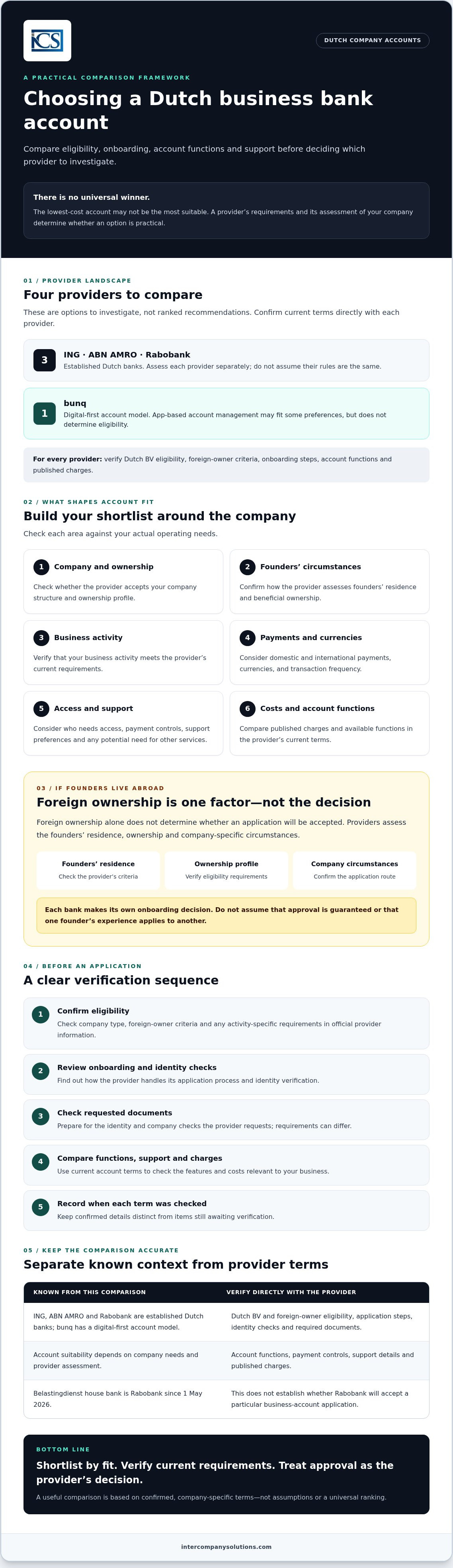
- Use the “Best banks for Dutch company accounts” comparison guide to assess providers against your company structure, business activity, payment needs and support preferences.
- Compare ING, ABN AMRO, Rabobank and bunq by checking current eligibility, onboarding requirements, account functions and published charges rather than choosing a universal winner.
- Foreign ownership alone doesn’t determine whether an application will be accepted. Check how each provider assesses your founders’ residence, ownership and company-specific circumstances.
- Before applying, confirm eligibility and current terms directly with the provider, then prepare for its requested identity and company checks.
- Belastingdienst house bank is Rabobank since 1 May 2026. This does not establish that Rabobank will accept a particular business-account application.
Table of Contents
- How to Compare Dutch Company Accounts Before Choosing a Bank
- Dutch Business Bank Comparison: How ING, ABN AMRO, Rabobank, and bunq Differ
- Can a Non-Resident Founder Open a Dutch Company Bank Account?
- How to Choose and Apply for a Dutch Company Account
- Choosing Your Dutch Company Account and Planning the Next Step
How to Compare Dutch Company Accounts Before Choosing a Bank
This guide compares business-account options for Dutch companies, including foreign-owned BVs. The right choice depends on more than the provider’s name: eligibility, business activity, ownership, payment needs and the support available all affect whether an account will work for your company. Use this “Best banks for Dutch company accounts” comparison guide to build a shortlist, then confirm each provider’s current requirements directly.
A bank or account provider opens and administers the account and makes its own onboarding decision. An intermediary may assist with an application, but cannot guarantee acceptance or change the provider’s eligibility rules. Keep those roles distinct as you compare options.
Which business-account needs should shape your shortlist?
Start with how the company will use the account. Estimate the pattern of domestic and international payments, the currencies involved, and whether transactions are occasional or frequent. Consider who needs account access, what approval or payment controls are required, and whether the business may need lending or other services. Confirm availability and conditions with each provider rather than assuming they’re included.
Which providers belong in a 2026 comparison?
ING, ABN AMRO, Rabobank and bunq are providers to investigate, not ranked winners. The List of banks in the Netherlands offers wider market context, but it isn’t a source for account terms. Check each provider’s official materials for its Dutch BV application route, foreign-owner eligibility, onboarding steps, account functions and charges. Requirements may depend on the company and its owners, so don’t assume that one founder’s experience applies to another.
Record the date you checked each term. A comparison is useful only if it distinguishes confirmed information from details still to verify.
| Comparison criterion | Provider | Current evidence to check | Verification date |
|---|---|---|---|
| Dutch BV eligibility and foreign ownership | ING | Official business-account eligibility and application information | Record the date checked |
| Onboarding route and identity checks | ABN AMRO | Official application steps and documentation requirements | Record the date checked |
| Account functions and support | Rabobank | Official account terms, functions and support details | Record the date checked |
| Ownership eligibility and published charges | bunq | Official eligibility criteria, account terms and pricing | Record the date checked |
This shortlist sets the scope for the comparison that follows. Treat every provider’s published terms as subject to confirmation, especially where directors or beneficial owners live outside the Netherlands.
Dutch Business Bank Comparison: How ING, ABN AMRO, Rabobank, and bunq Differ
ING, ABN AMRO and Rabobank are established Dutch banks; bunq offers a digital-first account model. This distinction can guide your research, but it doesn’t establish which provider will accept a Dutch BV or an owner who lives abroad. The bank’s current application criteria and its assessment of your company remain decisive. The “Best banks for Dutch company accounts” comparison guide is most useful when it helps you compare verified terms, not when it assigns a universal winner.
How to compare established Dutch banks
Assess ING, ABN AMRO and Rabobank separately. Don’t assume that one provider’s treatment of foreign ownership, directors’ residence or a particular legal entity applies to another. For each, check the official application pages for BV eligibility, identity verification, documents, account access and payment controls. The De Nederlandsche Bank provides information about the Dutch financial sector, but provider-specific account terms must come from the provider.
How to assess bunq for a Dutch BV
Apply the same tests to bunq: confirm BV and beneficial-owner eligibility, onboarding requirements, available account functions and current charges. Its digital-first model may suit companies that prefer app-based account management, but that preference doesn’t resolve eligibility. For setup instructions, consult the separate article How to Open a bunq Business Account for Your Dutch BV.
| Provider | Eligibility and company types | Onboarding | Account functions to compare | Published fees |
|---|---|---|---|---|
| ING | Confirm Dutch BV and foreign-owner eligibility in current official terms. | Verify identity checks, application route and required documents. | Check payment options, account access and any relevant integrations. | Confirm current package, transaction and additional charges on ING’s official pricing page. |
| ABN AMRO | Confirm BV eligibility and how the bank assesses foreign ownership. | Check application steps and identity requirements for each relevant applicant. | Compare payment controls, access arrangements and included functions. | Verify package pricing and any applicable additional charges in current disclosures. |
| Rabobank | Check which account options apply to the company’s legal form and ownership. | Confirm the current route and documentation directly with Rabobank. | Review payment features and account access against the company’s needs. | Check current account and transaction charges in Rabobank’s published terms. |
| bunq | Verify BV and beneficial-owner requirements before applying. | Confirm current digital onboarding steps and identity checks. | Assess app-based access and the functions offered for the relevant account. | Check current plan and transaction pricing in bunq’s official terms. |
Record the date you verify each provider’s terms, then compare like with like. Fees, features and eligibility can change, so don’t rely on an old comparison or assume a listed account is available to your company.
Can a Non-Resident Founder Open a Dutch Company Bank Account?
A foreign-owned Dutch BV can apply for a business account, but foreign ownership alone doesn’t establish that a provider will accept it. Each bank or account provider assesses applications under its own criteria. Dutch company registration and bank approval are separate steps, and using an intermediary to prepare or submit an application doesn’t guarantee acceptance.
Founder circumstances matter, but don’t treat EU or non-EU status as an automatic outcome. Consider these distinctions when asking a provider about eligibility:
- EU or non-EU founder: Ask whether the owner’s nationality or country of residence affects the application and what evidence the provider requires.
- Resident or non-resident director: Confirm whether directors must attend an identity check in person or can complete the provider’s current verification process remotely.
- Company-specific profile: Explain the ownership structure, business activity and expected transaction pattern accurately. Ask whether any of these details affect the provider’s assessment.
These are points to verify, not universal acceptance or rejection rules. A requirement stated by one provider may not apply to another, and the answer may depend on the specific company and people involved.
What can affect eligibility for a foreign-owned Dutch BV?
Providers may review the company’s ownership and directors, its activities, expected payments and the identification information supplied. The relevance of each factor depends on the provider’s own checks and the facts of the application. Ask for an assessment route that fits your circumstances, particularly if owners or directors live outside the Netherlands. Don’t assume a BV’s incorporation documents resolve the bank’s separate review.
What documents might providers request?
Document requirements can vary with ownership, residence, company activity and the provider’s onboarding process. Before applying, obtain the current checklist from the provider and confirm which documents it needs from the company, directors and beneficial owners. Use that list rather than relying on another applicant’s experience or a general online checklist.
Check whether documents must be current, translated, certified or submitted in a particular format. If the provider’s public guidance doesn’t address your situation, ask before filing the application. This can help you identify missing information early, but it cannot ensure approval.
For a foreign founder, the practical decision is whether a provider’s confirmed process fits the company and the people who must complete its checks. The bank makes the final onboarding decision.
How to Choose and Apply for a Dutch Company Account
Use a consistent process to move from a broad shortlist to an application. The “Best banks for Dutch company accounts” comparison guide can help you organize the comparison, but the provider’s current terms and its assessment of your company determine the outcome.
- Define your needs. List the company’s expected domestic and international payments, currencies, transaction patterns, account users and payment controls. Identify whether lending or other services are also relevant.
- Shortlist providers. Select options whose published account functions appear to fit those needs. Don’t base the shortlist on a headline fee alone.
- Check eligibility. Confirm that each provider accepts applications for your legal form and business activity, and ask how ownership and founder residence affect its process.
- Verify current terms. Review the provider’s official information on documents, identity checks, payment functions, support and charges. Save the source and date checked for every material claim.
- Apply and respond to requests. Submit the information the provider requests and follow up through its stated application channel. The provider makes its own decision.
What should you check before submitting an application?
Match the application requirements to the actual company profile. Confirm the legal form, activities and ownership structure the provider will assess, and establish how directors and beneficial owners must verify their identities. Check which payments and currencies the account supports and whether the functions you need are included in the relevant account option.
Compare charges on the same basis. Record any account or package charge, payment fees and additional costs shown in the provider’s current disclosures. Calculate the likely total using your own expected payment pattern, rather than relying on an industry average or comparing one provider’s package fee with another’s transaction fee. If a term or eligibility point is unclear, ask the provider and keep its written response with your notes.
How do company formation and account opening relate?
Company registration and bank-account approval are separate processes. Registering a Dutch BV doesn’t oblige a provider to open an account, and an intermediary that assists with an application can’t decide the outcome. If the company hasn’t yet been established, read the Dutch BV formation information for formation context and the business start-up guide for related planning. For bunq-specific application instructions, consult the separate article titled How to Open a bunq Business Account for Your Dutch BV.
Review Dutch BV formation options
Choosing Your Dutch Company Account and Planning the Next Step
Select a provider only after confirming that its account fits your company’s operating needs, that your company and founders meet its eligibility criteria, and that you’ve checked the current terms. A provider’s reputation or a general comparison cannot replace an assessment of your specific application.
Belastingdienst house bank is Rabobank since 1 May 2026. This designation doesn’t establish that Rabobank is the best fit for every company or that it will accept a particular application. Treat it as one relevant fact, then compare providers against your own requirements.
How should you make the final comparison?
Rank your shortlisted providers against the requirements you’ve verified, rather than general brand reputation. Before applying, check the provider’s current eligibility criteria, charges and account terms again. Keep a record of the official pages you reviewed, the date of each check, and any written answers from the provider.
Your comparison can focus on practical questions:
- Does the provider confirm that the account is available for your legal form, ownership and business activity?
- Do the payment functions, access arrangements and published charges suit the company’s expected use?
- Are the identity checks and application steps workable for the directors and beneficial owners involved?
Retain provider correspondence and application records with the company’s administration documents. If a term changes or the provider asks for further information, a clear record helps you track what was confirmed and when.
When can professional application assistance be useful?
Application assistance may be useful when you’re coordinating a Dutch BV setup with the account application, particularly if the founders live outside the Netherlands. Intercompany Solutions can assist with bank-account applications as part of relevant support, but the provider remains responsible for its onboarding checks and acceptance decision. Assistance does not guarantee approval.
For founders coordinating company formation and the account application, a consultation can help clarify the steps involved and what to confirm with the provider. Prepare your shortlist and any unresolved eligibility questions so the discussion stays focused on your company’s circumstances.
Last reviewed: September 2026
Choose an Account That Fits Your Dutch Company
The “Best banks for Dutch company accounts” comparison guide points to a practical decision rule: compare providers against your company’s legal form, ownership, activities, payment needs and support requirements. Confirm current eligibility and charges directly with each provider, especially if directors or beneficial owners live abroad. A Dutch registration or an application intermediary cannot guarantee approval.
Belastingdienst house bank is Rabobank since 1 May 2026, but that designation doesn’t mean Rabobank is the best fit for every business. Your shortlist should reflect your own circumstances, and your final checks should use the provider’s latest terms.
Intercompany Solutions supports international entrepreneurs establishing Dutch companies, and bank-account application assistance may be available as part of broader company services. The provider retains control of its onboarding and acceptance decision.
With a clear shortlist and verified application requirements, you can plan the next step with greater confidence.
Frequently Asked Questions
Can a non-resident open a bank account for a Dutch BV?
Yes, a non-resident founder may be able to apply, but acceptance depends on the provider and the company’s circumstances. EU or non-EU status, the residence of directors and beneficial owners, business activity and identity checks may affect the application. Ask each provider how its current process applies to your ownership structure, and whether any identity checks require an in-person step. Don’t assume remote application or approval is available.
Which bank is best for a Dutch company account?
There isn’t one provider that is best for every Dutch company. Compare ING, ABN AMRO, Rabobank and bunq against your legal form, ownership, business activity, payment requirements, onboarding needs and support preferences. Check current eligibility and charges on each provider’s official materials before deciding. Your shortlist should reflect your company’s circumstances, rather than a universal ranking of banks or account providers.
Is bunq suitable for a Dutch BV owned by foreign founders?
It may be suitable if the BV and its beneficial owners meet bunq’s current eligibility conditions. bunq’s official business-account information should be checked for current requirements, including any residency conditions for ultimate beneficial owners. A founder’s nationality alone doesn’t establish residence or eligibility. Confirm the rules for every UBO and the BV’s specific structure before applying, then compare the account terms with your operating needs.
What documents do Dutch banks require to open a business account?
There isn’t one document list that applies to every provider or application. Requirements can vary with the company’s ownership, directors’ residence and business activity. Before applying, obtain the provider’s current checklist and confirm which documents it requires, who must provide them, and whether any format or verification conditions apply. If your circumstances aren’t covered in its published guidance, ask the provider before submitting the application.
Does registering a Dutch BV guarantee that it can open a bank account?
No. Registering a BV establishes the company, but each bank or account provider makes an independent decision on whether to accept an account application. The provider may conduct identity and company checks under its own current requirements. An intermediary may assist with preparing or submitting an application, but cannot guarantee the result or make the acceptance decision. Confirm eligibility directly with the provider before relying on a particular account option.
Sources
- KVK - Registering with the Dutch Business Register
- Business.gov.nl - Private limited company (bv)
- Burgerlijk Wetboek Boek 2 (Dutch Civil Code, legal entities)
- Rijksoverheid - Ondernemen
- De Nederlandsche Bank - Supervision
- AFM - Licences and registers
- CJEU, Cadbury Schweppes, C-196/04 (ECLI:EU:C:2006:544)
- Hoge Raad, ECLI:NL:HR:2021:1152
- PwC Worldwide Tax Summaries - Netherlands
- ICLG - Corporate Governance Laws and Regulations, Netherlands
Need more information on the Dutch BV company?
Contact an expertReady to start your company in the Netherlands?
| Formation time | Dutch BV formation completed in 3 to 5 business days |
|---|---|
| Process | Fully remote setup with step-by-step guidance |
| Compliance | Expert support for registration, VAT and compliance |
| Aftercare | Accounting, tax and legal support included |
| One partner | All of the above through one trusted formation partner |