


September 18, 2026 · 17 min read
Maintaining a Dutch BV requires absolute adherence to the KVK filing deadlines and Belastingdienst tax regulations to avoid personal director liability. Most international founders find that the procedural complexity of Dutch tax administration is a significant barrier to efficient remote management. You likely recognize that staying compliant is a non-negotiable aspect of corporate life, yet the specific thresholds and reporting standards are difficult to manage from a distance. Securing professional accounting services helps bridge the gap between global business operations and local statutory requirements while you focus on core growth.
This guide provides a practical roadmap for mandatory financial reporting, corporate tax thresholds, and VAT compliance for foreign-owned Dutch BVs in 2026. You will learn how to synchronize your annual accounts with tax filings while utilizing specific incentives like the participation exemption to optimize your fiscal position. We cover essential details like the CIT 19% rate for profits up to €200,000 and the transition of the tax office's house bank to Rabobank. This overview prepares you for a year of structured compliance by outlining the specific requirements necessary to maintain your company's financial health.
Key Takeaways
- Learn the statutory requirements for maintaining financial records for 7 years and the mandatory KVK filing within 12 months of the year-end.
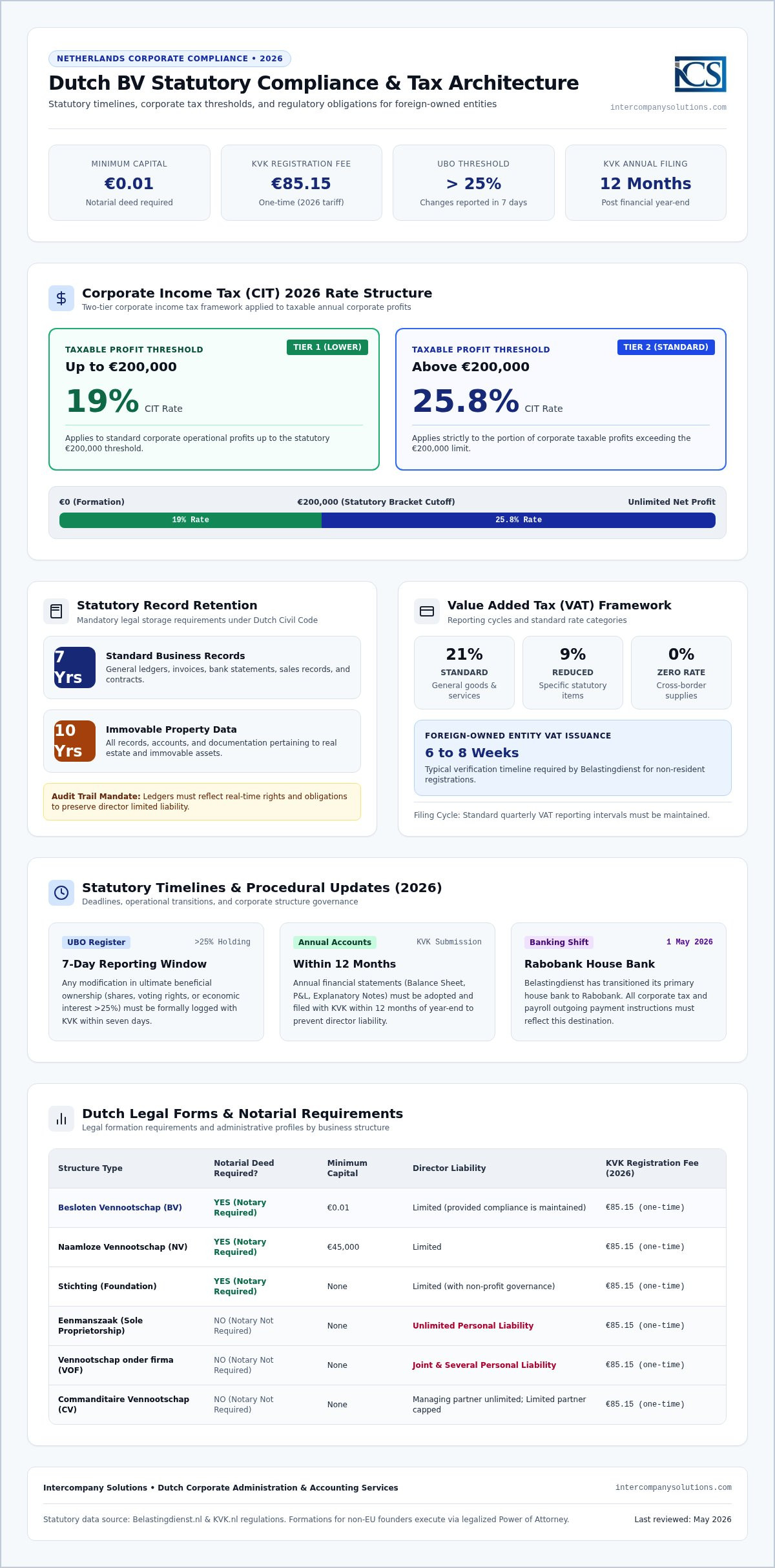
- Identify the 2026 corporate tax rates of 19% for profits up to €200,000 and 25.8% for profits exceeding this threshold.
- Utilize specialized accounting services to manage VAT compliance and quarterly reporting cycles for foreign-owned Dutch BVs.
- Understand the mandatory payroll tax filings and social security obligations required for all active employers in the Netherlands.
- Update your payment procedures to align with the Belastingdienst's transition to Rabobank as its primary house bank on 1 May 2026.
Table of Contents
Statutory Accounting Obligations for Dutch BV Entities
Operating a Dutch Besloten Vennootschap (BV) carries specific legal responsibilities defined under the Dutch Civil Code. Every director has a statutory duty to maintain a ledger that accurately reflects the company's financial position at any given moment. This requirement isn't just about internal oversight. It is a legal mandate to ensure that the rights and obligations of the entity can be determined immediately. While many founders focus on management accounting to track daily performance, statutory reporting is the primary concern for the Belastingdienst and the Dutch Chamber of Commerce (KVK). Accurate record-keeping protects the limited liability status of the directors and provides a clear audit trail for tax authorities.
Legal Framework for Dutch Bookkeeping
The Dutch legal framework requires all corporate entities to keep detailed records for a minimum of seven years. For immovable property, this retention period extends to ten years. These records must be accessible and organized so that a third party can understand the company's financial state without extensive delay. A critical component for non-resident owners is the necessity of a Dutch business address. This address serves as the official point for correspondence from tax authorities and the KVK. You can find detailed official administration rules on the government's portal to ensure your internal processes align with local expectations. Precise bookkeeping allows for the immediate determination of rights and obligations, which is a core requirement of Dutch law.
Mandatory KVK Registration and Maintenance
Transparency is a cornerstone of the Dutch business environment, managed through the KVK. Upon Dutch BV company formation, a one-time registration fee of €85.15 applies for 2026. The BV requires a minimum capital of only €0.01, and its formation must be executed via a notarial deed. Beyond initial setup, the BV must maintain an accurate UBO (Ultimate Beneficial Owner) register. Any person holding more than 25% of the shares, voting rights, or ownership interest is considered a UBO. Compliance requires that any changes to UBO information be reported within seven days. This public disclosure ensures that the company's structure remains transparent to financial institutions and regulatory bodies.
Managing these statutory obligations requires a methodical approach to bookkeeping. Engaging professional accounting services helps bridge the gap between international business practices and specific Dutch requirements. Since the Belastingdienst house bank transitioned to Rabobank on 1 May 2026, ensuring your payment and reporting systems are synchronized with the latest administrative shifts is vital. Specialized accounting services prevent the accumulation of penalties and ensure that your company's financial history remains beyond reproach during potential audits. This proactive management allows international founders to maintain full regulatory compliance while operating remotely.
Financial Reporting and Annual Accounts Standards
Every Dutch BV must prepare and file its financial statements annually to maintain legal transparency. This process involves more than just internal bookkeeping; it is a public disclosure requirement that ensures creditors and stakeholders can verify the company's fiscal health. The standard reporting package consists of a balance sheet, a profit and loss account, and explanatory notes. Publication requirements are not uniform for all entities. They vary significantly based on the size category of the BV, which ranges from Micro and Small to Medium and Large. Most foreign-owned BVs fall into the Micro or Small categories, which benefit from simplified reporting standards. Utilizing professional accounting services ensures that these documents are prepared according to the specific thresholds applicable to your business size.
Annual Accounts Preparation Deadlines
Timing is a critical factor when filing financial statements with the KVK. The law mandates that annual accounts must be filed with the KVK within 12 months of the financial year-end. Before this submission, the management board must prepare the statements for adoption by the shareholders during the annual general meeting. Shareholders typically have a set window to adopt these accounts after the financial year concludes. Missing these strict deadlines can lead to severe consequences. Late filing is classified as an economic offense, resulting in significant fines from the authorities. Perhaps more critically, failure to file on time can lead to personal director liability if the company ever faces insolvency. Filings are submitted through the kvk.nl portal, which requires specific digital protocols or the assistance of a registered intermediary.
Dutch GAAP vs. IFRS in Local Reporting
Most small and medium-sized Dutch BVs utilize the Dutch Generally Accepted Accounting Principles (GAAP) for their local reporting. While large international groups may choose International Financial Reporting Standards (IFRS), Dutch GAAP is often the preferred choice for its practical application within the local regulatory environment. There are specific exemptions available for smaller entities to protect operational privacy. For example, micro-entities are generally exempt from publishing their full profit and loss statements. For a more detailed breakdown of these fiscal duties, you can review our guide on Accounting for Dutch BV: Compliance and Tax Obligations in 2026.
Compliance also involves strict data management. Records must be retained for 7 years, though this period increases to 10 years for documents related to immovable property. Since the Belastingdienst house bank is Rabobank since 1 May 2026, all related tax payments or refunds must be coordinated with this transition in mind. Managing these standards from abroad requires a partner who understands the intersection of Dutch law and international business. Our team provides the accounting services necessary to handle these statutory filings efficiently, allowing you to manage your company's finances remotely without risking non-compliance or penalties.
Corporate Income Tax and VAT Compliance Framework
The Dutch tax system operates on a principle of global profit taxation for resident companies. For a foreign-owned BV, this means that all income generated worldwide is subject to Dutch corporate tax unless specific treaties or exemptions apply. Managing these filings requires a precise understanding of Belastingdienst business tax compliance. Since 1 May 2026, the tax office has utilized Rabobank as its primary house bank. This change affects all outgoing and incoming tax-related transactions. Maintaining compliance involves more than just calculating profit; it requires adhering to specific anti-tax avoidance measures, such as the interest deduction cap. For the 2026 tax year, this cap is set at 24.5% of the company's EBITDA.
Corporate Income Tax (CIT) Thresholds for 2026
For 2026, the Dutch corporate income tax structure remains divided into two distinct brackets. Taxable profits up to €200,000 are taxed at a rate of 19%. Any profit exceeding this €200,000 threshold is subject to a higher rate of 25.8%. Holding companies often benefit from the participation exemption. This rule prevents double taxation by exempting dividends and capital gains derived from qualifying subsidiaries from CIT. Implementing these exemptions correctly is a core part of professional accounting services. It allows companies to reinvest capital efficiently while staying within the legal boundaries of Dutch tax law.
VAT Rates and EORI Applications
Value Added Tax (VAT), or BTW, follows a structured reporting cycle. Most Dutch BVs file their declarations quarterly, though the authorities may mandate monthly or annual filings depending on the transaction volume. The standard VAT rate in the Netherlands is 21%, while a reduced rate of 9% applies to specific categories like food and books. For foreign-owned entities, obtaining a VAT number typically takes 6 to 8 weeks. This lead time is a vital consideration for businesses planning their launch. If your BV engages in international trade with countries outside the European Union, you must also obtain an EORI number. This identification is required for all customs declarations and ensures that your goods can move across borders without administrative delays.
Managing these multi-layered tax requirements from abroad can be demanding. Our specialized accounting services provide the local expertise needed to synchronize your VAT filings with CIT obligations. By ensuring every declaration is accurate and submitted on time, you protect your company from unnecessary scrutiny. This level of oversight is essential for maintaining a healthy relationship with the Dutch tax authorities while scaling your international operations.
Payroll Administration and Social Security Obligations
Employing staff through a Dutch BV requires adherence to specific labor laws and tax regulations. Every employee must have a written contract that complies with Dutch civil law. Before the first salary payment occurs, the company must register as an employer with the Belastingdienst. This registration enables the monthly submission of payroll tax filings, known as loonaangifte. These filings are mandatory for all active employers, regardless of whether the staff are residents or non-residents. Managing these filings accurately ensures that wage taxes and social security contributions are calculated correctly.
Social security in the Netherlands is comprehensive. Contributions cover essential protections including state pension (AOW), disability insurance, and unemployment benefits. Employers are responsible for withholding these amounts from the employee's gross salary and paying the employer-portion directly to the tax authorities. Since 1 May 2026, all such payments must be directed to the Belastingdienst via Rabobank. Failing to meet these monthly obligations can result in immediate fines and interest charges. Proactive management of these payments is a standard part of maintaining a compliant corporate presence.
Payroll and Staffing for International BVs
For international founders, managing a local workforce from abroad presents logistical challenges. Utilizing specialized Payroll and Staffing services allows you to handle employment contracts and social security obligations through a single monthly invoice. This includes assistance with mandatory pension scheme registrations and the procurement of sick-leave insurance, which is vital given the Dutch requirement to pay salary during long-term illness. If your business requires highly skilled migrants, we provide guidance on meeting the specific highly skilled migrant requirements set by the IND. This ensures that your international staff have the correct legal standing to work in the Netherlands.
The 30% Tax Reimbursement Ruling
The 30% tax-free allowance is a significant incentive for Dutch BVs recruiting specialized talent from abroad. Qualifying international employees can receive 30% of their gross salary tax-free, provided they meet specific salary thresholds and scarcity criteria. This ruling reduces the total employment cost for the BV while offering a competitive net salary to the recruit. The application process is handled through the Belastingdienst and requires precise documentation regarding the employee's recruitment from outside the Netherlands. For a deeper look at these benefits, see our Payroll Services in the Netherlands: 2026 Guide.
Criteria for Selecting Specialized Accounting Services
Selecting a partner for your company's fiscal management requires evaluating their specific experience with non-resident founders. For a foreign-owned Dutch BV, standard bookkeeping is often insufficient to address the intersection of local requirements and international business structures. Prioritize firms that offer a 24-hour response time guarantee to handle time-sensitive cross-border inquiries. This speed is essential when managing a business from a different timezone, ensuring that no KVK filing deadline or Belastingdienst request goes unanswered. A reliable partner acts as a bridge between your global operations and the meticulous standards of the Dutch tax system.
A critical differentiator for international entrepreneurs is the ability to manage the initial incorporation remotely through a legalized Power of Attorney (POA). This route allows the notary to execute the deed without the founder needing to travel to the Netherlands, which is the standard procedure for non-resident directors. Your provider should be comfortable working within this framework, providing a seamless transition from the setup phase to ongoing statutory compliance. You can learn more about the technical requirements of this process in our Professional Guide to Dutch BV Formation: Remote Setup in 2026.
Remote Compliance for International Entrepreneurs
Modern administrative workflows rely on digital portals for document submission and compliance monitoring. This technology allows you to upload invoices, track VAT obligations, and review financial statements without a physical presence in the Netherlands. During the first year of operation, dedicated administrative coordination becomes a vital component of your strategy. This ensures that all KVK and Belastingdienst correspondence is processed and archived correctly. With the UBO threshold set at >25% and changes requiring reporting within 7 days, having a proactive facilitator on the ground prevents administrative lapses that could lead to significant fines or legal complications.
Administrative Support for Foreign-Owned BVs
Financial compliance extends beyond tax returns to include coordinating bank account assistance and tax registration. Every administrative step must align with the current regulations found on belastingdienst.nl. For instance, the Belastingdienst house bank is Rabobank since 1 May 2026, which requires precise updates to your payment workflows for CIT and VAT settlements. Whether you are managing the transition between CIT brackets or ensuring records are retained for the mandatory 7 years, your choice of provider determines the efficiency of your remote operations. Utilizing specialized accounting services ensures your business remains accurate in its reporting while maintaining full digital accessibility for its directors.
Securing Your Dutch BV's Fiscal Future
Maintaining a compliant Dutch BV in 2026 requires a proactive approach to statutory deadlines and tax thresholds. You've now identified the necessity of filing annual accounts with the KVK within 12 months of the year-end and the specific CIT rates of 19% up to €200,000 and 25.8% above. Since the Belastingdienst transitioned its house bank to Rabobank on 1 May 2026, updating your payment protocols is a priority for smooth fiscal operations. Adhering to the 24.5% EBITDA interest deduction cap and the mandatory 7-year record retention period further ensures your entity remains in good standing.
Professional accounting services provide the specialized oversight needed to manage these requirements from abroad. Since 2015, we've focused on supporting foreign-owned BVs through the legalized Power of Attorney route, ensuring 100% satisfaction for over 1,000 entrepreneurs. Our expertise in the 30% ruling and HSM requirements ensures your international staff and corporate structure remain optimized for the 2026 fiscal year. We act as your knowledgeable guide in the local regulatory environment, providing the clarity needed for global growth.
We look forward to facilitating your continued success and stability in the Dutch market.
Last reviewed: October 2024
Frequently Asked Questions
What are the primary accounting services required for a Dutch BV?
Required financial tasks for a Dutch BV include maintaining a ledger, filing periodic VAT returns, and submitting annual corporate income tax declarations. Every BV must prepare financial statements consisting of a balance sheet and profit and loss account for submission to the Chamber of Commerce. These duties ensure compliance with the Dutch Civil Code and protect directors from personal liability while providing transparency to the Belastingdienst and potential investors.
How much is the KVK registration fee in 2026?
The one-time registration fee for the Dutch Chamber of Commerce (KVK) is €85.15 in 2026. This fee is mandatory for all new legal entities, including the Dutch BV, and must be paid upon incorporation. Since the BV requires a minimum share capital of only €0.01, the registration cost represents one of the few initial statutory outlays. This fee covers the entry of your company into the official trade register and the issuance of your unique KVK number.
What is the corporate tax rate for Dutch companies in 2026?
For the 2026 tax year, the Dutch corporate income tax (CIT) is structured into two brackets. A rate of 19% applies to taxable profits up to €200,000. Any profit exceeding this €200,000 threshold is taxed at 25.8%. These rates apply to the global profits of resident companies. Utilizing professional accounting services helps ensure that your taxable base is calculated accurately, allowing you to benefit from local incentives like the participation exemption where applicable.
How long must I retain my Dutch company financial records?
Dutch law requires companies to retain their financial records and administrative data for a minimum of seven years. This retention period is extended to ten years for records specifically related to immovable property, such as real estate deeds or maintenance invoices. These records must be stored in a manner that allows for inspection by the Belastingdienst. Maintaining an organized archive is essential for demonstrating compliance during audits and ensuring that the company's historical financial position remains verifiable.
Can I manage my Dutch company accounting remotely as a non-resident?
You can manage your Dutch company's accounting and compliance entirely from abroad. For non-EU founders, the process typically begins with a legalized Power of Attorney (POA) for remote incorporation. Once the BV is active, digital portals and specialized accounting services allow for the remote submission of invoices, VAT filings, and annual reports. This setup removes the need for a physical presence in the Netherlands while ensuring all statutory obligations to the KVK and Belastingdienst are met.
What is the deadline for filing annual accounts with the KVK?
Annual accounts must be filed with the KVK within 12 months of the end of the financial year. Before filing, the management board prepares the statements, which the shareholders must then adopt. Missing this deadline is an economic offense and can lead to significant administrative fines. Timely submission is a critical director's duty that maintains the company's legal standing and protects against personal liability in the event of insolvency or formal disputes.
Which bank does the Dutch tax authority use for payments?
The Belastingdienst uses Rabobank as its primary house bank for all tax transactions as of 1 May 2026. This change applies to both outgoing refunds and incoming payments for corporate income tax, VAT, and payroll taxes. Entrepreneurs must ensure their payment systems and bank templates are updated to reflect this change. Accurate banking details are necessary to avoid delays in processing tax returns or receiving eligible refunds from the Dutch tax administration.
Sources
- ICS Payroll - Dutch payroll services
- KVK - Registering with the Dutch Business Register
- Business.gov.nl - Private limited company (bv)
- Burgerlijk Wetboek Boek 2 (Dutch Civil Code, legal entities)
- Rijksoverheid - Ondernemen
- Belastingdienst - Payroll taxes (loonheffingen)
- UWV - Employer obligations
- SVB - Social insurance in the Netherlands
- Belastingdienst - VAT (btw) for entrepreneurs
- European Commission - VAT rules and rates
- IND - Highly skilled migrant
- IND - Start-up residence permit
- De Nederlandsche Bank - Supervision
- AFM - Licences and registers
- RVO - Doing business internationally
- Belastingdienst Douane - Customs
- CJEU, Cadbury Schweppes, C-196/04 (ECLI:EU:C:2006:544)
- Hoge Raad, ECLI:NL:HR:2021:1152
- PwC Worldwide Tax Summaries - Netherlands
- ICLG - Corporate Governance Laws and Regulations, Netherlands
Frequently Asked Questions
Need more information on the Dutch BV company?
Contact an expertReady to start your company in the Netherlands?
| Formation time | Dutch BV formation completed in 3 to 5 business days |
|---|---|
| Process | Fully remote setup with step-by-step guidance |
| Compliance | Expert support for registration, VAT and compliance |
| Aftercare | Accounting, tax and legal support included |
| One partner | All of the above through one trusted formation partner |