


August 22, 2026 · 17 min read
Maintaining a Dutch BV involves more than a local registration; it requires strict adherence to a seven-year record retention policy and precise reporting to the UBO registry within one week of any ownership change. For international business owners, the administrative burden often shifts from the excitement of market entry to the technicalities of local compliance. Staying in good standing with the Dutch Chamber of Commerce (KVK) and the Tax Administration requires a proactive approach to statutory obligations and record-keeping.
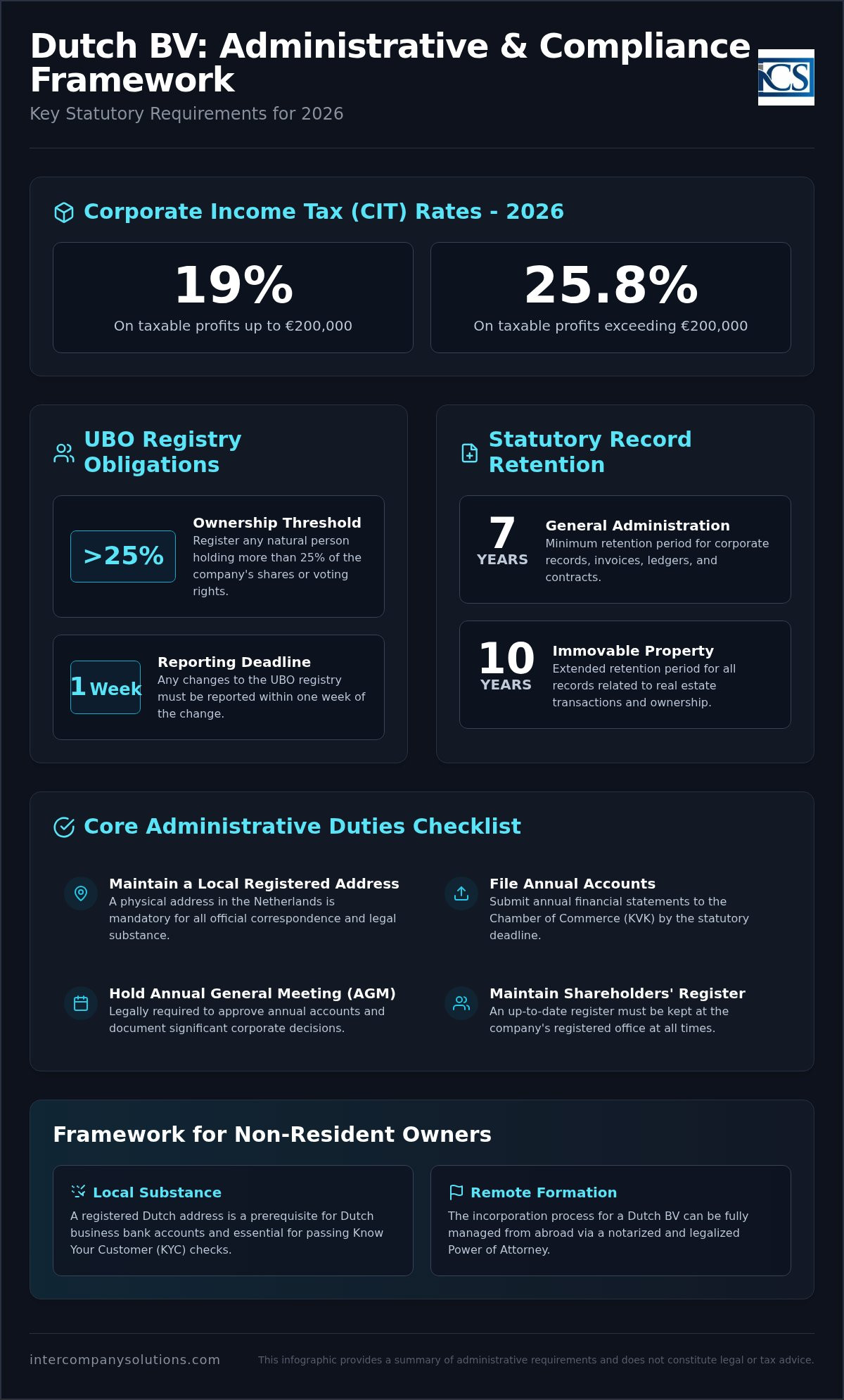
This article provides a precise overview of the administrative requirements Dutch companies must meet to ensure full statutory compliance. You'll learn how to manage mandatory VAT and CIT filings under the 2026 rates, where profits up to €200,000 are taxed at 19% and 25.8% thereafter. We'll also detail the requirements for maintaining a local registered address, managing payroll for staff, and meeting transparency standards for natural persons holding more than 25% of company interest. This guide serves as a practical roadmap for managing your Dutch entity's lifecycle with professional accuracy.
Key Takeaways
- Identify the specific administrative duties required to keep a Dutch legal entity in good standing with the Chamber of Commerce (KVK) and the Tax Authorities.
- Apply the 2026 Corporate Income Tax rates of 19% on taxable profits up to €200,000 and 25.8% on the excess.
- Manage UBO registry obligations by registering any natural person holding more than 25% of the company's shares or voting rights within one week of changes.
- Leverage corporate administration services Netherlands to manage statutory filings and facilitate remote incorporation via the legalized Power of Attorney route.
- Integrate secretarial support with Dutch BV accounting to ensure accurate VAT filings and the timely submission of annual accounts.
Table of Contents
- Defining Corporate Administration in the Dutch Regulatory Context
- Core Components of Dutch Company Secretarial Services
- Statutory Compliance Requirements and Tax Parameters for 2026
- Evaluating Corporate Service Providers for International Founders
- Integrated Administrative Solutions via Intercompany Solutions
Defining Corporate Administration in the Dutch Regulatory Context
Corporate administration is the mandatory framework for Dutch BV governance and statutory record-keeping. It encompasses the statutory, financial, and secretarial tasks required to keep a Dutch legal entity in good standing. This isn't a voluntary process; it's a legal requirement for every business registered in the country. Effective administration maintains the bridge between your company, the Dutch Chamber of Commerce (KVK), and the Tax Authorities (Belastingdienst). For foreign founders, corporate administration services Netherlands provides the necessary infrastructure to meet local substance and compliance requirements without needing a physical presence. This system aligns with broader principles of Corporate governance in the Netherlands, ensuring transparency for all stakeholders. Proper management also involves adhering to the statutory record retention period of 7 years for general administration and 10 years for records related to immovable property.
The Role of the Dutch Company Secretary
The Dutch company secretary manages the internal legal life of the BV. Their primary duty involves maintaining the shareholders' register, which must be kept at the company's registered office. They coordinate board resolutions and the mandatory Annual General Meeting (AGM) to ensure decisions are legally binding and documented. When changes occur, such as a director's resignation or a share transfer, the secretary ensures the KVK records are updated immediately. This includes managing the UBO registry, where any natural person with an interest greater than 25% must be recorded within one week of the change. Accuracy here prevents significant fines and legal complications. They act as the guardian of the company's legal history and ensure that corporate administration services Netherlands requirements are met through meticulous filing.
Administrative Substance for Non-Resident Owners
Non-resident owners face specific challenges regarding local substance. Dutch law requires every BV to have a local registered office address in the Netherlands to receive official correspondence from government bodies. Professional administration ensures that letters from the Belastingdienst don't go unanswered. This local presence is also a prerequisite for Dutch BV company formation and maintaining Dutch business bank accounts. Banks conduct rigorous "Know Your Customer" (KYC) checks and expect a well-documented administrative history and a clear local connection. For non-EU founders, this process often begins with remote setup via a legalized Power of Attorney. Professional services facilitate this by managing the documentation flow and ensuring the company meets the high standards of Dutch regulatory authorities. Without this administrative foundation, a company risks losing its VAT number or facing bank account closures.
Core Components of Dutch Company Secretarial Services
The operational success of a Dutch legal entity depends on the precision of its secretarial support. These services act as the primary interface between the company and regulatory bodies like the Dutch Chamber of Commerce (KVK) and the Tax Administration (Belastingdienst). While the board of directors holds ultimate responsibility, secretarial experts manage the technical execution of statutory duties. This includes drafting board resolutions, preparing minutes for the Annual General Meeting, and managing inquiries from the IND regarding the migration status of international staff. Reliable corporate administration services Netherlands providers ensure these actions align with the prevailing Dutch corporate governance laws to prevent administrative lapses.
Submitting annual accounts to the KVK is a critical deadline that varies based on the company's size category. Small BVs usually file a simplified balance sheet and notes, but the timeline for publication is strict. Missing these deadlines can lead to personal liability for directors in the event of bankruptcy. Secretarial support ensures these filings are accurate and uploaded within the designated windows, maintaining the company's status as a transparent and compliant entity.
Statutory Record Keeping and Retention
Dutch law mandates a rigorous approach to data preservation. All corporate and financial records, including ledger accounts, invoices, and contracts, must be retained for a minimum of 7 years. This period extends to 10 years for any documentation related to immovable property, such as office deeds or long-term lease agreements. While the Belastingdienst permits electronic storage, the digital files must remain accessible and legible throughout the entire retention period. If you're unsure about your current filing status, you can consult with a compliance specialist to review your records.
UBO Registry Compliance
The Ultimate Beneficial Owner (UBO) registry is a transparency measure designed to prevent money laundering and financial crime. A UBO is defined as any natural person holding more than 25% of the shares, voting rights, or ownership interest in a BV. Since 2022, specific UBO data has been accessible to competent authorities to ensure high standards of accountability. Companies must register their UBOs within one week of the entity’s formation or any subsequent change in ownership. Failure to comply with these registration deadlines or providing incorrect information can result in administrative fines or criminal sanctions. Professional corporate administration services Netherlands monitor these thresholds continuously to ensure the registry reflects the current ownership structure accurately.
Statutory Compliance Requirements and Tax Parameters for 2026
Compliance for a Dutch BV in 2026 centers on adhering to specific financial thresholds and filing schedules. For the 2026 fiscal year, the one-time registration fee at the Dutch Chamber of Commerce (KVK) is €85.15. Beyond this initial cost, businesses must navigate a structured tax landscape that demands monthly or quarterly attention. Utilizing professional corporate administration services Netherlands ensures these parameters are met accurately to avoid late-filing penalties. These requirements are part of the broader framework of Corporate Governance in the Netherlands, which emphasizes fiscal transparency and accountability for all legal entities.
Corporate Income Tax (CIT) Thresholds
The Dutch corporate tax system operates on a two-tier structure based on taxable profit. Profits up to €200,000 are taxed at the lower 19% rate in 2026. Any taxable profit exceeding this €200,000 threshold is subject to a rate of 25.8%. For entrepreneurs managing holding structures, the participation exemption is a vital component of tax administration. This rule prevents double taxation by exempting dividends and capital gains derived from a subsidiary, provided the parent company holds at least 5% of the shares and meets specific motive or asset tests. Proper administration ensures these exemptions are claimed correctly during the annual CIT filing process.
Value Added Tax (VAT) and EORI Applications
Most Dutch BVs are required to register for Value Added Tax (VAT), known locally as BTW. The standard rate is 21%, while a reduced rate of 9% applies to specific goods and services, such as food products and certain labor-intensive services. Non-resident companies often appoint a tax representative or use specialized corporate administration services Netherlands to secure a VAT number from the Belastingdienst. Filing frequency depends on the company's turnover; most BVs file quarterly, though the authorities may mandate monthly filings if turnover exceeds €7,000 per quarter or if payments are consistently late.
If your business engages in the import or export of goods outside the European Union, an Economic Operators Registration and Identification (EORI) number is mandatory. This number is used by customs authorities to track shipments and is linked to your VAT registration. Managing these applications during the starting a business in the Netherlands phase prevents delays in your supply chain.
Filing Deadlines and Financial Reporting
The financial year for most Dutch companies follows the calendar year, ending on December 31. Annual accounts must be prepared and presented to the shareholders within five months of the year-end. Following approval, the company has eight days to publish these accounts at the KVK. While extensions are possible under specific circumstances, the absolute deadline for filing annual accounts is 12 months after the end of the financial year. Missing this final cutoff is considered an economic offense and can lead to personal liability for the company's directors.
Evaluating Corporate Service Providers for International Founders
Selecting a partner for your Dutch entity requires a focus on procedural transparency and technical expertise. International founders often face the challenge of managing a local entity from a different time zone, making remote accessibility a non-negotiable requirement. A capable provider of corporate administration services Netherlands should offer a unified approach where secretarial tasks and accounting for Dutch BV compliance are managed under one roof. This integration ensures that statutory filings at the KVK align perfectly with the financial data submitted to the Belastingdienst, preventing discrepancies that could trigger audits.
Transparency in the fee structure is another critical indicator of a reliable partner. Professional firms disclose third-party costs, such as the €85.15 KVK registration fee and notary charges, at the start of the engagement rather than hiding them in fine print. Since approximately 93% of the Dutch population speaks English, your service provider must demonstrate high proficiency in English to ensure clear communication regarding complex legal and tax matters. High-quality corporate administration services Netherlands firms act as a bridge, translating local regulatory demands into actionable steps for the global entrepreneur.
Remote Formation and Administration
The legalized Power of Attorney (PoA) route is the standard procedure for non-resident founders who can't visit the Netherlands in person. This method allows a local representative to sign the deed of incorporation before a Dutch notary on your behalf, effectively bypassing the need for travel. To initiate this, you'll need to provide a set of specific documents, including a legalized copy of your passport and proof of residential address. This remote approach is central to the Netherlands business registration process for international entrepreneurs. Once the BV is formed, the administration service continues to manage your registered address and statutory correspondence without requiring your physical presence.
Integrated Payroll and Staffing
If your Dutch BV intends to hire local or international staff, your administrative partner should offer payroll services Netherlands to manage these complex obligations. This includes registering as an employer with the Tax Authorities and handling monthly payslips and pension contributions. For highly skilled migrants, the 30% tax reimbursement ruling is a significant incentive that requires precise application and ongoing monitoring to maintain eligibility. It's often beneficial to use an Employer of Record (EOR) model, which allows you to hire staff without setting up a full internal HR department, keeping your administrative overhead low while remaining fully compliant with Dutch labor laws.
Integrated Administrative Solutions via Intercompany Solutions
Establishing a presence in a foreign market requires a partner that understands the intersection of local law and international business strategy. Intercompany Solutions (ICS) provides a full-service package that facilitates everything from initial BV formation to VAT registration and banking assistance. We've assisted entrepreneurs from over 50 different countries in successfully launching their Dutch operations. This integrated approach ensures that your company doesn't just exist as a legal entry but functions as a fully compliant entity within the Dutch financial system. By centralizing your corporate administration services Netherlands requirements, you reduce the risk of communication gaps between separate legal and accounting providers.
The ICS Incorporation Process
Speed and remote accessibility are the foundations of our incorporation model. We handle the Dutch BV company formation process within 2 to 5 business days using the legalized Power of Attorney route. This method allows you to establish your business without visiting the Netherlands in person. Once you submit the required identification and residency documents, we manage the direct registration with the Dutch Chamber of Commerce (KVK) and ensure the €85.15 registration fee is processed correctly. After the deed of incorporation is signed, we provide dedicated assistance with opening business bank accounts. We work with modern fintech providers like bunq and traditional Dutch banks to ensure your entity has the necessary tools to manage local and international transactions. Our team guides you through the rigorous "Know Your Customer" (KYC) requirements to minimize delays in your account activation.
Ongoing Compliance and Accounting
Maintaining a BV involves continuous interaction with the Tax Authorities and the KVK. We assign dedicated account managers to oversee your quarterly VAT returns and the preparation of your annual financial statements. This long-term support is essential for meeting the 7-year record retention requirement and ensuring that your CIT filings reflect the 2026 rates of 19% and 25.8% accurately. If your business model involves hiring international talent, we facilitate Highly Skilled Migrant (HSM) visas and IND applications to streamline the relocation of your key staff. Our Premium Secretarial Support package includes 10 hours of dedicated consultation in your first year, allowing you to address specific legal or administrative questions as they arise. To maintain the momentum of your business, we guarantee a 24-hour response time for all administrative inquiries. This commitment to efficiency ensures that your professional interests remain in capable hands while you focus on scaling your operations.
Last reviewed: August 2026
Securing Your Dutch Business Future through Statutory Compliance
Maintaining a Dutch BV requires meticulous attention to the 2026 tax parameters, including the two-tier CIT rates and the €85.15 KVK registration fee. Long-term success depends on your ability to uphold the seven-year record retention standard and ensure the UBO registry accurately reflects any natural person holding more than 25% interest. These administrative duties aren't merely clerical tasks; they're the legal foundation that protects your company's standing with the Belastingdienst and the Chamber of Commerce.
Professional corporate administration services Netherlands provide the necessary infrastructure to bridge the gap between your international strategy and local regulatory adherence. As the #1 specialized incorporation firm for foreign entrepreneurs, we facilitate remote setup in 2-5 business days via the legalized Power of Attorney route. Our comprehensive support, backed by a 100% Satisfaction Guarantee, ensures that every statutory requirement is met with precision and procedural clarity.
We're ready to act as your knowledgeable guide in the Dutch market. Our team remains committed to providing the accuracy and legal integrity your international venture deserves.
Last reviewed: August 2026
Frequently Asked Questions
What are the mandatory corporate administration tasks for a Dutch BV?
Mandatory corporate administration tasks include filing annual accounts with the Chamber of Commerce (KVK), maintaining the shareholders' register at the registered office, and submitting periodic VAT and Corporate Income Tax (CIT) returns. You must also register Ultimate Beneficial Owners in the UBO registry within one week of any change. Professional corporate administration services Netherlands providers ensure these deadlines are met to prevent administrative fines or director liability in cases of non-compliance.
Do I need to be physically present in the Netherlands to manage my company?
You don't need to be physically present in the Netherlands to manage your company or complete the incorporation process. Foreign founders typically use the legalized Power of Attorney route to form a Dutch BV remotely in 2 to 5 business days. Once established, you can manage your entity's statutory obligations and tax filings through a local service partner who handles official correspondence and filings on your behalf from a Dutch registered office address.
What is the minimum share capital required for a Dutch BV in 2026?
The minimum share capital required to incorporate a Dutch BV in 2026 is €0.01. This flexibility allows founders to establish a private limited company without a significant upfront capital injection. During the formation process, you must decide on the par value of the shares and the total issued capital. While the legal minimum is nominal, having a higher capital might be beneficial for certain business bank account applications or commercial credibility.
How much are the corporate tax rates in the Netherlands for 2026?
For the 2026 fiscal year, the Netherlands applies a two-tier Corporate Income Tax (CIT) system. You'll pay a rate of 19% on taxable profits up to €200,000. Any profit exceeding this €200,000 threshold is taxed at a rate of 25.8%. These rates apply to the global income of Dutch-resident companies. Accurate bookkeeping and the application of specific tax exemptions, such as the participation exemption, are essential for optimizing your entity's tax burden.
What is the KVK registration fee for a new company in 2026?
The Dutch Chamber of Commerce (KVK) registration fee for a new company in 2026 is €85.15. This is a one-time, non-recurring fee payable upon the initial registration of your legal entity in the Trade Register. If you use corporate administration services Netherlands to facilitate your formation, this fee is often handled by the provider as part of the setup costs. You'll also receive a unique KVK number, which is required for all official business transactions.
Who is considered a Beneficial Owner (UBO) in the Netherlands?
A natural person is considered an Ultimate Beneficial Owner (UBO) if they hold more than 25% of the shares, voting rights, or ownership interest in a Dutch company. This definition also includes individuals who exercise effective control over the entity through other means. Since 2022, the UBO registry has been a mandatory transparency tool. You must register these individuals and update the registry within one week of any change in the company's ownership structure.
How long must I retain business records for a Dutch company?
You must retain all business and financial records for a statutory period of 7 years. This requirement covers ledger accounts, invoices, bank statements, and contracts. However, if your records relate to immovable property, such as office deeds or long-term lease agreements, the retention period extends to 10 years. Records can be stored electronically, provided they remain legible and accessible for audit by the Dutch Tax Administration (Belastingdienst) throughout the entire period.
Can I hire employees in the Netherlands through an administrative partner?
You can hire employees in the Netherlands using payroll and staffing support from an administrative partner. This allows you to manage local staff without setting up an internal HR department. Your partner handles employer registration with the Belastingdienst, monthly payslip generation, and pension contributions. They can also assist with the 30% tax reimbursement ruling for highly skilled migrants, ensuring your international staff benefit from available Dutch tax incentives.
Sources
- KVK - Registering with the Dutch Business Register
- Business.gov.nl - Private limited company (bv)
- Burgerlijk Wetboek Boek 2 (Dutch Civil Code, legal entities)
- Rijksoverheid - Ondernemen
- Belastingdienst - Corporate income tax rates
- ICS Payroll - Dutch payroll services
- Belastingdienst - Payroll taxes (loonheffingen)
- UWV - Employer obligations
- CJEU, Cadbury Schweppes, C-196/04 (ECLI:EU:C:2006:544)
- Hoge Raad, ECLI:NL:HR:2021:1152
- PwC Worldwide Tax Summaries - Netherlands
- ICLG - Corporate Governance Laws and Regulations, Netherlands
Need more information on the Dutch BV company?
Contact an expertReady to start your company in the Netherlands?
| Formation time | Dutch BV formation completed in 3 to 5 business days |
|---|---|
| Process | Fully remote setup with step-by-step guidance |
| Compliance | Expert support for registration, VAT and compliance |
| Aftercare | Accounting, tax and legal support included |
| One partner | All of the above through one trusted formation partner |