


By Intercompany Solutions, Intercompany Solutions
Published August 19, 2026
All blog posts are reviewed and fact checked by our labour law lawyer Zishan Hussain and our director.Editorial standards
August 19, 2026 · 16 min read
The Netherlands is the most strategic entry point for non-EU Amazon sellers, yet many lose thousands in liquid capital by paying import VAT at the border unnecessarily. Paying upfront import VAT Netherlands ecommerce fees can severely constrain your cash flow, especially when high-volume inventory is involved. Most sellers understand that VAT compliance is mandatory to avoid Amazon account suspensions, but the technical requirements for non-resident entities often remain unclear.
You likely don't want to risk your business growth on regulatory errors or blocked shipments. This professional guide outlines the 2026 requirements for Dutch VAT registration and statutory compliance. We provide a clear path for international sellers to secure an EORI number and an Article 23 permit, which allows for the deferment of import VAT to your periodic return. By following this procedural checklist, you can maintain a compliant Amazon Seller Central status while utilizing the Netherlands as a tax-efficient hub for your global operations.
Key Takeaways
- Learn when storing inventory in a Dutch warehouse triggers immediate VAT registration obligations, regardless of your total sales volume.
- Discover how an Article 23 permit optimizes cash flow by deferring import VAT Netherlands ecommerce payments to your periodic tax return.
- Identify the mandatory documentation required for a successful VAT and EORI registration, including the necessary Chamber of Commerce (KVK) extracts.
- Understand the statutory filing deadlines and the 7-year record retention requirement necessary to maintain a compliant Amazon Seller Central account.
- Evaluate the benefits of establishing a Dutch BV, including limited liability and 2026 corporate tax rates of 19% on profits up to €200,000.
Determining Your Dutch VAT Obligations as an Amazon Seller
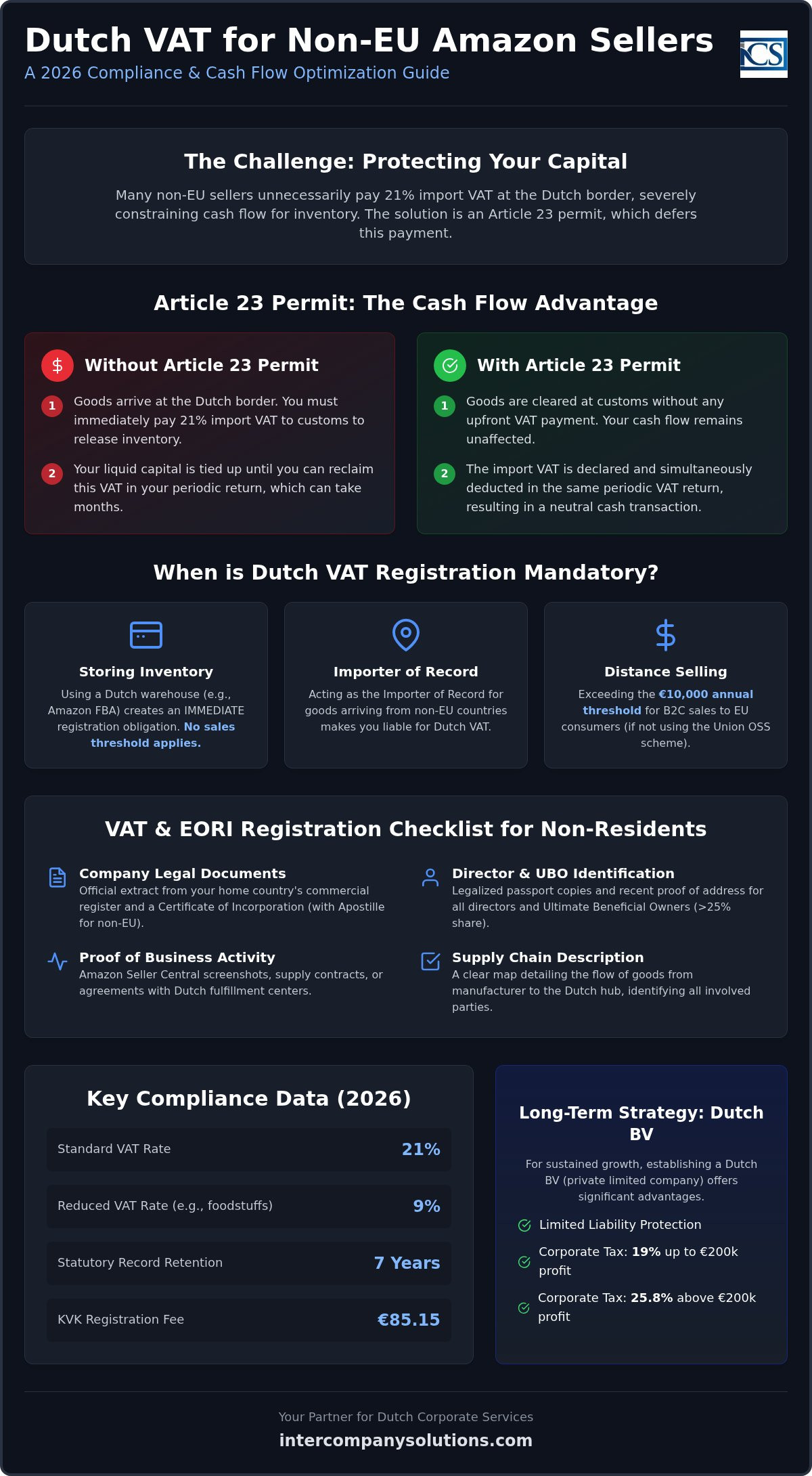
Storing physical inventory within the borders of the Netherlands creates an immediate obligation to register for VAT. Unlike distance selling, which follows specific thresholds, there's no minimum turnover limit for local storage. If you use Amazon FBA and your goods are held in a Dutch fulfillment center, you must obtain a Dutch VAT-ID before your first sale occurs. This requirement is a foundational element of the Dutch value-added tax system, ensuring that all commercial activity involving local inventory is documented for the Belastingdienst.
Amazon Seller Central enforces strict compliance for its European marketplaces. The platform won't enable FBA services for the Dutch market without a verified VAT-ID. This verification process prevents account suspensions and ensures that import VAT Netherlands ecommerce procedures are followed correctly from the start. You'll also need to distinguish between B2C consumer sales, where you collect Dutch VAT, and B2B transactions, where the reverse charge mechanism often applies to commercial buyers with valid VAT numbers.
Mandatory Local VAT Registration Scenarios
Specific operational activities necessitate a local registration regardless of your company's home country. International sellers often trigger these requirements through three primary routes. First, holding stock in any Dutch warehouse, whether managed by Amazon or a third-party logistics provider, requires a local number. Second, acting as the Importer of Record (IoR) for goods arriving from non-EU countries like China or the United States makes you liable for Dutch tax. Third, if your total cross-border B2C sales to EU consumers exceed the annual €10,000 threshold and you haven't opted for the Union OSS scheme, you must register locally in the Netherlands for any sales delivered to Dutch customers.
The Role of the VAT One-Stop Shop (OSS)
The Union OSS scheme simplifies reporting for cross-border B2C sales within the EU. It allows sellers to file a single quarterly return for all distance sales instead of registering in every member state. OSS has significant limitations that Amazon sellers must understand. It doesn't cover local storage. If you store goods in a Dutch warehouse to provide faster delivery times, you still need a local Dutch VAT number alongside your OSS registration. You must link this specific Dutch number to your Amazon tax settings to ensure the platform applies the correct 21% standard rate or 9% reduced rate for specific categories like foodstuffs or medicines. Proper synchronization between your OSS filings and local Dutch returns is necessary to avoid double taxation or compliance gaps.
Checklist: Requirements for Netherlands VAT Registration
Securing a Dutch VAT number is a structured process that requires precise documentation to satisfy the Belastingdienst. To begin, you must verify your company's legal structure. For Dutch entities, this involves a recent Chamber of Commerce (KVK) extract; for 2026, the KVK registration fee is €85.15. Non-resident companies must provide an equivalent official extract from their home country's commercial register. This documentation serves as the primary proof that your business is a legitimate legal person entitled to conduct trade within the Dutch VAT obligations for entrepreneurs framework.
Customs clearance for import VAT Netherlands ecommerce operations is impossible without a valid Economic Operators Registration and Identification (EORI) number. You should apply for this alongside your VAT registration. Additionally, the tax authorities require identification documents for all active directors and any Ultimate Beneficial Owner (UBO) holding more than 25% of the company's shares or voting rights. To demonstrate active business intent, you must provide evidence of your ecommerce activity. Amazon Seller Central screenshots showing your account status, manufacturer supply contracts, or signed agreements with Dutch fulfillment centers are typically sufficient.
Documentation for Non-Resident Sellers
Sellers based outside the Netherlands face additional verification steps. You must provide legalized copies of passports and recent proof of address for all directors. If your company is registered in a non-EU jurisdiction, a Certificate of Incorporation with an Apostille is mandatory. The Belastingdienst also requests a detailed description of your supply chain. This should clearly map the path of your goods from the manufacturer to the Dutch hub, identifying all parties involved in the transport and storage process. Clear documentation here prevents delays in the import VAT Netherlands ecommerce registration phase.
Remote Registration via Power of Attorney
International entrepreneurs don't need to travel to the Netherlands to complete their tax registration. You can utilize a legalized Power of Attorney (PoA) to authorize a representative to handle the application on your behalf. In 2026, processing timelines for the Belastingdienst typically range from four to six weeks, depending on the complexity of the file. Once approved, you'll receive two distinct numbers. The Omzetbelastingnummer is used for internal communication with the tax office, while the VAT-ID (starting with NL) is the number you'll use for invoices and your Amazon tax settings. If you require assistance managing these administrative requirements, you can contact our specialized tax team for guidance.
Strategic Advantages: Article 23 and Import VAT Deferment
The Netherlands operates as the primary logistics hub for Europe because of its efficient tax deferment system. Under Article 23 of the Dutch VAT Act, sellers can defer the payment of import tax from the moment of entry to the periodic VAT return. This mechanism effectively eliminates the need for upfront cash payments at the border. For import VAT Netherlands ecommerce operations, this means your capital isn't tied up in the Belastingdienst's accounts while you wait for a refund. Instead, the VAT is declared as both a payable and a deductible on the same return, resulting in a neutral cash flow position.
Your EORI number serves as your identification for customs, but the Article 23 license is what grants the deferment privilege. Without this specific permit, you must pay the applicable VAT rate before your goods are released. Most consumer goods fall under the 21% standard rate, though specific categories may qualify for lower tiers. You can check the official Netherlands VAT rates for your specific product category to understand your potential liability during the customs clearance process.
Eligibility and Fiscal Representation
Non-resident companies are required to appoint a fiscal representative to access Article 23 benefits. This representative acts as a local intermediary and assumes liability for your tax filings. While foreign entities can apply, establishing a Dutch BV often streamlines the process. A local BV is a Dutch tax resident, which typically results in lower security deposit requirements from the tax authorities. Our Accounting & Tax Services include managing these representative duties to ensure your business remains compliant with all statutory regulations while maintaining your deferment status.
Calculating the Financial Impact
The financial benefits are most visible when importing high-value inventory. Imagine a shipment of consumer electronics with a customs value of €200,000. Without deferment, you would owe €42,000 in VAT immediately upon arrival at the Port of Rotterdam or Schiphol Airport. With an Article 23 license, you retain that €42,000 in your bank account, allowing you to reinvest in advertising or additional stock. This reduction in working capital requirements is a significant competitive advantage for Amazon sellers scaling their EU operations. For more details on the registration process, see our guide on Netherlands VAT registration for foreign companies.
Operational Compliance: Invoicing and Filing Requirements
Maintaining compliance requires strict adherence to the Dutch quarterly filing cycle. You must submit your VAT returns by the last day of the month following each calendar quarter; for instance, the deadline for the first quarter is April 30. During this process, you'll apply the 21% standard rate to most commercial goods, while specific items like books or certain medicines qualify for the 9% reduced rate. Proper management of import VAT Netherlands ecommerce documentation ensures that the credits claimed on these returns match the records held by Dutch customs authorities.
Dutch Invoicing Standards for E-commerce
Every sale requires a valid invoice that meets specific statutory requirements to be considered compliant. You must include your Dutch VAT-ID, the customer's details, a unique invoice number, and a clear description of the goods sold. When moving stock between EU fulfillment centers, you'll handle zero-rated intra-Community supplies. These transfers don't incur VAT but must be documented accurately in your administration and EC Sales List. Amazon's VAT Calculation Service (VCS) can automate much of this generation, but you remain legally responsible for the accuracy of the final data. For a deeper look at these technical requirements, consult our E-commerce accounting in the Netherlands guide.
The Belastingdienst mandates a 7-year record retention period for all business administration. This requirement includes digital copies of invoices, bank statements, and customs documents related to your shipments. Keeping these files organized is vital, as the tax office can request an audit of your records at any point during this seven-year window. Digital storage is acceptable provided the integrity and legibility of the data are guaranteed.
Penalties and Risk Management
The 2026 audit environment is increasingly data-driven and transparent. Tax authorities now receive automated turnover data directly from platforms like Amazon under EU-wide data exchange directives. Discrepancies between your reported sales and the platform's data can trigger immediate inquiries or administrative fines. Late filings typically result in standard penalties, while structural inaccuracies in your VAT declarations can lead to more intensive audits. Managing these risks requires a proactive approach to your monthly bookkeeping and a clear understanding of the interaction between Amazon's reports and Dutch tax law.
Last reviewed: August 2026
Establishing a Dutch BV for Long-Term Amazon Growth
Establishing a Dutch private limited company (BV) provides a robust legal framework for scaling an Amazon business. Beyond the professional branding and limited liability it offers to international founders, a BV is a local tax resident. This status simplifies the acquisition of an Article 23 permit, which is essential for managing import VAT Netherlands ecommerce costs. For 2026, the corporate income tax (CIT) rates are set at 19% for taxable profits up to €200,000 and 25.8% for any amount exceeding that threshold.
The incorporation process is highly accessible for non-resident entrepreneurs. The minimum share capital requirement is just €1, and the one-time KVK registration fee is €85.15 in 2026. Unlike a non-resident VAT registration, a BV requires a deed of incorporation drafted by a Dutch notary. You must also register all Ultimate Beneficial Owners (UBOs) with a stake greater than 25% in the Dutch UBO register. As a Dutch entity, the BV must maintain its business administration for the statutory 7-year retention period, ensuring all financial records are available for potential audits.
BV Formation vs. Foreign VAT Registration
Many sellers start with a non-resident VAT registration but transition to a full legal entity as their turnover grows. A Dutch BV allows you to access local business banking and Dutch payment processing solutions like iDEAL, which can improve conversion rates on your own storefront. This transition involves ending your non-resident registration and transferring your Amazon Seller Central settings to the new entity. Moving to a BV structure often results in better terms with suppliers and logistics partners who prefer working with local companies. You can learn more about Dutch BV formation to determine if this structure aligns with your long-term expansion goals.
Implementation Steps for Amazon Sellers
To ensure a smooth market entry, we recommend a simultaneous application for BV formation, your VAT-ID, and an EORI number. This coordinated approach prevents delays in your supply chain and ensures your import VAT Netherlands ecommerce deferment is active before your first shipment arrives. If your operations require local staff for warehousing or customer support, you can utilize payroll services to manage Dutch employment law compliance. Non-EU founders don't have to visit the Netherlands to complete this process; the entire setup can be handled remotely via the legalized Power of Attorney route. If you're ready to begin, request a consultation via our contact page.
Last reviewed: August 2026
Securing Your Dutch Market Entry for 2026
Managing import VAT Netherlands ecommerce requirements is a procedural necessity that provides a distinct competitive advantage through Article 23 deferment. International sellers must balance immediate VAT and EORI registration with long-term structural decisions, such as establishing a Dutch BV. Maintaining statutory compliance, including the 7-year record retention period and accurate quarterly filings, ensures your Amazon Seller Central account remains in good standing.
Intercompany Solutions specializes in facilitating this entry for international entrepreneurs. We offer specialized e-commerce tax support and expertise in Article 23 deferment to optimize your business cash flow. Our team handles remote incorporation in 3 to 5 business days, allowing you to establish a professional Dutch presence without the need for international travel. We're here to help you manage these administrative steps with speed and precision.
We look forward to supporting your expansion into the Dutch e-commerce market and helping you build a stable foundation for growth in Europe.
Last reviewed: August 2026
Frequently Asked Questions
Do I need a Dutch company to get a Dutch VAT number for Amazon?
No, you don't need to establish a Dutch legal entity like a BV to obtain a Dutch VAT number. Non-resident companies can register directly with the Belastingdienst as foreign entrepreneurs. This is common for sellers who only need to manage import VAT Netherlands ecommerce obligations without a full local presence. While a BV isn't mandatory, it's often preferred for those seeking easier access to Dutch business banking or lower security deposits for import deferment licenses.
How long does it take to get a Netherlands VAT number in 2026?
In 2026, the typical processing time for a Dutch VAT registration for a non-resident company is between four and six weeks. This timeline depends on the completeness of your documentation, including legalized identification and proof of business activity. If you're also applying for an EORI number or an Article 23 license, these applications are usually handled concurrently. Delays often occur if the tax authorities require additional clarification regarding your supply chain or manufacturer contracts.
What is the Article 23 license and how does it help Amazon sellers?
The Article 23 license is a deferment permit that allows you to shift the payment of import VAT from the border to your periodic VAT return. This helps Amazon sellers by significantly improving cash flow, as you won't have to pay 21% VAT upfront when your goods clear customs. Instead, the tax is recorded as both a payable and a deductible on the same return, resulting in a neutral financial position for your working capital and inventory management.
Can I register for Dutch VAT remotely from outside the EU?
Yes, you can complete the entire VAT registration process remotely from outside the European Union. You must provide legalized documents and a Power of Attorney (PoA) to a local representative who will manage the application with the Dutch tax authorities. This route is specifically designed for international entrepreneurs who don't have a physical office in the Netherlands. It ensures you can meet all import VAT Netherlands ecommerce requirements without the need for a personal visit to the country.
What are the Dutch VAT rates for 2026?
For 2026, the standard VAT rate in the Netherlands is 21%, which applies to most consumer goods sold on Amazon. A reduced rate of 9% is applicable to specific categories, such as books, foodstuffs, and certain pharmaceutical products. There is also a 0% rate for international transport and goods supplied to other EU member states. You must ensure your Amazon tax settings correctly reflect these rates based on the specific product categories you sell to maintain compliance.
Is an EORI number different from a VAT number?
Yes, an EORI number is distinct from a VAT number, although both are required for international trade. The EORI number is used specifically by customs authorities to identify your business during the import and export of goods. The VAT number is used for reporting sales tax to the Belastingdienst and for issuing invoices to customers. You need both to successfully manage your supply chain and tax compliance when importing inventory into the Dutch market for fulfillment.
What happens if I sell on Amazon.nl without a VAT number?
Selling on Amazon.nl without a verified VAT number will lead to the immediate suspension of your seller account. Amazon is legally required to verify the tax status of sellers to prevent VAT fraud within the EU. If you plan to use Fulfillment by Amazon (FBA) and store goods in a Dutch warehouse, you cannot enable these services until your VAT-ID is uploaded and verified. This ensures all sales are correctly taxed from the first transaction you make.
Frequently Asked Questions
Need more information on the Dutch BV company?
Contact an expertReady to start your company in the Netherlands?
| Formation time | Dutch BV formation completed in 3 to 5 business days |
|---|---|
| Process | Fully remote setup with step-by-step guidance |
| Compliance | Expert support for registration, VAT and compliance |
| Aftercare | Accounting, tax and legal support included |
| One partner | All of the above through one trusted formation partner |