


By Intercompany Solutions, Intercompany Solutions
Published August 18, 2026
All blog posts are reviewed and fact checked by our labour law lawyer Zishan Hussain and our director.Editorial standards
August 18, 2026 · 16 min read
An e-commerce business processing 5,000 monthly orders across four currencies creates a data trail that traditional bookkeeping cannot handle without significant risk. Effective ecommerce accounting Netherlands requires more than just recording sales; it demands a real-time integration between your webshop and the Dutch tax authorities. You likely find that reconciling payment service provider payouts with individual shop orders is the most time-consuming part of your administrative week, often leading to discrepancies in your VAT reporting.
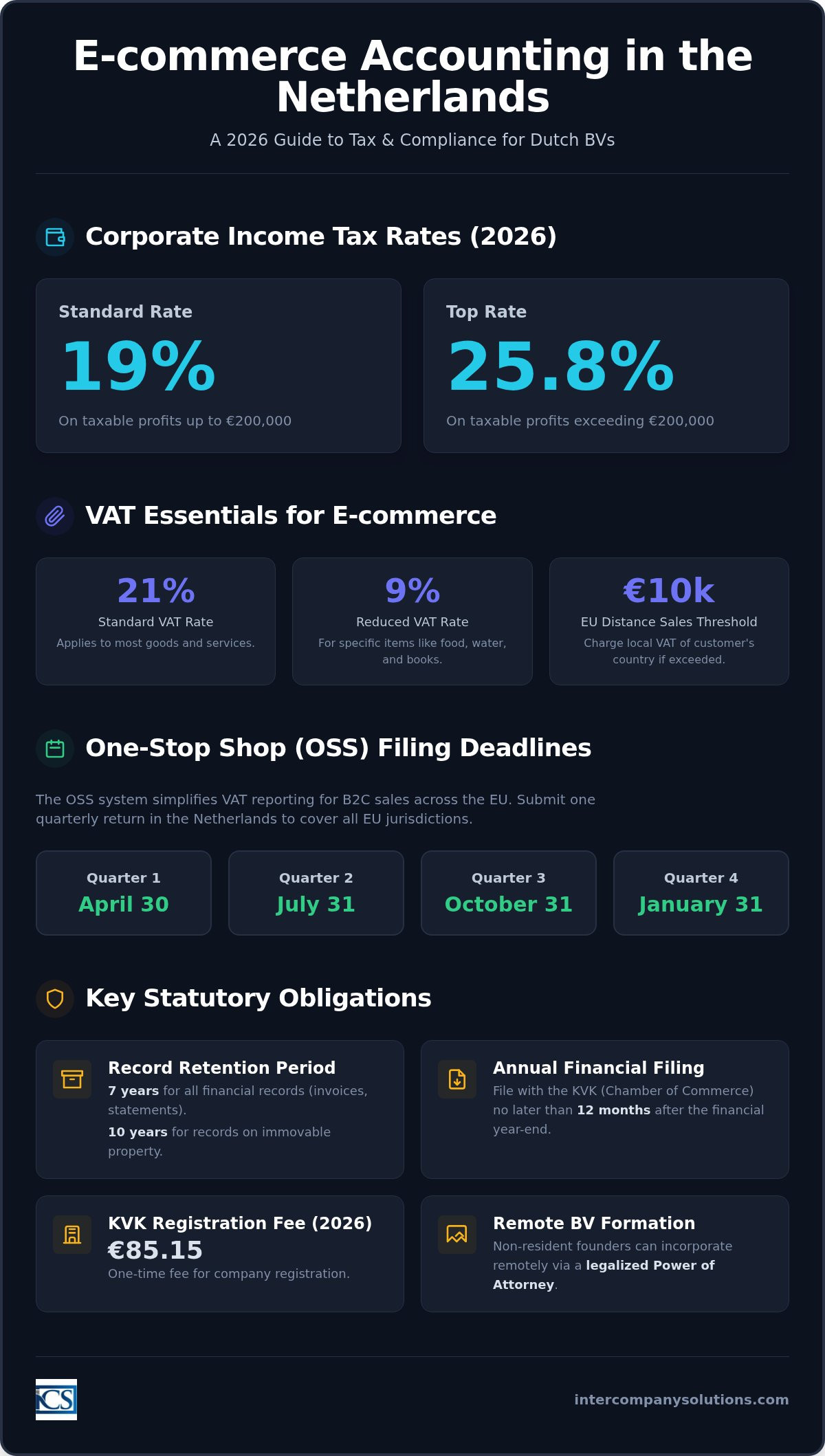
Managing high-volume micro-transactions while ensuring full compliance with the Belastingdienst is a complex task for any foreign entrepreneur. This guide provides the technical resources you need to manage your Dutch tax obligations, VAT integrations, and corporate reporting for the 2026 fiscal year. You'll learn how to automate data flows between your webshop and accounting software while maintaining the mandatory 7-year record retention period. We will outline the 2026 Corporate Income Tax rates, which are 19% for profits up to €200,000 and 25.8% for amounts above that. This article also covers One-Stop Shop (OSS) filings for cross-border EU sales and the specific KVK filing deadlines you must meet to remain in good standing.
Key Takeaways
- Dutch BVs are subject to a two-tier corporate tax system in 2026, with a 19% rate on profits up to €200,000 and 25.8% on profits exceeding this threshold.
- The Union One-Stop Shop (OSS) framework allows entrepreneurs to centralize VAT reporting for B2C sales across the European Union once the €10,000 EU-wide threshold is exceeded.
- Automated integrations between platforms like Shopify and local software are essential for effective ecommerce accounting Netherlands to reconcile multi-currency payouts and high-volume transactions.
- Annual financial statements must be prepared and filed with the KVK no later than 12 months after the financial year-end to maintain regulatory compliance.
- Dutch tax administration requires a mandatory 7-year retention period for all business and financial records, including invoices and bank statements.
Fundamentals of E-commerce Accounting for Dutch BVs
E-commerce accounting Netherlands differs fundamentally from traditional retail bookkeeping due to the sheer volume of digital data points. While a physical store might manage a few dozen transactions daily, an online platform often processes thousands of micro-transactions across various time zones and currencies. This high-frequency environment requires a robust framework for multi-currency reconciliation. You must ensure that payouts from payment service providers match the gross sales figures in your ledger, accounting for transaction fees and currency fluctuations at the point of sale. Efficient ecommerce accounting Netherlands relies on the seamless integration of your storefront with a Dutch-compliant ledger to maintain real-time accuracy.
High-Volume Transaction Management
Processing thousands of orders without manual entry errors is only possible through automated data synchronization. Automated categorization allows your system to map sales, shipping fees, and discounts to the correct ledger accounts instantly. This precision reduces the time required for year-end audits and helps lower annual reporting costs. Your financial records must also reflect a clear trail for returns, refunds, and chargebacks. These events require specific VAT corrections to ensure you don't overpay tax on revenue that was ultimately returned to the customer. Managing these adjustments correctly is a core requirement for maintaining audit-ready books.
Statutory Compliance and Record Keeping
Every Dutch BV must maintain a registered business address in the Netherlands and complete its registration with the Chamber of Commerce (KVK). For 2026, the KVK registration fee is €85.15. This legal foundation is necessary to comply with Dutch tax system fundamentals and to obtain a local VAT number. Entrepreneurs can finalize their Dutch BV company formation remotely through a legalized Power of Attorney, which is the standard procedure for non-resident founders who cannot visit the Netherlands in person.
The Dutch Tax and Customs Administration (Belastingdienst) requires you to store all financial records for a mandatory 7-year retention period. This includes digital invoices, bank statements, and proofs of delivery. If your e-commerce entity holds interests in immovable property, the retention requirement increases to 10 years. It's vital to separate business expenses from personal ones. Foreign directors often face scrutiny regarding mixed expenses; keeping clean, documented books prevents the tax authorities from reclassifying business outflows as taxable personal income or dividends.
VAT and OSS Framework for Online Sellers
Online sellers in the Netherlands must apply the correct Value Added Tax (VAT) or Belasting over de Toegevoegde Waarde (BTW) to every transaction. The standard rate is 21%, which applies to most consumer goods and services. A reduced rate of 9% is applicable to specific categories, including food products, water, and books. Accurate classification is a central component of ecommerce accounting Netherlands, as misapplying these rates can lead to significant corrections during a Belastingdienst audit. If your business sells to private consumers across the European Union, you must monitor the €10,000 EU-wide threshold for distance sales. Once your total annual cross-border sales exceed this limit, you're required to charge VAT based on the customer's location.
The OSS and IOSS Systems Explained
The Union One-Stop Shop (OSS) simplifies reporting by allowing you to declare and pay VAT for all EU B2C sales via a single quarterly Dutch filing. This eliminates the need for separate registrations in every country where you have customers. These returns are due by the last day of the month following the end of the quarter:
- April 30 for the first quarter
- July 31 for the second quarter
- October 31 for the third quarter
- January 31 for the fourth quarter
For entrepreneurs shipping goods from outside the EU directly to customers, the Import One-Stop Shop (IOSS) applies to consignments valued at €150 or less. Using IOSS allows for a more efficient customs process and prevents customers from facing unexpected import charges. It's vital to understand the VAT obligations for Dutch businesses to determine if your specific supply chain requires multiple registrations. While OSS covers distance sales, storing inventory in a foreign warehouse still typically triggers a local VAT registration requirement in that specific country.
VAT Compliance for Marketplace Sellers
Major platforms like Amazon and bol.com operate under 'deemed supplier' rules. This means the marketplace may be responsible for collecting VAT on sales made by non-EU entrepreneurs or for certain cross-border transactions. Even when the platform handles the tax remittance, your internal bookkeeping must remain transparent. You're required to reconcile marketplace reports with your bank payouts to ensure your profit and loss statements are accurate for corporate tax purposes. Non-resident founders often combine their VAT registration with the Dutch BV company formation process to ensure they're compliant from day one. If your business model involves complex dropshipping or multi-country fulfillment, you can consult our accounting team to establish the correct reporting flow.
Automated Bookkeeping and Software Integrations
Modern e-commerce requires a direct digital link between the storefront and the Dutch financial ledger. Manual data entry for platforms like Shopify, WooCommerce, or Magento is not sustainable and increases the risk of Belastingdienst penalties. Automated ecommerce accounting Netherlands solutions allow for the real-time transfer of sales orders, shipping data, and customer profiles into a Dutch-compliant system. This ensures that every transaction is recorded with the correct VAT rate and currency conversion applied at the moment of purchase. By removing manual intervention, you maintain a cleaner audit trail and reduce the administrative burden on your internal team.
Seamless Marketplace Integration
Selling on Amazon Seller Central or bol.com introduces specific data challenges. Automated extraction tools pull transaction reports directly, accounting for marketplace commissions and advertising spend. If you utilize Fulfillment by Amazon (FBA), your software must track inventory movements across various EU warehouses. Storing stock in a foreign warehouse triggers local VAT obligations, as previously discussed. Your accounting system must therefore distinguish between sales fulfilled from Dutch stock and those shipped from international hubs to maintain accurate SKU-level profitability. This visibility is essential for managing your margins and ensuring your inventory asset values are correct on the balance sheet.
Payment Service Provider Reconciliation
Reconciling payouts from Stripe, PayPal, or Adyen is where most manual bookkeeping fails. These providers often deposit a net amount that excludes transaction fees and currency conversion costs. Effective ecommerce accounting Netherlands requires matching these net payouts with the original gross sales figures. Your system must automatically calculate the variance between the exchange rate at the time of order and the rate at the time of payout. Daily or weekly automated syncs are necessary to ensure your bank balance remains aligned with your internal ledger. This level of precision is essential for foreign entrepreneurs who need to provide clear financial statements for their annual KVK filings. Without this automated matching, you risk underreporting expenses or overreporting taxable revenue.
Managing the Cost of Goods Sold (COGS) across multiple fulfillment centers requires a synchronized inventory ledger. When a sale occurs, the system should automatically deduct the item from the specific warehouse location and update the asset value on your balance sheet. This automation prevents stock discrepancies and ensures that your profit margins are based on real-time acquisition costs rather than outdated estimates. Maintaining these digital records is a core part of the 7-year retention requirement, ensuring every transaction is traceable from the initial order to the final bank deposit.
Corporate Tax Obligations and Annual Reporting
Dutch e-commerce BVs must calculate their taxable profit after deducting all business-related costs. For the 2026 fiscal year, the Corporate Income Tax (CIT) rate is set at 19% for taxable profits up to €200,000. Profits exceeding this threshold are taxed at a rate of 25.8%. These rates remain consistent with previous years, providing a stable fiscal environment for international founders. Accurate ecommerce accounting Netherlands ensures that your taxable base is minimized through the correct application of deductible expenses and available tax credits.
Corporate Income Tax (CIT) Deadlines
The Belastingdienst requires the annual CIT return to be filed within five months of the financial year end. For companies operating on a standard calendar year, the deadline is May 31, 2026. You can request an extension of up to five months for preparation, followed by an additional period for filing if handled by a registered tax consultant. E-commerce entities can deduct various operational costs, including digital marketing spend on platforms like Google Ads, SaaS subscription fees for shop management, and third-party fulfillment costs. If your Dutch BV acts as a parent company, the participation exemption may apply. This rule exempts dividends and capital gains from subsidiaries from further Dutch corporate tax, provided you hold at least a 5% interest.
KVK and Financial Statement Requirements
Every new e-commerce entity must pay a one-time KVK registration fee of €85.15 for 2026. Beyond initial setup, the Chamber of Commerce requires the annual filing of financial statements. Most e-commerce BVs fall into the 'micro' or 'small' category based on their asset value, net turnover, and employee count. Micro-businesses only need to file a condensed balance sheet and don't require an external audit. Small businesses must provide a balance sheet and brief explanatory notes. These publication requirements are mandatory and must be completed no later than 12 months after the financial year end. You can find more details in our guide on Accounting for Dutch BV: Compliance and Tax Obligations in 2026.
You must also maintain an accurate UBO (Ultimate Beneficial Owner) registration. An individual qualifies as a UBO if they hold more than 25% of the shares, voting rights, or ownership interest in the BV. This data is stored in the UBO register and must be updated whenever there is a change in the company's ownership structure. Failure to maintain accurate UBO records can lead to administrative fines or criminal sanctions.
Professional Support for Dutch E-commerce Entities
Establishing a Dutch presence requires a coordinated approach that bridges the gap between legal setup and operational reality. Intercompany Solutions provides specialized support for foreign entrepreneurs, ensuring that the initial company setup aligns with long-term ecommerce accounting Netherlands requirements. This integrated approach prevents the data silos that often occur when formation and bookkeeping are handled by separate providers. By centralizing these functions, you ensure that your financial data flows correctly from the first transaction.
End-to-End Corporate Services
You can combine your Dutch BV formation with ongoing tax compliance and monthly bookkeeping to maintain a clear financial overview. For e-commerce businesses involved in international trade, obtaining an Economic Operators Registration and Identification (EORI) number is a priority for customs clearance. This identifier is mandatory for all import and export activities within the European Union. You should also refer to our Netherlands VAT Registration: 2026 Foreign Company Guide to understand the specific documentation required for non-resident entities to obtain a VAT number efficiently.
Remote Management for Foreign Founders
Non-EU founders can utilize the legalized Power of Attorney route to incorporate their business without the need for physical travel to the Netherlands. This remote process allows you to establish a legal entity and manage Dutch tax obligations from abroad. As your operations grow, you might require local staff or a remote team managed under Dutch labor laws. Accessing specialized payroll services ensures that your employment contracts, social security contributions, and wage tax filings meet the strict standards set by the Belastingdienst.
Premium secretarial support provides additional stability by assisting with the acquisition of a Dutch corporate bank account and the necessary tax registrations. These administrative steps are often the most significant barriers for foreign entrepreneurs entering the European market. By utilizing a single partner for these tasks, you ensure that your ecommerce accounting Netherlands framework is built on a solid legal foundation. This comprehensive support model allows you to focus on marketplace growth while our team manages the 7-year record retention requirements and annual KVK filing obligations mentioned in previous sections. We act as your proactive facilitator in the Dutch market, ensuring every statutory detail is accounted for.
Last reviewed: August 2026
Establishing a Scalable E-commerce Framework for 2026
Operating a Dutch e-commerce entity requires a rigorous approach to data management and tax compliance. By integrating your sales platforms directly with your accounting software, you ensure you're eliminating manual errors and that every transaction meets the Belastingdienst standards. Maintaining clarity regarding the 2026 Corporate Income Tax rates and the Union One-Stop Shop (OSS) framework is essential for protecting your profit margins. These systems allow you to scale across the European Union while centralizing your reporting obligations in the Netherlands.
Professional ecommerce accounting Netherlands services provide the technical infrastructure needed to handle high-volume micro-transactions while fulfilling the mandatory 7-year record retention period. We facilitate the remote setup of your Dutch BV in just 3 to 5 business days, ensuring you can enter the market without physical travel. Our team specializes in maximizing Dutch tax advantages, including the 30% ruling for eligible staff. We provide a 100% satisfaction guarantee to ensure your professional interests are managed with precision.
We look forward to helping you establish a stable and compliant foundation for your international growth.
Frequently Asked Questions
What is the corporate tax rate for a Dutch e-commerce BV in 2026?
The corporate income tax rate for a Dutch e-commerce BV in 2026 follows a two-bracket system. You'll pay 19% on the first €200,000 of taxable profit. Any profit exceeding this threshold is subject to a rate of 25.8%. These rates apply to both resident and non-resident directors of a Dutch BV. Accurate tax planning is necessary to ensure your e-commerce entity remains compliant while optimizing your global tax position under Dutch regulations.
How often must I file VAT returns for my Dutch online shop?
Most e-commerce businesses in the Netherlands file VAT returns on a quarterly basis. The deadlines for these filings are the last day of the month following the end of the quarter, specifically April 30, July 31, October 31, and January 31. If your quarterly VAT payment consistently exceeds €15,000, the Belastingdienst may require you to switch to monthly filings. Maintaining digital records is essential for meeting these recurring deadlines without administrative errors.
What is the One-Stop Shop (OSS) and do I need to register?
The Union One-Stop Shop (OSS) is an electronic system that simplifies VAT obligations for B2C distance sales within the European Union. You must register for the OSS if your total cross-border sales to EU consumers exceed the €10,000 annual threshold. Once registered, you can declare and pay the VAT due in all EU member states through a single quarterly return in the Netherlands. This system is a vital component of ecommerce accounting Netherlands for growing shops.
Can I manage my Dutch e-commerce accounting remotely as a non-resident?
You can manage your Dutch e-commerce accounting entirely from abroad as a non-resident entrepreneur. Remote BV formation is possible via a legalized Power of Attorney route, and ongoing bookkeeping is handled through cloud-based integrations with your webshop. Digital accounting systems allow you to monitor your financial position and approve tax filings without needing a physical office in the Netherlands. This flexibility is a primary reason why many international founders choose the Dutch jurisdiction for European operations.
What are the record retention requirements for digital invoices in the Netherlands?
Dutch tax law requires you to retain all business and financial records for a mandatory period of 7 years. This retention period applies to digital invoices, bank statements, and proofs of delivery. If your e-commerce business involves immovable property, the requirement increases to 10 years. Records must be stored in a way that ensures their integrity over time, meaning digital files must remain accessible and readable for potential future audits by the Dutch Tax and Customs Administration.
Do I need a Dutch bank account for my e-commerce BV?
While the law does not strictly mandate a bank account physically located in the Netherlands, having an IBAN is necessary for operational efficiency. Most Dutch payment service providers and the tax authorities prefer local accounts for SEPA direct debits and iDEAL integrations. A local account also simplifies the process of paying your KVK registration fee and receiving VAT refunds. Many digital banks offer suitable business accounts for non-resident founders of a Dutch BV.
What is the 2026 KVK registration fee for a new business?
The one-time registration fee at the Chamber of Commerce (KVK) is €85.15 for the 2026 fiscal year. This fee is payable upon the formal entry of your new e-commerce BV into the Dutch Trade Register. You'll receive an invoice for this amount shortly after the notary has finalized the incorporation documents. This registration is a statutory requirement before you can obtain a VAT number or start commercial activities within the Dutch or European markets.
Is an EORI number required for my Dutch e-commerce company?
An Economic Operators Registration and Identification (EORI) number is mandatory if your Dutch e-commerce company imports or exports goods to countries outside the European Union. This unique identifier is used by customs authorities to track shipments and process import VAT. If you primarily engage in dropshipping from non-EU suppliers or maintain stock in international warehouses, having an EORI number is essential for ecommerce accounting Netherlands. You can apply for this number through the Dutch Customs office.
Frequently Asked Questions
Need more information on the Dutch BV company?
Contact an expertReady to start your company in the Netherlands?
| Formation time | Dutch BV formation completed in 3 to 5 business days |
|---|---|
| Process | Fully remote setup with step-by-step guidance |
| Compliance | Expert support for registration, VAT and compliance |
| Aftercare | Accounting, tax and legal support included |
| One partner | All of the above through one trusted formation partner |