

By Intercompany Solutions, Intercompany Solutions
Published August 16, 2026
All blog posts are reviewed and fact checked by our labour law lawyer Zishan Hussain and our director.Editorial standards
August 16, 2026 · 16 min read
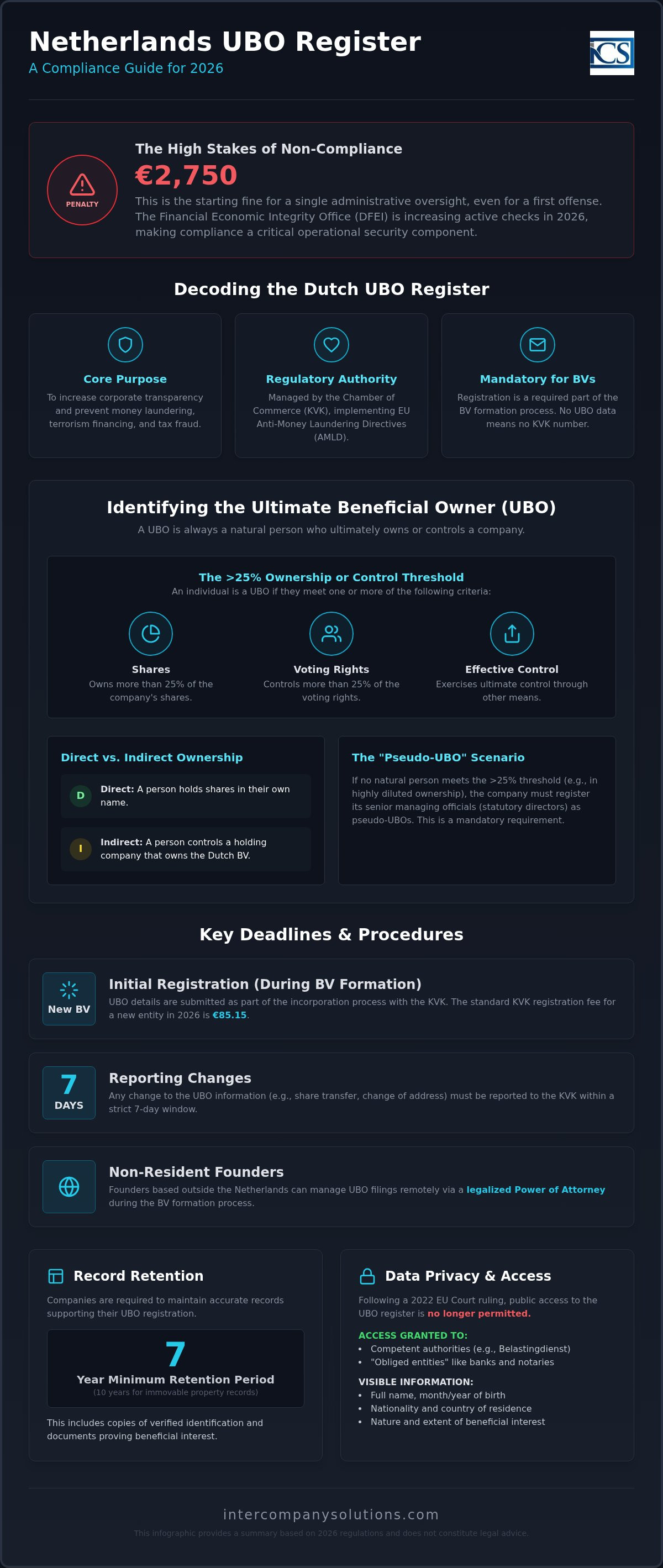
A single administrative oversight in your Dutch company registration can now trigger a starting fine of €2,750, even for a first offense. As the Financial Economic Integrity Office (DFEI) increases its active checks in 2026, understanding the UBO register Netherlands requirements is no longer just a formality; it's a critical component of your company's operational security. You likely feel uncertain about how recent EU court rulings impact your privacy or how to distinguish between direct and indirect control. It's a common concern for international founders who want to establish a BV without falling foul of complex Dutch AML laws.
This guide provides a precise breakdown of the current registration rules, ownership thresholds, and mandatory deadlines you must follow. We'll clarify the >25% threshold and the specific seven day window for reporting changes to the Chamber of Commerce (KVK). By following this procedural roadmap, you'll ensure your entity meets all statutory obligations while maintaining the necessary records for the required seven year retention period. Here is everything you need to know to achieve full compliance and successful KVK registration.
Key Takeaways
- Determine which natural persons qualify as ultimate beneficial owners by applying the >25% threshold to satisfy UBO register Netherlands requirements.
- Adhere to mandatory KVK deadlines, including the 8-day window for initial registration and the 7-day requirement for reporting any changes in ownership.
- Mitigate the risk of administrative fines starting at €2,750 by maintaining verified identification documents and proof of beneficial interest for each UBO.
- Learn how non-resident founders can manage these filings remotely via the legalized Power of Attorney route during the BV formation process.
- Ensure long-term compliance by maintaining a corporate administration that supports the 7-year record retention period required under Dutch law.
Understanding the Dutch UBO Register Purpose and Legal Framework
The Dutch UBO register is a centralized database managed by the Kamer van Koophandel (KVK). This registration system serves as the local implementation of the Fourth and Fifth European Anti-Money Laundering Directives (AMLD). Its primary objective is to create transparency in corporate ownership to prevent money laundering, terrorism financing, and tax fraud. All Dutch legal entities, including the Besloten Vennootschap (BV), Naamloze Vennootschap (NV), and foundations (stichtingen), are legally obligated to register at least one ultimate beneficial owner. Understanding Ultimate Beneficial Ownership is essential for any entrepreneur, as it defines the natural person who truly controls or profits from a legal structure.
Regulatory Authority and the KVK Role
The Kamer van Koophandel acts as the managing body for the register, ensuring that submitted data is processed and stored correctly. While the KVK facilitates the process, it doesn't verify the identity of UBOs on its own initiative; the legal responsibility for identifying and registering the correct individuals rests solely with the company directors. For 2026, the KVK registration fee for a new entity remains €85.15. Meeting the UBO register Netherlands requirements is an integral part of the Dutch BV formation process. If you fail to provide this information during incorporation, the KVK won't issue a company number. This ensures that every new business enters the Dutch market with a transparent ownership structure from day one.
Privacy Standards and Data Access in 2026
Privacy concerns regarding the register changed significantly following a 2022 ruling by the Court of Justice of the European Union (CJEU). Access to the register is no longer open to the general public. In 2026, UBO data is only accessible to "obliged entities" such as banks, notaries, and legal professionals, as well as competent government authorities like the Tax and Customs Administration (Belastingdienst). Correctly filing according to UBO register Netherlands requirements ensures that these obliged entities can verify your business status without delays. While the public cannot search for your details, the register still contains specific information:
- Full legal name and month/year of birth
- Nationality and country of residence
- The nature and extent of the beneficial interest (e.g., share percentage)
Restricting access helps balance the need for financial transparency with the personal security of business owners. Authorities use this data to cross-reference tax filings and detect suspicious financial patterns. Even with restricted access, the accuracy of the data is paramount. Financial institutions won't open business accounts if UBO records are incomplete or conflicting with other corporate documents.
Determining Ultimate Beneficial Ownership Criteria for BVs
Identifying the correct individuals is the most technical part of meeting UBO register Netherlands requirements. Under Dutch law, a UBO is always a natural person. A legal entity, such as a foreign holding company or a foundation, can never be listed as an ultimate owner. If your Dutch BV is part of a complex corporate group, you must look through each layer of the structure until you identify the human beings who ultimately benefit. This transparency is mandatory for all BV structures, regardless of whether the founders are based in the EU or abroad.
Direct vs. Indirect Ownership Thresholds
Direct ownership is straightforward; it refers to an individual holding shares or voting rights in their own name. Indirect ownership occurs when a natural person controls a holding company that, in turn, owns the Dutch BV. An individual is considered a UBO if they directly or indirectly own more than 25% of the shares, control more than 25% of the voting rights, or have effective control through other means. When registering, you must specify the exact range of this interest. The KVK uses three categories for this purpose: 25% to 50%, 50% to 75%, and 75% to 100%. If you aren't sure how to calculate these percentages in a multi-tier structure, you can request a compliance review from our specialists.
The Pseudo-UBO: Statutory Directors
Meeting UBO register Netherlands requirements for pseudo-UBOs is just as mandatory as for standard ownership. Some businesses have highly diluted ownership where no single individual holds more than 25%. In these specific scenarios, the law requires the registration of pseudo-UBOs. These are typically all the statutory directors of the company. If your BV is managed by a corporate director, the pseudo-UBOs are the natural persons who are the directors of that managing entity. This mechanism ensures every Dutch entity has a recorded person who remains accountable for its actions.
Pseudo-UBOs are usually the managing directors already listed in your KVK company extract. It's a common misconception that a company can simply leave the UBO register blank if no one meets the ownership threshold. This is incorrect and leads to immediate non-compliance. Even if ownership is split equally among five people at 20% each, the directors must still be registered to maintain the legal integrity of the BV. This ensures that the authorities always have a point of contact for corporate accountability.
UBO Register Netherlands Requirements and Documentation
Gathering the correct evidence is a prerequisite for a successful KVK filing. While identifying the UBO is the first step, the Chamber of Commerce requires physical proof of every claim made in the application. Meeting the UBO register Netherlands requirements involves submitting a comprehensive dossier that verifies the identity of each person and the exact nature of their control. For complex, multi-tier corporate structures, you must provide an organizational chart. This chart should clearly illustrate the path of ownership from the Dutch BV up to the final natural persons at the top of the chain.
Mandatory Information for Registration
The register tracks specific personal data points for every UBO. You'll need to provide the individual's full legal name, date of birth, and nationality. Their residential address and country of residence must also be recorded. A critical component is the Tax Identification Number. For Dutch residents, this is the Burgerservicenummer (BSN). For non-resident founders, you must provide the foreign Tax Identification Number (TIN) from their country of residence. Accuracy here is vital; discrepancies between these details and the provided ID documents will lead to a rejection of the filing.
Required Supporting Evidence
Documentation must be original or certified copies. A primary requirement is a copy of the shareholders’ register, which confirms the distribution of capital and voting rights. You must also submit high-quality copies of valid passports or national ID cards. If these documents are provided from abroad, they must be notarized to confirm their authenticity. For founders located outside the EU, the KVK often requires documents to be legalized or bear an apostille. This is a standard part of the Dutch BV formation process when utilizing the legalized Power of Attorney route.
If you're registering pseudo-UBOs, you must include notarized statements confirming their status as statutory directors. The KVK requires this to ensure that no individual with a >25% interest has been omitted. Once registered, all supporting evidence must be kept in the company's records. Dutch law mandates a 7-year record retention period for all corporate documentation related to UBO identification. Keeping these files organized ensures you can quickly respond to any future inquiries from the Financial Economic Integrity Office or your banking partner.
Maintenance Deadlines and Non-Compliance Penalties
Compliance is not a one-time task completed at incorporation. While the initial registration must occur within 8 days of your company's formation, meeting the UBO register Netherlands requirements is a continuous statutory obligation. The Dutch Tax Administration (Belastingdienst) and the Financial Economic Integrity Office actively cross-reference UBO data with corporate tax filings and annual accounts. Discrepancies between these records can trigger immediate audits or requests for clarification, as the Dutch government prioritizes the accuracy of its financial transparency systems.
Reporting Changes in Ownership
Any modification to the ownership structure or the personal details of a registered individual must be reported to the KVK within 7 days of the change becoming official. This requirement covers share transfers that shift ownership percentages across the 25% threshold, the appointment of new statutory directors (pseudo-UBOs), or changes in a UBO's residential address. It's practical to align these updates with your general accounting for Dutch BV workflows to ensure your internal shareholders' register remains perfectly synchronized with the public filing. Missing this 7-day window is a frequent cause of administrative warnings for international entrepreneurs.
Enforcement and Financial Penalties
Non-compliance with UBO regulations is classified as an economic offense under the Economic Offenses Act. For a first offense, the administrative fine typically starts at €2,750. If the violation is not rectified or if repeat offenses occur, penalties can escalate to a statutory maximum of €27,500. Beyond these direct financial costs, persistent failure to maintain an accurate register can lead to criminal prosecution of the directors. This can permanently damage a director's reputation and their ability to pass future "fit and proper" tests required for financial or legal roles in the Netherlands.
Operational risks often outweigh the fines themselves. Dutch banks operate under strict "Know Your Customer" protocols and are legally required to report any "discrepancy" they find in the UBO register. If a bank discovers that your registered UBO data is outdated or inconsistent with the information provided in your corporate account file, they may freeze your business accounts. This can lead to a complete halt in business operations, affecting payroll and supplier payments. Maintaining an accurate record is therefore a matter of financial stability, not just legal adherence.
Professional Facilitation of UBO Compliance for Foreign Founders
Intercompany Solutions manages UBO registration as a core component of the Dutch BV formation process. For international entrepreneurs, the primary challenge is meeting the UBO register Netherlands requirements without being physically present in the country. We utilize the legalized Power of Attorney (POA) route to bridge this gap, allowing non-EU and EU founders to incorporate their business and fulfill all statutory duties remotely. This ensures that your ownership structure is transparent and compliant from the moment the deed of incorporation is signed.
The Legalized Power of Attorney Process
Specialists at our firm prepare the necessary incorporation and UBO documents in the Netherlands and then send these to the founder in their country of residence. After the founder completes local notarization and obtains the required legalization or apostille, the physical documents are returned to our office. This POA grants us the legal authority to act on your behalf before a Dutch notary and the Chamber of Commerce. We handle the technical details, including the confirmation of the €1 minimum share capital and the payment of the €85.15 KVK registration fee. This remote route eliminates the need for a physical visit to a Dutch notary or a KVK office, which is essential for non-resident directors. To further explore the benefits of international living, you might discover Spaindinavia for exceptional property sales and rentals across the Costa Cálida and Costa Blanca regions.
Compliance doesn't end with the initial incorporation; it's a dynamic requirement that extends throughout the life of the company. Our secretarial services are designed to monitor your corporate structure for any changes that might affect your UBO status. If a share transfer or a change in residential address occurs, we ensure the update is reported to the KVK within the mandatory 7-day deadline. This proactive management is essential for staying aligned with CIT compliance in the Netherlands, as the Belastingdienst often verifies UBO records during corporate tax assessments.
Our team provides a 24-hour response time for all compliance-related inquiries to ensure your business remains in good standing. We specialize in drafting organizational charts for international holdings, ensuring they meet the specific transparency standards required by the KVK. By centralizing your corporate secretarial needs to meet UBO register Netherlands requirements, you reduce the risk of administrative fines and maintain the 7-year record retention period mandated by Dutch law. This structured approach provides the procedural clarity needed to operate a Dutch entity with professional confidence.
Securing Your Dutch Business Operations for 2026
Maintaining strict adherence to UBO register Netherlands requirements ensures your BV operates without the risk of administrative fines or banking disruptions. By accurately identifying natural persons who meet the >25% ownership threshold and submitting verified documentation to the KVK, you establish a transparent corporate foundation. It's vital to remember that any future changes to your structure, residential addresses, or personal data must be reported within seven days to remain in good standing with the Financial Economic Integrity Office.
Intercompany Solutions acts as a proactive partner for international founders, offering remote incorporation in 3-5 business days with a 100% satisfaction guarantee. We handle the technical complexities of your filing so you can focus on scaling your business in the Dutch market. Our specialists manage the legalized Power of Attorney route, ensuring every record is maintained according to the statutory seven year retention period. This structured approach provides the procedural clarity you need for long-term success.
Last reviewed: August 2026
Frequently Asked Questions
Is the Dutch UBO register public for everyone in 2026?
No. Following the 2022 CJEU ruling, the Netherlands moved to a restricted access model. Access is limited to authorities and "obliged entities" such as banks and notaries. The general public cannot search the database. This change protects the privacy of business owners while allowing law enforcement to maintain financial transparency. Authorities use this data specifically to investigate potential financial crimes and verify corporate structures during standard compliance audits.
What is the minimum ownership percentage to be considered a UBO in the Netherlands?
The threshold is more than 25%. This includes direct or indirect ownership of shares, voting rights, or ownership interest. It's important to differentiate between exactly 25% and "more than 25%". If a shareholder holds exactly 25%, they don't meet this specific UBO register Netherlands requirements criterion. Only individuals exceeding this percentage are registered as owners. This ensures that only those with significant control are formally listed in the register.
Can a non-EU resident be registered as a UBO for a Dutch BV?
Yes, non-EU residents are eligible and required to be registered if they meet the ownership criteria. The register identifies the natural person in control, regardless of their nationality or place of residence. Non-resident UBOs must provide a foreign Tax Identification Number (TIN) and valid, often notarized, identification documents from their home country during the filing process. This allows international entrepreneurs to maintain full ownership of their Dutch business entities remotely.
What happens if a Dutch company has no owner with more than 25% shares?
In this scenario, the company must register "pseudo-UBOs". These individuals are all the statutory directors of the legal entity. This ensures every BV has a recorded natural person who remains accountable. If a director is another legal entity, the natural persons managing that parent entity are listed. This prevents any Dutch business from operating with anonymous leadership. It's a mandatory fallback for companies with highly diluted share capital among many small investors.
Are there specific UBO registration fees for the Chamber of Commerce?
No, there isn't a separate fee specifically for UBO registration. The process is integrated into the general company registration at the KVK. For 2026, the one-time registration fee for a new Dutch entity is €85.15. This fee covers the entire incorporation package, including the entry into the Trade Register and the initial UBO filing required for the company's activation. Subsequent updates to UBO information are generally processed without additional government charges.
How long do I have to report a change in UBO information to the KVK?
You must report any changes within seven days. This deadline applies to changes in ownership percentages, residential addresses, or the appointment of new statutory directors. Failing to update the register within this one-week window is considered an economic offense. It can lead to administrative warnings or fines, and it may cause your bank to freeze your business accounts for non-compliance. Prompt reporting is essential to maintain your company's operational standing.
Do I need a Dutch notary to register my UBO information?
Not necessarily for the registration itself, but a notary is required for the incorporation of the BV. During the formation process, the notary verifies the UBO data and submits it to the KVK. If you're a non-resident founder using a Power of Attorney, your local notary will legalize the documents. Our firm then uses these certified copies to complete the registration in the Netherlands. This ensures the identification process meets the high standards of Dutch corporate law.
Is UBO registration mandatory for a dormant Dutch BV?
Yes, the UBO register Netherlands requirements apply to all active and dormant BVs. As long as the legal entity exists in the KVK Trade Register, it must have its ultimate beneficial owners recorded. Dormancy doesn't exempt a company from Dutch AML laws or the obligation to maintain accurate ownership records. Failure to comply can result in fines even if the company isn't trading. Directors must ensure data remains current regardless of the company's operational status.
Frequently Asked Questions
Need more information on the Dutch BV company?
Contact an expertReady to start your company in the Netherlands?
| Formation time | Dutch BV formation completed in 3 to 5 business days |
|---|---|
| Process | Fully remote setup with step-by-step guidance |
| Compliance | Expert support for registration, VAT and compliance |
| Aftercare | Accounting, tax and legal support included |
| One partner | All of the above through one trusted formation partner |