


By Intercompany Solutions, Intercompany Solutions
Published August 15, 2026
All blog posts are reviewed and fact checked by our labour law lawyer Zishan Hussain and our director.Editorial standards
August 15, 2026 · 17 min read
Approximately 80% of Dutch legal entities successfully registered their Ultimate Beneficial Owners by early 2024, highlighting the rigorous transparency standards now enforced by the Belastingdienst. For foreign entrepreneurs, maintaining cit compliance netherlands is a precise statutory requirement that leaves no room for administrative error or missed deadlines. It's common to feel overwhelmed by the technical language and the strict filing schedules required to keep a Dutch BV in good standing with the tax authorities.
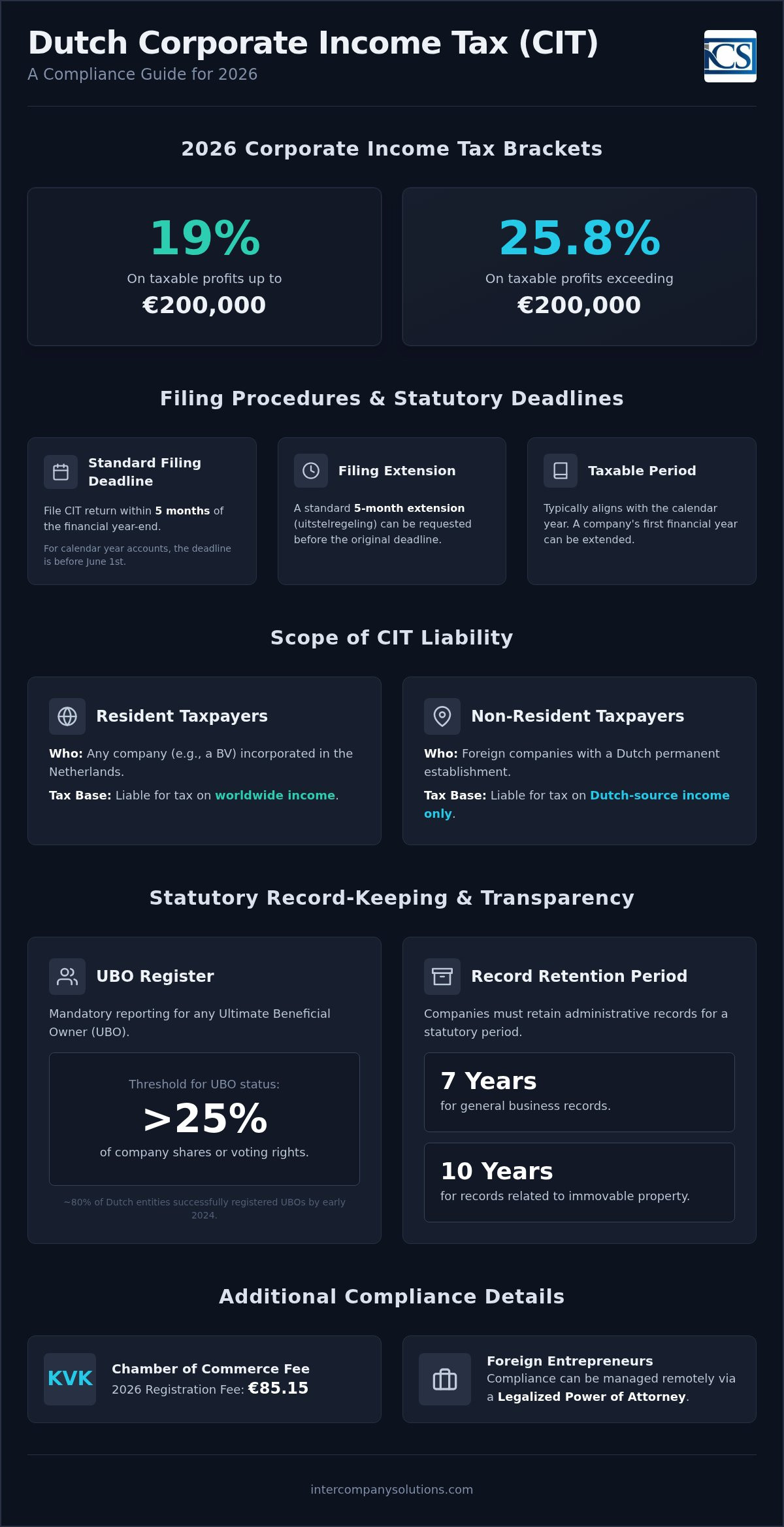
We understand that the complexity of Dutch tax law can be a significant barrier to international business growth. This guide provides a professional, step-by-step breakdown of the 2026 corporate income tax requirements, ensuring you have the exact data needed to manage your company's fiscal responsibilities. You'll gain a clear understanding of the current tax brackets, which remain set at 19% for profits up to €200,000 and 25.8% for anything above that threshold.
Beyond the tax rates, we'll detail the essential filing deadlines and the mandatory seven-year record retention period you must follow. We also cover the €85.15 KVK registration fees and the specific UBO reporting thresholds for shareholders with more than 25% ownership. This overview serves as a reliable roadmap to help you avoid administrative fines and maintain a transparent relationship with the Dutch state.
Key Takeaways
- Understand the two-bracket 2026 tax system to ensure accurate cit compliance netherlands, applying a 19% rate on profits up to €200,000 and 25.8% on the remainder.
- Identify critical filing deadlines, typically due within five months of the financial year-end, to prevent administrative penalties and late-payment interest.
- Implement statutory record-keeping protocols that meet the mandatory seven-year retention period, or ten years for records involving immovable property.
- Learn how non-resident directors can manage Dutch tax obligations remotely using the legalized Power of Attorney route for corporate compliance.
- Clarify transparency requirements for the UBO register, which applies to any natural person holding more than 25% of the company's shares or voting rights.
Scope of Dutch Corporate Income Tax Liability
Dutch corporate income tax (CIT) applies to entities based on their residency status and the nature of their activities within the country. For most international entrepreneurs, the primary vehicle for business is the Besloten Vennootschap (BV). Under Dutch law, any BV incorporated in the Netherlands is automatically considered a tax resident. This status dictates that the entity is liable for tax on its worldwide income, regardless of where that income is generated. This is a critical factor to consider during Dutch company formation, as it establishes the baseline for all future fiscal obligations.
Non-resident taxpayers, such as foreign companies with a permanent establishment or specific Dutch-source income, face a more limited scope. They only pay tax on profits derived directly from Dutch operations. Determining residency involves looking at the place of effective management. If the key commercial and strategic decisions are made within the Netherlands, the entity is typically classified as a resident for tax purposes. Understanding these distinctions is fundamental to maintaining cit compliance netherlands and ensuring that all statutory obligations are met from the date of incorporation. The Dutch corporate tax system provides a clear framework for these assessments, balancing local requirements with international treaties to prevent double taxation.
Entities Subject to CIT
The Dutch tax code mandates CIT liability for several legal forms. Private limited companies (BVs) and public companies (NVs) are the most common subjects. Foundations (stichtingen) and associations are generally exempt unless they engage in active business operations that compete with commercial enterprises. In such cases, they must register for CIT once their activities cross the threshold of a business. Foreign branches operating as permanent establishments must also comply with Dutch filing requirements for the portion of profit attributable to their local activities. This ensures a level playing field between local BVs and international groups with a physical presence in the country.
The Taxable Period
Most companies align their taxable period with the standard calendar year, running from January 1 to December 31. However, the law allows for broken financial years if specified in the company's deed of incorporation. For a newly established BV, the first financial year can be extended. This means a company formed in October 2025 might have its first reporting period end on December 31, 2026. This alignment is vital because CIT returns must correspond exactly with the annual financial statements filed at the Chamber of Commerce (KVK). Precise coordination between accounting and tax filing is a core component of successful cit compliance netherlands. It prevents discrepancies that could trigger audits or inquiries from the Belastingdienst.
Filing Procedures and Statutory Deadlines
Maintaining cit compliance netherlands requires strict adherence to the statutory filing timeline. For a Dutch BV with a financial year matching the calendar year, the corporate income tax return must be filed before June 1 of the following year. If your company uses a broken financial year, as discussed in the previous section regarding the deed of incorporation, the deadline is exactly five months after the end of that period. Missing these dates triggers automatic administrative penalties, which can escalate if the delay persists.
You can request a standard five-month extension for filing through the uitstelregeling. This is particularly useful for international entrepreneurs who need additional time to consolidate accounts from foreign subsidiaries or coordinate with non-resident directors. Most professional service providers manage this request on behalf of their clients, ensuring the company remains in good standing while the final figures are verified. It's a routine procedure, but it must be initiated before the original five-month deadline expires.
The CIT Return Process
The foundation of a correct tax return is the set of commercial annual accounts. However, the taxable profit often differs from the commercial profit due to specific fiscal adjustments. These include non-deductible expenses like certain fines or a portion of representation costs, as well as specific depreciation rules for business assets. You must submit the return electronically via the Belastingdienst portal or through certified software. This process ensures that CIT filing and compliance procedures are followed according to the latest 2026 standards, prioritizing accuracy in the transition from commercial to fiscal reporting.
Provisional vs. Final Assessments
The Dutch tax authorities typically issue a provisional assessment (voorlopige aanslag) early in the financial year based on previous results or estimates. This serves as a preliminary payment plan to help businesses manage their cash flow throughout the year. If you expect significantly higher or lower profits than in previous years, you should adjust this assessment immediately. Doing so prevents a large, unexpected tax bill at the end of the year and minimizes the interest charged on late payments. Proactive management of these assessments is a key component of effective cit compliance netherlands.
Following a 2026 Supreme Court ruling, the interest rate on late corporate tax payments is now capped at 4%. While this is lower than in previous years, it remains a cost that efficient businesses avoid through precise reporting. Once the Belastingdienst processes your submitted return, they issue a final assessment (definitieve aanslag). If you believe your tax obligations have been miscalculated, you can consult our accounting specialists to review your filing or initiate a formal objection process within the six-week statutory window.
Dutch Corporate Tax Rates and Thresholds for 2026
The Dutch corporate income tax structure for 2026 maintains a stable two-bracket system, providing a predictable environment for international businesses. For taxable profits up to €200,000, companies pay a rate of 19%. Once profits exceed this €200,000 threshold, the portion above that amount is taxed at 25.8%. These rates apply to the fiscal profit, which is determined after making the necessary adjustments to the commercial accounts as described in previous sections. Maintaining accurate records is essential to ensure that your company applies the correct thresholds during the annual filing process.
Holding companies often benefit from the participation exemption (deelnemingsvrijstelling). This rule ensures that dividends and capital gains received from a qualifying subsidiary, generally where the parent holds at least 5% of the shares, are exempt from CIT. This prevents double taxation within a corporate group, making the Netherlands a strategic location for holding structures. Proper application of this exemption is a cornerstone of cit compliance netherlands for groups with multiple entities, as it directly impacts the overall effective tax rate.
Calculating Taxable Profit
Determining the final tax bill requires a precise calculation of taxable profit. You can deduct most business-related expenses, provided they're incurred for the purpose of generating income. However, certain costs, such as interest on loans, are subject to specific limitation rules. If your company incurs a loss, the Dutch system allows for a one-year carry-back to the previous year's profit. For losses that can't be offset this way, you can carry them forward indefinitely. It's helpful to know that while carry-forward is indefinite, restrictions apply when offsetting against profits exceeding €1 million.
Groups with multiple BVs can often form a fiscal unity (fiscale eenheid). This allows the parent and its subsidiaries to be treated as a single taxpayer. The primary benefit is the ability to offset the losses of one company against the profits of another within the same group. It also simplifies the administrative burden, as only one consolidated CIT return is filed for the entire unity. This arrangement requires careful planning during starting a business in the Netherlands to ensure all entities meet the requirements for fiscal integration.
Incentives and Exemptions
The Dutch government offers several incentives to encourage specific types of economic activity. The Innovation Box is a prominent example, allowing profits derived from self-developed intellectual property or qualifying R&D to be taxed at an effective rate of 9% instead of the standard rates. This reduced rate significantly lowers the tax burden for tech-driven enterprises that hold valid patents or R&D declarations.
Additionally, companies can utilize investment allowances for energy-efficient or environmentally friendly equipment. These deductions are taken from the taxable profit before the CIT rates are applied. When combined with the participation exemption on dividends, these incentives provide a competitive fiscal framework for entrepreneurs who prioritize growth and innovation. Adhering to these rules is a vital part of cit compliance netherlands for any modern BV.
Statutory Record-Keeping and Transparency Requirements
Administrative integrity is the backbone of a compliant Dutch BV. The Belastingdienst requires you to maintain a comprehensive administration that's readily accessible for audits at any time. For standard business records, including invoices, bank statements, and contracts, the mandatory retention period is seven years. However, if your company owns or manages business premises, you must retain records pertaining to immovable property for ten years. This distinction is vital for long-term cit compliance netherlands, as failing to produce these documents during an inspection can lead to the reversal of the burden of proof in tax disputes.
Digital records are fully accepted by the authorities, provided they remain authentic and accessible. You must ensure that the data can be retrieved and read within a reasonable timeframe if requested by a tax inspector. While cloud-based accounting solutions facilitate this, the ultimate responsibility for data integrity rests with the company's directors. Keeping your digital archives organized is a practical way to demonstrate transparency and reliability to the Dutch state.
To ensure these systems remain secure and resilient, many international firms utilize the expertise of Insoft Services for professional IT consultancy and managed cybersecurity services.
KVK Filing and Fees
Every year, a Dutch BV must file its financial statements with the Chamber of Commerce (KVK). For the 2026 period, the registration fee for the Trade Register is €85.15. You must file these statements within 12 months after the end of the financial year to remain in good standing. The amount of information you're required to disclose depends on your company's size category. Micro and small companies typically only need to publish a condensed balance sheet and limited notes. In contrast, medium and large entities face more extensive audit and disclosure requirements. Timely filing protects directors from personal liability in case of bankruptcy and is a core part of corporate transparency.
UBO Register Compliance
Transparency extends to the ownership structure through the UBO register. You're required to register any natural person who is an Ultimate Beneficial Owner, defined as someone holding more than 25% of the shares or voting rights. As of early 2024, approximately 80% of Dutch entities had successfully completed this registration, reflecting the high priority placed on corporate transparency. Inaccurate or missing UBO data can lead to administrative fines and significant hurdles when opening or maintaining corporate bank accounts. Banks use this data as part of their mandatory KYC protocols, making UBO accuracy a prerequisite for smooth cit compliance netherlands. Any changes in ownership must be reported within eight days to ensure the register remains current.
Managing CIT Compliance as a Foreign Entrepreneur
Managing the regulatory environment as a non-resident director presents unique logistical hurdles. The Belastingdienst conducts almost all official correspondence in Dutch, making it difficult for foreign entrepreneurs to interpret time-sensitive requests or assessment notices. To maintain cit compliance netherlands, you must have a registered Dutch business address. This address serves as the official point of contact for tax service, ensuring that your company receives all statutory notifications without delay. Relying on an international address often leads to missed deadlines and subsequent administrative fines.
Remote management is standard practice for international BVs, provided you use the legalized Power of Attorney (PoA) route. This legal framework allows a local representative to manage your fiscal affairs, from VAT registrations to the final CIT return. It eliminates the need for physical travel for every administrative step, ensuring that your company remains compliant while you focus on global operations. The PoA must be properly notarized and legalized to be recognized by Dutch banks and the tax office, a process that our specialists handle during the incorporation phase.
Remote Compliance Solutions
Utilizing professional accounting for Dutch BV services is the most efficient way to handle these requirements. These specialists act as authorized agents, using secure digital portals to communicate directly with the tax authorities. By integrating your bookkeeping with payroll services, you ensure that all wage taxes and social security contributions are correctly calculated and ready for the year-end CIT consolidation. This holistic approach prevents data discrepancies between different tax categories, which is a common trigger for tax audits.
Strategic Compliance Planning
Long-term success requires planning for specific tax incentives and international obligations. For instance, you should determine if your international staff qualify for the 30% tax reimbursement ruling, which allows you to provide a tax-free allowance for extraterritorial costs to highly skilled migrants. Additionally, managing cross-border tax obligations is vital to benefit from double tax avoidance treaties between the Netherlands and your home country. This prevents the same profit from being taxed in two jurisdictions. Selecting a knowledgeable Netherlands company formation agent provides you with a single point of contact for both the initial setup and the ongoing statutory monitoring required for a healthy Dutch enterprise.
Last reviewed: August 2026
Securing Your Dutch BV’s Fiscal Future
Adhering to the statutory framework of the Netherlands ensures your business remains a transparent and reliable entity in the eyes of the Belastingdienst. By understanding the 2026 tax brackets of 19% and 25.8%, and respecting the five-month filing deadline, you protect your company from administrative penalties and unnecessary interest charges. Maintaining your records for the required seven or ten-year periods is not just a legal obligation but a strategic practice that prepares you for any future inquiries. Managing cit compliance netherlands effectively requires a proactive approach to these technical requirements.
Our team acts as a bridge between your international operations and the Dutch tax authorities, handling every procedural detail with efficiency. We provide the expertise needed to manage your UBO registrations, KVK filings, and annual returns remotely. This systematic approach allows you to focus on growth while we ensure your company meets every legal and fiscal standard required for long-term stability.
As an authorized tax agent with the Belastingdienst, Intercompany Solutions has specialized in foreign entrepreneur compliance since 2015. We offer a 100% satisfaction guarantee on our corporate services to reassure you that your professional interests are in experienced hands. We're ready to help you build a compliant and prosperous presence in the Dutch market.
Last reviewed: August 2026
Frequently Asked Questions
What is the corporate tax rate in the Netherlands for 2026?
The corporate income tax rate for 2026 is 19% on taxable profits up to €200,000 and 25.8% on any amount exceeding that threshold. These rates apply to both resident and non-resident taxpayers with Dutch-source income. You must calculate the fiscal profit after applying mandatory adjustments to your commercial annual accounts to ensure the correct bracket is applied during your filing.
When is the deadline for filing a Dutch CIT return?
For a financial year that follows the calendar year, the filing deadline is June 1 of the following year. If your BV uses a broken financial year, you must file within five months after the period ends. You can request a standard five-month extension through a registered tax service provider to ensure cit compliance netherlands while finalizing complex accounts or coordinating with international directors.
Can I file my Dutch corporate tax return remotely from abroad?
Yes, you can manage your corporate tax obligations entirely from abroad by utilizing the legalized Power of Attorney route. This legal framework allows a local representative to handle electronic submissions and correspondence with the Belastingdienst on your behalf. Most foreign entrepreneurs use this method to maintain their statutory duties without the need for frequent physical travel to the Netherlands for administrative purposes.
How long must a Dutch BV keep its financial records?
A Dutch BV is legally required to retain its general administrative records for a period of seven years. This includes all invoices, contracts, and bank statements relevant to the company's financial history. For any records specifically pertaining to immovable property, such as office premises or land, the mandatory retention period is extended to ten years to comply with statutory audit requirements.
What is the penalty for late CIT filing in the Netherlands?
The Belastingdienst issues automatic administrative fines for late filing, which can increase based on the duration of the delay. In addition to these penalties, you'll be charged interest on the outstanding tax amount. Following a 2026 ruling, this interest is capped at 4%. Accurate cit compliance netherlands is essential to avoid these avoidable costs and maintain a clean fiscal record with the authorities.
Does a Dutch BV need a local director for CIT compliance?
A Dutch BV does not strictly require a local director to fulfill its corporate tax obligations, but it must maintain a registered business address in the country. However, the location of effective management and control is a primary factor in determining tax residency. If all directors are non-residents, the company must still ensure it receives and interprets Dutch-language correspondence from the tax office promptly.
What is the KVK registration fee for 2026?
The one-time registration fee for the Dutch Trade Register at the Chamber of Commerce (KVK) is €85.15 for the 2026 period. This fee is payable upon the initial registration of your BV or NV. While this is a one-time cost, you must also consider the annual requirement to file financial statements, which ensures your company's data remains transparent and up to date in the public register.
Is a Dutch BV required to register UBO information?
Yes, every Dutch BV must register its Ultimate Beneficial Owners (UBOs) in the public register. A UBO is any natural person who ultimately owns or controls more than 25% of the company's shares or voting rights. Maintaining accurate UBO data is a critical transparency requirement, as missing or outdated information can lead to administrative fines and significant issues with maintaining corporate banking services.
Frequently Asked Questions
Need more information on the Dutch BV company?
Contact an expertReady to start your company in the Netherlands?
| Formation time | Dutch BV formation completed in 3 to 5 business days |
|---|---|
| Process | Fully remote setup with step-by-step guidance |
| Compliance | Expert support for registration, VAT and compliance |
| Aftercare | Accounting, tax and legal support included |
| One partner | All of the above through one trusted formation partner |