


August 23, 2026 · 16 min read
Failure to accurately register an Ultimate Beneficial Owner with the Dutch Chamber of Commerce now carries administrative fines starting at €2,750 as of January 2026. This underscores the precision required when obtaining your KVK number Netherlands, which serves as the mandatory 8-digit identifier for any business operating within the Dutch jurisdiction. For foreign entrepreneurs, securing this registration often presents specific procedural hurdles, particularly when attempting to bridge the gap between international documentation and the technical requirements of the Dutch Business Register.
You've likely felt frustrated by the lack of clarity regarding the differences between KVK, RSIN, and VAT numbers, or the perceived need for a physical presence in the country. This guide provides a technical roadmap for the 2026 registration process, including the €85.15 statutory fee and the legalized Power of Attorney route for remote BV formation. We'll explain how to satisfy the Dutch authorities without being physically present, ensuring your company is fully registered and compliant with current corporate income tax and UBO reporting standards.
Key Takeaways
- Identify the mandatory 8-digit KVK number Netherlands as the foundational identifier required for all commercial contracts, invoicing, and legal compliance within the Dutch jurisdiction.
- Learn the specific legalized Power of Attorney procedure that enables foreign entrepreneurs to complete the entire registration process remotely without a physical presence in the Netherlands.
- Distinguish between the KVK number, the RSIN assigned to legal entities, and the VAT identification number issued by the Belastingdienst to ensure accurate tax reporting.
- Prepare for the 2026 statutory registration fee of €85.15 and understand the invoicing protocols handled by the civil-law notary during the incorporation of a Dutch BV.
- Navigate the mandatory UBO register requirements for individuals holding more than 25% of shares or voting rights to avoid administrative fines starting at €2,750.
Table of Contents
Function and Purpose of the Dutch KVK Number
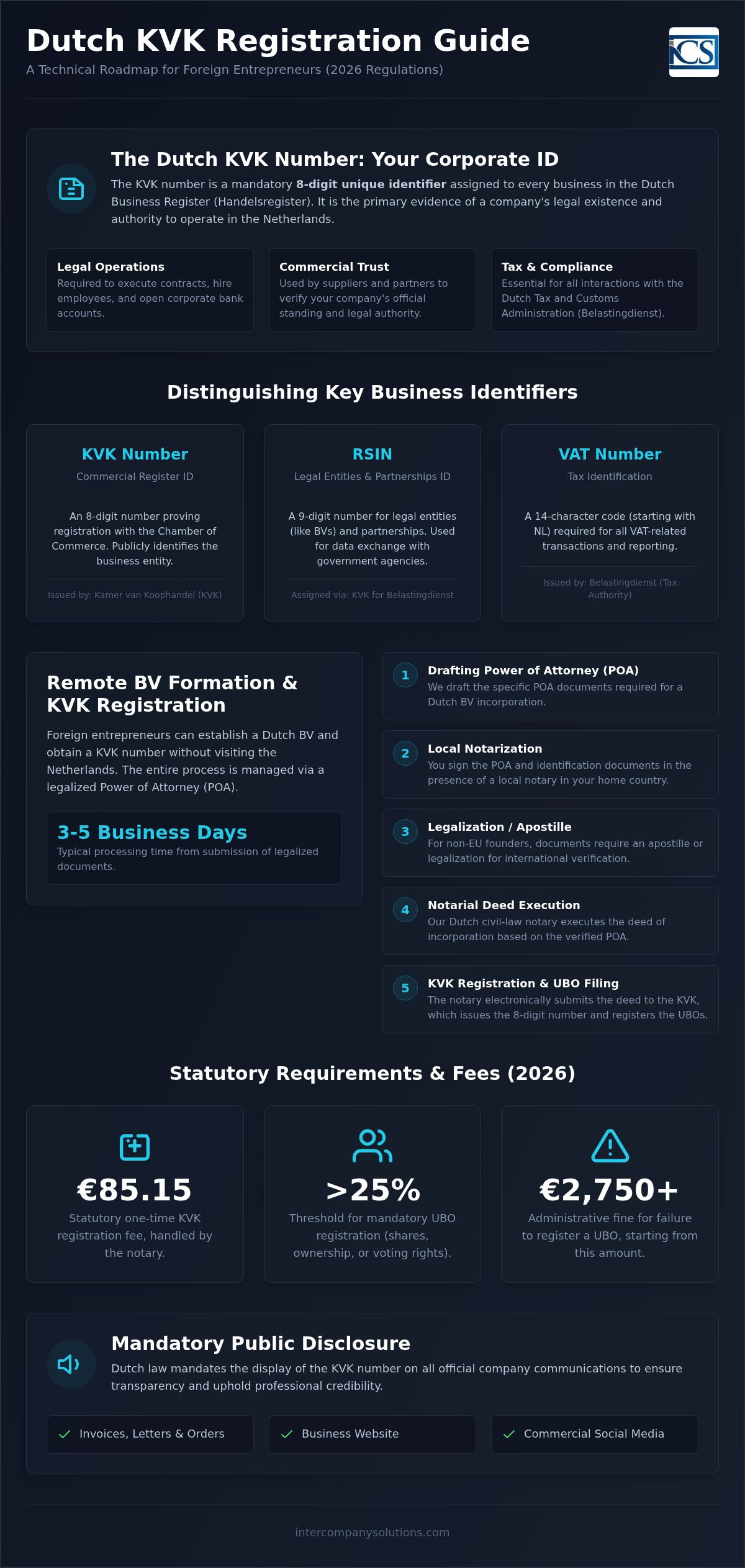
The KVK number Netherlands is an 8-digit unique identifier assigned to every business entity upon its entry into the Dutch Business Register (Handelsregister). Managed by the Dutch Chamber of Commerce (Kamer van Koophandel), this registration is a legal mandate under the Commercial Register Act. It serves as the primary evidence that a company exists as a recognized legal entity or commercial enterprise within the Dutch jurisdiction. Without this number, a business cannot legally execute contracts, hire employees, or settle taxes in the Netherlands.
For foreign entrepreneurs, the KVK number acts as the cornerstone of corporate legitimacy. Suppliers and financial institutions rely on the register to verify a company's standing before entering into trade agreements or opening corporate bank accounts. It provides a level of transparency that's essential for the stability of the Dutch economy. At Intercompany Solutions, we facilitate this registration as a standard part of our Dutch BV company formation services, ensuring that your corporate data is accurately reflected in the national database from the outset.
The verification process allows third parties to perform due diligence with high precision. By accessing the Handelsregister, a potential partner can check a company's fiscal history and identify exactly who holds the legal signing authority. This prevents unauthorized individuals from committing the company to financial obligations and helps mitigate the risk of corporate fraud. In a professional environment, providing your 8-digit code is often the first step in any business-to-business interaction.
When is a KVK Number Issued?
The KVK issues the number immediately upon the successful completion of the registration process. Entrepreneurs can initiate their application up to three months before their official start date, providing a pre-registration window that's useful for preparing administrative infrastructure. If a business undergoes a significant structural change, such as a transfer of ownership or a transition from a sole proprietorship to a BV, the KVK usually assigns a new number. This ensures the register always links the correct legal structure to its current financial and legal responsibilities.
Visibility and Public Disclosure Requirements
Dutch law dictates that you must display your KVK number Netherlands on all outgoing correspondence, including letters, orders, and invoices. This transparency extends to your digital presence; the number must be clearly visible on your business website and any professional social media profiles used for commercial activities. Failing to disclose the registration number on official documents can result in administrative fines. It also undermines your professional credibility with the Dutch Tax and Customs Administration (Belastingdienst). Maintaining clear disclosure is a simple but critical requirement for ongoing compliance.
Step-by-Step Guide to KVK Registration for Foreign Entrepreneurs
Foreign founders typically select the Dutch BV (Besloten Vennootschap) as their legal structure because it offers limited liability and a professional image for international trade. Obtaining a KVK number Netherlands for a BV requires a specific sequence involving a Dutch civil-law notary. The notary executes the deed of incorporation and handles the electronic filing with the Chamber of Commerce. Once the notary submits the deed, the KVK processes the registration and issues the 8-digit identification code. This is followed by a physical welcome letter and an official extract from the Business Register, which are sent to the company’s registered Dutch address.
The Remote Incorporation Process
The legalized Power of Attorney (POA) route allows for entirely remote formation, which is a significant advantage for non-resident entrepreneurs. We draft the necessary POA documents and provide clear instructions for execution in your home country. You must sign these documents in the presence of a local notary. For non-EU founders, legalization or an apostille is mandatory to verify the authenticity of the signatures and identification documents. This procedure ensures the Dutch authorities receive verified data without requiring you to travel. By utilizing the specialized services of Intercompany Solutions, the entire incorporation and registration process is typically finalized within 3 to 5 business days.
Documentation Required for Registration
Accuracy in your documentation prevents administrative delays at the KVK and the notary's office. You must provide a high-quality scan of a valid passport for all directors and shareholders. While identity cards are occasionally accepted for EU citizens, a passport remains the preferred global standard for Dutch incorporation. You'll also need to submit proof of your residential address. This must be a utility bill or bank statement that's no older than two months.
Additionally, every Dutch entity must have a registered business address within the Netherlands. This address is public and serves as the official point of contact for the government and the Belastingdienst. You can find more specific details regarding the forms and appointment protocols for KVK registration for foreign companies on the official Chamber of Commerce portal. If you need support in preparing your dossier or identifying a suitable registered office, you can discuss your requirements with our team to ensure all statutory criteria are met before submission.
Distinguishing Between KVK, RSIN, and VAT Identification Numbers
The KVK number Netherlands is your public-facing commercial identifier, but it's not the only number your company requires for legal operation. Upon the registration of a Dutch BV, the Chamber of Commerce automatically generates a Rechtspersonen en Samenwerkingsverbanden Informatie Nummer (RSIN). Unlike the 8-digit KVK number, the RSIN is used by the Belastingdienst to identify the legal entity across all tax categories. It's important to understand that while sole proprietors use their Citizen Service Number (BSN) for tax purposes, legal entities like BVs receive this specific RSIN to facilitate corporate tax administration.
You must also distinguish between your BTW-nummer (tax identification number) and your BTW-id (VAT identification number). The BTW-id is your public-facing number that you'll display on invoices and your website to facilitate trade within the EU. The BTW-nummer is used exclusively for private communication and filings with the Dutch tax office. If your Dutch entity engages in trading securities or financial instruments on the stock exchange, you'll also need a Legal Entity Identifier (LEI). This 20-character code is mandatory for global financial transparency and is separate from your domestic registrations.
The Tax Administration (Belastingdienst) Sequence
The KVK automatically notifies the Belastingdienst when a new entity is formed. This means you don't need to file a separate initial tax registration when starting a business in the Netherlands. You can expect to receive your VAT numbers by post within 10 working days after your KVK registration is finalized. Companies importing or exporting goods outside the EU must also apply for an Economic Operators Registration and Identification (EORI) number. This number is essential for customs clearance and is typically linked to your RSIN.
VAT Registration for Non-Resident Founders
Founders must determine if their activities qualify as taxable in the Netherlands. The standard VAT (BTW) rate is 21%, while a reduced rate of 9% applies to specific sectors such as food, water, and certain medical services. Your KVK registration is permanently linked to your tax profile, requiring quarterly VAT filings even if no transactions occurred during a specific period. Non-compliance with these filing deadlines can result in administrative penalties. We provide comprehensive accounting and tax services to ensure your filings remain accurate and synchronized with your KVK record.
Statutory Requirements and Registration Fees for 2026
The one-time registration fee to obtain a KVK number Netherlands is fixed at €85.15 for the 2026 calendar year. This is a mandatory, tax-deductible expense for all new commercial entities. For foreign founders utilizing our remote incorporation services, this fee is typically handled via the civil-law notary's invoice to streamline the administrative process. If you're registering a branch or a structure that doesn't require a notary, you'll pay this fee directly at the KVK office. They exclusively accept debit or credit card payments; cash is not an accepted form of payment at any Chamber of Commerce location.
Beyond the initial registration, you must factor in the Corporate Income Tax (CIT) environment. For the 2026 fiscal year, the Netherlands applies a CIT rate of 19% on profits up to €200,000. Any profit exceeding this €200,000 threshold is taxed at 25.8%. Unlike some other European jurisdictions, the Netherlands doesn't levy a capital tax on the issuance of shares. This tax was abolished on January 1, 2006, making the country a more cost-effective location for companies planning to issue significant share capital during or after their initial formation.
Minimum Share Capital for a Dutch BV
Since the implementation of the Flex-BV regulations, the minimum share capital requirement for a Dutch BV is set at €1. This flexibility allows you to tailor your corporate structure to your specific needs. However, in practice, many international entrepreneurs opt for a higher starting capital, such as €1,000 or €10,000, to build immediate credibility with Dutch financial institutions. The share issuance process is integrated into the KVK registration phase. The notary specifies the par value and quantity of shares in the deed of incorporation, which the KVK then records in the public register before the KVK number Netherlands is finalized.
Ongoing Administrative Compliance
Ongoing compliance involves more than just the initial registration. You're legally required to maintain a comprehensive administration for a 7-year record retention period. This includes all invoices, bank statements, and contracts. If your business involves immovable property, the law mandates a 10-year retention period for those specific records. While the KVK doesn't charge an annual maintenance fee, you'll need to pay for certified extracts when proving your company's status. These extracts are essential for opening bank accounts or signing high-value lease agreements and are available in both digital and physical formats.
Managing Corporate Records and the Dutch UBO Registry
The KVK number Netherlands acts as the primary link to the mandatory UBO (Ultimate Beneficial Owner) register. Dutch law requires all legal entities to identify and register their UBOs to prevent money laundering and financial crime. A UBO is defined as any natural person who ultimately owns or controls more than 25% of the company's shares, voting rights, or ownership interest. As of January 1, 2026, administrative fines for failing to maintain an accurate UBO registration start at €2,750. While public access to this register is restricted following European court rulings, competent authorities and organizations with a demonstrated legitimate interest retain full access to this data.
When you decide to close your Dutch operations or move the business abroad, you must follow a formal deregistration process. This involves liquidating the entity and notifying the KVK to strike the company from the Business Register. Only after this process is complete will your 8-digit identification number be retired. Remember that deregistration doesn't exempt you from the 7-year record retention period; you're still legally required to store your corporate administration even after the business ceases to exist.
Updating KVK Information
You have a statutory duty to report any changes to your corporate structure within 8 days of the change occurring. This includes the appointment of new directors, changes in shareholding, or a relocation of the business address. Maintaining outdated information in the register can lead to administrative penalties and may complicate your relationship with the Belastingdienst. You can manage most updates online through the "My KVK" portal using a DigiD or an authorized representative's credentials. Accurate records ensure that your KVK extract always reflects the current legal reality of your enterprise.
Annual Accounts Filing
Every Dutch BV must file annual financial statements with the KVK. The level of detail required in these accounts depends on your company's size, categorized as micro, small, medium, or large based on turnover, asset value, and employee count. Failing to file these accounts on time is considered an economic offense and can lead to personal liability for directors. At Intercompany Solutions, we assist our clients with comprehensive accounting services to ensure that both tax filings and KVK requirements are met within the legal deadlines. By integrating your financial reporting with your KVK compliance, you maintain the corporate standing necessary for starting a business in the Netherlands and scaling your international operations.
Last reviewed: August 2026
Finalizing Your Dutch Market Entry
Securing a KVK number Netherlands represents the foundational step in establishing a legitimate commercial presence within the European Union. We've outlined the technical sequence required for registration, including the €85.15 statutory fee for 2026 and the mandatory UBO reporting for individuals holding more than 25% ownership. Utilizing the legalized Power of Attorney route ensures that your business can be fully registered and active without the logistical burden of international travel.
Our firm brings over nine years of expertise in Dutch corporate law and tax administration to every incorporation. We guarantee a 24-hour response time and typically finalize the remote formation process within 3 to 5 business days. This efficiency allows you to transition from initial planning to active trading with the confidence that your legal and fiscal infrastructure is robust. Maintaining accurate records and adhering to the 7-year retention period will safeguard your company's standing as you scale your operations.
We look forward to facilitating your entry into the Dutch business ecosystem and supporting your professional growth in the Netherlands.
Frequently Asked Questions
What is the exact cost of a KVK registration in 2026?
The one-time registration fee for a new company at the Dutch Chamber of Commerce is €85.15 for the 2026 calendar year. This fee is mandatory and tax-deductible for your business. Payment is typically settled via the civil-law notary during the incorporation of a Dutch BV or paid directly by card if you're visiting a KVK office in person. Cash payments aren't accepted at any KVK location.
Can I get a KVK number without a Dutch business address?
You can't obtain a KVK number Netherlands without a registered business address located within the Netherlands. This address serves as the official point of contact for government agencies and the public. It must be a physical location where the business is actually managed; a P.O. Box is not sufficient for registration purposes. If you don't have a physical office, you must secure a registered office address through a service provider.
How long does it take for a foreigner to receive a KVK number?
Foreign entrepreneurs typically receive their 8-digit identification number within 3 to 5 business days when using the remote incorporation route. This timeline assumes that all identification documents and the legalized Power of Attorney are prepared correctly. Once the Dutch civil-law notary executes the deed of incorporation and submits the filing electronically, the KVK processes the registration and issues the number almost immediately.
Is the KVK number the same as my VAT number?
No, the KVK number is distinct from your VAT identification number. The KVK issues an 8-digit commercial identifier upon registration in the Business Register. The Dutch Tax and Customs Administration (Belastingdienst) separately issues your VAT numbers, which usually arrive by post within 10 working days after your company is formed. While the KVK number is for commercial identification, the VAT number is strictly for tax administration and EU trade.
What happens to my KVK number if I change my company type from a sole proprietorship to a BV?
Changing your legal structure from a sole proprietorship to a private limited company (BV) results in the issuance of a new KVK number. Because the BV is a separate legal entity from the individual owner, the previous registration must be closed and a new one opened. This transition also requires a new tax identification number (RSIN) and a new VAT number, as the fiscal identity of the business has fundamentally changed.
Do I need to visit the Netherlands in person to register at the KVK?
You don't need to visit the Netherlands in person if you're forming a Dutch BV. The registration can be completed remotely using a legalized Power of Attorney. This document allows a representative to handle the incorporation and KVK filing on your behalf. However, if you're registering as a sole proprietor, a personal visit to a KVK office is mandatory to verify your identity and residence permit.
Who can see my personal information in the KVK Business Register?
The Dutch Business Register is a public database, meaning anyone can see your company's registered address, director names, and signing authorities. This transparency is a legal requirement designed to ensure corporate legitimacy. However, private information such as your residential address is shielded from the general public and is only accessible to competent authorities like the police, tax office, or specific organizations with a legally recognized legitimate interest.
What is the UBO registry and do I need to register for it?
The UBO registry is a mandatory database managed by the KVK that identifies Ultimate Beneficial Owners who hold more than 25% of a company's shares or voting rights. All Dutch legal entities, including BVs, must register their UBOs. Failure to comply with these registration requirements as of 2026 can lead to administrative fines starting at €2,750. The registry's purpose is to prevent money laundering and ensure financial transparency across the EU.
Sources
- KVK - Registering with the Dutch Business Register
- Business.gov.nl - Private limited company (bv)
- Burgerlijk Wetboek Boek 2 (Dutch Civil Code, legal entities)
- Rijksoverheid - Ondernemen
- Belastingdienst - Corporate income tax rates
- ICS Payroll - Dutch payroll services
- Belastingdienst - Payroll taxes (loonheffingen)
- UWV - Employer obligations
- CJEU, Cadbury Schweppes, C-196/04 (ECLI:EU:C:2006:544)
- Hoge Raad, ECLI:NL:HR:2021:1152
- PwC Worldwide Tax Summaries - Netherlands
- ICLG - Corporate Governance Laws and Regulations, Netherlands
Need more information on the Dutch BV company?
Contact an expertReady to start your company in the Netherlands?
| Formation time | Dutch BV formation completed in 3 to 5 business days |
|---|---|
| Process | Fully remote setup with step-by-step guidance |
| Compliance | Expert support for registration, VAT and compliance |
| Aftercare | Accounting, tax and legal support included |
| One partner | All of the above through one trusted formation partner |