


By Intercompany Solutions, Intercompany Solutions
Published August 13, 2026
All blog posts are reviewed and fact checked by our labour law lawyer Zishan Hussain and our director.Editorial standards
August 13, 2026 · 16 min read
Many international entrepreneurs assume that a higher profit margin automatically leads to a linear increase in tax liability, yet the Dutch fiscal system operates on a tiered structure designed to support growth during the early stages of expansion. Understanding the Dutch corporate tax rate is fundamental for any foreign-owned BV looking to maintain compliance while optimizing its global tax position. You're likely managing the pressure of cross-border reporting and want to avoid the financial penalties associated with missing strict filing deadlines. It's a common challenge for those unfamiliar with the local Belastingdienst requirements.
This article provides a precise breakdown of the 2026 tax brackets, thresholds, and mandatory compliance steps. We'll clarify how the 19% rate applies to the first €200,000 of profit and when the 25.8% bracket takes effect. Our Accounting & Tax Services team has structured this guide to cover the 9% Innovation Box incentive and the participation exemption rules. You'll gain a reliable timeline for tax filings and a clear view of the €85.15 KVK registration fee for 2026, ensuring your business operates with full regulatory certainty from the start.
Key Takeaways
- The Dutch corporate tax rate for 2026 is 19% on the first €200,000 of taxable profit and 25.8% for profits exceeding this threshold.
- Qualifying innovative business activities can access a reduced 9% effective tax rate through the Innovation Box, while the participation exemption prevents double taxation for holding structures.
- Corporate income tax returns must be filed within five months after the end of the financial year, which corresponds to a May 31 deadline for calendar-year businesses.
- International entrepreneurs can manage all statutory obligations remotely by utilizing the legalized Power of Attorney route for company formation and ongoing tax compliance.
- Beyond profit taxes, businesses must account for a standard 21% VAT rate and the mandatory KVK registration fee of €85.15 for the 2026 fiscal year.
Understanding the Two-Tier Dutch Corporate Income Tax (CIT) Structure
The Netherlands applies a corporate income tax on the taxable profits generated by companies. This Dutch Corporate Tax System operates on a two-tier, stepped structure rather than a flat percentage. It's designed to provide a competitive fiscal environment, particularly for small and medium-sized enterprises (SMEs) that form the backbone of the local economy. By applying a lower rate to initial profit brackets, the government encourages businesses to reinvest their earnings into further growth and innovation.
Calculating your taxable profit is a straightforward process of subtracting deductible business expenses from your total gross revenue. While the concept is simple, the distinction between resident and non-resident status is vital for compliance. Resident companies, which are those incorporated or effectively managed within the Netherlands, are taxed on their worldwide income. Non-resident companies only face tax obligations on profits derived from Dutch sources, such as a local permanent establishment or Dutch real estate. Understanding your company's residency status is the first step in determining your total tax liability.
Corporate Tax Brackets and Thresholds for 2026
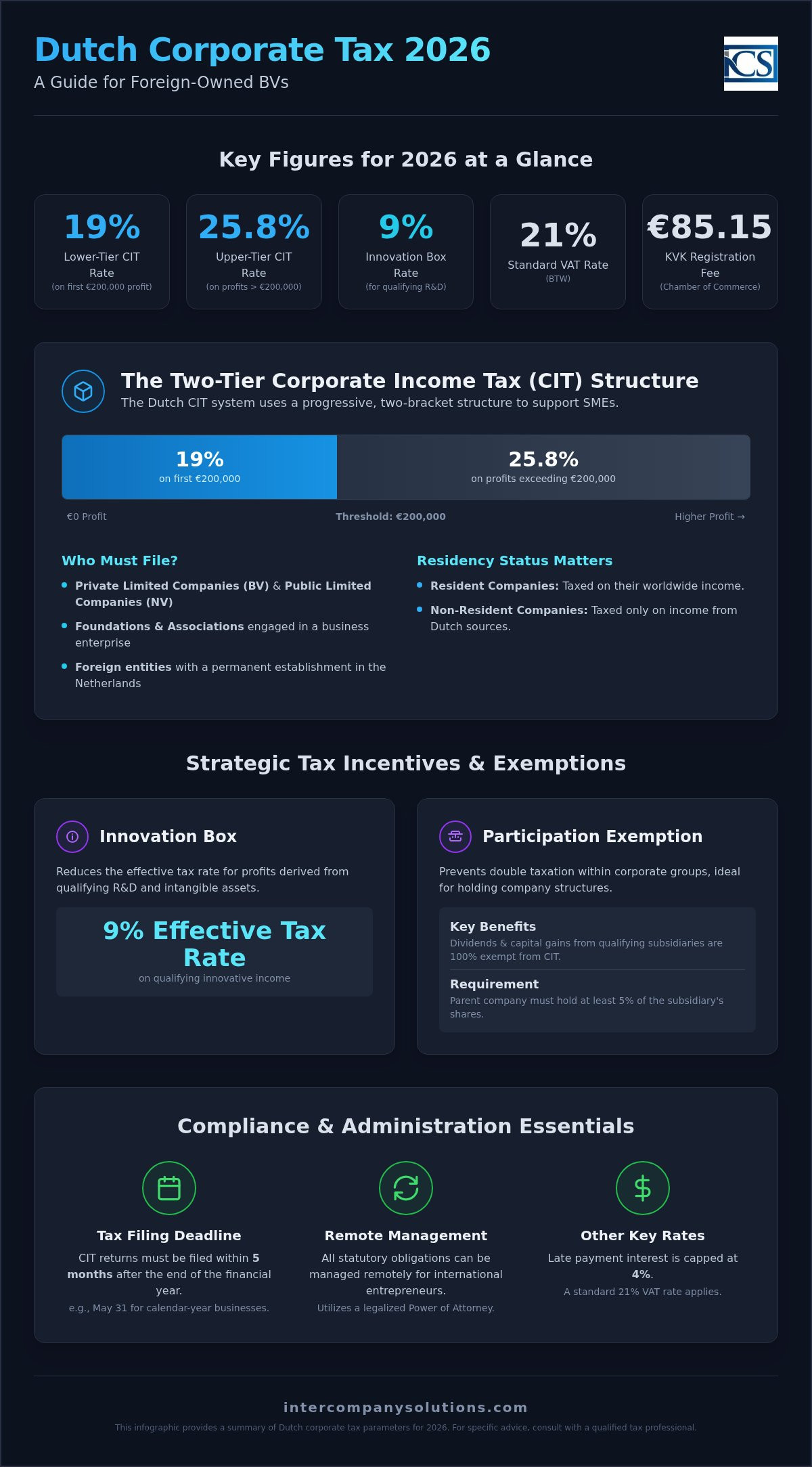
For the 2026 fiscal year, the Dutch corporate tax rate remains consistent with the previous year's parameters. Profits up to the threshold of €200,000 are subject to a 19% tax rate. Any profit that exceeds this €200,000 limit is taxed at the standard rate of 25.8%. It's important to understand that these rates are applied sequentially. This means that even a highly profitable company still pays the lower 19% rate on its first €200,000 of profit, with the higher 25.8% rate only applying to the portion above that amount. There are no local municipal or provincial corporate taxes, which simplifies the calculation for international founders.
Taxable Entities: Who Must File?
The obligation to file a corporate income tax return primarily rests with public limited companies (NV) and private limited companies (BV). If you're considering starting a business in the Netherlands, the BV structure is the most common choice for foreign investors due to its flexibility. However, tax liability isn't limited to these corporate forms. Foundations and associations must also file if they engage in a business enterprise that competes in the market. Foreign entities with a permanent establishment or a designated Dutch representative are similarly subject to CIT. Our Accounting & Tax Services team helps clients navigate these definitions to ensure that every entity meets its annual filing requirements without incurring late-payment interest, which is capped at 4%.
Strategic Tax Incentives and Exemptions for Dutch BVs
The Dutch tax code provides specific regimes to lower the effective tax burden for international group structures and innovative enterprises. These incentives aren't applied automatically; they require proactive management and precise documentation within your annual tax filings. While the standard Dutch corporate tax rate applies to general business profits, these exemptions can significantly alter the final liability for qualifying entities. It's essential to integrate these considerations with other administrative costs, such as the €85.15 KVK registration fee for 2026, to understand the total cost of maintaining a Dutch presence.
The Participation Exemption Framework
The participation exemption is a primary reason why many entrepreneurs choose the Netherlands for holding company structures. This regime eliminates corporate income tax on all dividends and capital gains derived from qualifying subsidiaries. To qualify, a Dutch parent company must hold at least 5% of the shares in a subsidiary. Additionally, the subsidiary cannot be held as a purely passive portfolio investment. This framework is a fundamental component of Dutch BV formation when the entity serves as a gateway for international investments or group expansion. It effectively prevents double taxation within a corporate group, ensuring that profits taxed at the subsidiary level aren't taxed again at the holding level.
Innovation Box and R&D Incentives
Companies engaged in technical research and development can benefit from the Innovation Box. Qualifying income generated from patented assets or developed software is taxed at an effective rate of only 9%, rather than the standard 19% or 25.8% brackets. To access this benefit, you must first obtain an R&D declaration (WBSO) from the Netherlands Enterprise Agency. This incentive is particularly relevant for businesses developing hardware, medical technology, or proprietary software solutions. The 9% rate applies to the net profit derived from the innovative asset after the development costs have been recovered.
Properly documenting these activities is vital for compliance. The Dutch tax authorities require a clear link between the R&D efforts and the resulting income. If your business model relies on intellectual property, managing these incentives correctly ensures that your global tax position remains optimized. If you require assistance in determining which incentives apply to your specific structure, you can consult our tax specialists for a detailed assessment of your eligibility. We ensure that all necessary declarations are filed correctly alongside your annual corporate income tax return.
Administrative Requirements and Compliance Deadlines
Maintaining a Dutch company requires strict adherence to administrative protocols. Compliance begins with systematic accounting for Dutch BV entities to ensure all taxable events are captured accurately throughout the year. The Dutch fiscal year typically follows the calendar year, running from January 1 to December 31. For all corporate entities, electronic filing via the Belastingdienst portal isn't optional; it's a mandatory requirement. The digital portal requires a secure login, which is typically managed by your tax representative to ensure data is transmitted securely. Failure to meet these obligations or missing specific deadlines results in standardized administrative fines and interest charges on any outstanding Dutch corporate tax rate liabilities.
Standard Filing Timeline
The standard deadline for submitting your Corporate Income Tax (CIT) return is June 1 of the year following the fiscal year. While this five-month window is the baseline, many international entrepreneurs utilize the extension system. You can request a standard extension of up to 11 months, provided the request is filed before the original June 1 deadline. This 11-month extension is particularly useful for companies operating in multiple jurisdictions, as it aligns the Dutch filing with international reporting cycles. Alongside the tax return, you must handle the publication of annual accounts at the Chamber of Commerce (KVK). This must be completed within 12 months of the financial year-end to avoid personal liability risks for directors.
The 7-Year Statutory Record Retention Rule
Dutch law mandates a rigorous approach to record-keeping. All business records, including invoices, bank statements, and contracts, must be retained for a minimum of 7 years. If your BV holds immovable property, this retention period extends to 10 years. While digital storage is permitted and often preferred for remote management, the integrity and accessibility of the data must be guaranteed. Records must be stored in a way that they can be presented in a readable format within a reasonable timeframe if requested by an inspector. The Belastingdienst must be able to perform a tax audit on these records at any time within the retention period. Keeping these records organized helps ensure that the correct Dutch corporate tax rate was applied in previous years, providing a safety net during regulatory reviews.
VAT and Local Administrative Costs for 2026
Operating a Dutch BV involves fiscal obligations that extend beyond the annual profit tax. While the Dutch corporate tax rate is a primary concern for profitability, indirect taxes and government registration fees represent the most frequent interactions with the local authorities. These costs are fixed by the government and adjusted annually to reflect administrative overhead. For the 2026 fiscal year, the one-time Chamber of Commerce (KVK) registration fee is €85.15. If your business model includes hiring staff, you must also implement payroll services in the Netherlands to manage wage tax deductions and social security contributions, which are filed monthly.
VAT Rates and Registration
Value Added Tax (VAT), or BTW in Dutch, is a consumption tax applied to nearly all domestic and intra-EU transactions. The standard VAT rate for 2026 remains at 21%, covering the vast majority of commercial goods and professional services. A reduced rate of 9% applies to specific categories, such as food products, books, and medical supplies. For international entrepreneurs, the practical filing process involves a quarterly return submitted via the Belastingdienst portal. If your BV engages in cross-border trade within the EU, you may utilize the reverse charge mechanism, where the VAT liability shifts to the customer, provided both parties have valid VAT identification numbers. Accurate VAT records are essential, as the authorities often cross-reference these filings with your annual corporate income tax return.
Chamber of Commerce (KVK) and UBO Costs
The KVK registration is the first step for any new entity. After the initial €85.15 fee, companies no longer pay annual contribution fees, which were abolished to reduce the administrative burden on SMEs. However, maintaining your registration involves the mandatory disclosure of Ultimate Beneficial Owners (UBO). The UBO register requires the identification of any natural person who holds more than 25% of the shares, voting rights, or ownership interest in the BV. This transparency is a legal requirement under Dutch Anti-Money Laundering (AML) regulations. Non-resident directors must ensure their UBO information is kept current, as failing to update this data can lead to administrative fines and the potential freezing of corporate bank accounts. These local costs, while smaller than the Dutch corporate tax rate, are critical for maintaining the legal standing of your entity.
Managing Dutch Tax Compliance Remotely
Foreign entrepreneurs can maintain full fiscal compliance without residing in the Netherlands. The Dutch legal system facilitates this through the legalized Power of Attorney (PoA) route, which allows for remote BV formation without a physical visit to a Dutch notary. Once your company is registered, digital accounting tools become your primary interface for monitoring tax liabilities in real-time. These systems allow you to track deductible expenses and gross revenue, providing a clear forecast of your obligations under the Dutch corporate tax rate. This remote model is supported by a robust digital infrastructure at the Belastingdienst, which accepts electronic filings for both VAT and corporate income tax.
Operating from abroad requires a disciplined approach to administrative deadlines. While you aren't physically present, your BV is still subject to the same 7-year record retention rules as local businesses. Digital storage solutions must ensure the integrity and accessibility of all financial data, including invoices and bank statements. Using a cloud-based accounting system allows your tax representative to access necessary documents instantly, ensuring that your quarterly VAT and annual corporate tax returns are filed accurately and on time.
The Role of a Corporate Service Provider
A corporate service provider serves as the essential link between your international headquarters and the Dutch Tax and Customs Administration. Beyond basic filing, we ensure your BV maintains the necessary local substance, which can be a requirement for accessing the extensive Dutch tax treaty network. This includes managing a local business address and ensuring that key management decisions are documented correctly. The transition from starting a business in the Netherlands to managing ongoing compliance involves several technical steps, such as obtaining a RSIN number and setting up the mandatory UBO registration. Professional representation is particularly recommended for non-EU founders to ensure that all local regulations are met from day one.
Next Steps for International Founders
- Conduct a preliminary tax assessment to determine if your projected profits will stay within the 19% bracket or reach the 25.8% Dutch corporate tax rate threshold.
- Gather the necessary identification documents for UBO and director registration, specifically for any natural person with a greater than 25% interest in the company.
- Establish a digital record retention system that complies with the 7-year statutory rule for business records.
- Contact a specialist to initiate the remote incorporation process via the legalized Power of Attorney route.
To discuss your specific tax situation, contact Intercompany Solutions for a consultation.
Last reviewed: August 2026
Securing Your Dutch Fiscal Position for 2026
The 2026 fiscal year offers a stable environment for international businesses, with the Dutch corporate tax rate remaining at 19% for profits up to €200,000 and 25.8% for profits exceeding that threshold. Successfully managing this two-tier system requires integrating tax planning with mandatory administrative requirements, such as the €85.15 KVK registration fee and the 7-year record retention rule. By leveraging incentives like the participation exemption or the Innovation Box, founders can structure their global operations to avoid double taxation effectively while fostering long-term growth.
Our specialists act as a reliable bridge to the Dutch market, providing comprehensive VAT and CIT filing services. We handle the intricacies of local tax regulations and substance requirements so your professional interests remain in experienced hands. This allows you to focus on your company's expansion while we ensure every filing deadline is met with precision. We manage remote incorporation via the Power of Attorney route, making the entry process efficient for founders worldwide.
We look forward to facilitating your entry into the Netherlands and supporting your success in the European market.
Last reviewed: August 2026
Frequently Asked Questions
What is the Dutch corporate tax rate for 2026?
The Dutch corporate tax rate for 2026 is 19% on the first €200,000 of taxable profit and 25.8% on any amount exceeding this threshold. This tiered structure ensures that smaller companies pay a lower percentage on their initial earnings. Since there are no local corporate taxes in the Netherlands, these national rates represent the total income tax liability for your Dutch entity.
When is the deadline for filing the corporate income tax return in the Netherlands?
Corporate income tax returns are due within five months after the end of the financial year. For businesses following the calendar year, the deadline is May 31. It's possible to request a standard extension of up to 11 months, which moves the deadline to April of the following year. Failing to file or request an extension on time will result in administrative penalties from the Belastingdienst.
Can a foreign-owned Dutch BV benefit from the 19% tax rate?
A foreign-owned Dutch BV is treated the same as a locally owned company and can fully benefit from the lower 19% tax bracket. The Dutch corporate tax rate applies to the company's profits regardless of the shareholders' nationality or residency. This equal treatment makes the BV an attractive vehicle for international entrepreneurs who wish to access the European market while maintaining a competitive tax position.
What is the participation exemption in Dutch tax law?
The participation exemption is a provision that prevents double taxation by exempting dividends and capital gains received from a subsidiary. To qualify, the Dutch parent company must hold at least 5% of the subsidiary's shares. Additionally, the subsidiary must not be held as a purely passive portfolio investment. This rule is a key feature for international holding structures, ensuring that profits already taxed at the subsidiary level aren't taxed again.
Do I need a Dutch bank account to pay corporate taxes?
You don't strictly need a Dutch bank account to pay your corporate taxes, but having a SEPA-compliant account is highly practical. The Dutch tax authorities prefer payments via bank transfer with specific reference numbers. While international transfers are possible, they can lead to delays or reconciliation issues. Most companies find that a local or EU-based business account simplifies VAT and corporate tax payments while ensuring compliance with local banking standards.
What happens if I miss the Dutch tax filing deadline?
Missing the tax filing deadline leads to standardized administrative fines and the application of late-payment interest. The interest rate on late corporate tax payments is currently capped at 4%. If you realize you can't meet the June 1 deadline, it's vital to request an extension before the date passes. Repeated non-compliance can trigger more significant audits or higher penalties from the Dutch Tax and Customs Administration.
Is there a minimum share capital required to start a BV in 2026?
There's no high statutory minimum share capital required to incorporate a Dutch BV in 2026. You can start a company with a share capital as low as €0.01, though many founders choose a more practical amount like €100 or €1,000. This flexibility was introduced to make the BV structure more accessible compared to the NV, which still requires a minimum capital of €45,000.
Frequently Asked Questions
Need more information on the Dutch BV company?
Contact an expertReady to start your company in the Netherlands?
| Formation time | Dutch BV formation completed in 3 to 5 business days |
|---|---|
| Process | Fully remote setup with step-by-step guidance |
| Compliance | Expert support for registration, VAT and compliance |
| Aftercare | Accounting, tax and legal support included |
| One partner | All of the above through one trusted formation partner |