


By Intercompany Solutions, Intercompany Solutions
Published August 14, 2026
All blog posts are reviewed and fact checked by our labour law lawyer Zishan Hussain and our director.Editorial standards
August 14, 2026 · 16 min read
Missing the final 12-month deadline for filing annual accounts with the Chamber of Commerce (KVK) isn't just a matter of a small fine; it can lead to personal director liability if your company faces bankruptcy. For international entrepreneurs, the pressure to maintain compliance while scaling operations is intense. You likely recognize that Dutch administrative requirements are rigid, and the fear of heavy penalties for late submissions is a valid concern. Understanding the specific Dutch BV tax filing deadlines for 2026 is essential to protect your investment and maintain a clean standing with the Dutch Tax and Customs Administration.
This guide provides a precise chronological checklist of statutory deadlines for corporate income tax, VAT, and annual account filings. You'll learn the difference between preparation and filing dates, including how to apply for a standard five-month extension for your corporate income tax return. We also outline the mandatory digital filing requirements via Standard Business Reporting (SBR) and the 7-year record retention laws. By following this structured path, you can ensure your BV meets every regulatory threshold, from the 19% corporate tax rate on profits up to €200,000 to the €85.15 KVK registration protocols for 2026.
Key Takeaways
- Understand the three-pillar compliance structure involving the Dutch Tax Administration, the Chamber of Commerce, and internal corporate governance requirements.
- Identify the specific Dutch BV tax filing deadlines for 2026, including the standard May 31 deadline for corporate income tax and the 12-month absolute limit for KVK filings.
- Learn the mandatory sequence for preparing, adopting, and filing annual accounts to protect directors from personal liability and ensure SBR digital compliance.
- Establish a precise reporting schedule for VAT, accounting for the specific two-month deadlines applicable to non-resident entrepreneurs.
- Maintain statutory record retention standards, requiring a 7-year storage period for general business administration and 10 years for documents related to immovable property.
Statutory Reporting Obligations for Dutch BVs
A Dutch BV operates as a distinct legal person, which means it carries its own rights and liabilities separate from its owners. This legal structure requires the company to maintain its own financial records and adhere to strict reporting standards. Compliance for a BV is structured around three primary pillars: the Tax Administration (Belastingdienst), the Chamber of Commerce (KVK), and internal corporate governance. Each pillar has specific requirements that ensure the company remains in good standing within the Dutch legal framework.
Foreign directors are subject to the exact same Dutch BV tax filing deadlines as those residing in the Netherlands. There are no concessions for international owners regarding the timing or accuracy of these submissions. For entrepreneurs who operate their businesses from abroad, the legalized Power of Attorney route is the standard method for managing administrative tasks. This process allows for Dutch BV Company Formation and ongoing secretarial management to be handled remotely, ensuring that all statutory obligations are met without requiring the director's physical presence in the country.
The Role of the Dutch Tax Administration (Belastingdienst)
The Belastingdienst is the authority responsible for collecting Corporate Income Tax (CIT) and Value Added Tax (VAT). The Corporate tax system in the Netherlands is highly digitalized, requiring all BVs to file their returns through Standard Business Reporting (SBR). This means you can't simply send a paper form or a basic PDF; filings must be submitted via compatible software or through a registered tax intermediary. The Tax Administration often issues provisional assessments at the start of the year. These are based on your previous year's performance or expected profit, and they help the government collect taxes in installments rather than as a single lump sum at the end of the period.
The Role of the Chamber of Commerce (KVK)
The KVK maintains the Dutch trade register, which is a public database of all active businesses. It also manages the UBO register, where anyone holding more than 25% of the company's shares or voting rights must be recorded. For entities established or registering changes in 2026, the mandatory KVK registration fee is €85.15. A primary duty of the BV is the annual filing of financial statements with the KVK. These documents are accessible to the public and provide transparency regarding the company’s financial health. If you miss the final 12-month window for this filing, you risk personal liability for company debts, making it vital to track Dutch BV tax filing deadlines throughout the year.
Corporate Income Tax (CIT) Filing Deadlines 2026
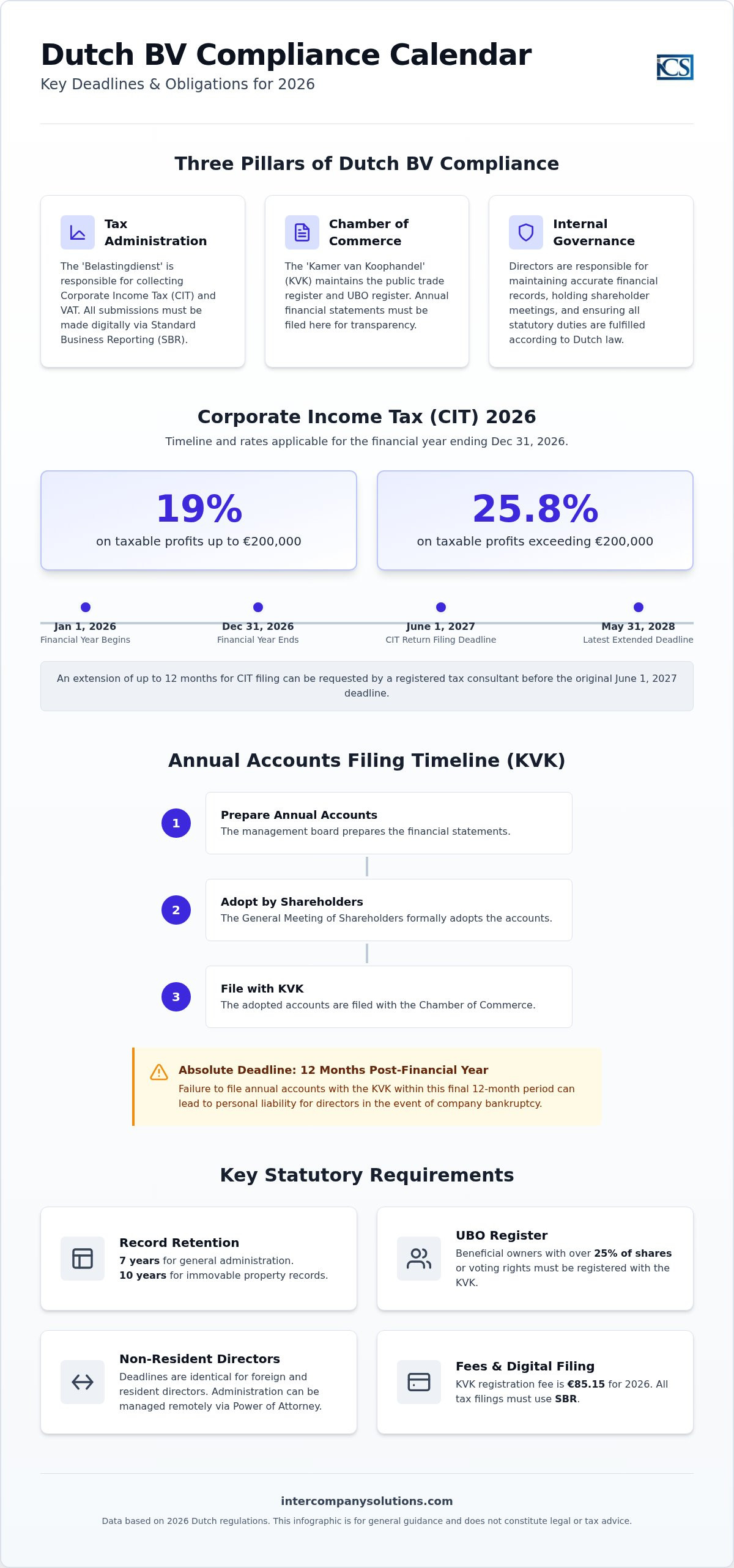
For the majority of Dutch BVs, the financial year follows the standard calendar year, beginning on January 1 and ending on December 31. Under the current regulatory framework, CIT returns must be filed no later than June 1 of the year following the financial year. For the 2026 reporting period, this means your submission must reach the Belastingdienst by June 1, 2027. Meeting these Dutch BV tax filing deadlines is a critical component of corporate governance, as it prevents the accumulation of late-payment interest and administrative penalties.
International entrepreneurs should be aware that extensions are available for those who require more time to finalize their accounts. By working with a registered tax consultant, a BV can request a filing extension of up to 12 months. This extension provides significant flexibility for complex global operations, but the request must be submitted before the original June 1 deadline. For the 2026 tax year, the corporate tax rates are set at 19% for taxable profits up to €200,000. Any profits exceeding this €200,000 threshold are subject to a rate of 25.8%.
Provisional vs. Final CIT Assessments
The Dutch Tax Administration typically issues a provisional assessment early in the financial year. This assessment is an estimate based on the company's performance in previous years or projected profits. You pay this amount in installments throughout the year. Once the actual CIT return is filed after the year ends, the Belastingdienst processes the data and issues a final assessment. If your actual profit was higher than estimated, you'll pay the difference. It's important to note that the interest rate for CIT assessments is 5% for 2026, which starts accruing six months after the financial year ends if the tax due hasn't been settled.
Functional Foreign Currency Regime
International BVs that primarily conduct business in a currency other than the Euro may apply for the functional foreign currency regime. This allows the company to calculate its taxable profits and file its CIT returns in a currency like USD or GBP. To use this regime, you must submit a formal request to the Dutch tax authorities before the start of the financial year in which you wish to switch. Once approved, the company must maintain this reporting currency for a minimum period of ten years. This stability ensures consistency in the tax treatment of exchange rate fluctuations and simplifies financial reporting for foreign parent companies.
Accurate preparation of these filings is a core part of our Accounting & Tax Services, helping you maintain full compliance with Dutch regulations.
Annual Accounts and KVK Filing Timeline
The administrative cycle of a Dutch BV concludes with the publication of its annual accounts. While previous sections detailed the Dutch BV tax filing deadlines for the Belastingdienst, the Chamber of Commerce (KVK) operates on a separate statutory timeline. For a BV with a financial year ending December 31, the management board must prepare the financial statements within five months, meaning by May 31 of the following year. An extension of five additional months for preparation may be granted by the shareholders in specific circumstances. However, the absolute final deadline for the KVK to receive the annual accounts is 12 months after the end of the financial year. For the 2026 reporting period, this hard deadline is December 31, 2027.
Preparation and Adoption Requirements
The management board holds the primary responsibility for drafting the annual accounts. All directors must sign these statements; if a signature is missing, the reason must be explicitly stated in the documents. Once prepared, the board presents the accounts to the shareholders. The formal adoption typically occurs during the Annual General Meeting (AGM), where shareholders review and approve the figures. Shareholders must adopt the accounts within two months after they've been prepared. If the company's deed of incorporation allows, shareholders can also adopt the accounts through written resolutions without a physical meeting. Following adoption, the BV must file the accounts with the KVK within eight days.
Publication Requirements by Company Size
The depth of information required for publication depends on the company's classification. Most international entrepreneurs establishing a BV fall into the micro or small categories. Micro entities only need to publish a condensed balance sheet, while small entities must provide a balance sheet and limited explanatory notes. Neither category requires a full audit by a registered accountant. In contrast, medium and large entities must undergo a mandatory audit and publish a more comprehensive director's report and profit and loss statement. Monitoring these Dutch BV tax filing deadlines and publication dates is vital to avoid personal liability, which can occur if the 12-month filing window is missed. Our Secretarial Services assist directors in managing this timeline with precision.
VAT Reporting and EU Compliance Requirements
VAT compliance is a continuous obligation that requires strict adherence to the Dutch BV tax filing deadlines set by the Belastingdienst. VAT, or Omzetbelasting (BTW), is an indirect tax collected on most goods and services. For a Dutch BV, the default reporting frequency is quarterly. You'll apply the standard 21% rate to most transactions, though a reduced 9% rate applies to specific items like food and certain medicines. As of January 1, 2026, the VAT rate for short-stay accommodation increased from 9% to the standard 21% rate. If your BV is involved in e-commerce and sells to consumers across the EU, you might need One-Stop-Shop (OSS) registration to simplify tax collection across multiple member states.
Quarterly VAT Filing Schedule 2026
Deadlines for VAT returns depend on whether your business is classified as resident or non-resident. Standard Dutch rules require filing by the last day of the month following the quarter. However, for non-resident entrepreneurs, the Belastingdienst allows two months for the return and payment to be received. Maintaining awareness of these Dutch BV tax filing deadlines is vital; as of 2026, the maximum penalty for late VAT payment has reached €6,709.
For non-resident entrepreneurs, the 2026 schedule is:
- Q1 (Jan-Mar): May 31, 2026
- Q2 (Apr-Jun): August 31, 2026
- Q3 (Jul-Sep): November 30, 2026
- Q4 (Oct-Dec): February 28, 2027
Intra-Community Transactions and EORI
If your BV sells goods or services to businesses in other EU countries, you must file an EC Sales List, known as an ICP filing. This report details customer VAT numbers and transaction values. For imports from outside the EU, an Economic Operators Registration and Identification (EORI) number is mandatory for customs clearance. You can find more details on VAT registration for foreign companies to ensure correct setup from the start.
One-Stop-Shop (OSS) registration is a procedural advantage for e-commerce entities. It allows you to report and pay VAT for all EU distance sales in a single return filed in the Netherlands. This eliminates the need to register for VAT in every member state where your customers reside, provided you stay within the relevant thresholds.
2026 Compliance Checklist for Foreign Directors
Managing a Dutch entity from abroad requires a structured approach to administrative duties. Foreign directors must ensure the company's UBO (Ultimate Beneficial Owner) register remains accurate. Any individual with more than 25% of the shares or voting rights must be registered. Failure to update the UBO register during ownership changes can lead to administrative fines or criminal sanctions. Directors should also verify that their profit projections align with the 2026 CIT thresholds. Staying below the €200,000 limit ensures the 19% rate, while profits above this amount trigger the 25.8% bracket. Adhering to the Dutch BV tax filing deadlines is the baseline for compliance, but high-level governance requires these proactive checks.
Scheduling the Annual General Meeting (AGM) is another critical step. As established in the previous section on reporting timelines, the accounts must be adopted within two months of preparation. The AGM serves as the formal venue for this adoption, providing directors with a discharge from liability for their management during the financial year. For companies with multiple international shareholders, this is the time to ensure all signatures are collected on the final financial statements.
Administrative Record Keeping
The Dutch Tax Administration imposes strict record-keeping requirements that apply to both digital and physical files. You must retain all business administration for a minimum of seven years. This requirement includes invoices, bank statements, contracts, and business correspondence. If your BV owns immovable property in the Netherlands, the retention period for related documentation extends to ten years. If you employ international staff under the 30% ruling, you're required to keep all relevant documentation, such as proof of recruitment from abroad and salary calculations, as part of your Payroll and Staffing records. These files must be readily accessible for inspection by the Belastingdienst if requested.
Next Steps for Compliance
Maintaining a valid KVK business address is a legal requirement for all BVs. If your company moves or changes its service address, you must update the trade register immediately to avoid service of process issues. Engaging a certified accountant is the most reliable way to monitor shifting Dutch BV tax filing deadlines throughout the year. A professional intermediary ensures that filings are submitted via SBR-compliant software, reducing the risk of technical errors or late-submission penalties. For assistance with filings or to review your current standing, contact Intercompany Solutions to speak with a corporate specialist.
Last reviewed: August 2026
Securing Your Dutch BV’s Financial Standing in 2026
Maintaining a Dutch BV requires consistent attention to the calendar to avoid administrative penalties and potential director liability. You've seen that the primary Dutch BV tax filing deadlines include the June 1st corporate income tax submission and quarterly VAT returns. Accuracy in these filings is essential, particularly when applying the 19% CIT rate for taxable profits up to €200,000. Since 2015, our specialists have focused on remote compliance, helping over 2,000 founders worldwide manage their statutory obligations with precision.
Following a structured checklist for UBO registration, record retention, and annual account adoption ensures your business remains a reliable partner in the European market. These procedures protect your professional interests while you focus on scaling your operations. Integrating secretarial and accounting services ensures every milestone, from the AGM to the final KVK publication, is handled with meticulous attention to detail.
We're ready to assist you in establishing a robust administrative framework that supports your global ambitions and ensures total regulatory adherence.
Last reviewed: August 2026
Frequently Asked Questions
What are the penalties for missing a Dutch BV tax filing deadline?
Missing a Dutch BV tax filing deadline results in administrative fines and interest charges. For Corporate Income Tax, the Belastingdienst applies a 5% interest rate on the outstanding amount starting six months after the financial year ends. Late VAT payments are subject to significantly higher penalties, which can reach a maximum of €6,709 as of 2026. Repeated non-compliance may also trigger more intensive audits or even criminal prosecution in cases of suspected tax fraud.
Can I file my Dutch BV annual accounts remotely from abroad?
You can file your annual accounts remotely through the mandatory Standard Business Reporting (SBR) system. This digital infrastructure requires specific software or the assistance of a registered tax intermediary in the Netherlands. Physical presence isn't required, provided your management board has adopted the accounts. Using these remote tools helps international directors meet Dutch BV tax filing deadlines and publication obligations with the Chamber of Commerce without traveling to the country for administrative tasks.
Is a Dutch auditor required for all private limited companies?
A Dutch auditor is not required for micro or small private limited companies. Most foreign-owned BVs fall into these categories and only need to publish a condensed balance sheet and limited notes. An audit by a registered accountant is mandatory only if your company meets at least two of three criteria for two consecutive years: assets exceeding €7.5 million, net turnover above €15 million, or more than 50 employees.
How do I apply for an extension for my corporate income tax return?
You apply for a Corporate Income Tax extension by submitting a request to the Belastingdienst before the standard June 1 deadline. Individual entrepreneurs can typically secure a five-month extension. However, working with a professional tax consultant allows your company to join a collective extension scheme, which can provide up to 12 additional months. This extra time is useful for finalizing complex international accounts while ensuring you eventually meet all statutory requirements.
What is the record retention period for Dutch business documents?
The statutory record retention period for general business documents is seven years. This includes all ledger accounts, invoices, bank statements, and contracts. If your BV owns immovable property, such as office space or land in the Netherlands, you must retain those specific records for at least ten years. These documents must be stored in a format that remains accessible for inspection by the Dutch tax authorities throughout the entire retention period.
Does a dormant Dutch BV still have filing requirements?
A dormant Dutch BV must still fulfill its primary filing obligations even if it has no commercial activity. You are required to file an annual Corporate Income Tax return and publish financial statements with the Chamber of Commerce every year. While these reports will show zero turnover, failing to submit them constitutes a breach of corporate law. This can lead to administrative fines and potential personal liability for the company's directors.
What is the UBO register and who must be listed?
The UBO register is a public database that identifies the Ultimate Beneficial Owners of a company. You must list any individual who holds more than 25% of the shares, voting rights, or ownership interest in the BV. This requirement aims to prevent money laundering and ensure corporate transparency. Directors are responsible for keeping this information current, as the Chamber of Commerce requires immediate notification of any changes in ownership structure or control.
How much is the KVK registration fee in 2026?
The mandatory registration fee for a new entity at the Chamber of Commerce is €85.15 for the 2026 calendar year. This is a one-time payment due when you first register your BV in the trade register. While the annual filing of financial statements is free of charge, you should budget for the costs of SBR-compliant software and the digital security certificates required to submit your documents to the KVK and the Belastingdienst.
Frequently Asked Questions
Need more information on the Dutch BV company?
Contact an expertReady to start your company in the Netherlands?
| Formation time | Dutch BV formation completed in 3 to 5 business days |
|---|---|
| Process | Fully remote setup with step-by-step guidance |
| Compliance | Expert support for registration, VAT and compliance |
| Aftercare | Accounting, tax and legal support included |
| One partner | All of the above through one trusted formation partner |